Introduction
Body Camera Evidence Management tools are software platforms used to store, manage, review, share, protect, and audit video evidence captured from body-worn cameras. In simple words, these tools help law enforcement agencies and public safety teams handle body camera footage in a secure and organized way. Instead of storing videos manually on local drives, agencies use these platforms to upload evidence, tag incidents, manage permissions, create audit trails, redact sensitive information, and share files with prosecutors or authorized teams.
Body camera evidence management matters because video evidence can support investigations, improve transparency, protect officers, help resolve complaints, and strengthen public trust. However, body camera footage also creates serious challenges around privacy, storage cost, retention rules, chain of custody, access control, redaction, and legal discovery.
Common use cases include police body camera footage storage, evidence review, redaction, case preparation, prosecutor sharing, internal investigations, complaint review, officer accountability, audit management, and digital evidence retention.
Buyers should evaluate storage scalability, chain of custody, redaction tools, audit logs, access permissions, integrations, mobile upload, video search, compliance readiness, cost predictability, and long-term vendor support.
Best for: police departments, sheriff offices, campus police, transit police, public safety agencies, prosecutors, internal affairs teams, evidence managers, legal teams, and government organizations managing digital evidence.
Not ideal for: small private teams that only need simple video storage, basic file sharing, or general cloud storage without strict chain of custody, auditability, retention, and legal evidence workflows.
Key Trends in Body Camera Evidence Management Tools
- Cloud-based evidence storage is becoming more common because agencies need scalable storage for high-volume video files without managing large local infrastructure.
- AI-assisted redaction is becoming important as agencies need to blur faces, license plates, minors, bystanders, and sensitive details faster.
- Digital evidence platforms are expanding beyond body cameras to include dashcams, CCTV, drones, interview room video, photos, audio, documents, and case files.
- Chain of custody tracking is now a core requirement because every access, edit, export, share, or deletion should be traceable.
- Integration with CAD, RMS, and case systems is becoming more valuable because evidence should connect naturally with incidents, reports, officers, and cases.
- Automated retention policies are growing in importance as agencies need to follow evidence retention rules, legal holds, and deletion schedules.
- Secure sharing with prosecutors is becoming a major workflow need because evidence must move quickly without losing control or auditability.
- Role-based access control is essential because not every user should be able to view, export, delete, redact, or share sensitive videos.
- Storage cost management is becoming a bigger concern as HD video, longer retention periods, and more camera deployments increase total cost.
- Privacy and public records workflows are becoming more complex because agencies must balance transparency, legal disclosure, victim privacy, and community expectations.
How We Selected These Tools
- We selected tools widely recognized in body-worn camera evidence, digital evidence management, law enforcement technology, and public safety video workflows.
- We included a balanced mix of body camera ecosystems, digital evidence platforms, redaction tools, cloud evidence systems, and public safety evidence suites.
- We focused on core evidence capabilities such as secure storage, chain of custody, audit trails, redaction, sharing, search, retention, and case association.
- We considered ecosystem strength, including integrations with body cameras, CAD, RMS, prosecutor systems, cloud storage, and digital evidence workflows.
- We considered agency fit across small departments, mid-sized agencies, large law enforcement organizations, prosecutors, and multi-agency environments.
- We looked at operational practicality, including upload workflows, user permissions, evidence review, discovery sharing, and long-term storage control.
- We avoided guessing public ratings, certifications, compliance claims, or pricing.
- We used “Not publicly stated” where security, compliance, platform, or support details are not confidently known.
- We considered both all-in-one body camera ecosystems and vendor-neutral evidence management approaches.
- We scored tools comparatively based on category fit, not as a universal ranking for every agency.
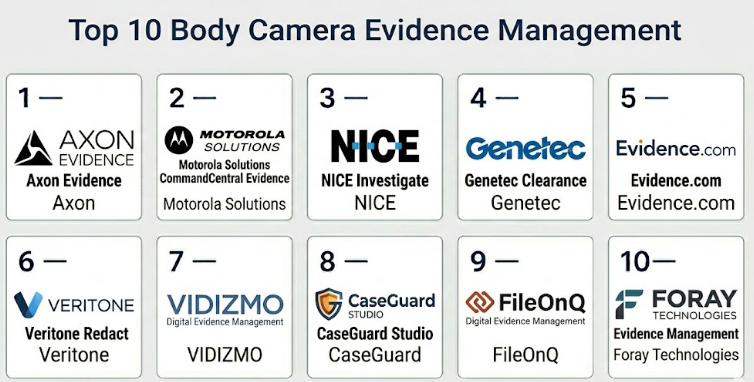
Top 10 Body Camera Evidence Management Tools
#1 — Axon Evidence
Short description :
Axon Evidence is one of the most recognized digital evidence management platforms for law enforcement agencies using body-worn cameras, in-car video, interview room video, photos, audio, and other evidence types. It is designed to help agencies upload, manage, review, redact, share, and retain digital evidence securely. The platform works especially well for agencies already using Axon body cameras and related public safety tools. It supports chain of custody, evidence workflows, case association, and prosecutor sharing. It is best for agencies that want a mature, large-scale body camera evidence ecosystem.
Key Features
- Digital evidence storage and management
- Body camera video upload and organization
- Chain of custody and audit trail workflows
- Evidence sharing with authorized users
- Redaction and review workflows
- Case and incident association
- Integration with Axon camera and public safety ecosystem
Pros
- Strong fit for agencies using Axon body cameras.
- Mature evidence ecosystem for large public safety deployments.
- Supports end-to-end video evidence lifecycle management.
Cons
- Best value is often within the Axon ecosystem.
- Storage and licensing costs should be reviewed carefully.
- Agencies using mixed camera brands should validate compatibility.
Platforms / Deployment
Web / Mobile-supported workflows / Body camera hardware ecosystem
Cloud
Security & Compliance
SSO/SAML: Varies / N/A
MFA: Varies / N/A
Encryption: Not publicly stated
Audit logs: Varies / N/A
RBAC: Varies / N/A
CJIS alignment: Varies / N/A
SOC 2 / ISO 27001 / HIPAA: Not publicly stated
Integrations & Ecosystem
Axon Evidence is strongest when used with the wider Axon public safety ecosystem. It can support evidence upload, review, redaction, sharing, and legal workflows from one connected environment.
- Axon body-worn cameras
- Axon in-car video systems
- CAD and RMS workflows where configured
- Prosecutor sharing workflows
- Digital evidence review tools
- Redaction and disclosure workflows
Support & Community
Support is generally structured for law enforcement agencies and public safety customers. Agencies should confirm onboarding, administrator training, storage planning, camera deployment support, and long-term evidence migration options.
#2 — Motorola Solutions CommandCentral Evidence
Short description :
Motorola Solutions CommandCentral Evidence is a digital evidence management platform designed for law enforcement and public safety agencies. It helps teams manage evidence from body cameras, in-car systems, photos, audio, documents, and other digital sources. The platform is useful for agencies that want evidence workflows connected with broader Motorola public safety systems. It supports storage, search, sharing, case association, and evidence lifecycle management. It is best for agencies already using Motorola body cameras, CAD, RMS, or command center tools.
Key Features
- Digital evidence storage and management
- Body camera and video evidence workflows
- Case and incident association
- Secure evidence sharing
- Search and evidence organization
- Audit trail and access control workflows
- Integration with Motorola public safety ecosystem
Pros
- Strong fit for agencies using Motorola public safety tools.
- Useful for managing different digital evidence types in one platform.
- Supports connected workflows across public safety operations.
Cons
- Best value may depend on broader Motorola ecosystem usage.
- Implementation planning is important for large evidence migration.
- Agencies should validate exact camera and system compatibility.
Platforms / Deployment
Web / Mobile-supported workflows / Public safety hardware ecosystem
Cloud / Hybrid
Security & Compliance
SSO/SAML: Varies / N/A
MFA: Varies / N/A
Encryption: Not publicly stated
Audit logs: Varies / N/A
RBAC: Varies / N/A
CJIS alignment: Varies / N/A
SOC 2 / ISO 27001 / HIPAA: Not publicly stated
Integrations & Ecosystem
CommandCentral Evidence fits agencies that want body camera evidence management connected with public safety operations, records, and command workflows.
- Motorola body camera ecosystem
- CAD and RMS workflows
- In-car video systems
- Digital evidence files
- Case management workflows
- Public safety analytics and command tools
Support & Community
Support is generally enterprise and agency-focused. Agencies should plan for deployment design, evidence transfer, retention setup, user roles, and long-term administrator training.
#3 — NICE Investigate
Short description :
NICE Investigate is a digital evidence management and investigation platform used by law enforcement, emergency communications, and public safety organizations. It helps agencies collect, manage, analyze, and share digital evidence from multiple sources, including video, audio, documents, and other case-related files. The platform is useful where body camera footage needs to be combined with 911 audio, CCTV video, interview recordings, and investigation materials. It is best for agencies and justice partners that need a broader digital investigation workflow, not only body camera storage.
Key Features
- Digital evidence management
- Multi-source evidence collection
- Investigation workflow support
- Evidence sharing and disclosure workflows
- Auditability and chain of custody support
- Search and case organization
- Support for audio, video, documents, and related evidence
Pros
- Strong for multi-source digital evidence investigations.
- Useful for agencies managing more than body camera footage.
- Supports evidence sharing and case collaboration workflows.
Cons
- May be more advanced than needed for small agencies.
- Setup can require clear evidence process design.
- Exact integrations and deployment details should be validated.
Platforms / Deployment
Web / Digital evidence workflow ecosystem
Cloud / Hybrid / Varies / N/A
Security & Compliance
SSO/SAML: Varies / N/A
MFA: Varies / N/A
Encryption: Not publicly stated
Audit logs: Varies / N/A
RBAC: Varies / N/A
CJIS alignment: Varies / N/A
SOC 2 / ISO 27001 / HIPAA: Not publicly stated
Integrations & Ecosystem
NICE Investigate works well where agencies need to bring different evidence sources together into investigation and disclosure workflows.
- Body camera video workflows
- 911 audio and communication records
- CCTV and surveillance video
- Case management workflows
- Prosecutor and justice partner sharing
- Digital file evidence management
Support & Community
Support is typically project and enterprise-focused. Agencies should plan for process mapping, user training, evidence source integration, and governance around sharing and retention.
#4 — Genetec Clearance
Short description :
Genetec Clearance is a digital evidence management platform designed for collecting, organizing, sharing, and managing video and digital evidence. It is useful for law enforcement, public safety, city agencies, transportation operators, campuses, and organizations that handle video evidence from different systems. The platform can support body camera evidence workflows as part of a broader evidence ecosystem. It is especially relevant where agencies need to manage evidence from surveillance cameras, mobile devices, body cameras, and external sources. It is best for organizations already using or considering the Genetec security ecosystem.
Key Features
- Digital evidence collection and storage
- Video evidence sharing workflows
- Case-based evidence organization
- Audit trail and access control support
- Public request and disclosure support where configured
- Integration with video surveillance ecosystems
- Multi-source evidence management
Pros
- Strong fit for organizations managing video from multiple sources.
- Useful for public safety and security teams with surveillance ecosystems.
- Supports controlled evidence sharing and case organization.
Cons
- Not limited to body camera workflows, so agency fit should be tested.
- Best value may depend on broader video security environment.
- Agencies should validate supported camera and evidence sources.
Platforms / Deployment
Web / Video evidence ecosystem
Cloud / Hybrid
Security & Compliance
SSO/SAML: Varies / N/A
MFA: Varies / N/A
Encryption: Not publicly stated
Audit logs: Varies / N/A
RBAC: Varies / N/A
CJIS alignment: Varies / N/A
SOC 2 / ISO 27001 / HIPAA: Not publicly stated
Integrations & Ecosystem
Genetec Clearance is useful when digital evidence must connect with video security and public safety operations.
- Genetec video surveillance ecosystem
- Body camera workflows where configured
- CCTV video sources
- Case management workflows
- Evidence sharing workflows
- Public safety and security operations
Support & Community
Support is generally available through enterprise vendor and partner channels. Agencies should confirm training, implementation scope, storage planning, and integration support before selection.
#5 — Evidence.com
Short description :
Evidence.com is commonly associated with Axon’s evidence management ecosystem and is used by public safety agencies to store, manage, and share digital evidence. It supports body camera footage workflows, secure access, retention controls, and case-based evidence organization. Agencies often use it to manage video from body-worn cameras and related digital evidence. It is best for teams that need structured cloud evidence workflows and are already aligned with the Axon body camera environment. It can be especially useful for law enforcement evidence units and prosecutors working with digital files.
Key Features
- Cloud-based digital evidence storage
- Body camera video management
- Case and evidence organization
- Secure sharing workflows
- Retention and evidence lifecycle support
- Auditability and access tracking workflows
- Integration with Axon camera ecosystem
Pros
- Strong fit for agencies using Axon devices.
- Useful for managing body camera footage at scale.
- Mature cloud evidence workflow for public safety needs.
Cons
- Best suited to Axon-centered environments.
- Storage planning and cost management are important.
- Agencies using multiple camera brands should validate workflow fit.
Platforms / Deployment
Web / Body camera ecosystem
Cloud
Security & Compliance
SSO/SAML: Varies / N/A
MFA: Varies / N/A
Encryption: Not publicly stated
Audit logs: Varies / N/A
RBAC: Varies / N/A
CJIS alignment: Varies / N/A
SOC 2 / ISO 27001 / HIPAA: Not publicly stated
Integrations & Ecosystem
Evidence.com is strongest when used with Axon body camera and public safety evidence workflows.
- Axon body cameras
- Video evidence workflows
- Prosecutor sharing
- Case association
- Redaction workflows
- Digital evidence lifecycle management
Support & Community
Support is generally agency-focused and tied to the larger Axon customer ecosystem. Agencies should ask about migration, retention setup, account permissions, evidence export, and long-term access control.
#6 — Veritone Redact
Short description :
Veritone Redact is a redaction-focused tool used to help agencies and organizations redact sensitive information from video, audio, and images. It is especially useful for body camera footage where faces, license plates, minors, victims, addresses, or private details may need to be obscured before release. While it is not always a full evidence management platform by itself, it can be a valuable part of the body camera evidence workflow. It is best for agencies handling public records requests, legal disclosure, and high-volume video redaction. It helps reduce manual redaction workload when used properly.
Key Features
- Video redaction workflows
- Face and object redaction support
- Audio redaction workflows where applicable
- Public records and disclosure support
- Review and export workflows
- Useful for body camera footage processing
- Supports faster privacy protection workflows
Pros
- Strong fit for video redaction and disclosure workflows.
- Useful for agencies with many public records requests.
- Can reduce manual redaction effort.
Cons
- Not a complete body camera evidence management platform by itself.
- Output should still be reviewed by trained staff.
- Agencies need to validate integration with their evidence system.
Platforms / Deployment
Web / Digital media workflow ecosystem
Cloud / Varies / N/A
Security & Compliance
SSO/SAML: Varies / N/A
MFA: Not publicly stated
Encryption: Not publicly stated
Audit logs: Varies / N/A
RBAC: Varies / N/A
CJIS alignment: Varies / N/A
SOC 2 / ISO 27001 / HIPAA: Not publicly stated
Integrations & Ecosystem
Veritone Redact fits into evidence and public records workflows where video must be reviewed and redacted before sharing.
- Body camera footage workflows
- Public records request workflows
- Digital evidence systems
- Video export workflows
- Audio and media review workflows
- Legal disclosure processes
Support & Community
Support depends on customer plan and deployment model. Agencies should confirm training, redaction accuracy review process, export controls, and staff workflow before adoption.
#7 — VIDIZMO Digital Evidence Management
Short description :
VIDIZMO Digital Evidence Management is a platform for managing, storing, reviewing, sharing, and controlling access to digital evidence, including videos, images, audio, documents, and body camera footage. It is useful for law enforcement agencies, legal teams, government organizations, and enterprises that need secure evidence workflows. The platform focuses on secure storage, access control, redaction support, audit trails, and case-based organization. It can be helpful for agencies that want flexible digital evidence management beyond one camera vendor. It is best for teams needing a broader evidence management system with privacy and governance features.
Key Features
- Digital evidence storage and management
- Video, audio, image, and document support
- Body camera footage workflows
- Access control and audit logs
- Redaction support
- Case-based evidence organization
- Secure sharing and review workflows
Pros
- Useful for multi-format digital evidence management.
- Can support agencies that need flexible evidence workflows.
- Strong fit where access control and auditability matter.
Cons
- Agencies should validate body camera hardware compatibility.
- Implementation may require process and role design.
- Public compliance details should be reviewed directly.
Platforms / Deployment
Web / Mobile-supported workflows
Cloud / On-premise / Hybrid
Security & Compliance
SSO/SAML: Varies / N/A
MFA: Varies / N/A
Encryption: Not publicly stated
Audit logs: Varies / N/A
RBAC: Varies / N/A
CJIS alignment: Varies / N/A
SOC 2 / ISO 27001 / HIPAA: Not publicly stated
Integrations & Ecosystem
VIDIZMO can fit into evidence workflows where agencies want digital evidence management across multiple file types and sources.
- Body camera video workflows
- Digital media evidence
- Case management workflows
- Redaction workflows
- Secure evidence sharing
- Access control and governance systems
Support & Community
Support and onboarding may vary by deployment model and customer requirements. Agencies should confirm migration support, retention setup, administrator training, and integration assistance.
#8 — CaseGuard Studio
Short description :
CaseGuard Studio is a redaction and evidence processing tool used by law enforcement, legal teams, government organizations, healthcare organizations, and public records teams. It helps redact video, audio, images, and documents, making it useful for body camera footage disclosure workflows. It is especially relevant for agencies that need to process sensitive media before public release or legal sharing. The platform is not always positioned as a complete evidence repository, but it can support an important part of evidence management. It is best for teams that need strong redaction and media review functionality.
Key Features
- Video redaction
- Audio redaction
- Image and document redaction
- Body camera footage processing
- Public records disclosure support
- Media review workflows
- Export and release preparation
Pros
- Strong fit for agencies with redaction-heavy workloads.
- Supports multiple media types beyond video.
- Useful for public records and legal disclosure teams.
Cons
- Not always a full evidence storage platform.
- Redaction quality should be reviewed before release.
- Agencies should validate workflow fit with existing evidence systems.
Platforms / Deployment
Windows / Web-supported workflows / Varies / N/A
Cloud / On-premise / Hybrid / Varies / N/A
Security & Compliance
SSO/SAML: Not publicly stated
MFA: Not publicly stated
Encryption: Not publicly stated
Audit logs: Varies / N/A
RBAC: Varies / N/A
CJIS alignment: Varies / N/A
SOC 2 / ISO 27001 / HIPAA: Not publicly stated
Integrations & Ecosystem
CaseGuard Studio is useful in evidence workflows where media must be reviewed, redacted, and prepared for release.
- Body camera redaction workflows
- Public records teams
- Legal discovery workflows
- Audio and video review
- Document redaction processes
- Evidence export workflows
Support & Community
Support generally depends on licensing and deployment model. Agencies should confirm user training, redaction workflow design, media format support, and export controls.
#9 — FileOnQ Digital Evidence Management
Short description :
FileOnQ Digital Evidence Management is a platform used by public safety agencies and organizations to manage physical and digital evidence workflows. It can support digital media files, evidence tracking, chain of custody, property room workflows, and evidence lifecycle management. It is useful for agencies that want evidence management connected across physical property and digital evidence. Body camera footage can be part of a broader evidence process where retention, custody, and case association matter. It is best for agencies that need evidence management beyond video storage alone.
Key Features
- Digital and physical evidence management
- Chain of custody support
- Evidence tracking and lifecycle workflows
- Case and item association
- Audit and access workflows
- Digital media evidence support
- Property room and evidence unit workflows
Pros
- Useful for agencies managing both physical and digital evidence.
- Strong fit for property and evidence room operations.
- Helps connect custody workflows with evidence records.
Cons
- Body camera workflows should be validated during evaluation.
- May require configuration for agency-specific processes.
- Not always a camera-native platform.
Platforms / Deployment
Web / Windows-supported workflows / Varies / N/A
Cloud / On-premise / Hybrid
Security & Compliance
SSO/SAML: Varies / N/A
MFA: Not publicly stated
Encryption: Not publicly stated
Audit logs: Varies / N/A
RBAC: Varies / N/A
CJIS alignment: Varies / N/A
SOC 2 / ISO 27001 / HIPAA: Not publicly stated
Integrations & Ecosystem
FileOnQ fits evidence units that need structured tracking across digital evidence, physical property, and chain-of-custody workflows.
- Digital evidence workflows
- Physical evidence tracking
- Property room systems
- Case association
- Audit trail workflows
- Evidence lifecycle management
Support & Community
Support is generally focused on evidence management and agency implementation. Agencies should confirm evidence migration, barcode workflows, chain-of-custody configuration, and digital storage requirements.
#10 — Foray Technologies Evidence Management
Short description :
Foray Technologies provides digital evidence and forensic media management tools used by public safety, forensic labs, and investigative teams. The platform can help agencies manage photos, videos, forensic media, and digital evidence workflows. It is useful where evidence integrity, media organization, and investigative review are important. For body camera evidence, it may fit agencies that need broader forensic and digital media management rather than only camera upload storage. It is best for teams that handle different evidence media types across investigations and forensic workflows.
Key Features
- Digital media evidence management
- Photo and video evidence workflows
- Forensic and investigative media support
- Evidence organization and search
- Case association workflows
- Audit and access management support
- Public safety and forensic lab use cases
Pros
- Strong fit for forensic and investigative media workflows.
- Useful for agencies managing multiple digital evidence types.
- Supports structured evidence organization.
Cons
- Body camera-specific workflows should be validated.
- May not replace a full body camera vendor ecosystem for all agencies.
- Deployment and integration details should be reviewed directly.
Platforms / Deployment
Web / Windows-supported workflows / Varies / N/A
Cloud / On-premise / Hybrid / Varies / N/A
Security & Compliance
SSO/SAML: Not publicly stated
MFA: Not publicly stated
Encryption: Not publicly stated
Audit logs: Varies / N/A
RBAC: Varies / N/A
CJIS alignment: Varies / N/A
SOC 2 / ISO 27001 / HIPAA: Not publicly stated
Integrations & Ecosystem
Foray Technologies fits agencies and forensic teams that need to manage digital media as part of investigative workflows.
- Forensic image and video workflows
- Case management processes
- Public safety evidence systems
- Digital media archives
- Investigative review workflows
- Evidence export and reporting processes
Support & Community
Support is typically specialized around evidence and forensic media workflows. Agencies should confirm implementation help, media format support, security controls, and long-term retention planning.
Comparison Table
| Tool Name | Best For | Platform(s) Supported | Deployment | Standout Feature | Public Rating |
|---|---|---|---|---|---|
| Axon Evidence | Law enforcement agencies using body cameras at scale | Web, mobile-supported workflows, body camera ecosystem | Cloud | Mature body camera evidence ecosystem | N/A |
| Motorola Solutions CommandCentral Evidence | Agencies using Motorola public safety tools | Web, mobile-supported workflows, public safety hardware ecosystem | Cloud / Hybrid | Evidence connected with public safety operations | N/A |
| NICE Investigate | Multi-source digital investigations | Web, digital evidence workflow ecosystem | Cloud / Hybrid / Varies / N/A | Combines body camera, audio, video, and case evidence | N/A |
| Genetec Clearance | Video evidence and security ecosystems | Web, video evidence ecosystem | Cloud / Hybrid | Multi-source video evidence sharing | N/A |
| Evidence.com | Axon-centered evidence management workflows | Web, body camera ecosystem | Cloud | Cloud body camera evidence storage and sharing | N/A |
| Veritone Redact | Video and audio redaction teams | Web, digital media workflow ecosystem | Cloud / Varies / N/A | AI-assisted redaction workflows | N/A |
| VIDIZMO Digital Evidence Management | Flexible multi-format evidence management | Web, mobile-supported workflows | Cloud / On-premise / Hybrid | Secure evidence management across file types | N/A |
| CaseGuard Studio | Public records and redaction-heavy workflows | Windows, web-supported workflows, varies / N/A | Cloud / On-premise / Hybrid / Varies / N/A | Video, audio, image, and document redaction | N/A |
| FileOnQ Digital Evidence Management | Evidence units managing physical and digital evidence | Web, Windows-supported workflows, varies / N/A | Cloud / On-premise / Hybrid | Chain of custody across evidence types | N/A |
| Foray Technologies Evidence Management | Forensic and investigative media workflows | Web, Windows-supported workflows, varies / N/A | Cloud / On-premise / Hybrid / Varies / N/A | Digital media evidence and forensic workflow support | N/A |
Evaluation & Body Camera Evidence Management Tools
| Tool Name | Core (25%) | Ease (15%) | Integrations (15%) | Security (10%) | Performance (10%) | Support (10%) | Value (15%) | Weighted Total (0–10) |
|---|---|---|---|---|---|---|---|---|
| Axon Evidence | 9 | 8 | 9 | 8 | 9 | 8 | 6 | 8.15 |
| Motorola Solutions CommandCentral Evidence | 8 | 7 | 9 | 8 | 8 | 8 | 6 | 7.75 |
| NICE Investigate | 8 | 7 | 8 | 8 | 8 | 8 | 7 | 7.70 |
| Genetec Clearance | 8 | 7 | 8 | 8 | 8 | 7 | 7 | 7.60 |
| Evidence.com | 9 | 8 | 8 | 8 | 9 | 8 | 6 | 8.00 |
| Veritone Redact | 7 | 8 | 7 | 7 | 8 | 7 | 7 | 7.30 |
| VIDIZMO Digital Evidence Management | 8 | 7 | 8 | 8 | 8 | 7 | 7 | 7.60 |
| CaseGuard Studio | 7 | 8 | 7 | 7 | 8 | 7 | 7 | 7.30 |
| FileOnQ Digital Evidence Management | 7 | 7 | 7 | 7 | 7 | 7 | 7 | 7.00 |
| Foray Technologies Evidence Management | 7 | 7 | 7 | 7 | 7 | 7 | 7 | 7.00 |
These scores are comparative and should be used as a practical starting point, not as a universal ranking. A police department using Axon body cameras may naturally prefer Axon Evidence, while an agency with many video sources may consider NICE Investigate or Genetec Clearance. A public records team may value Veritone Redact or CaseGuard Studio more because redaction workload is their main issue. Buyers should validate camera compatibility, storage costs, security controls, retention policies, and evidence-sharing workflows before selecting a platform.
Which Body Camera Evidence Management Tool Should You Choose?
Solo / Freelancer
Solo professionals, private consultants, and small non-public-safety operators usually do not need a full body camera evidence management platform. These systems are designed for agencies that require legal-grade evidence workflows, chain of custody, access logs, secure storage, retention policies, and auditability.
If the need is simple video storage, a secure business file management system may be enough. However, if videos may become legal evidence, the team should consider a more structured evidence platform with audit trails and controlled access.
SMB
Small police departments, campus safety teams, private security agencies, and local public safety groups should focus on ease of use, affordability, evidence organization, and basic chain-of-custody workflows. VIDIZMO Digital Evidence Management, FileOnQ Digital Evidence Management, CaseGuard Studio, and Veritone Redact may be useful depending on whether the main need is storage, tracking, or redaction.
Small agencies using Axon or Motorola cameras may prefer staying within those ecosystems because camera upload and evidence management workflows can be smoother. However, storage costs, export rules, and long-term data ownership should be reviewed carefully.
Mid-Market
Mid-sized law enforcement agencies and public safety departments often need stronger evidence workflows, prosecutor sharing, redaction, CAD or RMS integration, and retention management. Axon Evidence, Motorola Solutions CommandCentral Evidence, Genetec Clearance, VIDIZMO Digital Evidence Management, and NICE Investigate can be practical options depending on camera environment and evidence sources.
Mid-market buyers should test daily workflows such as officer upload, supervisor review, tagging, case association, redaction, prosecutor sharing, records request response, and deletion approval.
Enterprise
Large police departments, sheriff offices, state agencies, prosecutors, and regional public safety organizations need advanced scalability, strong security, deep integrations, reliable storage, auditability, and long-term evidence governance. Axon Evidence, Motorola Solutions CommandCentral Evidence, NICE Investigate, and Genetec Clearance are often better suited for enterprise-scale evidence operations.
Enterprise buyers should involve IT, legal, prosecutors, internal affairs, evidence managers, records teams, command staff, and privacy officers in the selection process. A body camera evidence platform affects many departments, not only patrol officers.
Budget vs Premium
Budget-focused agencies should identify the biggest evidence pain point first. If the issue is redaction, a redaction-focused tool may solve the problem without replacing the entire evidence system. If the issue is storage and chain of custody, a full evidence management platform is more appropriate.
Premium tools usually provide deeper ecosystem integration, stronger automation, larger-scale storage options, and better support for complex evidence workflows. However, premium systems can also create higher long-term storage and licensing costs, so agencies should model total cost carefully.
Feature Depth vs Ease of Use
Feature depth matters when agencies handle high evidence volume, many users, legal discovery, public records requests, and multi-agency sharing. However, ease of use is equally important because officers, supervisors, prosecutors, and evidence teams must use the system every day.
A powerful platform that is hard to use can slow investigations and increase training burden. Agencies should run practical demos using real workflows, not only polished vendor presentations.
Integrations & Scalability-
Important integrations include body cameras, in-car cameras, CAD, RMS, prosecutor systems, case management systems, digital evidence platforms, redaction tools, public records workflows, and identity management systems.
Scalability should include storage volume, video resolution, number of cameras, number of users, retention periods, upload speed, sharing volume, and long-term archive needs. Agencies should test whether the platform can handle growth without unexpected operational or cost problems.
Security & Compliance Needs
Body camera evidence contains sensitive information, including victims, minors, bystanders, officers, addresses, medical details, suspects, witnesses, and crime scenes. Security must be reviewed carefully before purchase.
Agencies should ask about encryption, SSO, MFA, RBAC, audit logs, access reviews, deletion controls, legal holds, data retention, CJIS alignment, prosecutor sharing, and breach response procedures. Do not assume compliance unless the vendor provides formal documentation.
Frequently Asked Questions
1. What is Body Camera Evidence Management?
Body Camera Evidence Management is the process of securely storing, organizing, reviewing, sharing, redacting, and retaining video footage captured from body-worn cameras. It helps agencies maintain chain of custody and control access to sensitive evidence.
2. Why is general cloud storage not enough for body camera evidence?
General cloud storage may not provide proper chain of custody, audit logs, legal holds, retention rules, redaction workflows, case association, or controlled prosecutor sharing. Body camera evidence usually needs stronger governance than normal file storage.
3. What features matter most in a body camera evidence platform?
Important features include secure upload, video storage, chain of custody, audit logs, role-based access, redaction, search, case tagging, retention policies, legal holds, prosecutor sharing, and integration with CAD or RMS systems.
4. How expensive is body camera evidence management?
Cost varies based on number of cameras, users, storage volume, retention period, redaction needs, integrations, support, and deployment model. Agencies should evaluate long-term storage cost, not only the initial software price.
5. What is chain of custody in digital evidence?
Chain of custody is a record of who accessed, edited, moved, shared, exported, or deleted evidence. It helps prove that evidence was handled properly and was not altered in an unauthorized way.
6. Do these tools support video redaction?
Many evidence platforms include redaction features or integrate with redaction tools. Redaction is important when footage includes faces, minors, victims, license plates, addresses, medical information, or sensitive public safety details.
7. Can body camera evidence platforms integrate with CAD and RMS?
Many platforms can integrate with CAD or RMS systems, but integration depth varies. Agencies should validate whether incidents, case numbers, officer details, locations, and metadata can sync properly.
8. What are common mistakes when buying these tools?
Common mistakes include underestimating storage costs, ignoring redaction workload, failing to test integrations, not involving prosecutors, skipping legal review, and choosing a platform based only on camera hardware.
9. How long should body camera footage be retained?
Retention rules vary by agency policy, incident type, legal requirements, public records laws, and investigation status. Agencies should configure retention schedules carefully and use legal holds when footage must not be deleted.
10. Can prosecutors access evidence directly?
Some platforms support secure prosecutor sharing or external user access. Agencies should confirm permissions, audit logs, expiration controls, download rules, and whether external users can access only approved evidence.
Conclusion
Body Camera Evidence Management tools are essential for agencies that need to handle video evidence securely, responsibly, and efficiently. As body-worn cameras produce large volumes of sensitive footage, agencies need more than basic storage. They need clear chain of custody, strong access controls, retention policies, redaction workflows, audit logs, case association, secure sharing, and reliable long-term storage. The best platform depends on the agency’s camera ecosystem, evidence volume, legal requirements, storage budget, prosecutor workflows, and integration needs. Agencies using Axon devices may prefer Axon Evidence or Evidence.com, while Motorola-centered agencies may consider CommandCentral Evidence.
