Introduction
Probation & Parole Case Management software helps community corrections agencies manage people under supervision after sentencing, release, or court order. In simple words, these tools help probation officers, parole officers, supervision teams, and correctional agencies track cases, appointments, risk levels, conditions, violations, treatment referrals, reports, contacts, court updates, and reentry progress.
This software matters because probation and parole teams manage high caseloads, sensitive records, public safety responsibilities, compliance rules, and human service coordination. A strong case management system can help officers stay organized, reduce manual paperwork, improve supervision planning, track program participation, document violations, and support better decision-making.
Common use cases include offender supervision, risk and needs assessment, case plans, appointment tracking, violation management, court reporting, drug testing workflows, treatment referrals, reentry planning, electronic monitoring integration, and performance reporting.
Buyers should evaluate case workflow flexibility, security, audit logs, mobile access, reporting, risk assessment support, court integration, corrections integration, document management, alerts, officer usability, scalability, and vendor support.
Best for: probation departments, parole boards, community corrections agencies, reentry programs, corrections departments, court services teams, sheriff offices, offender supervision teams, and government justice agencies.
Not ideal for: small teams that only need basic notes, simple spreadsheets, or general task tracking without offender supervision, court reporting, compliance monitoring, auditability, and sensitive justice data controls.
Key Trends in Probation & Parole Case Management Tools
- Risk and needs assessment integration is becoming more important because agencies want supervision decisions to be guided by structured offender profiles and case plans.
- Mobile access is growing as officers need to update contacts, visits, notes, and compliance checks while working in the field.
- Reentry-focused case planning is becoming a bigger priority because supervision is not only about monitoring but also about connecting individuals with housing, employment, treatment, and community support.
- Automated alerts and reminders are now essential for appointments, court dates, program deadlines, testing schedules, conditions, and violation follow-up.
- Integration with courts and corrections systems is increasing so sentence details, conditions, release dates, warrants, violations, and case updates can flow more smoothly.
- Electronic monitoring and drug testing integrations are becoming more valuable for agencies managing higher-risk supervision cases.
- Data dashboards are helping leaders manage caseloads, officer workload, outcomes, recidivism indicators, violations, and program participation.
- Cloud and hybrid deployment models are gaining attention because agencies want modern access while still managing sensitive justice data carefully.
- Role-based security and audit logs are now core requirements because supervision files often include legal, medical, behavioral, treatment, and victim-related information.
- Interagency collaboration is becoming more common as probation, parole, courts, corrections, treatment providers, and community programs share responsibility for successful supervision.
How We Selected These Tools
- We selected tools recognized in community corrections, probation, parole, offender management, public safety, case management, and justice agency workflows.
- We included a balanced mix of enterprise corrections platforms, probation-specific solutions, offender lifecycle systems, court-connected tools, and public sector case management platforms.
- We considered core features such as offender profiles, supervision plans, appointments, conditions, violations, contacts, referrals, assessments, reports, and officer notes.
- We considered integrations with courts, jail systems, prison systems, RMS, electronic monitoring, drug testing, treatment programs, and reporting systems.
- We evaluated suitability for small probation offices, county agencies, state parole systems, community corrections departments, and multi-agency justice environments.
- We avoided guessing public ratings, certifications, pricing, or compliance claims.
- We used “Not publicly stated” where security, compliance, support, or deployment details are unclear.
- We considered usability because probation and parole officers need fast workflows while handling high caseloads.
- We considered scalability for agencies managing many officers, clients, programs, regions, and reporting obligations.
- We scored tools comparatively based on probation and parole case management fit, not as a universal ranking for every agency.
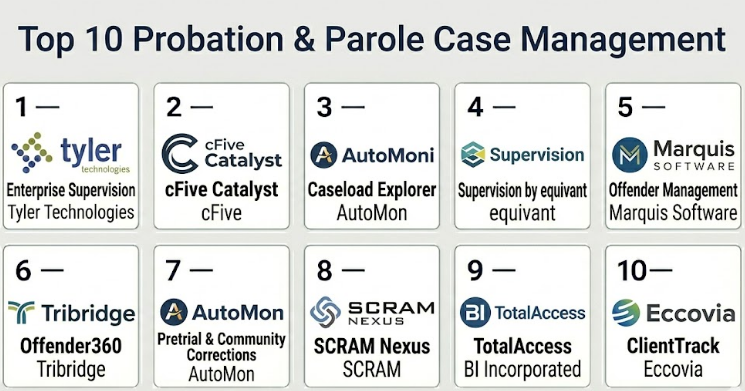
Top 10 Probation & Parole Case Management Tools
#1 — Tyler Technologies Enterprise Supervision
Short description :
Tyler Technologies Enterprise Supervision is designed for public sector justice agencies that manage probation, parole, community corrections, and offender supervision workflows. It supports case planning, supervision conditions, appointments, contacts, violations, assessments, and reporting. The platform is useful for agencies that already use Tyler court, corrections, or public safety systems and want supervision data connected with broader justice workflows. It can help officers manage caseloads, track compliance, and document supervision activities. It is best for agencies needing structured supervision management connected with courts and correctional systems.
Key Features
- Probation and parole case management
- Offender supervision plans
- Conditions and compliance tracking
- Appointment and contact documentation
- Violation management workflows
- Reporting and dashboards
- Integration with justice and court systems
Pros
- Strong fit for public sector justice agencies.
- Useful when supervision data must connect with courts and corrections.
- Supports structured case planning and reporting workflows.
Cons
- Best value may depend on Tyler ecosystem usage.
- Implementation may require detailed workflow configuration.
- Smaller agencies should validate whether the platform depth fits their needs.
Platforms / Deployment
Web / Windows / Mobile-supported workflows
Cloud / On-premise / Hybrid
Security & Compliance
SSO/SAML: Varies / N/A
MFA: Varies / N/A
Encryption: Not publicly stated
Audit logs: Varies / N/A
RBAC: Varies / N/A
CJIS alignment: Varies / N/A
SOC 2 / ISO 27001 / HIPAA: Not publicly stated
Integrations & Ecosystem
Tyler Enterprise Supervision fits agencies that need community corrections workflows connected with broader justice systems.
- Court case management systems
- Corrections and offender records
- Public safety workflows
- Reporting and analytics
- Document management
- Government justice data-sharing workflows
Support & Community
Support is generally public-sector focused and depends on agency contract, deployment scope, and configuration. Agencies should confirm training, migration support, reporting setup, and long-term maintenance.
#2 — cFive Catalyst
Short description :
cFive Catalyst is a case management platform built for probation, parole, pretrial, community corrections, and offender supervision agencies. It supports officer workflows, case plans, assessments, contact notes, conditions, violations, appointments, programs, and reporting. The platform is useful for agencies that need a configurable supervision system focused on community corrections operations. It can help officers manage caseloads and supervisors monitor compliance and performance. It is best for agencies looking for a probation and parole-focused system rather than a generic case management tool.
Key Features
- Probation, parole, and pretrial case management
- Risk and needs assessment workflows
- Supervision plans and case notes
- Conditions and violation tracking
- Appointment and contact management
- Program and referral tracking
- Reporting and officer workload visibility
Pros
- Strong focus on community corrections workflows.
- Useful for agencies needing configurable case supervision processes.
- Practical for officer caseload and compliance tracking.
Cons
- Integration requirements should be validated early.
- Agencies may need configuration time for local supervision policies.
- Public security certification details should be reviewed directly.
Platforms / Deployment
Web / Mobile-supported workflows
Cloud / Hybrid / Varies / N/A
Security & Compliance
SSO/SAML: Varies / N/A
MFA: Varies / N/A
Encryption: Not publicly stated
Audit logs: Varies / N/A
RBAC: Varies / N/A
CJIS alignment: Varies / N/A
SOC 2 / ISO 27001 / HIPAA: Not publicly stated
Integrations & Ecosystem
cFive Catalyst fits supervision environments where probation, parole, and community corrections workflows need strong case structure.
- Court workflow integrations
- Offender management systems
- Risk assessment tools
- Program and treatment referral workflows
- Reporting dashboards
- Drug testing and electronic monitoring workflows where configured
Support & Community
Support is generally focused on justice and community corrections agencies. Buyers should confirm onboarding, workflow configuration, training, data migration, and report customization support.
#3 — Automon Caseload Explorer
Short description :
Automon Caseload Explorer is a community corrections case management system used by probation, parole, pretrial, and supervision agencies. It helps officers manage cases, contacts, assessments, appointments, conditions, violations, documents, and reporting. The platform is designed for justice agencies that need structured workflows for supervising individuals in the community. It is useful for departments that want to improve officer productivity and case visibility. It is best for agencies seeking a supervision-focused tool with strong case documentation capabilities.
Key Features
- Probation and parole caseload management
- Contact and appointment tracking
- Risk and needs assessment support
- Case notes and documentation
- Conditions and violations tracking
- Document and report generation
- Supervisor and agency reporting
Pros
- Strong fit for probation and parole teams.
- Helps officers manage contacts, notes, and supervision activities.
- Useful for agencies focused on caseload visibility and reporting.
Cons
- Integration depth should be validated during procurement.
- Configuration may be required for agency-specific workflows.
- Mobile and deployment options should be reviewed based on agency needs.
Platforms / Deployment
Web / Windows-supported workflows / Mobile-supported workflows
Cloud / On-premise / Hybrid / Varies / N/A
Security & Compliance
SSO/SAML: Varies / N/A
MFA: Not publicly stated
Encryption: Not publicly stated
Audit logs: Varies / N/A
RBAC: Varies / N/A
CJIS alignment: Varies / N/A
SOC 2 / ISO 27001 / HIPAA: Not publicly stated
Integrations & Ecosystem
Automon Caseload Explorer is useful for agencies that need supervision records connected with justice workflows and reporting.
- Court systems
- Offender records
- Assessment workflows
- Document generation
- Reporting tools
- Community corrections data workflows
Support & Community
Support is generally agency-focused. Departments should confirm implementation services, officer training, migration support, and ongoing help for reports and workflows.
#4 — Supervision by equivant
Short description :
Supervision by equivant supports probation, parole, pretrial, and community corrections workflows for justice agencies. It can help officers manage supervision cases, contacts, conditions, risk assessments, violations, documents, and reporting. The platform is useful for agencies that need community supervision connected with broader court and justice system workflows. It is especially relevant for courts, probation offices, and county agencies managing many active cases. It is best for organizations looking for supervision tools within a justice-focused software ecosystem.
Key Features
- Probation and parole case tracking
- Supervision condition management
- Officer contact notes and activity logs
- Risk and assessment workflows
- Violation tracking and reporting
- Document and form management
- Court and justice system connectivity
Pros
- Useful for court-connected supervision workflows.
- Good fit for probation and community corrections agencies.
- Supports structured case and compliance documentation.
Cons
- Exact feature depth may depend on configuration.
- Agencies should validate integrations with existing systems.
- Training and change management may be required for adoption.
Platforms / Deployment
Web / Browser-based workflows / Varies / N/A
Cloud / On-premise / Hybrid / Varies / N/A
Security & Compliance
SSO/SAML: Varies / N/A
MFA: Not publicly stated
Encryption: Not publicly stated
Audit logs: Varies / N/A
RBAC: Varies / N/A
CJIS alignment: Varies / N/A
SOC 2 / ISO 27001 / HIPAA: Not publicly stated
Integrations & Ecosystem
equivant supervision tools fit agencies that need probation and parole workflows tied to broader justice case management.
- Court case management workflows
- Probation records
- Pretrial services workflows
- Document management
- Reporting dashboards
- Justice agency integrations
Support & Community
Support is typically court and justice-agency focused. Buyers should confirm implementation planning, staff training, report configuration, and integration assistance.
#5 — Marquis Software Offender Management
Short description :
Marquis Software Offender Management supports corrections, community supervision, offender records, case planning, and justice agency workflows. It is useful for agencies that need to manage offender information across custody, supervision, programs, treatment, and reentry. The platform can help probation and parole teams track case progress, risk levels, referrals, and compliance activities. It is especially relevant for agencies that need broader offender lifecycle management rather than only appointment tracking. It is best for corrections and supervision agencies that want structured offender management across multiple stages.
Key Features
- Offender records management
- Probation and parole supervision support
- Case planning and program tracking
- Risk and classification workflows
- Reporting and analytics
- Reentry and service coordination support
- Justice agency data workflows
Pros
- Useful for offender lifecycle management.
- Supports corrections, supervision, and program-related workflows.
- Good fit for agencies needing structured offender data.
Cons
- Exact module fit should be validated with the vendor.
- Implementation may require detailed workflow planning.
- Public security and compliance details should be reviewed directly.
Platforms / Deployment
Web / Windows-supported workflows / Varies / N/A
Cloud / On-premise / Hybrid / Varies / N/A
Security & Compliance
SSO/SAML: Varies / N/A
MFA: Not publicly stated
Encryption: Not publicly stated
Audit logs: Varies / N/A
RBAC: Varies / N/A
CJIS alignment: Varies / N/A
SOC 2 / ISO 27001 / HIPAA: Not publicly stated
Integrations & Ecosystem
Marquis Software fits agencies that need supervision, programs, and offender records connected across justice operations.
- Corrections workflows
- Probation and parole records
- Program tracking
- Reentry planning
- Reporting dashboards
- Justice agency data sharing
Support & Community
Support is generally agency and project focused. Buyers should confirm implementation support, migration planning, report configuration, and user training.
#6 — Tribridge Offender360
Short description :
Tribridge Offender360 is an offender management platform designed to support corrections, supervision, case planning, programs, and justice agency workflows. It can help agencies manage offender information across custody, parole, probation, and reentry processes. The platform is useful for organizations that need a broader view of the offender lifecycle rather than only a single case file. It can support supervision tracking, case plans, program participation, and reporting. It is best for agencies managing complex offender workflows across multiple departments.
Key Features
- Offender lifecycle management
- Probation and parole workflow support
- Case planning and supervision tracking
- Program and service referral tracking
- Reporting and analytics
- Custody and community supervision data
- Configurable justice workflows
Pros
- Strong fit for broader offender lifecycle management.
- Useful where custody and community supervision data need to connect.
- Can support multi-department justice workflows.
Cons
- Current availability and support model should be validated.
- Implementation can require significant workflow mapping.
- Public compliance and product roadmap details may be limited.
Platforms / Deployment
Web / Windows-supported workflows / Varies / N/A
Cloud / On-premise / Hybrid / Varies / N/A
Security & Compliance
SSO/SAML: Not publicly stated
MFA: Not publicly stated
Encryption: Not publicly stated
Audit logs: Varies / N/A
RBAC: Varies / N/A
CJIS alignment: Varies / N/A
SOC 2 / ISO 27001 / HIPAA: Not publicly stated
Integrations & Ecosystem
Offender360 fits justice agencies that need offender information connected across custody, supervision, programs, and reporting.
- Corrections systems
- Probation and parole workflows
- Program management
- Reentry workflows
- Court and justice data systems
- Reporting tools
Support & Community
Support details should be validated during procurement. Agencies should confirm current product status, implementation services, migration support, and long-term maintenance.
#7 — AutoMon Pretrial & Community Corrections
Short description :
AutoMon offers tools for pretrial, probation, parole, and community corrections agencies that need structured supervision workflows. Its systems can help agencies manage individuals under supervision, document officer contacts, track conditions, schedule appointments, monitor compliance, and generate reports. It is useful for agencies that want practical tools for community-based supervision. The platform is especially relevant where pretrial and probation teams need similar case workflows. It is best for agencies that need supervision-focused features rather than generic case management.
Key Features
- Pretrial and community corrections workflows
- Probation and parole case records
- Contact and appointment tracking
- Conditions and compliance monitoring
- Assessment and supervision planning
- Reports and document generation
- Officer workload visibility
Pros
- Strong community corrections focus.
- Useful for probation, parole, and pretrial supervision teams.
- Helps structure officer documentation and reporting.
Cons
- Integration capabilities should be reviewed carefully.
- Deployment and mobile options may vary by configuration.
- Agencies may need customization for local policies.
Platforms / Deployment
Web / Windows-supported workflows / Mobile-supported workflows
Cloud / On-premise / Hybrid / Varies / N/A
Security & Compliance
SSO/SAML: Varies / N/A
MFA: Not publicly stated
Encryption: Not publicly stated
Audit logs: Varies / N/A
RBAC: Varies / N/A
CJIS alignment: Varies / N/A
SOC 2 / ISO 27001 / HIPAA: Not publicly stated
Integrations & Ecosystem
AutoMon fits community corrections environments that need supervision data, reports, and offender records organized clearly.
- Court systems
- Pretrial services workflows
- Probation and parole case records
- Assessment tools
- Reporting workflows
- Community corrections data systems
Support & Community
Support is generally justice-agency focused. Buyers should confirm training, configuration, report design, migration assistance, and integration planning.
#8 — SCRAM Nexus
Short description :
SCRAM Nexus is a case management and client monitoring platform commonly associated with community corrections, supervision programs, and monitoring workflows. It can help agencies manage cases, compliance details, monitoring information, client status, and program-related records. It is especially useful where supervision includes alcohol monitoring, location monitoring, or other compliance technologies. The platform is not always a full replacement for a statewide offender management system, but it can be valuable for agencies with monitoring-heavy supervision programs. It is best for agencies that need case management connected with compliance monitoring.
Key Features
- Client and case management workflows
- Monitoring and compliance tracking
- Supervision program support
- Alerts and status visibility
- Reporting and case notes
- Electronic monitoring-related workflows
- Community corrections use cases
Pros
- Strong fit for monitoring-heavy supervision programs.
- Useful when case management needs to connect with compliance data.
- Can support officer visibility into client status.
Cons
- May not replace a full probation and parole case management system.
- Best value depends on monitoring program needs.
- Integration with existing agency systems should be validated.
Platforms / Deployment
Web / Mobile-supported workflows / Monitoring ecosystem
Cloud / Varies / N/A
Security & Compliance
SSO/SAML: Varies / N/A
MFA: Not publicly stated
Encryption: Not publicly stated
Audit logs: Varies / N/A
RBAC: Varies / N/A
CJIS alignment: Varies / N/A
SOC 2 / ISO 27001 / HIPAA: Not publicly stated
Integrations & Ecosystem
SCRAM Nexus fits supervision environments where monitoring devices, alerts, and compliance activities are central.
- Alcohol monitoring workflows
- Location monitoring workflows
- Supervision case records
- Compliance dashboards
- Officer alert workflows
- Program reporting
Support & Community
Support is generally tied to monitoring and community corrections programs. Agencies should confirm staff training, device workflow support, data retention, and integration options.
#9 — BI Incorporated TotalAccess
Short description :
BI Incorporated TotalAccess is associated with community supervision and electronic monitoring workflows. It can support agencies that manage clients under supervision, location monitoring, compliance alerts, program participation, and related case activities. The platform is useful for probation, parole, and community corrections programs where electronic monitoring plays an important role. It may work alongside broader case management systems rather than replacing them completely. It is best for agencies focused on supervision monitoring, accountability, and compliance visibility.
Key Features
- Electronic monitoring workflow support
- Client supervision visibility
- Compliance and alert management
- Location monitoring data workflows
- Case activity documentation
- Reporting and program oversight
- Community corrections support
Pros
- Useful for supervision programs using electronic monitoring.
- Helps officers track compliance and alerts.
- Good fit for monitoring-focused probation and parole workflows.
Cons
- Not always a complete agency-wide case management platform.
- Integration with existing systems should be verified.
- Best fit depends on electronic monitoring program scope.
Platforms / Deployment
Web / Mobile-supported workflows / Monitoring ecosystem
Cloud / Varies / N/A
Security & Compliance
SSO/SAML: Not publicly stated
MFA: Not publicly stated
Encryption: Not publicly stated
Audit logs: Varies / N/A
RBAC: Varies / N/A
CJIS alignment: Varies / N/A
SOC 2 / ISO 27001 / HIPAA: Not publicly stated
Integrations & Ecosystem
BI Incorporated TotalAccess fits supervision environments that rely on electronic monitoring and compliance tracking.
- Location monitoring workflows
- Electronic supervision programs
- Officer alert workflows
- Case activity tracking
- Reporting dashboards
- Community corrections data workflows
Support & Community
Support is typically tied to electronic monitoring services and agency programs. Buyers should confirm training, escalation support, device data workflows, and integration capabilities.
#10 — Eccovia ClientTrack
Short description :
Eccovia ClientTrack is a human services case management platform that can support justice-adjacent programs, reentry, community services, behavioral health referrals, housing support, and coordinated care workflows. While it is not a traditional probation and parole system by itself, it can be useful where supervision agencies work closely with social service providers. It helps teams manage client records, referrals, services, outcomes, and program coordination. It is best for reentry programs, community-based supervision support, and agencies focused on service connection rather than only enforcement.
Key Features
- Client and case management
- Service referral tracking
- Program participation workflows
- Reentry and community support coordination
- Outcome reporting
- Multi-provider collaboration
- Human services data management
Pros
- Strong fit for reentry and community support programs.
- Useful for service coordination across agencies.
- Good option where supervision includes human services collaboration.
Cons
- Not a traditional probation/parole enforcement system.
- May need integration with justice systems for full supervision workflows.
- Buyers should validate security and justice-specific requirements.
Platforms / Deployment
Web / Mobile-supported workflows
Cloud / Varies / N/A
Security & Compliance
SSO/SAML: Varies / N/A
MFA: Varies / N/A
Encryption: Not publicly stated
Audit logs: Varies / N/A
RBAC: Varies / N/A
CJIS alignment: Not publicly stated
HIPAA: Varies / N/A
SOC 2 / ISO 27001: Not publicly stated
Integrations & Ecosystem
ClientTrack fits reentry and service coordination environments where probation and parole clients need support from community programs.
- Human services workflows
- Reentry program management
- Housing and employment referrals
- Behavioral health service coordination
- Outcome reporting
- Multi-agency collaboration
Support & Community
Support is generally focused on human services and public sector programs. Agencies should confirm onboarding, data sharing controls, reporting setup, and integration with justice systems.
Comparison Table
| Tool Name | Best For | Platform(s) Supported | Deployment | Standout Feature | Public Rating |
|---|---|---|---|---|---|
| Tyler Technologies Enterprise Supervision | Court-connected probation and parole agencies | Web, Windows, mobile-supported workflows | Cloud / On-premise / Hybrid | Supervision connected with justice workflows | N/A |
| cFive Catalyst | Probation, parole, pretrial, and community corrections | Web, mobile-supported workflows | Cloud / Hybrid / Varies / N/A | Community corrections-focused case management | N/A |
| Automon Caseload Explorer | Probation and parole officer caseload management | Web, Windows-supported workflows, mobile-supported workflows | Cloud / On-premise / Hybrid / Varies / N/A | Officer caseload and contact tracking | N/A |
| Supervision by equivant | Court-connected supervision agencies | Web, browser-based workflows, varies / N/A | Cloud / On-premise / Hybrid / Varies / N/A | Supervision workflows tied to justice case management | N/A |
| Marquis Software Offender Management | Offender lifecycle and supervision workflows | Web, Windows-supported workflows, varies / N/A | Cloud / On-premise / Hybrid / Varies / N/A | Offender records and program tracking | N/A |
| Tribridge Offender360 | Custody, supervision, and reentry workflows | Web, Windows-supported workflows, varies / N/A | Cloud / On-premise / Hybrid / Varies / N/A | Broad offender lifecycle management | N/A |
| AutoMon Pretrial & Community Corrections | Pretrial and community corrections teams | Web, Windows-supported workflows, mobile-supported workflows | Cloud / On-premise / Hybrid / Varies / N/A | Supervision documentation and reporting | N/A |
| SCRAM Nexus | Monitoring-heavy supervision programs | Web, mobile-supported workflows, monitoring ecosystem | Cloud / Varies / N/A | Case management connected with compliance monitoring | N/A |
| BI Incorporated TotalAccess | Electronic monitoring and compliance programs | Web, mobile-supported workflows, monitoring ecosystem | Cloud / Varies / N/A | Supervision monitoring and alert visibility | N/A |
| Eccovia ClientTrack | Reentry and human services coordination | Web, mobile-supported workflows | Cloud / Varies / N/A | Service coordination and reentry case support | N/A |
Evaluation & Probation & Parole Case Management Tools
| Tool Name | Core (25%) | Ease (15%) | Integrations (15%) | Security (10%) | Performance (10%) | Support (10%) | Value (15%) | Weighted Total (0–10) |
|---|---|---|---|---|---|---|---|---|
| Tyler Technologies Enterprise Supervision | 9 | 7 | 9 | 8 | 8 | 8 | 7 | 8.05 |
| cFive Catalyst | 9 | 8 | 8 | 8 | 8 | 8 | 7 | 8.15 |
| Automon Caseload Explorer | 8 | 7 | 8 | 7 | 8 | 7 | 7 | 7.50 |
| Supervision by equivant | 8 | 7 | 8 | 7 | 8 | 7 | 7 | 7.50 |
| Marquis Software Offender Management | 8 | 7 | 7 | 7 | 7 | 7 | 7 | 7.25 |
| Tribridge Offender360 | 8 | 7 | 7 | 7 | 7 | 7 | 7 | 7.25 |
| AutoMon Pretrial & Community Corrections | 8 | 7 | 8 | 7 | 8 | 7 | 7 | 7.50 |
| SCRAM Nexus | 7 | 8 | 7 | 7 | 8 | 7 | 7 | 7.30 |
| BI Incorporated TotalAccess | 7 | 7 | 7 | 7 | 8 | 7 | 7 | 7.15 |
| Eccovia ClientTrack | 7 | 8 | 7 | 7 | 7 | 7 | 8 | 7.25 |
These scores are comparative and should be used as a practical shortlist guide. A probation agency may value officer caseload tracking and court reports more heavily, while a parole agency may prioritize risk assessment, violations, reentry, and electronic monitoring. A reentry program may find service coordination more important than enforcement workflows. Buyers should validate workflows, security controls, integrations, data migration, reporting, and officer usability before selecting a platform.
Which Probation & Parole Case Management Tool Should You Choose?
Solo / Freelancer
Solo consultants, independent reentry advisors, and small service providers usually do not need a full probation and parole system. These platforms are built for agencies that manage court-ordered supervision, compliance tracking, violations, legal records, and sensitive offender data.
If the work involves basic service coordination, notes, or referrals, a lighter human services case management tool may be enough. If supervision includes court conditions, violation reporting, officer contacts, and legal accountability, a dedicated probation and parole case management tool is more appropriate.
SMB
Small probation offices, municipal supervision teams, nonprofit reentry providers, and community corrections programs should focus on ease of use, affordability, case notes, appointment tracking, conditions, referrals, and reporting. cFive Catalyst, Automon Caseload Explorer, AutoMon Pretrial & Community Corrections, and Eccovia ClientTrack may be useful depending on whether the need is enforcement-focused or service-focused.
Smaller teams should avoid overly complex platforms unless they need deep court, corrections, or electronic monitoring integrations.
Mid-Market
Mid-sized probation and parole agencies need stronger case planning, risk assessments, officer workload tracking, violation workflows, reporting, and external integrations. Tyler Technologies Enterprise Supervision, cFive Catalyst, Automon Caseload Explorer, Supervision by equivant, and Marquis Software Offender Management may be relevant options.
Mid-market buyers should test daily officer workflows such as intake, case plan creation, contact logging, violation documentation, referral tracking, court report generation, and supervisor review.
Enterprise
State probation systems, parole boards, large community corrections departments, and multi-region justice agencies need advanced scalability, security, reporting, role controls, integration depth, and long-term support. Tyler Technologies Enterprise Supervision, cFive Catalyst, Marquis Software Offender Management, Tribridge Offender360, and Supervision by equivant may be stronger candidates.
Enterprise buyers should involve probation leadership, parole administrators, IT, legal, courts, corrections, reentry teams, data analysts, supervisors, and frontline officers before final selection.
Budget vs Premium
Budget-focused agencies should identify the most important workflow first. If the issue is officer caseload documentation, a focused case management tool may be enough. If the issue is offender lifecycle management across courts, custody, parole, and reentry, a broader platform may be needed.
Premium systems usually offer deeper integrations, stronger reporting, more configuration, and better scalability. However, they may also require more training, implementation planning, and change management.
Feature Depth vs Ease of Use
Probation and parole tools need enough feature depth to manage complex supervision, but they must also be easy for officers to use every day. Officers should not need to spend excessive time navigating screens when documenting contacts or updating case plans.
During evaluation, agencies should test common workflows with real users, including officers, supervisors, administrators, and reporting staff.
Integrations & Scalability-
Important integrations include court systems, corrections systems, jail management, prison management, electronic monitoring, drug testing, treatment providers, document management, identity systems, reporting tools, and payment systems where applicable.
Scalability should include caseload growth, number of officers, regional offices, supervision types, risk levels, program referrals, violation volume, report volume, mobile users, and long-term data retention.
Security & Compliance Needs
Probation and parole systems store sensitive legal, behavioral, medical, family, victim, employment, housing, and supervision data. Security review should be mandatory before purchase.
Agencies should ask about SSO, MFA, RBAC, audit logs, encryption, CJIS alignment, HIPAA relevance, access reviews, data retention, backup, disaster recovery, breach response, and administrative controls. Do not assume compliance without formal documentation.
Frequently Asked Questions
1. What is Probation & Parole Case Management software?
Probation & Parole Case Management software helps agencies manage individuals under supervision. It tracks case plans, contacts, appointments, conditions, violations, referrals, reports, risk assessments, and supervision outcomes.
2. How is probation case management different from general case management?
General case management tracks tasks and client records, while probation case management must support court conditions, violations, supervision levels, legal reporting, officer contacts, compliance monitoring, and sensitive justice data.
3. What features matter most for probation and parole teams?
Important features include case plans, conditions tracking, appointment scheduling, contact notes, risk assessments, violation workflows, referrals, reports, mobile access, alerts, audit logs, and integrations with courts or corrections systems.
4. Can these tools support both probation and parole?
Many tools can support both probation and parole, but workflows may differ. Probation often connects more closely with courts, while parole may connect more closely with corrections, release planning, risk management, and reentry support.
5. Can officers use these tools in the field?
Some systems support mobile or browser-based access for field work. This can help officers document home visits, contacts, compliance checks, and case updates, but agencies must confirm device security and access controls.
6. Do these tools integrate with electronic monitoring?
Some probation and parole systems integrate with electronic monitoring platforms, while others require separate workflows. Agencies using GPS, alcohol monitoring, or other compliance tools should validate integrations before purchase.
7. What are common mistakes when selecting these tools?
Common mistakes include ignoring officer usability, underestimating reporting needs, failing to test integrations, choosing only by price, skipping security review, and not involving frontline officers in demos.
8. How do these systems help with violations?
They can help officers document violations, track condition failures, generate reports, notify supervisors, attach evidence, and prepare court or parole board documentation. Exact workflows depend on the platform and agency policy.
9. Can these tools support reentry programs?
Yes, some tools support reentry planning, referrals, service coordination, housing support, employment tracking, treatment referrals, and program outcomes. Service-focused tools may be helpful alongside supervision platforms.
10. How should agencies evaluate pricing?
Agencies should review software licensing, users, modules, integrations, data migration, training, support, reporting, mobile access, and long-term maintenance. The lowest initial price may not be the best long-term value.
Conclusion
Probation & Parole Case Management software helps agencies manage supervision more effectively by organizing case plans, contacts, conditions, appointments, violations, referrals, assessments, reports, and officer workloads in one structured system. The best platform depends on agency size, supervision model, court connectivity, corrections integration, electronic monitoring needs, reentry priorities, and reporting requirements. A court-connected probation office may prefer Tyler Technologies Enterprise Supervision or Supervision by equivant, while a community corrections agency may consider cFive Catalyst or Automon Caseload Explorer.
