Introduction
Civic Engagement Platforms are digital tools that help governments, public agencies, municipalities, nonprofits, planning teams, and community organizations collect public feedback, manage consultations, run surveys, host discussions, share project updates, and involve residents in decision-making.
In simple words, these platforms help public-sector teams listen to people in a more organized, transparent, and measurable way. Instead of depending only on town hall meetings, emails, paper forms, or social media comments, civic engagement software brings community participation into one structured platform.
These tools are useful for city planning, transportation projects, budgeting feedback, policy consultations, climate action plans, public safety discussions, housing development, parks and recreation planning, and community surveys.
Buyers should evaluate:
- Ease of use for residents and administrators
- Survey, polling, and discussion features
- Accessibility and multilingual support
- Moderation and community management tools
- Reporting and analytics quality
- GIS mapping and location-based feedback
- Data privacy and security controls
- Integration with CRM, websites, email, and GIS systems
- Support for public-sector workflows
- Pricing transparency and implementation support
Best for: city governments, public agencies, urban planners, transportation departments, civic innovation teams, nonprofits, universities, and community engagement teams.
Not ideal for: very small teams that only need a basic survey form, organizations without a public consultation process, or teams that only need social media posting rather than structured resident participation.
Key Civic Engagement Platform Trends
- Digital-first public participation is becoming normal. Residents expect easy online ways to share feedback without attending physical meetings.
- Hybrid engagement is growing. Strong platforms now support both online feedback and offline event data collection.
- Mapping-based feedback is increasingly important. Planning teams need residents to comment on specific roads, parks, buildings, and neighborhoods.
- AI-assisted analysis is becoming useful. Some platforms help summarize public comments, identify themes, and reduce manual review work.
- Accessibility is a major requirement. Civic tools must support inclusive participation for people with different devices, abilities, and language needs.
- Data privacy matters more than ever. Public trust depends on responsible data handling, clear consent, secure storage, and role-based access.
- Dashboards are replacing spreadsheet-heavy workflows. Public teams want real-time summaries, sentiment trends, participation levels, and exportable reports.
- Community trust is now a product requirement. Platforms must make engagement transparent, easy to understand, and less confusing for residents.
- Integration with government systems is becoming important. Civic platforms often need to connect with websites, email tools, GIS systems, CRM platforms, and open data portals.
- Open-source civic technology remains relevant. Some governments prefer open-source tools for transparency, flexibility, and public accountability.
How We Selected These Tools
The platforms below were selected based on:
- Recognition in civic engagement, public participation, urban planning, and government consultation
- Breadth of engagement features such as surveys, discussions, polls, ideas, forums, mapping, and reporting
- Fit for different buyers including local governments, regional agencies, nonprofits, and large public institutions
- Support for structured consultation workflows and public feedback management
- Availability of analytics, dashboards, and reporting tools
- Ability to support inclusive, accessible, and transparent participation
- Integration potential with websites, GIS, email, CRM, and government communication tools
- Practical value for both small projects and large public engagement programs
- Suitability for real-world public-sector use cases
- Balance between enterprise platforms, planning-focused tools, and open-source options
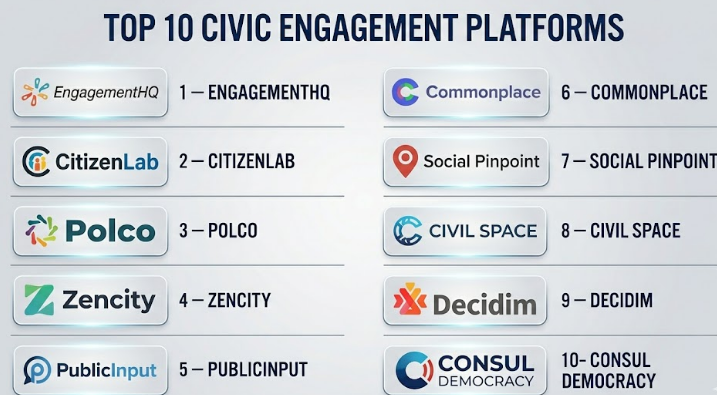
Top 10 Civic Engagement Platforms
#1 — EngagementHQ
Short description :
EngagementHQ is a widely used civic engagement platform designed for public-sector organizations that need to consult with communities online. It helps governments and agencies run surveys, discussions, idea boards, mapping projects, polls, and information pages in one place. The platform is useful for city planning, infrastructure projects, environmental consultations, policy feedback, and community programs. It is especially suitable for teams that need a full engagement website rather than only a survey tool. EngagementHQ works well for municipalities, public agencies, transportation teams, and community consultation professionals.
Key Features
- Online surveys, polls, forums, and idea collection
- Project pages for public consultations
- Mapping-based community feedback
- Analytics and engagement reporting
- Participant management and moderation
- Tools for community storytelling and updates
- Support for structured public engagement programs
Pros
- Strong fit for public consultation and local government engagement
- Broad set of participation tools in one platform
- Useful for both small projects and large engagement programs
Cons
- May be more than needed for simple surveys
- Setup requires clear project planning and content structure
- Pricing and advanced features may vary by package
Platforms / Deployment
Web-based platform
Cloud deployment
Mobile access through browser
Security & Compliance
Not publicly stated. Buyers should validate SSO/SAML, MFA, encryption, audit logs, RBAC, GDPR, data residency, accessibility, and public-sector compliance requirements.
Integrations & Ecosystem
EngagementHQ can support civic engagement teams that need to connect public feedback with reporting and project communication workflows.
- Website embedding and project pages
- Email communication workflows
- GIS and map-based feedback use cases
- Data exports for analysis
- Reporting dashboards
- Public consultation content management
Support & Community
Support generally depends on package and implementation needs. Civic engagement teams should review onboarding, training, moderation guidance, documentation, and customer success support before purchase.
#2 — CitizenLab
Short description :
CitizenLab is a civic engagement platform built for governments and public organizations that want to involve residents in decision-making. It supports surveys, idea collection, participatory budgeting, consultation pages, and community feedback workflows. The platform is designed to help public teams collect input, analyze comments, and communicate decisions more clearly. It is useful for local governments, regional authorities, and civic innovation teams. CitizenLab is a good fit for organizations that want a modern digital participation platform with structured engagement methods.
Key Features
- Surveys and public consultations
- Idea collection and discussion spaces
- Participatory budgeting support
- Community input analysis
- Project pages and engagement hubs
- Reporting and dashboards
- Multi-project engagement management
Pros
- Strong civic participation focus
- Good for structured consultation and resident feedback
- Useful for participatory budgeting and policy engagement
Cons
- Smaller teams may need time to learn the full workflow
- Advanced analytics and configuration may depend on plan
- Buyers should validate local compliance and data hosting needs
Platforms / Deployment
Web-based platform
Cloud deployment
Mobile access through browser
Security & Compliance
Not publicly stated. Buyers should confirm SSO/SAML, MFA, encryption, RBAC, audit logs, GDPR, data residency, and accessibility standards.
Integrations & Ecosystem
CitizenLab is suitable for governments that want to organize resident input and connect engagement results with decision-making.
- Survey and consultation workflows
- Public project pages
- Email and communication support
- Data exports
- Reporting dashboards
- Participatory budgeting workflows
Support & Community
Support and onboarding may vary by subscription and region. Public-sector buyers should check training, customer success, implementation guidance, and documentation depth.
#3 — Polco
Short description :
Polco is a civic engagement and community survey platform focused on helping governments gather statistically useful resident feedback. It is often used for public opinion surveys, community benchmarking, policy feedback, and resident satisfaction measurement. The platform is useful for local governments that want structured survey data rather than only open discussion comments. Polco is especially relevant for city managers, public administrators, and agencies that need measurable insights for planning and decision-making. It is a strong option where data quality and resident sentiment tracking are important.
Key Features
- Community surveys and polling
- Resident sentiment analysis
- Benchmarking and reporting
- Public policy feedback collection
- Dashboard-based insights
- Support for local government decision-making
- Community data and engagement tools
Pros
- Strong for survey-driven civic engagement
- Useful for measurable public feedback and benchmarking
- Good fit for city managers and policy teams
Cons
- Less suitable if the main need is open discussion or mapping feedback
- May not replace a full public consultation website
- Some advanced research features may require additional services
Platforms / Deployment
Web-based platform
Cloud deployment
Mobile access through browser
Security & Compliance
Not publicly stated. Buyers should validate SSO/SAML, MFA, encryption, RBAC, audit logs, privacy policies, data handling, and public-sector compliance needs.
Integrations & Ecosystem
Polco fits well where community feedback needs to become structured insight for public reporting and decision-making.
- Survey workflows
- Resident panels
- Reporting dashboards
- Data exports
- Public opinion tracking
- Community benchmarking workflows
Support & Community
Polco generally serves public-sector teams and may provide research support, onboarding, and survey guidance depending on the package. Buyers should confirm available support levels.
#4 — Zencity
Short description :
Zencity is a community intelligence and civic engagement platform that helps governments understand resident needs, public sentiment, and community priorities. It focuses on collecting and analyzing feedback from multiple channels, including surveys and public conversations. The platform is useful for local governments that need to monitor resident sentiment and make data-informed decisions. Zencity is especially relevant for city leaders, communications teams, and public administrators who want ongoing insight, not just one-time consultation. It is a strong fit where analytics and public sentiment tracking are important.
Key Features
- Community sentiment analysis
- Surveys and resident feedback tools
- Public conversation monitoring
- Dashboards and insight reporting
- Issue tracking and trend identification
- Data-informed decision support
- Tools for government communication teams
Pros
- Strong analytics and community intelligence focus
- Useful for ongoing resident sentiment monitoring
- Good fit for public administrators and communications teams
Cons
- May not be ideal for teams needing deep participatory budgeting workflows
- Buyers should validate data sources and privacy approach
- Advanced capabilities may depend on package
Platforms / Deployment
Web-based platform
Cloud deployment
Mobile access through browser
Security & Compliance
Not publicly stated. Buyers should validate SSO/SAML, MFA, encryption, audit logs, RBAC, GDPR, data privacy controls, and public-sector procurement requirements.
Integrations & Ecosystem
Zencity is most useful when combined with communication, survey, reporting, and public feedback workflows.
- Survey tools
- Public sentiment dashboards
- Community feedback analysis
- Reporting exports
- Communication planning workflows
- Public issue monitoring
Support & Community
Support generally includes onboarding and customer success for public-sector users. Buyers should ask about analyst support, training, dashboard setup, and data interpretation assistance.
#5 — PublicInput
Short description :
PublicInput is a public engagement platform designed for governments, transportation agencies, planners, and public-sector teams that need surveys, meetings, CRM-style engagement records, mapping, and communication tools. It is especially useful for agencies that manage complex public involvement programs across multiple projects. PublicInput helps teams collect online and offline feedback, track participants, manage outreach, and generate reports. It is a strong choice for transportation planning, infrastructure projects, public meetings, and long-running community engagement programs. The platform is practical for teams that need both engagement tools and stakeholder management.
Key Features
- Surveys and public feedback collection
- Public meeting management
- Stakeholder and participant tracking
- Mapping and location-based feedback
- Email and SMS communication workflows
- Analytics and reporting
- Tools for online and offline engagement
Pros
- Strong fit for transportation and planning agencies
- Good combination of engagement and stakeholder management
- Useful for complex projects with many participants
Cons
- May require configuration for larger programs
- Interface and workflow fit should be tested by non-technical staff
- Pricing and features may vary by agency needs
Platforms / Deployment
Web-based platform
Cloud deployment
Mobile access through browser
Security & Compliance
Not publicly stated. Buyers should confirm SSO/SAML, MFA, encryption, audit logs, RBAC, GDPR, accessibility, and public-sector security requirements.
Integrations & Ecosystem
PublicInput works well when engagement data needs to connect with outreach, meetings, planning, and reporting.
- GIS and mapping workflows
- Public meeting tools
- Email and SMS engagement
- Stakeholder records
- Survey data exports
- Reporting dashboards
Support & Community
PublicInput typically supports public agencies and planning teams. Buyers should review onboarding, training, project setup assistance, and support response expectations.
#6 — Commonplace
Short description :
Commonplace is a community engagement platform often used for planning, development, transport, regeneration, and public consultation projects. It helps project teams collect location-based feedback, run surveys, share project updates, and understand community concerns. The platform is especially useful for urban planning teams, housing developers, local authorities, transport planners, and infrastructure projects. Commonplace is strong when feedback needs to be tied to places, routes, neighborhoods, or proposed development areas. It works well for project-based engagement where maps and visual context matter.
Key Features
- Map-based public feedback
- Project consultation pages
- Surveys and questionnaires
- Resident sentiment and issue tracking
- Analytics and reporting
- Stakeholder engagement tools
- Planning and development engagement workflows
Pros
- Strong for place-based consultation
- Useful for planning, transport, and development projects
- Helps convert local feedback into actionable project insights
Cons
- Less suitable for broad civic CRM needs
- May not replace a full government-wide engagement platform
- Best value comes when projects are map or place focused
Platforms / Deployment
Web-based platform
Cloud deployment
Mobile access through browser
Security & Compliance
Not publicly stated. Buyers should validate SSO/SAML, MFA, encryption, RBAC, audit logs, GDPR, accessibility, and local data protection needs.
Integrations & Ecosystem
Commonplace is useful for engagement projects where geography and public sentiment are important.
- Mapping and location feedback
- Project information pages
- Survey exports
- Engagement reports
- Planning and consultation workflows
- Stakeholder communication support
Support & Community
Support usually depends on project scope and service package. Planning teams should ask about consultation design, reporting support, onboarding, and accessibility guidance.
#7 — Social Pinpoint
Short description :
Social Pinpoint is a community engagement platform designed for public consultation, planning projects, and stakeholder feedback. It supports interactive maps, surveys, discussion boards, idea walls, participatory budgeting, and project pages. The platform is especially useful for local governments, planning consultants, infrastructure teams, and community development organizations. Social Pinpoint is strong when teams need a visually engaging way to gather input from residents. It is suitable for both small consultations and larger community engagement programs.
Key Features
- Interactive maps and place-based feedback
- Surveys and polls
- Idea walls and discussion tools
- Participatory budgeting features
- Project pages and consultation hubs
- Reporting and analytics
- Tools for online community engagement
Pros
- Strong visual engagement experience
- Good for planning, infrastructure, and public consultation
- Flexible mix of surveys, maps, and idea tools
Cons
- May need careful moderation for public discussion features
- Not ideal if the only need is basic polling
- Advanced enterprise needs should be validated
Platforms / Deployment
Web-based platform
Cloud deployment
Mobile access through browser
Security & Compliance
Not publicly stated. Buyers should validate SSO/SAML, MFA, encryption, RBAC, audit logs, GDPR, accessibility, and public-sector privacy requirements.
Integrations & Ecosystem
Social Pinpoint works well for project-based engagement and public consultation workflows.
- Interactive mapping
- Survey data exports
- Project pages
- Reporting dashboards
- Community discussion tools
- Planning and engagement workflows
Support & Community
Support may include onboarding, project guidance, and platform training depending on subscription. Buyers should review service levels and customer success options.
#8 — Civil Space
Short description :
Civil Space is a civic engagement platform focused on helping governments and organizations run public consultations, surveys, discussions, and community participation programs. It is designed to make engagement easier for residents while giving administrators tools to manage feedback and reporting. The platform is useful for local governments, public agencies, nonprofit organizations, and civic teams that want a clean engagement portal. Civil Space is a practical option for teams that need structured participation without unnecessary complexity. It can support consultations, policy feedback, planning input, and resident engagement initiatives.
Key Features
- Public consultation pages
- Surveys and feedback tools
- Discussion and idea collection
- Community participation workflows
- Reporting and analytics
- Engagement project management
- Resident-friendly participation experience
Pros
- Practical for small to mid-sized public engagement teams
- Clear structure for consultation projects
- Useful for organizations that want a focused civic engagement tool
Cons
- May not have the depth of larger enterprise platforms
- Advanced integrations should be validated
- Public information on security and compliance may be limited
Platforms / Deployment
Web-based platform
Cloud deployment
Mobile access through browser
Security & Compliance
Not publicly stated. Buyers should confirm SSO/SAML, MFA, encryption, RBAC, audit logs, GDPR, accessibility, and data retention policies.
Integrations & Ecosystem
Civil Space can support engagement teams that need to organize consultation input and produce usable reports.
- Survey and feedback workflows
- Discussion tools
- Public project pages
- Reporting exports
- Engagement dashboards
- Communication support
Support & Community
Support details may vary. Buyers should ask about onboarding, administrator training, help documentation, moderation guidance, and response times.
#9 — Decidim
Short description :
Decidim is an open-source digital democracy and participatory governance platform. It is used by public institutions, civic organizations, and communities that want transparent, participatory processes. Decidim can support proposals, assemblies, participatory budgeting, consultations, meetings, voting-style workflows, and community decision-making. It is especially suitable for organizations that value open-source technology, public accountability, and flexible democratic participation. Because it is open-source, it may require more technical ownership than fully managed commercial platforms.
Key Features
- Open-source civic participation platform
- Proposals and public consultations
- Participatory budgeting support
- Assemblies and process management
- Meeting and debate support
- Voting-style participation workflows
- Flexible community governance features
Pros
- Open-source and transparent
- Strong fit for participatory democracy initiatives
- Flexible for governments and civic organizations with technical support
Cons
- Requires technical expertise for hosting and maintenance
- Support depends on implementation partner or internal team
- May need customization for polished public-sector workflows
Platforms / Deployment
Web-based platform
Self-hosted / Cloud through implementation partners
Mobile access through browser
Security & Compliance
Varies / N/A. Security depends on hosting, configuration, maintenance, and implementation partner. Buyers should validate encryption, authentication, admin controls, audit logging, GDPR, accessibility, and infrastructure security.
Integrations & Ecosystem
Decidim’s open-source model gives teams flexibility, but integrations depend on technical capability.
- Custom APIs and extensions
- Participatory budgeting workflows
- Meeting and proposal modules
- Public consultation pages
- Self-hosted data control
- Civic technology ecosystem
Support & Community
Decidim has an open-source community and ecosystem of implementation partners. Support quality depends on whether the organization self-manages the platform or works with a specialist provider.
#10 — CONSUL Democracy
Short description :
CONSUL Democracy is an open-source citizen participation platform designed for governments and civic organizations. It supports processes such as proposals, debates, participatory budgeting, voting, consultations, and collaborative legislation. The platform is especially useful for public bodies that want an open, transparent, and customizable civic participation system. CONSUL Democracy is a good fit for organizations with technical capacity or access to implementation partners. It may not be the easiest choice for teams that want a fully managed SaaS experience with minimal setup.
Key Features
- Open-source citizen participation platform
- Proposals and debates
- Participatory budgeting
- Public consultations
- Voting and decision support workflows
- Collaborative policy and legislation tools
- Customizable civic engagement structure
Pros
- Strong open-source civic democracy foundation
- Useful for governments focused on transparency and participation
- Flexible for complex participation models
Cons
- Requires technical setup and ongoing maintenance
- May need customization and design work
- Support depends on internal team or implementation partner
Platforms / Deployment
Web-based platform
Self-hosted / Cloud through implementation partners
Mobile access through browser
Security & Compliance
Varies / N/A. Security depends on deployment model, hosting provider, configuration, and maintenance. Buyers should validate authentication, encryption, audit logs, RBAC, GDPR, accessibility, and data protection requirements.
Integrations & Ecosystem
CONSUL Democracy works best for organizations that want control over civic participation workflows and technical customization.
- Open-source extensions
- Proposal and debate modules
- Participatory budgeting workflows
- Public voting processes
- Custom integrations
- Government participation portals
Support & Community
Support depends on implementation approach. Organizations may rely on internal developers, civic technology partners, or open-source community resources.
Comparison Table
| Tool Name | Best For | Platform(s) Supported | Deployment | Standout Feature | Public Rating |
|---|---|---|---|---|---|
| EngagementHQ | Public consultations and government engagement portals | Web / Mobile browser | Cloud | Broad engagement toolkit for public projects | N/A |
| CitizenLab | Digital participation and participatory budgeting | Web / Mobile browser | Cloud | Structured resident participation workflows | N/A |
| Polco | Resident surveys and public opinion insights | Web / Mobile browser | Cloud | Community survey and benchmarking focus | N/A |
| Zencity | Community intelligence and resident sentiment | Web / Mobile browser | Cloud | Public sentiment analysis and dashboards | N/A |
| PublicInput | Transportation, planning, and stakeholder engagement | Web / Mobile browser | Cloud | Engagement CRM plus public meetings and surveys | N/A |
| Commonplace | Place-based planning and development feedback | Web / Mobile browser | Cloud | Map-based community consultation | N/A |
| Social Pinpoint | Visual public consultation and interactive maps | Web / Mobile browser | Cloud | Interactive maps, idea walls, and surveys | N/A |
| Civil Space | Simple public consultation and civic participation | Web / Mobile browser | Cloud | Focused engagement portal for public feedback | N/A |
| Decidim | Open-source participatory democracy | Web / Mobile browser | Self-hosted / Partner-hosted | Open-source governance and participation modules | N/A |
| CONSUL Democracy | Open-source citizen participation | Web / Mobile browser | Self-hosted / Partner-hosted | Proposals, debates, voting, and budgeting | N/A |
Evaluation & Civic Engagement Platforms
| Tool Name | Core (25%) | Ease (15%) | Integrations (15%) | Security (10%) | Performance (10%) | Support (10%) | Value (15%) | Weighted Total (0–10) |
|---|---|---|---|---|---|---|---|---|
| EngagementHQ | 9 | 8 | 8 | 7 | 8 | 8 | 8 | 8.10 |
| CitizenLab | 9 | 8 | 8 | 7 | 8 | 8 | 8 | 8.10 |
| Polco | 8 | 8 | 7 | 7 | 8 | 8 | 8 | 7.75 |
| Zencity | 8 | 8 | 8 | 7 | 8 | 8 | 7 | 7.75 |
| PublicInput | 9 | 7 | 8 | 7 | 8 | 8 | 8 | 8.00 |
| Commonplace | 8 | 8 | 7 | 7 | 8 | 8 | 8 | 7.75 |
| Social Pinpoint | 8 | 8 | 7 | 7 | 8 | 8 | 8 | 7.75 |
| Civil Space | 7 | 8 | 6 | 6 | 7 | 7 | 8 | 7.00 |
| Decidim | 8 | 6 | 8 | 6 | 7 | 7 | 9 | 7.45 |
| CONSUL Democracy | 8 | 6 | 8 | 6 | 7 | 7 | 9 | 7.45 |
These scores are comparative and should not be treated as final buying decisions. A higher score means the platform is stronger across the selected criteria, but the best choice depends on your public engagement goals. For example, a planning team may value mapping tools more, while a city manager may value resident surveys and dashboards. Open-source platforms may score high on value and control, but they require more technical ownership.
Which Civic Engagement Platform Should You Choose?
Solo / Freelancer
Solo consultants and independent civic engagement specialists usually do not need a large enterprise platform unless they manage public-sector projects for clients. For basic research, surveys, and feedback collection, simple survey tools may be enough.
However, if a freelancer works with municipalities, planning projects, or public participation campaigns, tools like Social Pinpoint, Commonplace, Civil Space, or EngagementHQ may be useful depending on the project size.
Recommended direction: Choose a lightweight civic platform only when client projects require public-facing consultation, mapping, or structured reporting.
SMB
Small organizations, nonprofits, and community groups should focus on ease of use, affordability, and quick setup. They usually need surveys, idea collection, simple project pages, and clear reporting rather than complex enterprise workflows.
Civil Space, Social Pinpoint, Commonplace, or open-source options may be suitable depending on budget and technical capability.
Recommended direction: Choose a simple platform that supports public feedback without requiring heavy administration.
Mid-Market
Mid-sized cities, regional agencies, universities, planning firms, and public organizations often need multiple engagement projects running at once. They may need surveys, maps, discussion tools, stakeholder tracking, dashboards, and exportable reports.
At this level, it becomes important to choose a platform that supports repeatable engagement workflows and clear reporting.
Recommended direction: EngagementHQ, CitizenLab, PublicInput, Commonplace, Social Pinpoint, or Polco can be strong options depending on the engagement model.
Enterprise
Large cities, national agencies, transport authorities, infrastructure organizations, and multi-department public bodies need stronger governance, integrations, analytics, accessibility, and security review.
They should evaluate whether they need a broad civic engagement portal, public sentiment intelligence, survey benchmarking, mapping-heavy consultation, or open-source control.
Recommended direction: EngagementHQ, CitizenLab, PublicInput, Zencity, Polco, Decidim, or CONSUL Democracy depending on technical and policy needs.
Budget vs Premium
Budget-focused teams should avoid buying a large platform if they only need simple surveys. Open-source tools may be attractive, but they require setup, hosting, technical support, and maintenance.
Premium civic engagement platforms are more suitable when the organization needs better reporting, multiple projects, stakeholder management, moderation, accessibility support, and professional onboarding.
Budget direction: Civil Space, Decidim, CONSUL Democracy, or simple survey tools.
Premium direction: EngagementHQ, CitizenLab, PublicInput, Polco, Zencity, Commonplace, or Social Pinpoint.
Feature Depth vs Ease of Use
A platform with many features is useful only if staff and residents can use it easily. Public engagement fails when the tool is confusing, hard to navigate, or too technical for residents.
If your team runs complex consultations, choose feature depth. If your team is new to digital engagement, choose simplicity first.
Feature depth: EngagementHQ, CitizenLab, PublicInput, Decidim, CONSUL Democracy.
Ease of use: Polco, Commonplace, Social Pinpoint, Civil Space.
Integrations & Scalability
Civic engagement platforms should connect with public websites, GIS systems, email tools, CRM systems, open data portals, analytics tools, and reporting workflows. Larger public organizations should also review API access, data exports, user permissions, and identity management.
Scalability also means the platform can support many projects, departments, languages, residents, and engagement methods.
Strong integration candidates: PublicInput, EngagementHQ, CitizenLab, Zencity, Decidim, and CONSUL Democracy.
Security & Compliance Needs
Public engagement platforms may store names, emails, demographic information, comments, locations, survey answers, and sensitive community concerns. Buyers should treat security and privacy as core requirements, not optional extras.
Important checks include:
- SSO/SAML
- MFA
- Encryption in transit and at rest
- Role-based access control
- Audit logs
- Data retention policies
- GDPR or local privacy compliance
- Accessibility standards
- Moderation controls
- Data export and deletion options
For sensitive public-sector use, always complete a security review before purchase.
Frequently Asked Questions
1. What is a Civic Engagement Platform?
A Civic Engagement Platform is software that helps public organizations collect, manage, analyze, and report community feedback. It supports tools such as surveys, discussions, idea boards, maps, polls, consultations, and public project pages.
2. How is it different from a normal survey tool?
A normal survey tool usually collects responses through forms. A civic engagement platform goes further by supporting public consultation pages, resident participation, mapping, moderation, reporting, stakeholder tracking, and sometimes participatory budgeting.
3. Who uses Civic Engagement Platforms?
They are used by local governments, public agencies, planning departments, transportation teams, universities, nonprofits, housing authorities, civic innovation teams, and community engagement professionals.
4. What pricing models are common?
Pricing is often based on organization size, number of projects, population served, modules, users, support level, and contract length. Some open-source tools may reduce license cost but require hosting, setup, and technical support.
5. How long does onboarding usually take?
A simple consultation project can be launched quickly if content and questions are ready. Larger implementations with multiple departments, branding, integrations, permissions, and reporting workflows may require more planning and training.
6. What are common mistakes when choosing a platform?
Common mistakes include focusing only on features, ignoring resident usability, skipping accessibility checks, failing to plan moderation, not defining success metrics, and choosing a tool without testing reporting quality.
7. Are Civic Engagement Platforms secure?
Many platforms offer security controls, but buyers should not assume. Always confirm encryption, role-based access, SSO, MFA, audit logs, data retention, privacy policies, and compliance with local data protection rules.
8. Can these platforms support multilingual communities?
Some platforms support multilingual engagement, but capabilities vary. Buyers should test translation workflows, language switching, accessibility, moderation, and reporting across languages before committing.
9. Do these tools support map-based feedback?
Many civic engagement platforms support map-based feedback, especially tools focused on planning, transport, infrastructure, and development. Commonplace, Social Pinpoint, PublicInput, and EngagementHQ are strong examples for place-based engagement.
10. Can open-source civic platforms replace commercial tools?
Open-source platforms like Decidim and CONSUL Democracy can be strong alternatives when an organization has technical resources. They offer flexibility and transparency, but they also require hosting, maintenance, security management, and support planning.
Conclusion
Civic Engagement Platforms help public organizations move from scattered feedback to structured, transparent, and measurable participation. The best platform depends on the type of engagement you run. EngagementHQ and CitizenLab are strong for broad civic participation. PublicInput is useful for planning, transportation, and stakeholder-heavy projects. Polco is strong for surveys and resident sentiment measurement. Zencity helps leaders understand community intelligence. Commonplace and Social Pinpoint work well for map-based and project-based consultation. Civil Space can support simpler public engagement needs, while Decidim and CONSUL Democracy are strong open-source options for organizations that want more technical control.
