Introduction
Marketing Attribution Platforms help businesses understand which marketing channels, campaigns, ads, content, touchpoints, and customer journeys contribute to leads, sales, revenue, app installs, subscriptions, and conversions. In simple English, these tools help answer: Which marketing efforts are actually helping customers move toward purchase?
Modern buyers interact with brands through many touchpoints before converting. A customer may first see a social ad, later search on Google, read a blog, open an email, visit a review page, click a retargeting ad, and finally purchase through a website or app. Without attribution, marketing teams may give too much credit to the last click and ignore earlier touchpoints that created awareness and trust.
Real-world use cases include paid media optimization, customer journey analysis, campaign ROI measurement, app install tracking, ecommerce performance reporting, B2B pipeline attribution, partner tracking, and budget allocation.
Buyers should evaluate attribution model flexibility, data accuracy, privacy readiness, integrations, cross-device tracking, reporting depth, fraud detection, CRM connectivity, mobile measurement, ecommerce support, and ease of implementation.
Best for: Growth teams, performance marketers, ecommerce brands, app marketers, B2B demand generation teams, agencies, marketing operations teams, and revenue leaders.
Not ideal for: Very small teams running only one or two simple campaigns, businesses without clean conversion tracking, or teams that only need basic traffic reports instead of journey-level attribution.
Key Trends in Marketing Attribution Platforms
- Privacy-safe attribution is becoming more important: Platforms are adapting to cookie limitations, mobile privacy changes, consent requirements, and limited user-level tracking.
- Multi-touch attribution is still useful, but not enough alone: Many teams now combine attribution with incrementality testing, media mix modeling, and first-party data analysis.
- Server-side tracking is growing: More businesses are moving tracking logic away from only browser-based pixels to improve reliability and reduce data loss.
- First-party data is becoming central: CRM, ecommerce, product analytics, app events, and customer data platforms are now important inputs for attribution.
- Mobile attribution remains specialized: App marketers need deep linking, install tracking, SKAdNetwork support, fraud prevention, and partner integration coverage.
- B2B attribution is becoming revenue-focused: B2B teams want attribution connected to pipeline, opportunities, deal velocity, account engagement, and closed revenue.
- Ecommerce attribution is becoming more blended: DTC brands often compare platform-reported ROAS with blended ROAS, contribution margin, LTV, and post-purchase survey data.
- AI is improving journey analysis: Some platforms use AI-assisted reporting, anomaly detection, journey pattern discovery, and spend recommendation features.
- Integration quality is now a major buying factor: Attribution tools must connect with ad platforms, analytics tools, CRM systems, ecommerce platforms, mobile apps, data warehouses, and BI dashboards.
- Fraud detection matters more for paid acquisition: App install fraud, fake clicks, bot traffic, and invalid conversions can damage attribution quality if not monitored.
How We Selected These Tools
The following tools were selected based on practical buyer needs across mobile, ecommerce, B2B, performance marketing, and enterprise attribution.
- Market adoption and mindshare: Preference was given to platforms commonly recognized in marketing measurement, mobile attribution, ecommerce attribution, and B2B revenue attribution.
- Feature completeness: Tools were evaluated for campaign tracking, attribution modeling, dashboards, integrations, reporting, privacy controls, and journey analysis.
- Use-case fit: The list includes platforms for app marketers, ecommerce brands, B2B teams, agencies, and enterprise marketing organizations.
- Integration ecosystem: Stronger tools connect with ad networks, CRM systems, ecommerce platforms, analytics tools, BI tools, and data warehouses.
- Data quality and reliability: Platforms were considered stronger when they support event tracking, conversion validation, deduplication, and fraud prevention.
- Security posture signals: Tools with enterprise access controls, privacy practices, and governance capabilities were considered stronger, but no certifications are assumed.
- Scalability: Preference was given to platforms that can support growing campaign volume, multiple markets, multiple business units, and complex customer journeys.
- Practical usability: Tools were evaluated not only for advanced features but also for how useful they are to marketing, growth, revenue, and analytics teams.
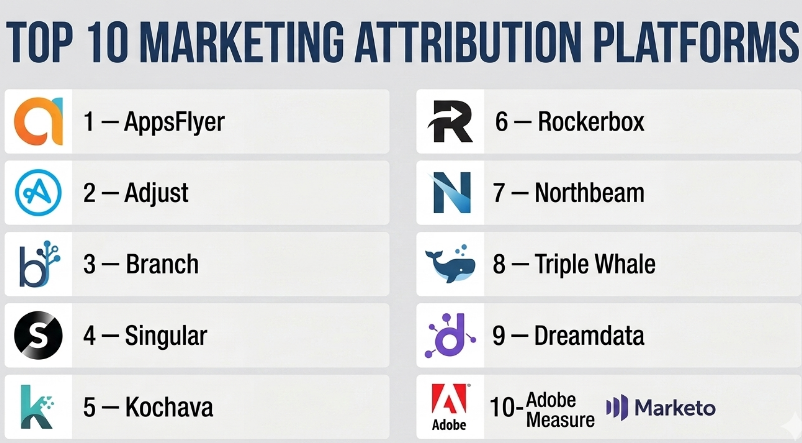
Top 10 Marketing Attribution Platforms
#1 — AppsFlyer
Short description :
AppsFlyer is a well-known mobile attribution and marketing analytics platform used by app marketers, gaming companies, ecommerce apps, fintech apps, and mobile-first brands. It helps teams track installs, in-app events, campaigns, partner performance, user journeys, and marketing ROI. AppsFlyer is especially useful for companies that spend heavily on mobile user acquisition and need accurate measurement across ad networks. It also supports fraud prevention, privacy-aware measurement, and deep mobile ecosystem integrations. For teams focused on mobile growth, AppsFlyer is one of the most recognized attribution platforms.
Key Features
- Mobile attribution and install tracking
- In-app event measurement
- Ad network and partner attribution
- Fraud detection and prevention
- Deep linking and customer journey support
- Privacy-aware measurement workflows
- Campaign and ROI reporting
Pros
- Strong mobile attribution ecosystem.
- Useful for app marketers managing multiple ad partners.
- Good fit for scaling mobile user acquisition programs.
Cons
- May be more complex than needed for small web-only businesses.
- Pricing may not suit early-stage teams with low volume.
- Setup requires careful event and partner configuration.
Platforms / Deployment
Web-based platform.
Mobile SDK support for app tracking.
Cloud deployment.
Security & Compliance
Enterprise security and privacy controls may be available depending on contract and configuration.
SOC 2, ISO 27001, HIPAA: Not publicly stated.
Integrations & Ecosystem
AppsFlyer has a broad mobile marketing ecosystem and is commonly used with ad networks, analytics platforms, and mobile growth workflows.
- Mobile ad networks
- App analytics tools
- Deep linking workflows
- Data warehouses
- BI dashboards
- Fraud prevention workflows
Support & Community
AppsFlyer provides documentation, onboarding resources, partner support, and customer success options. It has strong recognition among mobile marketers and app growth teams.
#2 — Adjust
Short description :
Adjust is a mobile measurement and analytics platform focused on app attribution, campaign tracking, fraud prevention, and mobile growth analytics. It is used by mobile app companies that need to measure installs, user events, partner performance, retention, and revenue. Adjust is suitable for app marketers, product teams, gaming companies, subscription apps, and ecommerce apps. The platform helps teams understand which campaigns and channels bring valuable users, not just installs. It is especially useful when mobile measurement accuracy and fraud protection are important.
Key Features
- Mobile attribution and analytics
- Install and in-app event tracking
- Campaign and partner measurement
- Fraud prevention capabilities
- Cohort and retention reporting
- Deep linking support
- Privacy-aware mobile measurement
Pros
- Strong fit for mobile-first businesses.
- Good reporting for app growth and retention analysis.
- Useful for managing paid user acquisition quality.
Cons
- Less relevant for companies without mobile apps.
- Implementation requires SDK and event setup.
- Advanced use may need technical and marketing alignment.
Platforms / Deployment
Web-based platform.
Mobile SDK support.
Cloud deployment.
Security & Compliance
Security controls and privacy features may vary by plan and implementation.
SOC 2, ISO 27001, HIPAA: Not publicly stated.
Integrations & Ecosystem
Adjust connects with mobile marketing partners, analytics systems, and internal reporting workflows. It is commonly used in app growth stacks.
- Mobile ad networks
- Analytics platforms
- Data exports
- BI tools
- Deep linking workflows
- Fraud monitoring systems
Support & Community
Adjust offers documentation, technical implementation resources, and customer support. It is widely recognized in the mobile measurement space.
#3 — Branch
Short description :
Branch is a mobile linking, deep linking, and attribution platform that helps companies connect user journeys across apps, websites, emails, ads, and referrals. It is especially useful for businesses that need better mobile journeys, app growth, and cross-platform attribution. Branch helps users move from web to app smoothly while helping marketers measure campaign performance. It is commonly used by mobile apps, ecommerce businesses, marketplaces, media companies, and consumer brands. Branch is a strong option when deep linking and attribution must work together.
Key Features
- Deep linking and deferred deep linking
- Mobile attribution
- Cross-platform journey tracking
- Web-to-app measurement
- Referral and campaign tracking
- Partner and channel reporting
- User journey analytics
Pros
- Strong for improving mobile user journeys.
- Useful when attribution and deep linking are both needed.
- Helps reduce friction between web and app experiences.
Cons
- May not be a full replacement for all enterprise attribution needs.
- Setup requires technical implementation.
- Best value is for businesses with meaningful app journeys.
Platforms / Deployment
Web-based platform.
Mobile SDK support.
Cloud deployment.
Security & Compliance
Enterprise security features may be available depending on plan.
SOC 2, ISO 27001, HIPAA: Not publicly stated.
Integrations & Ecosystem
Branch fits into mobile growth, product analytics, campaign tracking, and app engagement workflows.
- Mobile apps
- Ad platforms
- Email marketing tools
- Referral workflows
- Analytics platforms
- Data warehouse exports
Support & Community
Branch provides technical documentation, onboarding resources, and support options. It has strong adoption among mobile growth, app product, and performance marketing teams.
#4 — Singular
Short description :
Singular is a marketing intelligence and attribution platform that helps teams measure campaign performance, unify cost data, track mobile attribution, and analyze ROI across channels. It is suitable for app marketers, performance marketers, gaming companies, ecommerce teams, and growth teams managing multiple ad partners. Singular is known for connecting attribution data with cost aggregation and marketing analytics. It helps teams understand not only where conversions come from, but also how much each result costs. This makes it useful for budget optimization and performance reporting.
Key Features
- Mobile attribution
- Marketing cost aggregation
- ROI and campaign analytics
- Partner and channel reporting
- Fraud detection support
- SKAdNetwork and privacy-aware measurement support
- Data exports and reporting workflows
Pros
- Strong combination of attribution and cost reporting.
- Useful for performance teams managing many channels.
- Good fit for mobile and app-focused growth teams.
Cons
- May require careful setup to unify cost and attribution data.
- Less useful for small teams with simple campaigns.
- Technical implementation may be needed for full value.
Platforms / Deployment
Web-based platform.
Mobile SDK and data integrations.
Cloud deployment.
Security & Compliance
Security and compliance details should be verified during procurement.
SOC 2, ISO 27001, HIPAA: Not publicly stated.
Integrations & Ecosystem
Singular is designed for performance marketing teams that need data from ad networks, attribution events, cost sources, and internal reporting systems.
- Mobile ad networks
- Cost data sources
- Analytics tools
- Data warehouses
- BI dashboards
- Campaign reporting workflows
Support & Community
Singular provides documentation, onboarding, and customer support resources. It is well recognized among app marketers and performance marketing teams.
#5 — Kochava
Short description :
Kochava is a mobile attribution, analytics, and measurement platform used by app marketers, advertisers, agencies, and enterprise teams. It supports install attribution, event tracking, campaign performance, fraud detection, and identity-related measurement workflows. Kochava is useful for businesses that need mobile measurement across multiple partners and channels. It can support app growth, user acquisition, retention analysis, and marketing performance reporting. It is especially relevant for teams looking for a flexible mobile measurement partner.
Key Features
- Mobile attribution tracking
- Campaign and partner measurement
- In-app event analytics
- Fraud detection capabilities
- Audience and identity-related measurement workflows
- Reporting and dashboards
- Data export options
Pros
- Strong fit for mobile attribution and campaign analytics.
- Flexible for advertisers and agencies.
- Useful for app growth and paid acquisition teams.
Cons
- May be too specialized for web-only businesses.
- Implementation requires technical setup.
- Pricing and capabilities may vary by need.
Platforms / Deployment
Web-based platform.
Mobile SDK support.
Cloud deployment.
Security & Compliance
Security details should be confirmed with the vendor.
SOC 2, ISO 27001, HIPAA: Not publicly stated.
Integrations & Ecosystem
Kochava connects with mobile marketing partners and analytics workflows. It is commonly used by teams managing app install campaigns and post-install measurement.
- Mobile ad partners
- App analytics workflows
- Data exports
- Fraud monitoring
- Audience workflows
- BI reporting systems
Support & Community
Kochava provides documentation, customer support, and implementation resources. It has strong visibility in the mobile attribution and measurement market.
#6 — Rockerbox
Short description :
Rockerbox is a marketing measurement and attribution platform focused on helping brands understand channel performance, customer journeys, and media impact. It is suitable for ecommerce brands, DTC companies, agencies, and performance marketing teams that want better visibility beyond platform-reported metrics. Rockerbox helps connect data across paid media, site activity, conversions, and customer touchpoints. It is useful for teams that want multi-touch attribution, marketing mix insights, and reporting in one place. It can help brands make more confident budget decisions across channels.
Key Features
- Multi-touch attribution
- Customer journey analysis
- Marketing performance dashboards
- Channel and campaign reporting
- Ecommerce and DTC measurement support
- Media mix insights
- Data integrations and exports
Pros
- Good fit for ecommerce and DTC marketing teams.
- Helps reduce dependence on platform-reported performance.
- Useful for comparing channels in one reporting view.
Cons
- May require clean data and tracking setup.
- Not always ideal for very small advertisers.
- Advanced analysis may need marketing operations support.
Platforms / Deployment
Web-based platform.
Cloud deployment.
Security & Compliance
Security features should be validated directly with the vendor.
SOC 2, ISO 27001, HIPAA: Not publicly stated.
Integrations & Ecosystem
Rockerbox fits into ecommerce, paid media, and analytics workflows where marketers need unified performance views.
- Paid media platforms
- Ecommerce systems
- Analytics tools
- Data warehouses
- BI dashboards
- Marketing reporting workflows
Support & Community
Rockerbox provides onboarding and customer support. It has strong relevance among DTC, ecommerce, and performance marketing teams.
#7 — Northbeam
Short description :
Northbeam is an ecommerce-focused attribution and marketing measurement platform used by DTC brands and performance marketing teams. It helps brands understand channel performance, customer journeys, revenue impact, and media efficiency. Northbeam is especially useful for teams that sell online and want a clearer view of paid media performance across channels. It can help reduce confusion caused by different ad platforms claiming credit for the same conversion. It is best for ecommerce brands that need attribution, reporting, and budget decision support.
Key Features
- Ecommerce attribution
- Customer journey tracking
- Multi-channel performance reporting
- Revenue and ROAS analysis
- Paid media measurement
- Dashboard-based insights
- Budget decision support
Pros
- Strong fit for DTC and ecommerce brands.
- Helps compare paid media channels more fairly.
- Useful for teams managing significant online ad spend.
Cons
- Less relevant for non-ecommerce companies.
- Value depends on data quality and sales volume.
- May not replace broader enterprise analytics needs.
Platforms / Deployment
Web-based platform.
Cloud deployment.
Security & Compliance
Security and compliance details should be verified with the vendor.
SOC 2, ISO 27001, HIPAA: Not publicly stated.
Integrations & Ecosystem
Northbeam fits into ecommerce growth stacks and paid media reporting workflows.
- Ecommerce platforms
- Paid media platforms
- Analytics tools
- Data exports
- Reporting dashboards
- Growth marketing workflows
Support & Community
Northbeam provides support and onboarding resources. It is commonly discussed among ecommerce operators, DTC marketers, and performance marketing teams.
#8 — Triple Whale
Short description :
Triple Whale is an ecommerce analytics and attribution platform built mainly for Shopify and DTC brands. It helps brands track revenue, ad performance, profit metrics, customer behavior, and marketing attribution from one dashboard. Triple Whale is useful for founders, ecommerce operators, media buyers, and growth teams that want simplified reporting across multiple channels. It focuses on helping ecommerce teams understand what is working across ads, store performance, customer value, and profitability. It is especially useful for fast-moving DTC teams that need daily performance visibility.
Key Features
- Ecommerce attribution and analytics
- Paid media performance reporting
- Revenue and profitability dashboards
- Customer journey insights
- Shopify-focused workflows
- Creative and campaign reporting
- Executive-friendly ecommerce dashboards
Pros
- Strong fit for Shopify and DTC brands.
- Easier to use than many enterprise measurement platforms.
- Combines attribution with ecommerce business metrics.
Cons
- Less suitable for non-ecommerce or complex B2B businesses.
- Best value depends on ecommerce platform compatibility.
- Advanced enterprise governance may be limited compared with larger suites.
Platforms / Deployment
Web-based platform.
Cloud deployment.
Security & Compliance
Security details should be confirmed with the vendor.
SOC 2, ISO 27001, HIPAA: Not publicly stated.
Integrations & Ecosystem
Triple Whale works best in ecommerce environments where store, ad, and revenue data need to be visible together.
- Shopify ecosystem
- Paid media platforms
- Ecommerce analytics
- Customer data workflows
- Dashboard reporting
- Marketing operations workflows
Support & Community
Triple Whale has documentation, support resources, and a strong community presence among ecommerce founders and DTC marketers.
#9 — Dreamdata
Short description :
Dreamdata is a B2B revenue attribution platform designed to help marketing and revenue teams understand how accounts move from first touch to closed revenue. It connects marketing, sales, website, and CRM data to show which activities influence pipeline and deals. Dreamdata is suitable for B2B SaaS companies, demand generation teams, revenue operations teams, and marketing leaders. It is especially useful where buyer journeys are long, involve multiple stakeholders, and cannot be explained by simple last-click attribution. The platform helps connect marketing activity to pipeline and revenue outcomes.
Key Features
- B2B revenue attribution
- Account-based journey tracking
- CRM and pipeline measurement
- Multi-touch attribution
- Website and campaign tracking
- Revenue dashboarding
- Customer journey visualization
Pros
- Strong fit for B2B SaaS and long sales cycles.
- Connects marketing activity with pipeline and revenue.
- Useful for revenue operations and demand generation teams.
Cons
- Less relevant for simple ecommerce or mobile app attribution.
- Requires clean CRM and campaign data.
- Setup may require sales and marketing operations alignment.
Platforms / Deployment
Web-based platform.
Cloud deployment.
Security & Compliance
Security details should be verified directly with the vendor.
SOC 2, ISO 27001, HIPAA: Not publicly stated.
Integrations & Ecosystem
Dreamdata fits into B2B revenue stacks where CRM, marketing automation, website analytics, and sales data need to be connected.
- CRM systems
- Marketing automation platforms
- Website tracking
- Ad platforms
- Revenue dashboards
- Data warehouses
Support & Community
Dreamdata provides onboarding, documentation, and customer support. It has strong relevance among B2B SaaS, revenue operations, and demand generation teams.
#10 — Adobe Marketo Measure
Short description :
Adobe Marketo Measure is a B2B marketing attribution platform designed to help revenue teams connect marketing touchpoints with pipeline and revenue. It is useful for companies that run complex B2B campaigns across paid media, events, content, email, webinars, and sales-driven journeys. Marketo Measure helps teams understand which channels influence opportunities and revenue, not only leads. It is best suited for B2B organizations already using structured CRM and marketing automation workflows. It can be especially valuable when marketing leadership needs attribution reporting for revenue planning.
Key Features
- B2B multi-touch attribution
- Pipeline and revenue attribution
- Campaign and channel reporting
- CRM-connected measurement
- Opportunity journey analysis
- Marketing ROI dashboards
- Enterprise B2B reporting workflows
Pros
- Strong fit for B2B revenue attribution.
- Useful for connecting marketing with pipeline impact.
- Good option for teams in the Adobe and Marketo ecosystem.
Cons
- Less suitable for ecommerce and mobile app attribution.
- Setup requires clean CRM and campaign structure.
- May be too complex for smaller marketing teams.
Platforms / Deployment
Web-based platform.
Cloud deployment.
Security & Compliance
Adobe enterprise security capabilities may vary by product and contract. Buyers should validate exact controls directly.
SOC 2, ISO 27001, HIPAA: Not publicly stated here.
Integrations & Ecosystem
Adobe Marketo Measure works best in B2B revenue environments with CRM, marketing automation, sales processes, and campaign governance.
- CRM systems
- Marketing automation workflows
- Paid media reporting
- Campaign management
- Pipeline dashboards
- Revenue operations workflows
Support & Community
Adobe provides enterprise documentation, training, customer support, and partner ecosystem support. Support depth may depend on contract and product environment.
Comparison Table (Top 10)
| Tool Name | Best For | Platform(s) Supported | Deployment | Standout Feature | Public Rating |
|---|---|---|---|---|---|
| AppsFlyer | Mobile app attribution | Web, Mobile SDK | Cloud | Mobile install and in-app attribution | N/A |
| Adjust | App growth and mobile measurement | Web, Mobile SDK | Cloud | Mobile analytics with fraud prevention | N/A |
| Branch | Deep linking and mobile journey attribution | Web, Mobile SDK | Cloud | Web-to-app and deep linking attribution | N/A |
| Singular | Mobile attribution and cost aggregation | Web, Mobile SDK | Cloud | Unified cost and attribution reporting | N/A |
| Kochava | Mobile attribution and campaign analytics | Web, Mobile SDK | Cloud | Flexible mobile measurement and partner tracking | N/A |
| Rockerbox | Ecommerce and multi-touch attribution | Web | Cloud | Unified channel and customer journey reporting | N/A |
| Northbeam | DTC ecommerce attribution | Web | Cloud | Ecommerce revenue attribution dashboards | N/A |
| Triple Whale | Shopify and DTC analytics | Web | Cloud | Ecommerce attribution plus profit dashboards | N/A |
| Dreamdata | B2B revenue attribution | Web | Cloud | Account-based journey and pipeline attribution | N/A |
| Adobe Marketo Measure | Enterprise B2B marketing attribution | Web | Cloud | Revenue attribution for B2B campaigns | N/A |
Evaluation & Marketing Attribution Platforms
| Tool Name | Core (25%) | Ease (15%) | Integrations (15%) | Security (10%) | Performance (10%) | Support (10%) | Value (15%) | Weighted Total (0–10) |
|---|---|---|---|---|---|---|---|---|
| AppsFlyer | 9 | 7 | 9 | 7 | 8 | 8 | 7 | 8.00 |
| Adjust | 9 | 7 | 8 | 7 | 8 | 8 | 7 | 7.85 |
| Branch | 8 | 8 | 8 | 7 | 8 | 8 | 8 | 7.95 |
| Singular | 8 | 7 | 9 | 7 | 8 | 8 | 7 | 7.80 |
| Kochava | 8 | 7 | 8 | 7 | 8 | 7 | 7 | 7.55 |
| Rockerbox | 8 | 8 | 8 | 7 | 8 | 7 | 8 | 7.80 |
| Northbeam | 8 | 8 | 7 | 7 | 8 | 7 | 8 | 7.65 |
| Triple Whale | 7 | 9 | 7 | 6 | 8 | 7 | 9 | 7.65 |
| Dreamdata | 8 | 8 | 8 | 7 | 8 | 7 | 8 | 7.80 |
| Adobe Marketo Measure | 9 | 7 | 9 | 8 | 8 | 8 | 7 | 8.10 |
These scores are comparative and should be used as a shortlist guide, not as a final buying decision. A mobile app company may rank AppsFlyer, Adjust, Branch, Singular, or Kochava higher. An ecommerce brand may prefer Rockerbox, Northbeam, or Triple Whale. A B2B SaaS company may get more value from Dreamdata or Adobe Marketo Measure. Always validate real integrations, tracking accuracy, reporting needs, and security requirements before purchase.
Which Marketing Attribution Platforms
Solo / Freelancer
Solo marketers and freelancers usually do not need a heavy attribution platform unless they manage serious paid media spend for clients. For simple campaigns, platform dashboards, web analytics, and spreadsheet reporting may be enough.
However, if the freelancer supports ecommerce clients, Triple Whale or Northbeam may be useful. If the client is a mobile app, Branch, AppsFlyer, Adjust, Singular, or Kochava may be relevant depending on budget and technical needs.
SMB
Small and mid-sized businesses should choose attribution tools based on business model. Ecommerce SMBs should look at Triple Whale, Northbeam, or Rockerbox. Mobile app SMBs should consider Branch, AppsFlyer, Adjust, Singular, or Kochava.
For B2B SMBs, Dreamdata may be useful if the company already has CRM discipline and enough pipeline activity. If data quality is poor, improving tracking and CRM hygiene should come before buying an advanced attribution system.
Mid-Market
Mid-market teams usually need more reliable measurement because they manage more channels, larger budgets, and more stakeholders. They may need multi-touch attribution, revenue reporting, cost aggregation, and better customer journey visibility.
Rockerbox, Northbeam, AppsFlyer, Adjust, Singular, Dreamdata, and Adobe Marketo Measure can all fit depending on the company type. The best choice depends on whether the business is mobile-first, ecommerce-first, or B2B revenue-driven.
Enterprise
Enterprise teams need attribution platforms that support governance, access control, multiple teams, large data volume, complex integrations, and executive reporting. They may also need privacy reviews, security documentation, and data warehouse connectivity.
AppsFlyer, Adjust, Singular, Kochava, Adobe Marketo Measure, Dreamdata, and Rockerbox may be stronger fits depending on use case. Large organizations often use more than one measurement system because app attribution, ecommerce attribution, and B2B revenue attribution solve different problems.
Budget vs Premium
Budget-focused teams should avoid buying attribution tools before fixing tracking basics. A low-cost tool will not solve unclear campaign naming, broken conversion tracking, poor CRM hygiene, or missing revenue data.
Premium platforms are worth considering when paid media spend is high, channel mix is complex, or leadership needs better budget confidence. The right platform should help reduce wasted spend, improve reporting trust, and support better allocation decisions.
Feature Depth vs Ease of Use
AppsFlyer, Adjust, Singular, Kochava, and Adobe Marketo Measure offer deeper attribution capabilities for specific advanced use cases. However, they may require stronger implementation and technical discipline.
Triple Whale and Northbeam may be easier for ecommerce teams. Dreamdata can simplify B2B journey visibility when CRM data is clean. Branch is strong when deep linking and cross-platform app journeys are central to the business.
Integrations & Scalability-
Attribution platforms must connect with the systems where marketing and revenue data lives. Important integrations include ad platforms, mobile apps, ecommerce platforms, CRM, marketing automation, analytics tools, data warehouses, BI dashboards, and customer data platforms.
Scalability also matters. A platform should support multiple campaigns, regions, brands, teams, products, currencies, conversion events, attribution windows, and reporting models as the business grows.
Security & Compliance Needs
Attribution platforms may process customer events, campaign data, device data, revenue data, and CRM information. Buyers should evaluate SSO, SAML, MFA, RBAC, encryption, audit logs, data retention, consent handling, data residency, and privacy controls.
If a vendor does not clearly publish certifications, do not assume them. Security and compliance should be validated through formal vendor review before sharing sensitive business data.
Frequently Asked Questions (FAQs)
1. What are Marketing Attribution Platforms?
Marketing Attribution Platforms help businesses understand which marketing channels and touchpoints contribute to conversions, revenue, leads, installs, or pipeline. They show how customers interact with campaigns before taking action. This helps teams make better budget and campaign decisions.
2. How is attribution different from web analytics?
Web analytics focuses on website behavior such as sessions, pages, traffic sources, events, and conversions. Attribution goes deeper into how different campaigns and touchpoints receive credit for business outcomes. Attribution often connects ad platforms, CRM, ecommerce data, app events, and revenue data.
3. What are common attribution models?
Common models include first-touch, last-touch, linear, time-decay, position-based, data-driven, and multi-touch attribution. Each model gives credit differently. No model is perfect, so teams should understand the logic before using attribution reports for budget decisions.
4. How much do Marketing Attribution Platforms cost?
Pricing varies based on business size, data volume, number of users, event volume, integrations, support, and platform category. Mobile attribution, B2B revenue attribution, and ecommerce attribution may all use different pricing structures. Buyers should request clear pricing for setup, monthly usage, data exports, and support.
5. How long does implementation take?
Implementation depends on the platform and data complexity. A simple ecommerce attribution setup may be faster, while mobile attribution or B2B revenue attribution can require SDK setup, CRM cleanup, campaign mapping, and conversion event planning. Clean data makes implementation much easier.
6. What are common mistakes when using attribution tools?
Common mistakes include trusting last-click data too much, using messy campaign naming, ignoring offline touchpoints, failing to deduplicate conversions, and comparing platform-reported ROAS without context. Another mistake is treating attribution as exact truth instead of directional decision support.
7. Are Marketing Attribution Platforms secure?
Many established platforms offer security controls, but details vary by vendor and plan. Buyers should verify SSO, MFA, RBAC, encryption, audit logs, data retention, privacy controls, and compliance documentation. Do not assume certifications unless the vendor confirms them.
8. Can attribution platforms integrate with CRM systems?
Yes, many attribution platforms integrate with CRM systems, especially B2B revenue attribution tools. CRM integration helps connect marketing touchpoints with leads, opportunities, pipeline, and closed revenue. However, the quality of attribution depends heavily on clean CRM data.
9. Which attribution tool is best for ecommerce brands?
Ecommerce brands may consider Triple Whale, Northbeam, Rockerbox, or other platforms depending on store platform, ad spend, data needs, and reporting expectations. The best choice depends on whether the team needs simple dashboards, multi-touch attribution, profit reporting, or deeper measurement.
10. Which attribution tool is best for mobile apps?
Mobile app teams often evaluate AppsFlyer, Adjust, Branch, Singular, and Kochava. These platforms support mobile install tracking, in-app events, partner attribution, deep linking, fraud prevention, and privacy-aware mobile measurement. The right choice depends on app size, paid acquisition channels, and technical setup.
Conclusion
Marketing Attribution Platforms are valuable because modern customer journeys are no longer simple. A single conversion may involve social ads, search campaigns, influencer exposure, email, website visits, app events, sales conversations, retargeting, and review research. Without attribution, teams may over-credit the final click and under-value earlier touchpoints that created trust and demand.
