Introduction
E-commerce platforms are software solutions that allow businesses to create, manage, and scale online stores. They handle everything from product listings, payments, and order processing to customer experience and analytics. In simple terms, they are the backbone of any online retail business.
In the current digital economy, where direct-to-consumer (D2C), omnichannel retail, and global selling are becoming the norm, choosing the right platform is more critical than ever. Businesses are not just selling products—they are building digital experiences. Modern platforms now integrate AI-driven personalization, automation, and real-time analytics to stay competitive.
Real-world use cases include:
- Launching a D2C brand with minimal technical effort
- Scaling a multi-country e-commerce operation
- Managing marketplace + website + social commerce in one place
- Building headless commerce experiences for mobile-first users
- Integrating ERP, CRM, and logistics systems
What buyers should evaluate:
- Ease of setup and usability
- Customization and scalability
- Payment and checkout flexibility
- Integrations (ERP, CRM, marketing tools)
- Performance and uptime reliability
- Security and compliance
- Pricing and transaction fees
- Multi-channel capabilities
- Developer support and APIs
Best for: Retailers, startups, D2C brands, SMBs, enterprise e-commerce teams, and digital transformation leaders.
Not ideal for: Businesses with no online sales strategy, very small offline-only shops, or teams that only need simple catalog websites without transaction capabilities.
Key Trends in E-commerce Platforms
- AI-driven personalization for product recommendations and dynamic pricing
- Headless commerce adoption, separating frontend from backend
- Composable commerce architecture with microservices-based design
- Omnichannel selling, including social commerce and marketplaces
- Subscription and recurring revenue models
- Mobile-first and progressive web app (PWA) experiences
- Built-in analytics and predictive insights
- Low-code / no-code store builders
- Enhanced security with zero-trust models and compliance frameworks
- Global commerce support (multi-currency, multi-language, tax automation)
How We Selected These Tools (Methodology)
- Evaluated market adoption and industry recognition
- Assessed feature completeness across store management, payments, and analytics
- Considered performance, scalability, and uptime reputation
- Reviewed security capabilities and compliance readiness
- Analyzed integration ecosystem and API flexibility
- Checked fit across different business sizes (startup to enterprise)
- Considered ease of use and onboarding experience
- Evaluated support quality and community presence
- Compared pricing flexibility and long-term value
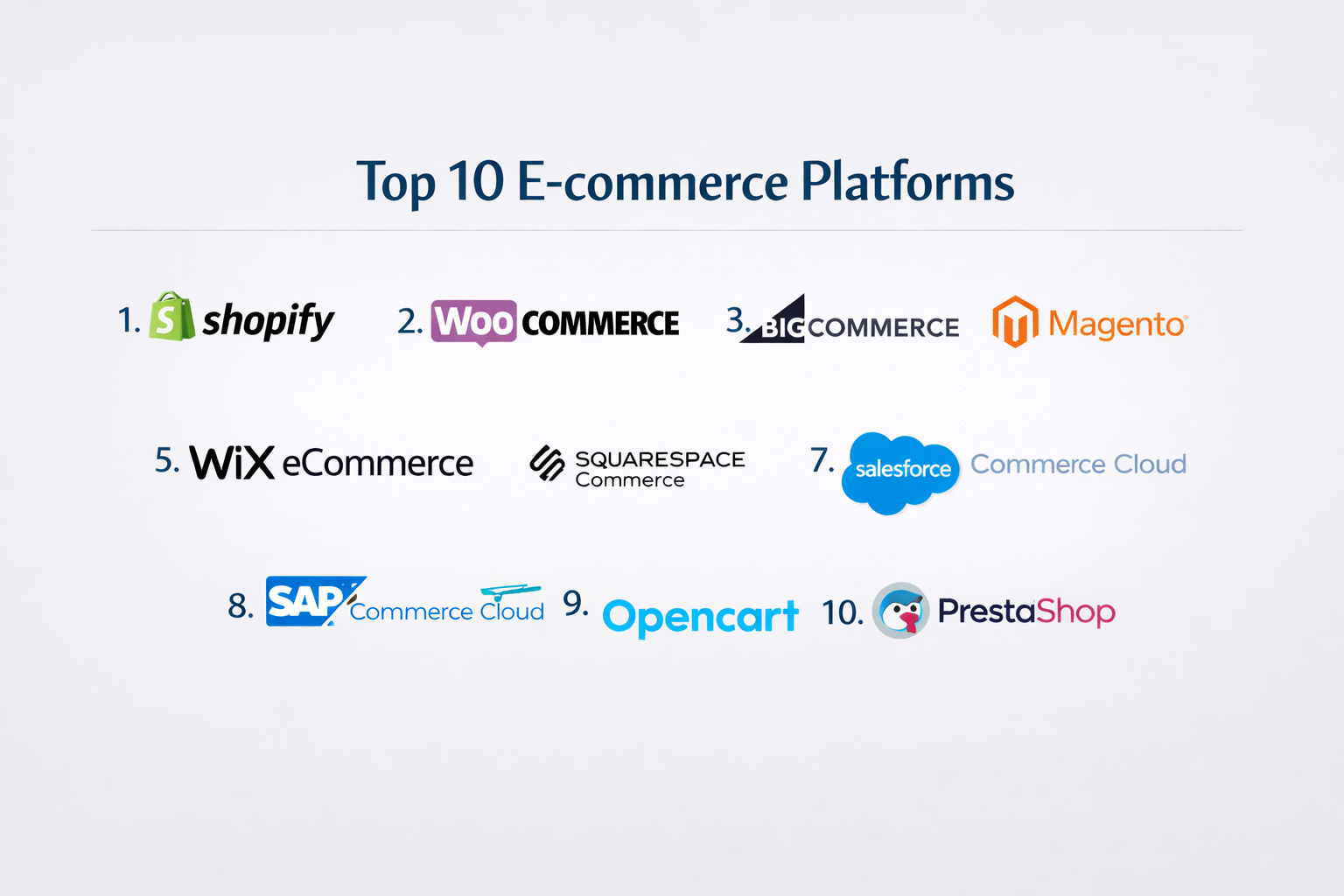
Top 10 E-commerce Platforms
#1 — Shopify
Short description:
Shopify is one of the most widely used e-commerce platforms, designed for ease of use and rapid deployment. It is ideal for SMBs and growing brands that want to launch quickly without deep technical expertise. Shopify provides a complete hosted solution with built-in payment, marketing, and store management tools.
Key Features
- Drag-and-drop store builder
- Built-in payment gateway (Shopify Payments)
- Large app marketplace
- Multi-channel selling (Amazon, Instagram, etc.)
- Inventory and order management
- Mobile commerce support
Pros
- Very easy to use and quick to launch
- Strong ecosystem and app marketplace
Cons
- Transaction fees on some plans
- Limited deep customization without apps
Platforms / Deployment
- Web
- Cloud
Security & Compliance
- SSL encryption, PCI compliance
- MFA, RBAC
- Other certifications: Not publicly stated
Integrations & Ecosystem
Shopify has one of the largest ecosystems in e-commerce.
- Payment gateways
- CRM tools
- Marketing automation platforms
- ERP integrations
- APIs and developer tools
Support & Community
Strong documentation, 24/7 support, and a large developer community.
#2 — WooCommerce
Short description:
WooCommerce is an open-source e-commerce plugin for WordPress. It is highly customizable and ideal for developers or businesses that want full control over their store.
Key Features
- Open-source flexibility
- WordPress integration
- Plugin-based architecture
- Custom themes and extensions
- SEO-friendly structure
Pros
- Highly customizable
- No platform lock-in
Cons
- Requires hosting and maintenance
- Performance depends on setup
Platforms / Deployment
- Web
- Self-hosted
Security & Compliance
- Depends on hosting environment
- Not publicly stated
Integrations & Ecosystem
- WordPress plugins
- Payment gateways
- Marketing tools
- Custom API integrations
Support & Community
Large global community; support varies by provider.
#3 — BigCommerce
Short description:
BigCommerce is a SaaS platform focused on scalability and enterprise-grade features. It supports both SMB and enterprise businesses.
Key Features
- Built-in SEO tools
- Multi-storefront support
- Headless commerce capabilities
- Advanced product management
- No transaction fees
Pros
- Strong built-in features
- Good scalability
Cons
- Learning curve for beginners
- Pricing tiers can increase quickly
Platforms / Deployment
- Web
- Cloud
Security & Compliance
- SSL, PCI compliance
- Not publicly stated beyond standard protections
Integrations & Ecosystem
- ERP systems
- Payment providers
- Marketing tools
- API-first architecture
Support & Community
Good support and enterprise-grade onboarding.
#4 — Magento (Adobe Commerce)
Short description:
Magento is a powerful and flexible platform used by large enterprises. It offers extensive customization and scalability.
Key Features
- Advanced customization
- Multi-store support
- B2B features
- AI-powered recommendations
- Headless architecture
Pros
- Highly scalable
- Enterprise-grade features
Cons
- Requires technical expertise
- High cost for enterprise version
Platforms / Deployment
- Cloud / Self-hosted
Security & Compliance
- RBAC, encryption, audit logs
- Additional certifications: Not publicly stated
Integrations & Ecosystem
- ERP integrations
- CRM tools
- Payment gateways
- Custom APIs
Support & Community
Strong enterprise support; active developer community.
#5 — Wix eCommerce
Short description:
Wix eCommerce is a beginner-friendly platform that combines website building with e-commerce capabilities.
Key Features
- Drag-and-drop builder
- Built-in templates
- Payment integration
- Mobile optimization
Pros
- Easy to use
- Quick setup
Cons
- Limited scalability
- Fewer advanced features
Platforms / Deployment
- Web
- Cloud
Security & Compliance
- SSL encryption
- Not publicly stated
Integrations & Ecosystem
- Basic integrations
- App marketplace
Support & Community
Good support for beginners; smaller community.
#6 — Squarespace Commerce
Short description:
Squarespace is known for design-focused e-commerce stores. It is ideal for creatives and small businesses.
Key Features
- Beautiful templates
- Built-in analytics
- Inventory management
- Subscription support
Pros
- Excellent design capabilities
- Simple setup
Cons
- Limited customization
- Not ideal for large stores
Platforms / Deployment
- Web
- Cloud
Security & Compliance
- SSL encryption
- Not publicly stated
Integrations & Ecosystem
- Payment providers
- Marketing tools
- Limited APIs
Support & Community
Good support; smaller developer ecosystem.
#7 — Salesforce Commerce Cloud
Short description:
A powerful enterprise platform designed for large-scale retail operations and omnichannel commerce.
Key Features
- AI-driven personalization
- Omnichannel capabilities
- Advanced analytics
- Cloud scalability
Pros
- Enterprise-grade performance
- Deep CRM integration
Cons
- Expensive
- Complex implementation
Platforms / Deployment
- Cloud
Security & Compliance
- Advanced enterprise security
- Specific certifications: Not publicly stated
Integrations & Ecosystem
- Salesforce ecosystem
- CRM integrations
- Marketing cloud tools
Support & Community
Strong enterprise support.
#8 — SAP Commerce Cloud
Short description:
SAP Commerce Cloud is designed for large enterprises needing deep integration with ERP systems.
Key Features
- B2B and B2C support
- Advanced product catalog
- ERP integration
- AI recommendations
Pros
- Strong enterprise integration
- Scalable architecture
Cons
- Complex implementation
- High cost
Platforms / Deployment
- Cloud
Security & Compliance
- Enterprise-grade security
- Not publicly stated
Integrations & Ecosystem
- SAP ecosystem
- ERP and CRM integrations
Support & Community
Enterprise support; strong vendor backing.
#9 — OpenCart
Short description:
OpenCart is a lightweight open-source platform suitable for small businesses.
Key Features
- Free core platform
- Extension marketplace
- Multi-store support
Pros
- Cost-effective
- Easy to set up
Cons
- Limited advanced features
- Requires technical setup
Platforms / Deployment
- Web
- Self-hosted
Security & Compliance
- Not publicly stated
Integrations & Ecosystem
- Extensions
- Payment gateways
- APIs
Support & Community
Moderate community support.
#10 — PrestaShop
Short description:
PrestaShop is an open-source platform offering flexibility and a strong plugin ecosystem.
Key Features
- Customizable themes
- Multi-language support
- Marketplace for add-ons
Pros
- Flexible
- Good for international stores
Cons
- Requires technical skills
- Add-ons can increase cost
Platforms / Deployment
- Web
- Self-hosted
Security & Compliance
- Not publicly stated
Integrations & Ecosystem
- Payment providers
- Plugins
- APIs
Support & Community
Active community; support varies.
Comparison Table (Top 10)
| Tool Name | Best For | Platform(s) Supported | Deployment | Standout Feature | Public Rating |
|---|---|---|---|---|---|
| Shopify | SMB & D2C | Web | Cloud | Ease of use | N/A |
| WooCommerce | Developers | Web | Self-hosted | Full customization | N/A |
| BigCommerce | Scaling businesses | Web | Cloud | Built-in features | N/A |
| Magento | Enterprise | Web | Hybrid | Deep customization | N/A |
| Wix eCommerce | Beginners | Web | Cloud | Drag-and-drop builder | N/A |
| Squarespace | Creatives | Web | Cloud | Design templates | N/A |
| Salesforce Commerce Cloud | Enterprise | Web | Cloud | AI personalization | N/A |
| SAP Commerce Cloud | Enterprise | Web | Cloud | ERP integration | N/A |
| OpenCart | Small businesses | Web | Self-hosted | Lightweight | N/A |
| PrestaShop | Global SMB | Web | Self-hosted | Multi-language support | N/A |
Evaluation & Scoring of E-commerce Platforms
| Tool Name | Core (25%) | Ease (15%) | Integrations (15%) | Security (10%) | Performance (10%) | Support (10%) | Value (15%) | Weighted Total |
|---|---|---|---|---|---|---|---|---|
| Shopify | 9 | 9 | 9 | 8 | 9 | 9 | 8 | 8.8 |
| WooCommerce | 8 | 6 | 9 | 7 | 7 | 7 | 9 | 7.7 |
| BigCommerce | 9 | 7 | 9 | 8 | 9 | 8 | 8 | 8.5 |
| Magento | 10 | 6 | 10 | 9 | 9 | 8 | 7 | 8.6 |
| Wix eCommerce | 7 | 9 | 6 | 7 | 7 | 8 | 8 | 7.5 |
| Squarespace | 7 | 9 | 6 | 7 | 7 | 8 | 8 | 7.5 |
| Salesforce Commerce Cloud | 10 | 6 | 10 | 9 | 10 | 9 | 6 | 8.7 |
| SAP Commerce Cloud | 10 | 5 | 10 | 9 | 10 | 9 | 6 | 8.6 |
| OpenCart | 6 | 7 | 7 | 6 | 7 | 6 | 9 | 7.0 |
| PrestaShop | 7 | 6 | 8 | 7 | 7 | 7 | 8 | 7.3 |
How to interpret scores:
These scores are comparative and relative within this category. A higher score does not mean universally better—it indicates stronger performance across weighted criteria. Enterprise tools score high on features and scalability, while SMB tools excel in ease and value.
Which E-commerce Platforms
Solo / Freelancer
Choose Shopify, Wix, or Squarespace for simplicity and fast setup.
SMB
Shopify, BigCommerce, or WooCommerce offer the best balance of cost and features.
Mid-Market
BigCommerce and Magento provide scalability and customization.
Enterprise
Salesforce Commerce Cloud and SAP Commerce Cloud are ideal for large-scale operations.
Budget vs Premium
- Budget: OpenCart, WooCommerce
- Premium: Salesforce, SAP, Magento
Feature Depth vs Ease of Use
- Easy: Shopify, Wix
- Deep features: Magento, SAP
Integrations & Scalability
- Strong integrations: Salesforce, SAP, BigCommerce
- Moderate: Shopify
Security & Compliance Needs
- Enterprise-grade: Salesforce, SAP
- Standard: Shopify, BigCommerce
Frequently Asked Questions (FAQs)
1. What is the typical pricing model for e-commerce platforms?
Most platforms use subscription-based pricing with additional transaction fees. Open-source platforms may have no licensing cost but require hosting and maintenance.
2. How long does it take to launch an online store?
It can take a few hours with SaaS platforms or several months for enterprise implementations.
3. Are e-commerce platforms secure?
Most modern platforms include encryption and compliance features, but security depends on configuration and hosting.
4. Can I migrate from one platform to another?
Yes, but it requires careful data migration, testing, and downtime planning.
5. What are common mistakes when choosing a platform?
Ignoring scalability, integrations, and long-term costs.
6. Do I need coding skills?
Not always. Platforms like Shopify and Wix require minimal technical knowledge.
7. How do platforms handle payments?
They integrate with payment gateways or provide built-in solutions.
8. Can I sell internationally?
Yes, most platforms support multi-currency and localization.
9. What integrations are important?
CRM, ERP, payment gateways, logistics, and marketing tools.
10. What alternatives exist to e-commerce platforms?
Marketplaces like Amazon or social commerce channels.
Conclusion
Choosing the right e-commerce platform is not about finding the “best” solution—it’s about finding the right fit for your business model, scale, and technical capability. SMBs often benefit from ease-of-use platforms like Shopify or Wix, while enterprises require scalable, customizable solutions like Magento, Salesforce, or SAP Commerce Cloud. Open-source platforms like WooCommerce and PrestaShop provide flexibility but demand technical expertise.
