Introduction
Shopping cart software is a core component of any e-commerce system that enables customers to select products, manage orders, and complete purchases securely. It handles key processes such as product selection, checkout, payment processing, and order confirmation. In simple terms, it is the engine that converts browsing into buying.
As digital commerce continues to evolve, modern shopping cart solutions are no longer just checkout tools—they are intelligent systems optimized for conversion, personalization, and seamless user experience. With increasing competition, businesses must deliver fast, secure, and frictionless checkout experiences to reduce cart abandonment and maximize revenue.
Real-world use cases include:
- Enabling checkout for online retail stores
- Managing subscriptions and recurring billing
- Integrating with mobile and social commerce platforms
- Supporting global transactions with multi-currency support
- Providing secure and compliant payment workflows
What buyers should evaluate:
- Checkout experience and conversion optimization
- Payment gateway flexibility
- Security and compliance features
- Integration with e-commerce platforms
- Mobile responsiveness
- Scalability under high traffic
- Customization and branding
- Pricing and transaction fees
- Speed and performance
Best for: E-commerce businesses, online retailers, SaaS subscription companies, marketplaces, and digital product sellers.
Not ideal for: Businesses that do not process online transactions or only require simple catalog browsing without checkout functionality.
Key Trends in Shopping Cart Software
- One-click checkout and express payment options
- AI-driven cart recovery and abandonment reduction
- Embedded checkout within apps and social platforms
- Headless checkout APIs for custom frontends
- Subscription billing and recurring payments
- Fraud detection and real-time risk analysis
- Mobile-first checkout optimization
- Localization (currency, tax, language)
- Integration with digital wallets and BNPL (Buy Now Pay Later)
- Serverless and API-first architectures
How We Selected These Tools (Methodology)
- Considered market adoption and brand recognition
- Evaluated checkout performance and reliability
- Assessed security features and compliance readiness
- Analyzed integration capabilities with e-commerce systems
- Compared ease of implementation and developer support
- Reviewed scalability for high-traffic environments
- Examined pricing models and value for money
- Looked at user experience and conversion optimization features
- Balanced tools across SMB, mid-market, and enterprise needs
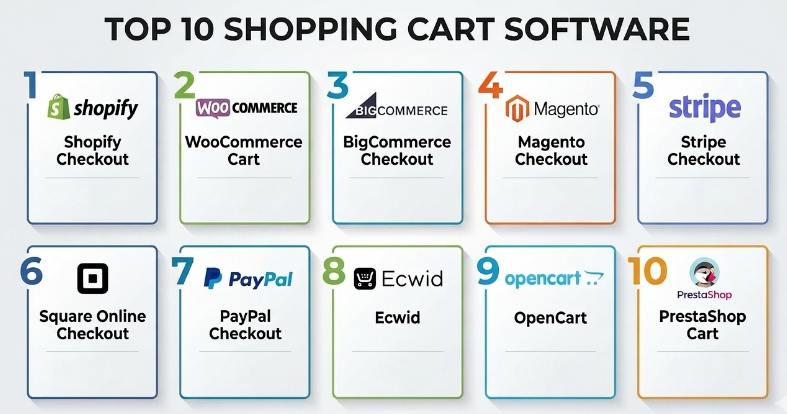
Top 10 Shopping Cart Software
#1 — Shopify Checkout
Short description:
Shopify Checkout is a fully integrated checkout system designed for high conversion and ease of use. It is optimized for speed, security, and mobile performance, making it ideal for SMBs and scaling businesses.
Key Features
- One-click checkout (Shop Pay)
- Multi-currency support
- Mobile-optimized checkout
- Fraud analysis tools
- Built-in payment gateway
- Customizable checkout flow
Pros
- High conversion rates
- Easy setup and integration
Cons
- Limited customization on lower plans
- Transaction fees may apply
Platforms / Deployment
- Web
- Cloud
Security & Compliance
- PCI compliance, encryption
- MFA, fraud detection
Integrations & Ecosystem
Shopify Checkout integrates seamlessly within the Shopify ecosystem and beyond.
- Payment gateways
- CRM tools
- Marketing platforms
- API support
Support & Community
Strong support with extensive documentation and global community.
#2 — WooCommerce Cart
Short description:
WooCommerce Cart is a flexible, open-source solution for WordPress users, offering complete control over checkout customization.
Key Features
- Open-source flexibility
- Custom checkout pages
- Plugin ecosystem
- Payment gateway integration
- Subscription support
Pros
- Fully customizable
- No platform lock-in
Cons
- Requires maintenance
- Performance depends on hosting
Platforms / Deployment
- Web
- Self-hosted
Security & Compliance
- Depends on hosting
- Not publicly stated
Integrations & Ecosystem
- WordPress plugins
- Payment gateways
- Custom APIs
Support & Community
Large community; support varies by provider.
#3 — BigCommerce Checkout
Short description:
BigCommerce offers a scalable checkout system with built-in features for growing businesses.
Key Features
- Optimized checkout flow
- Multi-storefront support
- Built-in payment integrations
- Custom checkout APIs
Pros
- No transaction fees
- Scalable architecture
Cons
- Learning curve
- Limited design flexibility
Platforms / Deployment
- Web
- Cloud
Security & Compliance
- PCI compliance
- Encryption
Integrations & Ecosystem
- Payment providers
- ERP systems
- APIs
Support & Community
Strong support and enterprise capabilities.
#4 — Magento Checkout (Adobe Commerce)
Short description:
Magento provides a highly customizable checkout system suited for large enterprises.
Key Features
- Custom checkout workflows
- Multi-store support
- B2B checkout features
- AI personalization
Pros
- Highly flexible
- Enterprise-grade
Cons
- Complex setup
- High cost
Platforms / Deployment
- Cloud / Self-hosted
Security & Compliance
- RBAC, encryption
- Not publicly stated
Integrations & Ecosystem
- ERP, CRM integrations
- Custom APIs
Support & Community
Enterprise-level support; active developer base.
#5 — Stripe Checkout
Short description:
Stripe Checkout is a developer-friendly, hosted checkout solution known for simplicity and global payment support.
Key Features
- Prebuilt checkout pages
- Subscription billing
- Global payments
- Fraud detection
Pros
- Easy integration
- Strong developer tools
Cons
- Limited UI customization
- Requires coding knowledge
Platforms / Deployment
- Web
- Cloud
Security & Compliance
- PCI compliance, encryption
- Fraud protection
Integrations & Ecosystem
- Payment APIs
- SaaS integrations
- Webhooks
Support & Community
Excellent developer documentation.
#6 — Square Online Checkout
Short description:
Square provides a simple checkout system integrated with POS systems, ideal for small retailers.
Key Features
- POS integration
- Online checkout links
- Mobile payments
- Inventory sync
Pros
- Easy for offline-to-online transition
- Unified system
Cons
- Limited customization
- Not ideal for large enterprises
Platforms / Deployment
- Web
- Cloud
Security & Compliance
- Encryption, PCI compliance
Integrations & Ecosystem
- POS systems
- Payment processing
- APIs
Support & Community
Good support for SMBs.
#7 — PayPal Checkout
Short description:
PayPal Checkout is widely used for its trusted payment experience and global reach.
Key Features
- Express checkout
- Digital wallet support
- Global payments
- Buyer protection
Pros
- Trusted brand
- Easy integration
Cons
- Transaction fees
- Limited customization
Platforms / Deployment
- Web
- Cloud
Security & Compliance
- Encryption, fraud detection
Integrations & Ecosystem
- Payment integrations
- APIs
Support & Community
Widely supported globally.
#8 — Ecwid
Short description:
Ecwid is a lightweight shopping cart solution that can be embedded into existing websites.
Key Features
- Embedded checkout
- Multi-channel selling
- Mobile-friendly
- Easy setup
Pros
- Quick integration
- Affordable
Cons
- Limited advanced features
- Not ideal for large stores
Platforms / Deployment
- Web
- Cloud
Security & Compliance
- SSL encryption
- Not publicly stated
Integrations & Ecosystem
- CMS platforms
- Payment gateways
Support & Community
Good support for SMB users.
#9 — OpenCart
Short description:
OpenCart offers a simple shopping cart system with open-source flexibility.
Key Features
- Lightweight platform
- Extension marketplace
- Multi-store support
Pros
- Cost-effective
- Easy to customize
Cons
- Limited advanced features
- Requires technical setup
Platforms / Deployment
- Web
- Self-hosted
Security & Compliance
- Not publicly stated
Integrations & Ecosystem
- Extensions
- Payment gateways
Support & Community
Moderate community support.
#10 — PrestaShop Cart
Short description:
PrestaShop provides a customizable shopping cart with strong international capabilities.
Key Features
- Multi-language support
- Custom themes
- Plugin marketplace
Pros
- Flexible
- Good for global stores
Cons
- Requires technical skills
- Add-on costs
Platforms / Deployment
- Web
- Self-hosted
Security & Compliance
- Not publicly stated
Integrations & Ecosystem
- Payment providers
- APIs
Support & Community
Active community.
Comparison Table (Top 10)
| Tool Name | Best For | Platform(s) Supported | Deployment | Standout Feature | Public Rating |
|---|---|---|---|---|---|
| Shopify Checkout | SMB | Web | Cloud | One-click checkout | N/A |
| WooCommerce Cart | Developers | Web | Self-hosted | Full customization | N/A |
| BigCommerce Checkout | Growing businesses | Web | Cloud | No transaction fees | N/A |
| Magento Checkout | Enterprise | Web | Hybrid | Custom workflows | N/A |
| Stripe Checkout | Developers | Web | Cloud | Payment APIs | N/A |
| Square Online Checkout | Retail SMB | Web | Cloud | POS integration | N/A |
| PayPal Checkout | Global sellers | Web | Cloud | Trusted payments | N/A |
| Ecwid | Small stores | Web | Cloud | Embedded checkout | N/A |
| OpenCart | Budget users | Web | Self-hosted | Lightweight | N/A |
| PrestaShop Cart | International SMB | Web | Self-hosted | Multi-language | N/A |
Evaluation & Scoring of Shopping Cart Software
| Tool Name | Core (25%) | Ease (15%) | Integrations (15%) | Security (10%) | Performance (10%) | Support (10%) | Value (15%) | Weighted Total |
|---|---|---|---|---|---|---|---|---|
| Shopify Checkout | 9 | 9 | 9 | 8 | 9 | 9 | 8 | 8.8 |
| WooCommerce Cart | 8 | 6 | 9 | 7 | 7 | 7 | 9 | 7.7 |
| BigCommerce Checkout | 9 | 7 | 9 | 8 | 9 | 8 | 8 | 8.5 |
| Magento Checkout | 10 | 6 | 10 | 9 | 9 | 8 | 7 | 8.6 |
| Stripe Checkout | 9 | 7 | 10 | 9 | 9 | 9 | 8 | 8.8 |
| Square Online Checkout | 8 | 8 | 8 | 8 | 8 | 8 | 8 | 8.0 |
| PayPal Checkout | 8 | 9 | 8 | 9 | 8 | 8 | 7 | 8.1 |
| Ecwid | 7 | 9 | 7 | 7 | 7 | 8 | 8 | 7.6 |
| OpenCart | 6 | 7 | 7 | 6 | 7 | 6 | 9 | 7.0 |
| PrestaShop Cart | 7 | 6 | 8 | 7 | 7 | 7 | 8 | 7.3 |
Score interpretation:
These scores are relative comparisons within the category. Tools scoring higher typically offer better balance across features, integrations, and performance. However, the “best” choice depends on your business needs, technical capability, and growth plans.
Which Shopping Cart Software
Solo / Freelancer
Shopify Checkout, Ecwid, and PayPal are best for quick setup and minimal complexity.
SMB
Shopify, BigCommerce, and Square provide balanced functionality and scalability.
Mid-Market
BigCommerce, Stripe, and WooCommerce offer flexibility and integrations.
Enterprise
Magento, Salesforce integrations, and Stripe are ideal for complex environments.
Budget vs Premium
- Budget: OpenCart, WooCommerce
- Premium: Magento, Stripe
Feature Depth vs Ease of Use
- Easy: Shopify, PayPal
- Advanced: Magento, Stripe
Integrations & Scalability
- Strong: Stripe, BigCommerce
- Moderate: Shopify
Security & Compliance Needs
- High: Stripe, PayPal
- Standard: Shopify
Frequently Asked Questions (FAQs)
1. What is shopping cart software?
It is a system that allows customers to select products and complete purchases online securely.
2. How does it differ from e-commerce platforms?
Shopping cart software focuses on checkout, while e-commerce platforms manage the entire store.
3. Is shopping cart software secure?
Most modern tools include encryption and compliance features, but setup matters.
4. Can I customize checkout?
Yes, depending on the platform—open-source tools offer more flexibility.
5. What payment options are supported?
Most support credit cards, wallets, and digital payment systems.
6. Do I need coding skills?
Not always—many tools offer no-code solutions.
7. Can I integrate with other tools?
Yes, most support CRM, ERP, and marketing integrations.
8. What is cart abandonment?
It occurs when customers leave before completing checkout.
9. How can I reduce cart abandonment?
Use fast checkout, fewer steps, and multiple payment options.
10. Can I scale with these tools?
Yes, most tools support scaling with business growth.
Conclusion
Shopping cart software plays a critical role in converting visitors into customers. While tools like Shopify Checkout and Stripe focus on ease and performance, platforms like Magento and WooCommerce provide deeper customization and flexibility. SMBs often benefit from simple, ready-to-use solutions, whereas enterprises require scalable, secure, and highly customizable systems.
