Introduction
Shipping Rate Management Tools are specialized platforms that help businesses calculate, compare, optimize, and automate shipping costs across multiple carriers. In simple terms, these tools ensure that you always select the best shipping option—balancing speed, cost, and reliability—without manual effort.
As logistics complexity increases in modern commerce, especially with cross-border trade, same-day delivery expectations, and fluctuating fuel surcharges, managing shipping rates manually is no longer practical. In the 2026+ landscape, businesses are leveraging automation, AI-based rate optimization, and real-time carrier integrations to stay competitive.
Real-world use cases:
- E-commerce brands optimizing checkout shipping rates in real time
- Logistics teams comparing multi-carrier pricing for bulk shipments
- Manufacturers reducing freight costs across global supply chains
- Retailers managing regional vs international delivery pricing
- 3PL providers offering dynamic shipping solutions to clients
What buyers should evaluate:
- Multi-carrier support and rate comparison
- Real-time pricing accuracy and updates
- Automation and rule-based rate selection
- Integration with e-commerce, ERP, and WMS systems
- Scalability for high shipment volumes
- Cost optimization and analytics capabilities
- International shipping and compliance features
- API availability and customization options
- Security and data protection features
Best for: E-commerce companies, logistics providers, supply chain teams, operations managers, and enterprises dealing with high-volume shipping.
Not ideal for: Very small businesses with minimal shipping needs or companies using a single carrier with fixed pricing, where simpler solutions may suffice.
Key Trends in Shipping Rate Management Tools
- AI-driven rate optimization: Predictive algorithms suggest the best carrier based on cost, delivery time, and historical performance
- Real-time pricing engines: Instant rate calculation during checkout or dispatch planning
- Multi-carrier orchestration: Seamless switching between carriers based on dynamic conditions
- API-first architecture: Developer-friendly platforms enabling deep customization
- Embedded logistics platforms: Shipping tools becoming part of broader supply chain ecosystems
- Automation workflows: Rule-based automation for carrier selection, packaging, and pricing
- Cross-border compliance support: Built-in duties, taxes, and documentation handling
- Cloud-native deployments: Scalable SaaS models replacing legacy systems
- Analytics and cost intelligence: Advanced dashboards for shipping cost insights
- Integration with AI logistics assistants: Conversational and automated logistics decision-making
How We Selected These Tools (Methodology)
- Evaluated market adoption and industry reputation
- Assessed feature completeness, including rate calculation, automation, and reporting
- Reviewed performance and reliability signals in high-volume environments
- Considered security posture and compliance readiness
- Analyzed integration capabilities with e-commerce, ERP, and logistics systems
- Balanced tools across SMB, mid-market, and enterprise segments
- Examined developer ecosystem and API capabilities
- Evaluated ease of use vs customization depth
- Considered global shipping support and scalability
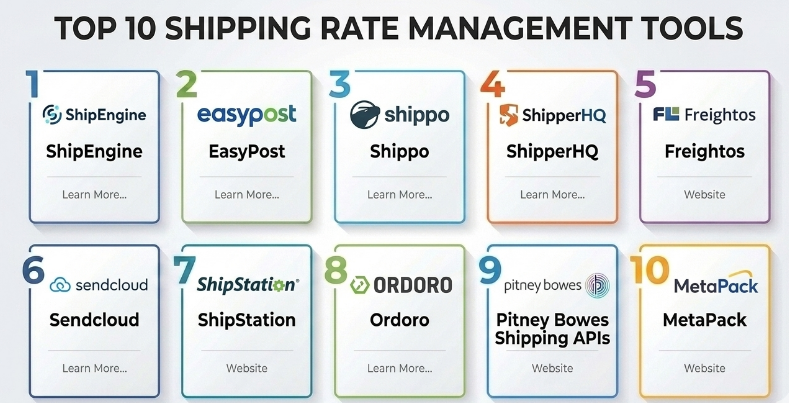
Top 10 Shipping Rate Management Tools
#1 — ShipEngine
Short description (5-6 lines):
ShipEngine is a developer-first shipping API platform designed for businesses that need deep customization and automation. It provides access to multiple carriers and enables real-time rate calculations, label generation, and shipment tracking. Ideal for tech-driven companies, it integrates seamlessly into custom applications and workflows. It is widely used by SaaS platforms and logistics startups.
Key Features
- Multi-carrier rate comparison
- Real-time shipping rate APIs
- Label generation and tracking
- Address validation
- Webhook-based automation
- International shipping support
Pros
- Highly flexible API-first design
- Strong developer ecosystem
Cons
- Requires technical expertise
- Not beginner-friendly UI
Platforms / Deployment
Web / Cloud
Security & Compliance
Encryption, API authentication; other details not publicly stated
Integrations & Ecosystem
Integrates with e-commerce platforms, ERPs, and custom apps.
- REST APIs
- Carrier APIs
- Webhooks
- SDK support
Support & Community
Strong documentation and developer support; enterprise support tiers available
#2 — EasyPost
Short description (5-6 lines):
EasyPost is a cloud-based shipping API solution that simplifies rate management across carriers. It is designed for businesses looking to integrate shipping into applications quickly. EasyPost focuses on reliability and scalability, making it suitable for high-volume shipping environments.
Key Features
- Multi-carrier rate APIs
- Address verification
- Shipment tracking
- Batch processing
- Insurance support
Pros
- Easy integration
- Scalable for large volumes
Cons
- Limited UI features
- Pricing transparency varies
Platforms / Deployment
Cloud
Security & Compliance
Not publicly stated
Integrations & Ecosystem
Works with major carriers and platforms.
- APIs
- Webhooks
- Developer SDKs
Support & Community
Good developer documentation; support tiers vary
#3 — Shippo
Short description (5-6 lines):
Shippo is a popular shipping platform focused on SMBs and e-commerce businesses. It provides discounted shipping rates and easy integration with online stores. Shippo simplifies rate comparison and label generation without requiring deep technical knowledge.
Key Features
- Carrier rate comparison
- Discounted shipping rates
- Label printing
- Tracking dashboard
- Returns management
Pros
- Easy to use
- Affordable for SMBs
Cons
- Limited advanced customization
- Fewer enterprise features
Platforms / Deployment
Web / Cloud
Security & Compliance
Not publicly stated
Integrations & Ecosystem
Integrates with e-commerce platforms.
- Shopify
- WooCommerce
- APIs
Support & Community
Strong SMB support and onboarding resources
#4 — ShipperHQ
Short description (5-6 lines):
ShipperHQ specializes in advanced checkout shipping rate optimization. It enables businesses to create custom shipping rules and pricing strategies. It is widely used by e-commerce brands needing precise control over shipping rates.
Key Features
- Advanced rate rules
- Multi-origin shipping
- Carrier integrations
- Real-time checkout rates
- Delivery date estimation
Pros
- Highly customizable
- Strong checkout optimization
Cons
- Complex setup
- Pricing varies
Platforms / Deployment
Cloud
Security & Compliance
Not publicly stated
Integrations & Ecosystem
- Magento
- Shopify
- APIs
Support & Community
Good documentation and enterprise support
#5 — Freightos
Short description (5-6 lines):
Freightos focuses on freight shipping rate management, particularly for international logistics. It provides real-time freight quotes and marketplace-based pricing, making it ideal for global supply chains.
Key Features
- Freight rate comparison
- Global carrier marketplace
- Real-time quotes
- Shipment booking
- Analytics
Pros
- Strong global coverage
- Transparent pricing
Cons
- Focused on freight only
- Complex for small businesses
Platforms / Deployment
Web / Cloud
Security & Compliance
Not publicly stated
Integrations & Ecosystem
- Freight APIs
- Carrier integrations
Support & Community
Enterprise-focused support
#6 — Sendcloud
Short description (5-6 lines):
Sendcloud is a shipping automation platform designed for e-commerce businesses in Europe and globally. It simplifies multi-carrier shipping and rate management with automation workflows.
Key Features
- Multi-carrier shipping
- Automated workflows
- Branded tracking
- Returns management
- Analytics dashboard
Pros
- Easy automation
- Strong e-commerce focus
Cons
- Regional limitations
- Advanced features cost more
Platforms / Deployment
Cloud
Security & Compliance
Not publicly stated
Integrations & Ecosystem
- Shopify
- Magento
- APIs
Support & Community
Strong onboarding and support
#7 — ShipStation
Short description (5-6 lines):
ShipStation is a widely used shipping platform that includes rate comparison and automation features. It is ideal for growing e-commerce businesses needing efficient order fulfillment.
Key Features
- Multi-carrier rate comparison
- Automation rules
- Order management
- Batch processing
- Reporting
Pros
- User-friendly interface
- Strong integrations
Cons
- Limited customization
- Pricing tiers vary
Platforms / Deployment
Web / Cloud
Security & Compliance
Not publicly stated
Integrations & Ecosystem
- Shopify
- Amazon
- APIs
Support & Community
Strong community and support
#8 — Ordoro
Short description (5-6 lines):
Ordoro combines shipping rate management with inventory and order management. It is ideal for SMBs looking for an all-in-one logistics solution.
Key Features
- Shipping rate comparison
- Inventory management
- Automation workflows
- Dropshipping support
- Reporting
Pros
- All-in-one platform
- Easy to use
Cons
- Limited enterprise features
- Scaling limitations
Platforms / Deployment
Cloud
Security & Compliance
Not publicly stated
Integrations & Ecosystem
- E-commerce platforms
- APIs
Support & Community
Good SMB support
#9 — Pitney Bowes Shipping APIs
Short description (5-6 lines):
Pitney Bowes offers enterprise-grade shipping APIs with advanced rate calculation and logistics capabilities. It is suitable for large organizations with complex shipping needs.
Key Features
- Carrier rate APIs
- Address validation
- Cross-border shipping
- Compliance support
- Analytics
Pros
- Enterprise-grade
- Strong global capabilities
Cons
- Complex implementation
- Higher cost
Platforms / Deployment
Cloud
Security & Compliance
Not publicly stated
Integrations & Ecosystem
- APIs
- Enterprise systems
Support & Community
Enterprise-level support
#10 — MetaPack
Short description (5-6 lines):
MetaPack is an enterprise delivery management platform with strong shipping rate optimization features. It is used by large retailers to manage global shipping strategies.
Key Features
- Delivery management
- Rate optimization
- Carrier selection
- Customer experience tools
- Analytics
Pros
- Enterprise scalability
- Advanced optimization
Cons
- Expensive
- Complex setup
Platforms / Deployment
Cloud
Security & Compliance
Not publicly stated
Integrations & Ecosystem
- Retail systems
- APIs
Support & Community
Enterprise support model
Comparison Table (Top 10)
| Tool Name | Best For | Platform(s) Supported | Deployment | Standout Feature | Public Rating |
|---|---|---|---|---|---|
| ShipEngine | Developers | Web | Cloud | API-first shipping | N/A |
| EasyPost | High-volume APIs | Web | Cloud | Scalable API | N/A |
| Shippo | SMB e-commerce | Web | Cloud | Discounted rates | N/A |
| ShipperHQ | Checkout optimization | Web | Cloud | Custom rate rules | N/A |
| Freightos | Global freight | Web | Cloud | Freight marketplace | N/A |
| Sendcloud | E-commerce automation | Web | Cloud | Workflow automation | N/A |
| ShipStation | Order fulfillment | Web | Cloud | Automation rules | N/A |
| Ordoro | SMB logistics | Web | Cloud | Inventory + shipping | N/A |
| Pitney Bowes APIs | Enterprise logistics | Web | Cloud | Global shipping APIs | N/A |
| MetaPack | Large retailers | Web | Cloud | Delivery optimization | N/A |
Evaluation & Scoring of Shipping Rate Management Tools
| Tool Name | Core (25%) | Ease (15%) | Integrations (15%) | Security (10%) | Performance (10%) | Support (10%) | Value (15%) | Weighted Total |
|---|---|---|---|---|---|---|---|---|
| ShipEngine | 9 | 7 | 9 | 7 | 9 | 8 | 8 | 8.4 |
| EasyPost | 9 | 8 | 9 | 7 | 9 | 8 | 8 | 8.5 |
| Shippo | 8 | 9 | 8 | 6 | 8 | 8 | 9 | 8.3 |
| ShipperHQ | 9 | 7 | 8 | 6 | 8 | 7 | 7 | 7.8 |
| Freightos | 9 | 7 | 7 | 6 | 8 | 7 | 7 | 7.7 |
| Sendcloud | 8 | 9 | 8 | 6 | 8 | 8 | 8 | 8.2 |
| ShipStation | 8 | 9 | 9 | 6 | 8 | 8 | 8 | 8.3 |
| Ordoro | 7 | 9 | 7 | 6 | 7 | 7 | 8 | 7.6 |
| Pitney Bowes APIs | 9 | 6 | 9 | 7 | 9 | 8 | 7 | 8.1 |
| MetaPack | 9 | 6 | 8 | 7 | 9 | 8 | 7 | 8.2 |
How to interpret scores:
- Scores are comparative, not absolute
- Focus on categories most relevant to your needs
- Higher “Core” = feature richness
- Higher “Ease” = faster adoption
- “Value” reflects cost vs capabilities
Which Shipping Rate Management Tools
Solo / Freelancer
Tools like Shippo or Sendcloud are ideal due to ease of use and affordability.
SMB
ShipStation, Ordoro, and Sendcloud offer strong balance of features and simplicity.
Mid-Market
ShipperHQ and EasyPost provide customization and scalability.
Enterprise
MetaPack, Pitney Bowes, and Freightos are better suited for complex operations.
Budget vs Premium
Budget users should consider Shippo; premium users should explore MetaPack.
Feature Depth vs Ease of Use
APIs like ShipEngine offer depth; ShipStation offers simplicity.
Integrations & Scalability
Choose API-first platforms for long-term scalability.
Security & Compliance Needs
Enterprise tools provide better compliance and governance features.
Frequently Asked Questions (FAQs)
1. What is a Shipping Rate Management Tool?
It helps businesses compare and optimize shipping costs across carriers in real time.
2. How do these tools calculate rates?
They use APIs to fetch live carrier pricing and apply rules or algorithms.
3. Are these tools expensive?
Pricing varies; SMB tools are affordable, enterprise tools are premium.
4. Can they integrate with e-commerce platforms?
Yes, most tools integrate with major platforms and APIs.
5. Do they support international shipping?
Yes, many include global carrier support and compliance features.
6. How long does implementation take?
From a few hours (SMB tools) to weeks (enterprise solutions).
7. Are these tools secure?
Most provide encryption and authentication; details vary.
8. Can I switch tools easily?
Depends on integrations and data migration complexity.
9. What are common mistakes?
Choosing tools without considering scalability or integrations.
10. Are there alternatives?
Manual rate management or single-carrier solutions exist but are less efficient.
Conclusion
Shipping Rate Management Tools have become essential for modern businesses navigating complex logistics environments. From small e-commerce startups to global enterprises, the ability to dynamically compare and optimize shipping rates can directly impact profitability, customer satisfaction, and operational efficiency. While tools like Shippo and Sendcloud offer simplicity and affordability, platforms like ShipEngine and EasyPost provide powerful customization for tech-driven teams, and enterprise solutions like MetaPack deliver deep optimization at scale.
