Introduction
Cap Table Management Tools are software platforms designed to help startups, investors, and companies manage ownership structures, equity distribution, and shareholder records. Instead of relying on spreadsheets, these tools provide a structured and secure way to track shares, options, dilution, and fundraising events.
In today’s startup ecosystem, managing equity has become increasingly complex. With multiple funding rounds, ESOP allocations, and investor reporting requirements, manual tracking is error-prone and risky. Modern cap table tools simplify compliance, improve transparency, and enable better decision-making for founders and finance teams.
Real-world use cases include:
- Managing founder, investor, and employee equity
- Tracking dilution across funding rounds
- Running scenario modeling for fundraising
- Managing ESOPs and vesting schedules
- Generating reports for investors and audits
What buyers should evaluate:
- Ease of use for founders and finance teams
- Scenario modeling and forecasting capabilities
- ESOP and vesting management
- Compliance and reporting features
- Integration with accounting and legal tools
- Security and access control
- Scalability for future funding rounds
- Customer support and onboarding
- Pricing structure and transparency
Best for: Startups, venture-backed companies, angel investors, CFOs, and legal/finance teams managing equity.
Not ideal for: Very small businesses with no external investors or simple ownership structures; spreadsheets may suffice initially.
Key Trends in Cap Table Management Tools
- AI-driven scenario modeling for fundraising outcomes
- Increased focus on compliance and regulatory reporting
- Integration with HR, payroll, and accounting systems
- Real-time equity dashboards for founders and investors
- Automation of ESOP management and vesting schedules
- Cloud-first platforms with secure data handling
- Investor communication and reporting modules
- Support for global equity regulations
- Role-based access and audit trails
- Subscription pricing with modular add-ons
How We Selected These Tools (Methodology)
- Evaluated market adoption among startups and investors
- Assessed feature depth across equity management workflows
- Considered reliability and performance indicators
- Reviewed security capabilities and compliance features
- Analyzed integrations with financial and legal systems
- Evaluated ease of use for non-technical users
- Considered scalability from seed to IPO stages
- Reviewed support quality and onboarding experience
- Balanced selection across startups, SMBs, and enterprise-grade tools
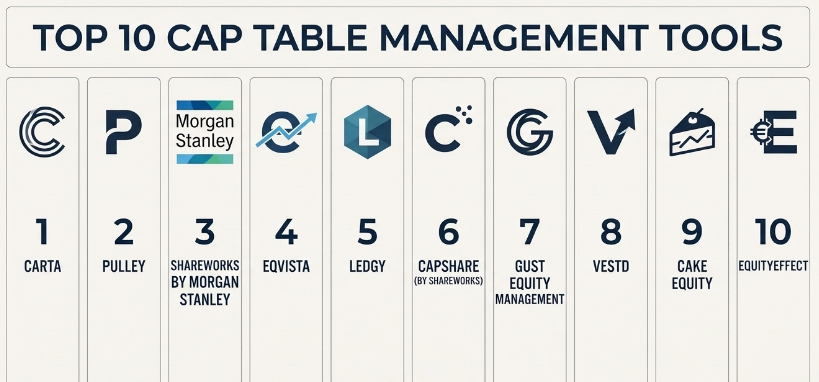
Top 10 Cap Table Management Tools
#1 — Carta
Short description (5-6 lines):
Carta is one of the most widely used cap table management platforms, especially among venture-backed startups. It offers a comprehensive suite for equity management, valuations, and investor relations. The platform is designed to scale from early-stage startups to public companies, making it a strong choice for high-growth organizations.
Key Features
- Cap table tracking and ownership visualization
- ESOP and vesting management
- Scenario modeling for fundraising
- 409A valuation support
- Investor reporting tools
- Equity issuance workflows
Pros
- Industry standard for startups
- Comprehensive feature set
Cons
- Premium pricing
- Can be complex for small teams
Platforms / Deployment
Web
Cloud
Security & Compliance
SSO, MFA, encryption, audit logs
Not publicly stated
Integrations & Ecosystem
Integrates with financial and HR systems for end-to-end equity management.
- Accounting tools
- HR platforms
- API access
- Investor reporting tools
Support & Community
Strong onboarding and enterprise support; widely used community.
#2 — Pulley
Short description (5-6 lines):
Pulley is a modern cap table tool designed for startups and growth companies. It focuses on ease of use while providing advanced features like scenario modeling and compliance support. It is gaining popularity among early-stage founders.
Key Features
- Cap table management
- Scenario modeling
- ESOP management
- Compliance reporting
- Waterfall analysis
Pros
- Clean and intuitive UI
- Strong modeling capabilities
Cons
- Limited enterprise features
- Smaller ecosystem
Platforms / Deployment
Web
Cloud
Security & Compliance
Encryption, RBAC
Not publicly stated
Integrations & Ecosystem
Supports integrations with financial tools.
- API access
- Accounting integrations
Support & Community
Responsive support; growing community.
#3 — Shareworks by Morgan Stanley
Short description (5-6 lines):
Shareworks is an enterprise-grade equity management solution widely used by global organizations. It provides advanced features for equity plans, compliance, and reporting, making it suitable for large companies.
Key Features
- Equity plan management
- Global compliance support
- Reporting and analytics
- Employee equity tracking
- Tax reporting
Pros
- Strong enterprise capabilities
- Global compliance features
Cons
- Complex implementation
- Higher cost
Platforms / Deployment
Web / Mobile
Cloud
Security & Compliance
SSO, encryption, audit logs
Not publicly stated
Integrations & Ecosystem
Enterprise integrations with HR and finance systems.
- Payroll systems
- HR tools
- API support
Support & Community
Enterprise support with onboarding programs.
#4 — Eqvista
Short description (5-6 lines):
Eqvista is a cost-effective cap table management platform designed for startups and small businesses. It offers essential features for equity tracking and valuations without the complexity of enterprise tools.
Key Features
- Cap table tracking
- ESOP management
- 409A valuation services
- Shareholder management
- Reporting tools
Pros
- Affordable pricing
- Easy to use
Cons
- Limited advanced features
- Smaller ecosystem
Platforms / Deployment
Web
Cloud
Security & Compliance
Encryption
Not publicly stated
Integrations & Ecosystem
Basic integrations with financial tools.
- API support
- Export/import features
Support & Community
Basic support; suitable for SMBs.
#5 — Ledgy
Short description (5-6 lines):
Ledgy is a modern equity management platform popular in Europe. It focuses on transparency and automation, offering tools for cap table management, employee equity, and investor relations.
Key Features
- Cap table management
- Employee equity tracking
- Investor dashboards
- Compliance support
- Scenario modeling
Pros
- Strong UI and UX
- Good investor communication tools
Cons
- Limited global reach
- Pricing may scale
Platforms / Deployment
Web
Cloud
Security & Compliance
Encryption, RBAC
Not publicly stated
Integrations & Ecosystem
Integrates with HR and financial tools.
- HR platforms
- API support
Support & Community
Good support; growing adoption.
#6 — Capshare (by Shareworks)
Short description (5-6 lines):
Capshare is designed for startups transitioning into growth stages. It provides equity tracking, compliance, and reporting tools with a focus on simplicity.
Key Features
- Cap table tracking
- Equity issuance
- Compliance tools
- Reporting dashboards
- Scenario modeling
Pros
- Balanced feature set
- Easy onboarding
Cons
- Limited advanced analytics
- Integration gaps
Platforms / Deployment
Web
Cloud
Security & Compliance
Encryption
Not publicly stated
Integrations & Ecosystem
Moderate integrations.
- API support
- Financial tools
Support & Community
Standard support; onboarding available.
#7 — Gust Equity Management
Short description (5-6 lines):
Gust Equity Management is tailored for startups and early-stage companies. It simplifies cap table tracking and integrates with the broader Gust ecosystem for fundraising.
Key Features
- Cap table tracking
- Investor management
- ESOP tracking
- Scenario modeling
- Reporting tools
Pros
- Startup-friendly
- Integrated with fundraising tools
Cons
- Limited enterprise features
- Basic UI
Platforms / Deployment
Web
Cloud
Security & Compliance
Encryption
Not publicly stated
Integrations & Ecosystem
Integrated with startup ecosystems.
- Investor platforms
- API support
Support & Community
Good for early-stage startups.
#8 — Vestd
Short description (5-6 lines):
Vestd focuses on equity management and employee share schemes. It is designed for companies looking to simplify ESOP management and compliance.
Key Features
- ESOP management
- Cap table tracking
- Vesting schedules
- Compliance tools
- Reporting dashboards
Pros
- Strong ESOP features
- Easy to use
Cons
- Limited enterprise features
- Regional focus
Platforms / Deployment
Web
Cloud
Security & Compliance
Encryption
Not publicly stated
Integrations & Ecosystem
Supports HR integrations.
- HR tools
- API support
Support & Community
Good onboarding and support.
#9 — Cake Equity
Short description (5-6 lines):
Cake Equity is a startup-focused cap table tool that emphasizes simplicity and affordability. It helps founders manage equity without complexity.
Key Features
- Cap table management
- ESOP tracking
- Scenario modeling
- Reporting tools
- Investor dashboards
Pros
- Affordable
- Simple interface
Cons
- Limited advanced features
- Smaller ecosystem
Platforms / Deployment
Web
Cloud
Security & Compliance
Encryption
Not publicly stated
Integrations & Ecosystem
Basic integrations.
- API support
- Export tools
Support & Community
Startup-focused support.
#10 — EquityEffect
Short description (5-6 lines):
EquityEffect is designed for mid-market and enterprise organizations managing complex equity structures. It offers advanced reporting and compliance tools.
Key Features
- Equity plan management
- Reporting and analytics
- Compliance tracking
- Employee equity tracking
- Scenario modeling
Pros
- Strong enterprise features
- Scalable
Cons
- Complex setup
- Pricing not transparent
Platforms / Deployment
Web
Cloud
Security & Compliance
Encryption, RBAC
Not publicly stated
Integrations & Ecosystem
Enterprise integrations available.
- HR systems
- Financial tools
- API support
Support & Community
Enterprise support with onboarding.
Comparison Table (Top 10)
| Tool Name | Best For | Platform(s) Supported | Deployment | Standout Feature | Public Rating |
|---|---|---|---|---|---|
| Carta | Venture-backed startups | Web | Cloud | Industry standard | N/A |
| Pulley | Growth startups | Web | Cloud | Scenario modeling | N/A |
| Shareworks | Enterprises | Web, Mobile | Cloud | Global compliance | N/A |
| Eqvista | SMB startups | Web | Cloud | Affordable pricing | N/A |
| Ledgy | European startups | Web | Cloud | Investor dashboards | N/A |
| Capshare | Scaling startups | Web | Cloud | Balanced features | N/A |
| Gust Equity | Early-stage startups | Web | Cloud | Fundraising integration | N/A |
| Vestd | ESOP-focused companies | Web | Cloud | ESOP management | N/A |
| Cake Equity | Small startups | Web | Cloud | Simplicity | N/A |
| EquityEffect | Enterprises | Web | Cloud | Advanced reporting | N/A |
Evaluation & Scoring of Cap Table Management Tools
| Tool Name | Core (25%) | Ease (15%) | Integrations (15%) | Security (10%) | Performance (10%) | Support (10%) | Value (15%) | Weighted Total |
|---|---|---|---|---|---|---|---|---|
| Carta | 9 | 7 | 8 | 9 | 9 | 9 | 7 | 8.4 |
| Pulley | 8 | 9 | 7 | 8 | 8 | 8 | 8 | 8.1 |
| Shareworks | 9 | 7 | 8 | 9 | 9 | 9 | 6 | 8.3 |
| Eqvista | 7 | 9 | 6 | 7 | 7 | 7 | 9 | 7.5 |
| Ledgy | 8 | 8 | 7 | 8 | 8 | 8 | 7 | 7.9 |
| Capshare | 7 | 8 | 6 | 7 | 8 | 7 | 7 | 7.3 |
| Gust Equity | 7 | 8 | 6 | 7 | 7 | 7 | 8 | 7.3 |
| Vestd | 7 | 9 | 6 | 7 | 7 | 7 | 8 | 7.4 |
| Cake Equity | 6 | 9 | 5 | 7 | 7 | 7 | 9 | 7.2 |
| EquityEffect | 8 | 7 | 7 | 8 | 8 | 8 | 6 | 7.8 |
Score interpretation:
These scores are relative comparisons based on typical use cases. A higher score indicates stronger overall capabilities, but the right tool depends on your business stage, compliance needs, and budget.
Which Cap Table Management Tools
Solo / Freelancer
Most freelancers do not need these tools unless managing investor-backed equity.
SMB
Eqvista, Cake Equity, and Vestd are ideal due to affordability and simplicity.
Mid-Market
Pulley and Ledgy provide a balance of features and usability.
Enterprise
Carta, Shareworks, and EquityEffect are better suited for complex structures and compliance.
Budget vs Premium
- Budget: Eqvista, Cake Equity
- Premium: Carta, Shareworks
Feature Depth vs Ease of Use
- Feature-rich: Carta, Shareworks
- Easy to use: Pulley, Vestd
Integrations & Scalability
- Strong integrations: Carta, Shareworks
- Moderate: Pulley, Ledgy
Security & Compliance Needs
- High compliance: Shareworks, Carta
- Moderate: Eqvista, Cake Equity
Frequently Asked Questions (FAQs)
1. What is a cap table management tool?
It is software that helps companies track ownership, equity distribution, and shareholder information in a structured and secure way.
2. How much do these tools cost?
Pricing varies depending on features and company size, typically using subscription models.
3. Are these tools secure?
Most provide encryption and access controls, but compliance levels vary by vendor.
4. Can startups use these tools?
Yes, many tools are specifically designed for startups and early-stage companies.
5. What is ESOP management?
It refers to managing employee stock option plans, including vesting schedules and grants.
6. How long does implementation take?
Usually a few days to a couple of weeks depending on complexity.
7. Can these tools integrate with accounting systems?
Yes, many support integrations with financial and HR tools.
8. What are common mistakes when choosing a tool?
Ignoring scalability, overpaying for features, and not validating compliance needs.
9. Can I switch tools later?
Yes, but it requires data migration and reconfiguration.
10. What are alternatives to these tools?
Spreadsheets can be used initially, but they lack scalability and accuracy.
Conclusion
Cap Table Management Tools have become essential for startups and growing companies navigating complex equity structures, fundraising rounds, and compliance requirements. While platforms like Carta and Shareworks dominate the enterprise and venture-backed ecosystem with deep functionality and scalability, tools like Pulley, Eqvista, and Cake Equity offer accessible and cost-effective solutions for early-stage companies. The choice ultimately depends on your company’s growth stage, regulatory needs, and budget constraints. Instead of looking for a one-size-fits-all solution, it is more practical to shortlist a few tools that align with your current and future needs, test their usability, and ensure they integrate well with your financial and operational workflows before making a final decision.