Introduction
Strategic Planning Tools are software platforms designed to help organizations define goals, align teams, track progress, and execute long-term strategies effectively. In simple terms, they turn high-level business plans into actionable, measurable workflows that teams can follow and improve over time.
In the current business environment, where organizations are navigating rapid digital transformation, distributed teams, and AI-driven decision-making, strategic planning tools have become essential. They help ensure alignment across departments, improve visibility into performance, and reduce execution gaps between planning and delivery.
Real-world use cases include:
- Aligning OKRs (Objectives and Key Results) across teams
- Managing corporate strategy execution dashboards
- Driving quarterly business reviews and performance tracking
- Planning product roadmaps and go-to-market strategies
- Coordinating cross-functional initiatives
What buyers should evaluate:
- Goal-setting frameworks (OKRs, KPIs, Balanced Scorecards)
- Collaboration and workflow capabilities
- Reporting and analytics depth
- Integration with existing tools (CRM, ERP, DevOps tools)
- Scalability for growing teams
- Security and compliance features
- Ease of onboarding and adoption
- Customization and flexibility
- AI-driven insights and automation
Best for: Product managers, strategy leaders, CTOs, operations heads, and founders across startups, SMBs, and enterprises who need structured planning and execution visibility.
Not ideal for: Individuals or very small teams who only need simple task tracking—basic project management tools may be sufficient in those cases.
Key Trends in Strategic Planning Tools
- AI-assisted planning: Tools now suggest goals, risks, and performance insights using AI models.
- OKR-first platforms: Many solutions prioritize OKR frameworks as the core planning method.
- Real-time dashboards: Live performance tracking and predictive analytics are becoming standard.
- Integration-first ecosystems: Deep integrations with tools like Jira, Salesforce, and Slack are expected.
- Cross-functional alignment features: Visual strategy maps and dependency tracking across teams.
- Low-code customization: Users can build workflows without heavy IT involvement.
- Hybrid deployment models: Enterprise tools increasingly support hybrid cloud setups.
- Security-first architecture: Strong focus on SSO, RBAC, and compliance frameworks.
- Mobile-first interfaces: Planning and tracking on mobile devices is becoming common.
- Outcome-driven metrics: Shift from activity tracking to outcome-based measurement.
How We Selected These Tools (Methodology)
- Evaluated market adoption and brand recognition across industries
- Assessed feature completeness for strategy planning and execution
- Reviewed performance and reliability signals from enterprise usage
- Considered security posture and compliance readiness
- Analyzed integration ecosystems and extensibility
- Checked customer fit across startups, SMBs, and enterprises
- Evaluated ease of use and onboarding experience
- Considered innovation in AI and automation features
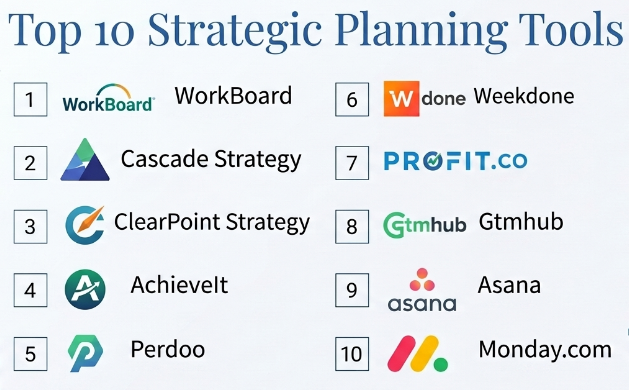
Top 10 Strategic Planning Tools
#1 — WorkBoard
Short description:
WorkBoard is an enterprise-grade OKR and strategy execution platform designed for large organizations. It helps align teams around measurable goals and provides real-time insights into execution progress.
Key Features
- OKR management with cascading goals
- Real-time dashboards and analytics
- Strategy execution tracking
- AI-driven insights
- Enterprise reporting capabilities
Pros
- Strong enterprise focus
- Excellent OKR tracking
Cons
- Steep learning curve
- Pricing not transparent
Platforms / Deployment
Web / iOS / Android
Cloud
Security & Compliance
SSO, RBAC, encryption (details not publicly stated)
Integrations & Ecosystem
Integrates with enterprise systems like CRM and collaboration tools.
- Slack
- Microsoft Teams
- Salesforce
- APIs available
Support & Community
Enterprise-level support; documentation is strong.
#2 — Cascade Strategy
Short description:
Cascade is a strategic planning and execution platform designed for organizations looking to align business goals with measurable outcomes.
Key Features
- Strategy dashboards
- Goal tracking
- KPI alignment
- Reporting tools
- Collaboration features
Pros
- Easy to use
- Strong visualization
Cons
- Limited advanced automation
- Some reporting limitations
Platforms / Deployment
Web
Cloud
Security & Compliance
Not publicly stated
Integrations & Ecosystem
Supports integrations with common business tools.
- Slack
- Excel
- APIs
Support & Community
Good onboarding and support.
#3 — ClearPoint Strategy
Short description:
ClearPoint focuses on performance management and strategic reporting using frameworks like Balanced Scorecards.
Key Features
- Balanced Scorecard support
- KPI tracking
- Reporting automation
- Data visualization
- Performance dashboards
Pros
- Strong reporting
- Ideal for governance-focused teams
Cons
- UI can feel outdated
- Limited flexibility
Platforms / Deployment
Web
Cloud
Security & Compliance
Not publicly stated
Integrations & Ecosystem
- Excel
- BI tools
- APIs
Support & Community
Reliable support with strong documentation.
#4 — AchieveIt
Short description:
AchieveIt helps organizations track and execute strategic plans through structured workflows and reporting.
Key Features
- Plan tracking
- Progress monitoring
- Reporting tools
- Collaboration workflows
- KPI tracking
Pros
- Strong execution tracking
- Good reporting
Cons
- Limited UI customization
- Moderate learning curve
Platforms / Deployment
Web
Cloud
Security & Compliance
Not publicly stated
Integrations & Ecosystem
- Microsoft tools
- APIs
Support & Community
Good enterprise support.
#5 — Perdoo
Short description:
Perdoo is an OKR-focused tool designed for startups and mid-sized companies looking to align teams around goals.
Key Features
- OKR management
- KPI tracking
- Alignment dashboards
- Progress tracking
- Reporting
Pros
- Simple and intuitive
- Affordable for SMBs
Cons
- Limited enterprise features
- Basic integrations
Platforms / Deployment
Web
Cloud
Security & Compliance
Not publicly stated
Integrations & Ecosystem
- Slack
- APIs
Support & Community
Good for SMB users.
#6 — Weekdone
Short description:
Weekdone is a lightweight OKR and weekly planning tool designed for small to mid-sized teams.
Key Features
- Weekly planning
- OKR tracking
- Progress reports
- Team updates
- Dashboard views
Pros
- Easy to use
- Quick setup
Cons
- Limited scalability
- Basic reporting
Platforms / Deployment
Web
Cloud
Security & Compliance
Not publicly stated
Integrations & Ecosystem
- Slack
- APIs
Support & Community
Simple onboarding and support.
#7 — Profit.co
Short description:
Profit.co is a comprehensive OKR and performance management platform with strong analytics and automation features.
Key Features
- OKR management
- Performance reviews
- Task management
- Analytics dashboards
- Automation workflows
Pros
- Feature-rich
- Strong analytics
Cons
- Complex interface
- Learning curve
Platforms / Deployment
Web / Mobile
Cloud
Security & Compliance
Not publicly stated
Integrations & Ecosystem
- Jira
- Slack
- Salesforce
Support & Community
Good documentation and support.
#8 — Gtmhub
Short description:
Gtmhub is an enterprise OKR platform known for data-driven goal tracking and integrations.
Key Features
- Data-driven OKRs
- Real-time dashboards
- AI insights
- Integration capabilities
- Reporting
Pros
- Strong integrations
- Data-driven insights
Cons
- Expensive
- Complex setup
Platforms / Deployment
Web
Cloud
Security & Compliance
Not publicly stated
Integrations & Ecosystem
- Salesforce
- Jira
- Snowflake
Support & Community
Enterprise-level support.
#9 — Asana
Short description:
Asana is a project management tool that also supports strategic planning through goals, portfolios, and reporting.
Key Features
- Goal tracking
- Project management
- Workflow automation
- Reporting dashboards
- Collaboration tools
Pros
- Easy to use
- Widely adopted
Cons
- Not strategy-first
- Limited advanced analytics
Platforms / Deployment
Web / Mobile
Cloud
Security & Compliance
SSO, encryption (details not fully stated)
Integrations & Ecosystem
- Slack
- Google Workspace
- Microsoft Teams
Support & Community
Strong community and support.
#10 — Monday.com
Short description:
Monday.com offers a flexible work OS that supports strategic planning through customizable workflows and dashboards.
Key Features
- Custom workflows
- Dashboards
- Automation
- Collaboration
- Reporting
Pros
- Highly flexible
- Visual interface
Cons
- Can get complex
- Pricing scales quickly
Platforms / Deployment
Web / Mobile
Cloud
Security & Compliance
SSO, RBAC (details not fully stated)
Integrations & Ecosystem
- Slack
- Jira
- CRM tools
Support & Community
Large user base and support.
Comparison Table (Top 10)
| Tool Name | Best For | Platform(s) Supported | Deployment | Standout Feature | Public Rating |
|---|---|---|---|---|---|
| WorkBoard | Enterprise OKRs | Web, Mobile | Cloud | Enterprise OKR alignment | N/A |
| Cascade Strategy | Strategy dashboards | Web | Cloud | Visual strategy tracking | N/A |
| ClearPoint Strategy | Balanced scorecards | Web | Cloud | Reporting automation | N/A |
| AchieveIt | Execution tracking | Web | Cloud | Plan execution workflows | N/A |
| Perdoo | SMB OKRs | Web | Cloud | Simple OKR tracking | N/A |
| Weekdone | Weekly planning | Web | Cloud | Weekly progress reports | N/A |
| Profit.co | Analytics-driven OKRs | Web, Mobile | Cloud | Advanced analytics | N/A |
| Gtmhub | Data-driven OKRs | Web | Cloud | Integration-heavy insights | N/A |
| Asana | Project + goals | Web, Mobile | Cloud | Task + goal alignment | N/A |
| Monday.com | Flexible workflows | Web, Mobile | Cloud | Custom dashboards | N/A |
Evaluation & Scoring of Strategic Planning Tools
| Tool Name | Core | Ease | Integrations | Security | Performance | Support | Value | Weighted Total |
|---|---|---|---|---|---|---|---|---|
| WorkBoard | 9 | 7 | 8 | 8 | 8 | 8 | 7 | 8.0 |
| Cascade Strategy | 8 | 8 | 7 | 7 | 7 | 7 | 8 | 7.6 |
| ClearPoint Strategy | 8 | 6 | 7 | 7 | 7 | 8 | 7 | 7.3 |
| AchieveIt | 8 | 7 | 7 | 7 | 7 | 7 | 7 | 7.3 |
| Perdoo | 7 | 9 | 6 | 6 | 7 | 7 | 8 | 7.4 |
| Weekdone | 6 | 9 | 6 | 6 | 6 | 7 | 8 | 7.0 |
| Profit.co | 9 | 7 | 8 | 7 | 8 | 8 | 7 | 8.0 |
| Gtmhub | 9 | 6 | 9 | 7 | 8 | 8 | 6 | 7.9 |
| Asana | 8 | 9 | 9 | 7 | 8 | 9 | 8 | 8.5 |
| Monday.com | 8 | 8 | 9 | 7 | 8 | 8 | 7 | 8.1 |
How to interpret scores:
- Scores are comparative, not absolute.
- A higher score indicates stronger overall capability for strategic planning use cases.
- Enterprise tools may score lower on ease but higher on depth.
- SMB tools often score higher on usability but lower on scalability.
- Always validate based on your specific use case.
Which Strategic Planning Tools
Solo / Freelancer
Tools like Weekdone and Asana are ideal due to simplicity and low overhead.
SMB
Perdoo and Cascade Strategy provide strong OKR tracking with affordability.
Mid-Market
Profit.co and Monday.com offer a balance between flexibility and depth.
Enterprise
WorkBoard and Gtmhub are best for large-scale strategy execution.
Budget vs Premium
- Budget: Weekdone, Perdoo
- Premium: WorkBoard, Gtmhub
Feature Depth vs Ease of Use
- Deep features: WorkBoard, Profit.co
- Easy to use: Asana, Weekdone
Integrations & Scalability
- Best integrations: Asana, Gtmhub
- Scalable: WorkBoard, Monday.com
Security & Compliance Needs
- Enterprise-ready: WorkBoard, Monday.com
- Basic: Weekdone, Perdoo
Frequently Asked Questions (FAQs)
1. What is a strategic planning tool?
It is software that helps organizations set goals, align teams, and track execution. It bridges the gap between planning and real-world outcomes.
2. How much do these tools cost?
Pricing varies widely based on features and scale. Many offer tiered subscriptions; enterprise pricing is often custom.
3. How long does implementation take?
Basic tools can be deployed in days, while enterprise platforms may take weeks for full onboarding.
4. Are these tools secure?
Most provide standard security features like encryption and SSO, but compliance details vary.
5. Can they integrate with existing systems?
Yes, most tools support integrations with CRM, ERP, and collaboration platforms.
6. What are common mistakes when adopting these tools?
Not aligning teams properly, overcomplicating workflows, and lack of training are common issues.
7. Can startups benefit from strategic planning tools?
Yes, especially tools designed for SMBs like Perdoo or Weekdone.
8. How scalable are these tools?
Enterprise tools scale well, while simpler tools may struggle with large organizations.
9. Is AI important in these tools?
Increasingly yes—AI helps with insights, forecasting, and automation.
10. Can I switch tools later?
Yes, but data migration and retraining teams can take effort.
Conclusion
Strategic planning tools have evolved from simple goal trackers into powerful platforms that drive alignment, accountability, and execution across organizations. Whether you are a startup founder trying to align your team or an enterprise leader managing complex strategies, the right tool can significantly improve visibility and outcomes. However, there is no single “best” solution for everyone. The ideal choice depends on your organization’s size, complexity, integration needs, and budget. A practical next step is to shortlist two or three tools that match your requirements, run a pilot with real use cases, and evaluate how well they integrate with your existing systems and workflows before making a final decision.