Introduction
Retail Point of Sale (POS) systems are the central platforms used by businesses to process transactions, manage inventory, track sales, and handle customer interactions. In simple terms, a POS system replaces the traditional cash register with a smarter, connected solution that integrates billing, inventory, payments, and reporting into one system.
In today’s retail environment, POS systems are more than just checkout tools. They are becoming business intelligence hubs that provide real-time insights into sales trends, customer behavior, and operational performance. With the rise of omnichannel retail, mobile payments, and cloud-based operations, modern POS systems must support both in-store and online experiences seamlessly.
Real-world use cases include:
- Managing retail store billing and checkout operations
- Tracking inventory across multiple locations
- Handling online and offline sales in one system
- Managing customer loyalty programs
- Generating sales reports and analytics
What buyers should evaluate:
- Ease of use for staff
- Hardware compatibility
- Payment processing options
- Inventory management capabilities
- Multi-location support
- Reporting and analytics
- Integration with eCommerce platforms
- Security and compliance (PCI DSS, etc.)
- Pricing model and transaction fees
Best for: Retail store owners, chains, restaurants, supermarkets, and businesses needing integrated sales and inventory management.
Not ideal for: Businesses that only require basic billing or manual tracking—simpler invoicing tools may be sufficient.
Key Trends in Retail Point of Sale (POS) Systems
- Cloud-based POS adoption: Businesses are moving to SaaS POS platforms for flexibility and scalability.
- Mobile POS (mPOS): Tablets and smartphones are replacing fixed terminals.
- AI-driven analytics: Predictive sales insights and customer behavior tracking.
- Omnichannel retail integration: Seamless online and offline sales management.
- Contactless and digital payments: QR codes, NFC, and wallet-based transactions.
- Subscription-based pricing models: Monthly SaaS pricing replacing one-time licenses.
- Self-checkout systems: Increasing use in supermarkets and large retail chains.
- Integrated CRM and loyalty programs: Built-in customer engagement tools.
- API-first ecosystems: Easier integrations with accounting, ERP, and eCommerce systems.
How We Selected These Tools (Methodology)
- Evaluated market popularity and adoption in retail segments
- Assessed feature coverage across billing, inventory, and reporting
- Reviewed ease of use for frontline staff
- Analyzed hardware and payment ecosystem compatibility
- Considered security standards and compliance readiness
- Examined integration capabilities with eCommerce and accounting tools
- Evaluated scalability for growing businesses and multi-store operations
- Considered vendor reliability and support quality
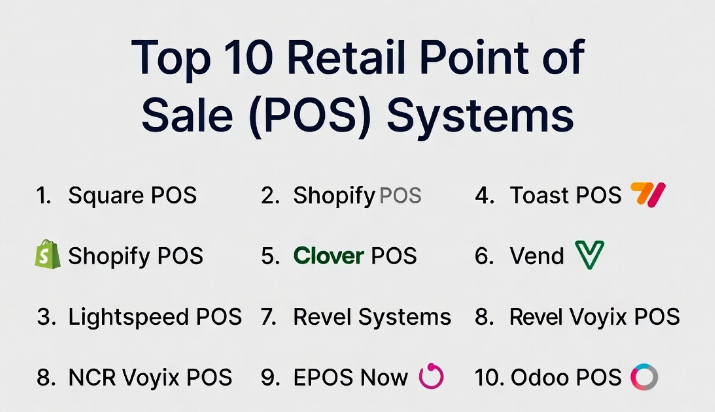
Top 10 Retail Point of Sale (POS) Systems
#1 — Square POS
Short description: Square POS is a popular cloud-based POS system designed for small to mid-sized retail businesses. It is known for its ease of use, quick setup, and strong payment processing capabilities.
Key Features
- Integrated payment processing
- Inventory tracking
- Sales reporting and analytics
- Customer management tools
- Mobile POS support
- Offline mode
Pros
- Easy to set up and use
- No upfront hardware cost options
Cons
- Transaction fees can add up
- Limited advanced features for large enterprises
Platforms / Deployment
Web / iOS / Android
Cloud
Security & Compliance
Encryption, RBAC
Compliance: Not publicly stated
Integrations & Ecosystem
Square integrates with accounting, eCommerce, and CRM systems.
- QuickBooks
- Shopify
- WooCommerce
Support & Community
Good documentation and support for SMB users.
#2 — Shopify POS
Short description: Shopify POS extends Shopify’s eCommerce platform into physical retail, making it ideal for businesses operating both online and offline.
Key Features
- Unified online and offline sales
- Inventory synchronization
- Customer profiles
- Order management
- Mobile POS
Pros
- Strong eCommerce integration
- Easy omnichannel management
Cons
- Requires Shopify ecosystem
- Costs increase with add-ons
Platforms / Deployment
Web / iOS / Android
Cloud
Security & Compliance
Encryption, RBAC
Compliance: Not publicly stated
Integrations & Ecosystem
Deep integration with Shopify ecosystem and third-party apps.
Support & Community
Strong support and large ecosystem.
#3 — Lightspeed POS
Short description: Lightspeed is a feature-rich POS system designed for retail and hospitality businesses, offering advanced inventory and reporting capabilities.
Key Features
- Advanced inventory management
- Multi-store support
- Analytics dashboards
- eCommerce integration
- Customer management
Pros
- Powerful inventory features
- Scalable for growing businesses
Cons
- Higher pricing
- Learning curve for new users
Platforms / Deployment
Web / iOS / Android
Cloud
Security & Compliance
RBAC, encryption
Compliance: Not publicly stated
Integrations & Ecosystem
Supports integrations with accounting and retail tools.
Support & Community
Reliable support with enterprise options.
#4 — Toast POS
Short description: Toast POS is designed specifically for restaurants and food service businesses, offering specialized features for order management and kitchen workflows.
Key Features
- Restaurant order management
- Menu customization
- Kitchen display system
- Payment processing
- Reporting tools
Pros
- Industry-specific features
- Strong hardware ecosystem
Cons
- Limited retail features
- Hardware dependency
Platforms / Deployment
Android
Cloud
Security & Compliance
Encryption, RBAC
Compliance: Not publicly stated
Integrations & Ecosystem
Integrates with restaurant-specific tools.
Support & Community
Strong support for restaurant businesses.
#5 — Clover POS
Short description: Clover offers a flexible POS system with customizable hardware and software options for small and medium retail businesses.
Key Features
- Customizable hardware devices
- Payment processing
- Inventory management
- Employee management
- App marketplace
Pros
- Flexible hardware options
- Easy customization
Cons
- Vendor lock-in
- Pricing complexity
Platforms / Deployment
Web / Android
Cloud
Security & Compliance
Encryption, RBAC
Compliance: Not publicly stated
Integrations & Ecosystem
App marketplace with various integrations.
Support & Community
Moderate support and ecosystem.
#6 — Vend (Lightspeed Retail)
Short description: Vend is a retail-focused POS system offering strong inventory and reporting features for small and medium businesses.
Key Features
- Inventory tracking
- Customer loyalty tools
- Sales analytics
- Multi-store support
Pros
- Retail-focused features
- Easy to use
Cons
- Limited advanced customization
- Pricing can scale up
Platforms / Deployment
Web / iOS
Cloud
Security & Compliance
RBAC, encryption
Compliance: Not publicly stated
Integrations & Ecosystem
Integrates with accounting and eCommerce platforms.
Support & Community
Good SMB-focused support.
#7 — Revel Systems
Short description: Revel is an iPad-based POS system designed for retail and restaurant businesses requiring advanced features and scalability.
Key Features
- iPad-based POS
- Inventory management
- CRM tools
- Reporting and analytics
Pros
- Strong scalability
- Good reporting
Cons
- Expensive
- Setup complexity
Platforms / Deployment
iOS
Cloud
Security & Compliance
RBAC, encryption
Compliance: Not publicly stated
Integrations & Ecosystem
Supports integrations with enterprise systems.
Support & Community
Enterprise-level support.
#8 — NCR Voyix POS
Short description: NCR Voyix POS is an enterprise-grade solution used by large retail chains for complex operations and multi-location management.
Key Features
- Enterprise retail management
- Multi-location support
- Advanced analytics
- Payment processing
Pros
- Highly scalable
- Strong enterprise features
Cons
- Expensive
- Complex implementation
Platforms / Deployment
Varies / N/A
Cloud / Hybrid
Security & Compliance
RBAC, encryption
Compliance: Not publicly stated
Integrations & Ecosystem
Supports large enterprise integrations.
Support & Community
Enterprise-grade support.
#9 — EPOS Now
Short description: EPOS Now is a cloud-based POS system offering simple setup and retail-focused features for small businesses.
Key Features
- Inventory management
- Sales tracking
- Cloud reporting
- Payment processing
Pros
- Affordable
- Easy setup
Cons
- Limited advanced features
- Smaller ecosystem
Platforms / Deployment
Web / iOS / Android
Cloud
Security & Compliance
Encryption
Compliance: Not publicly stated
Integrations & Ecosystem
Basic integrations with accounting tools.
Support & Community
Moderate support.
#10 — Odoo POS
Short description: Odoo POS is part of the Odoo ERP ecosystem, offering integrated retail management with accounting, CRM, and inventory modules.
Key Features
- ERP integration
- Inventory management
- Sales tracking
- Offline mode
Pros
- Highly customizable
- Cost-effective
Cons
- Requires ERP setup
- Learning curve
Platforms / Deployment
Web / iOS / Android
Cloud / Self-hosted
Security & Compliance
RBAC
Compliance: Not publicly stated
Integrations & Ecosystem
Part of Odoo ecosystem with multiple modules.
Support & Community
Strong open-source community.
Comparison Table (Top 10)
| Tool Name | Best For | Platform(s) Supported | Deployment | Standout Feature | Public Rating |
|---|---|---|---|---|---|
| Square POS | SMB retail | Web, Mobile | Cloud | Easy setup | N/A |
| Shopify POS | Omnichannel retail | Web, Mobile | Cloud | eCommerce integration | N/A |
| Lightspeed POS | Growing retail | Web, Mobile | Cloud | Inventory management | N/A |
| Toast POS | Restaurants | Android | Cloud | Food service tools | N/A |
| Clover POS | SMB retail | Web, Android | Cloud | Hardware flexibility | N/A |
| Vend | Retail SMB | Web, iOS | Cloud | Retail features | N/A |
| Revel Systems | Mid-market | iOS | Cloud | Scalability | N/A |
| NCR Voyix POS | Enterprise | Varies | Hybrid | Enterprise scale | N/A |
| EPOS Now | Small business | Web, Mobile | Cloud | Simplicity | N/A |
| Odoo POS | ERP users | Web, Mobile | Hybrid | ERP integration | N/A |
Evaluation & Scoring of Retail Point of Sale (POS) Systems
| Tool Name | Core | Ease | Integrations | Security | Performance | Support | Value | Weighted Total |
|---|---|---|---|---|---|---|---|---|
| Square POS | 8 | 9 | 8 | 7 | 8 | 8 | 9 | 8.3 |
| Shopify POS | 9 | 8 | 9 | 8 | 8 | 9 | 7 | 8.4 |
| Lightspeed POS | 9 | 7 | 8 | 8 | 8 | 8 | 7 | 8.0 |
| Toast POS | 8 | 8 | 7 | 7 | 8 | 8 | 7 | 7.8 |
| Clover POS | 8 | 8 | 7 | 7 | 8 | 7 | 7 | 7.6 |
| Vend | 8 | 8 | 7 | 7 | 8 | 7 | 7 | 7.6 |
| Revel Systems | 9 | 7 | 8 | 8 | 8 | 8 | 6 | 7.9 |
| NCR Voyix POS | 9 | 6 | 8 | 9 | 9 | 9 | 5 | 8.1 |
| EPOS Now | 7 | 9 | 6 | 7 | 7 | 7 | 8 | 7.5 |
| Odoo POS | 8 | 6 | 8 | 7 | 7 | 7 | 8 | 7.6 |
How to interpret scores:
- Higher scores indicate better overall balance of features and usability
- Enterprise tools score higher in security but lower in ease of use
- SMB tools score higher in ease and value
- Scores are comparative and depend on use-case fit
Which Retail Point of Sale (POS) Systems
Solo / Freelancer
Square POS or EPOS Now are simple and affordable.
SMB
Shopify POS, Vend, or Clover provide strong retail features.
Mid-Market
Lightspeed and Revel offer scalability and advanced reporting.
Enterprise
NCR Voyix and enterprise POS systems are best suited.
Budget vs Premium
- Budget: Square, EPOS Now
- Premium: NCR Voyix, Lightspeed
Feature Depth vs Ease of Use
- Feature-rich: Lightspeed, NCR
- Easy to use: Square, Shopify
Integrations & Scalability
Shopify POS and Odoo POS excel due to ecosystems.
Security & Compliance Needs
Enterprise systems like NCR are better for compliance-heavy environments.
Frequently Asked Questions (FAQs)
1. What is a POS system?
A POS system is software and hardware used to process sales transactions and manage retail operations.
2. How much does a POS system cost?
Costs vary from subscription-based models to enterprise pricing depending on features.
3. Can POS systems work offline?
Yes, many POS systems offer offline mode for uninterrupted transactions.
4. Are POS systems secure?
Most include encryption and RBAC, but compliance levels vary.
5. Can POS systems integrate with eCommerce?
Yes, many modern POS systems support omnichannel integration.
6. Do POS systems support mobile devices?
Yes, mobile POS is a growing trend using tablets and smartphones.
7. How long does implementation take?
Small systems can be set up in hours, while enterprise systems take weeks.
8. What industries use POS systems?
Retail, hospitality, healthcare, and service industries widely use POS systems.
9. Can POS systems manage inventory?
Yes, inventory tracking is a core feature in most systems.
10. Can I switch POS systems easily?
Switching is possible but may require data migration and retraining.
Conclusion
Retail POS systems have evolved into powerful business platforms that go far beyond simple transaction processing. They now play a central role in inventory management, customer engagement, and data-driven decision-making. Choosing the right POS system depends on your business size, industry, and operational complexity.
