Introduction
Returns Management Software helps businesses handle product returns, exchanges, refunds, and reverse logistics efficiently. Instead of managing returns manually through emails, spreadsheets, or disconnected systems, these platforms automate workflows, improve visibility, and enhance customer experience across the entire return lifecycle.
In modern commerce, especially with the growth of eCommerce and omnichannel retail, returns are no longer an exception—they are a standard part of operations. Customers expect fast refunds, easy return processes, and transparent tracking. At the same time, businesses must control costs, prevent fraud, and recover value from returned goods. This is where returns management platforms play a critical role.
Real-world use cases include:
- eCommerce returns and exchanges automation
- Retail reverse logistics optimization
- Warranty and repair management
- Subscription product returns
- B2B product return handling
What buyers should evaluate:
- Return workflow automation
- Customer self-service portals
- Integration with eCommerce platforms
- Refund and exchange flexibility
- Analytics and reporting capabilities
- Reverse logistics support
- Fraud detection features
- Multi-channel return support
- Scalability and performance
Best for: eCommerce brands, retailers, D2C companies, logistics providers, and enterprises handling high return volumes.
Not ideal for: small businesses with very low return volume or companies selling non-returnable digital products.
Key Trends in Returns Management Software
- AI-driven return predictions: Identifying high-return-risk products and customers
- Automated return approvals: Reducing manual intervention with rule-based workflows
- Customer self-service portals: Improving user experience and reducing support load
- Reverse logistics optimization: Integrating with shipping and warehouse systems
- Omnichannel returns: Supporting online-to-store and store-to-online returns
- Fraud prevention tools: Detecting abusive return patterns
- Sustainability focus: Reducing waste and optimizing resale or recycling
- Embedded analytics dashboards: Tracking return reasons and trends
- Integration-first architecture: Seamless connection with ERP, CRM, and OMS
- Flexible refund options: Store credit, exchanges, and instant refunds
How We Selected These Tools (Methodology)
- Evaluated market adoption and industry presence
- Compared feature depth for returns workflows
- Assessed integration capabilities with eCommerce systems
- Reviewed scalability and performance indicators
- Considered security and compliance readiness
- Analyzed customer experience features
- Looked at fit across SMB, mid-market, and enterprise
- Prioritized innovation in automation and analytics
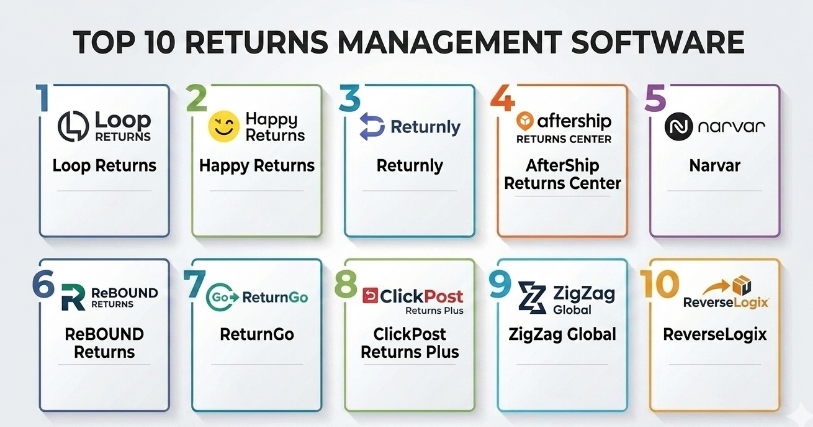
Top 10 Returns Management Software
#1 — Loop Returns
Short description: Loop Returns is a popular platform for Shopify-based brands, offering seamless return and exchange workflows with a strong focus on customer experience and retention.
Key Features
- Automated returns and exchanges
- Instant store credit options
- Branded return portals
- Analytics dashboards
- Fraud prevention rules
Pros
- Excellent UX for customers
- Strong Shopify integration
Cons
- Limited outside Shopify ecosystem
- Pricing can scale with volume
Platforms / Deployment
Web / Cloud
Security & Compliance
Not publicly stated
Integrations & Ecosystem
Strong integration ecosystem
- Shopify
- Payment providers
- Logistics tools
Support & Community
Strong support for eCommerce brands; growing community
#2 — Happy Returns
Short description: Happy Returns focuses on in-person and mail returns, offering a network of drop-off locations to simplify reverse logistics.
Key Features
- Box-free return drop-offs
- Real-time return tracking
- Refund automation
- Logistics optimization
- Analytics insights
Pros
- Reduces shipping costs
- Enhances customer convenience
Cons
- Limited global coverage
- Dependent on partner network
Platforms / Deployment
Web / Cloud
Security & Compliance
Not publicly stated
Integrations & Ecosystem
Integrates with major eCommerce platforms
- Shopify
- Magento
- Logistics providers
Support & Community
Enterprise support available
#3 — Returnly
Short description: Returnly enables fast refunds and exchanges with a focus on improving customer satisfaction and retention.
Key Features
- Instant refunds
- Exchange-first workflows
- Customer return portals
- Policy automation
- Return analytics
Pros
- Improves customer retention
- Fast refund process
Cons
- Limited customization
- Pricing varies by usage
Platforms / Deployment
Cloud
Security & Compliance
Not publicly stated
Integrations & Ecosystem
- Payment systems
- eCommerce platforms
Support & Community
Good documentation and onboarding
#4 — AfterShip Returns Center
Short description: AfterShip Returns Center is part of the AfterShip ecosystem, offering return automation and tracking features for eCommerce businesses.
Key Features
- Self-service return portal
- Automated approvals
- Shipment tracking
- Multi-language support
- Analytics
Pros
- Easy to implement
- Strong tracking features
Cons
- Limited advanced customization
- Best suited for SMBs
Platforms / Deployment
Cloud
Security & Compliance
Basic security features
Integrations & Ecosystem
- Shopify
- WooCommerce
- Shipping carriers
Support & Community
Strong documentation and support
#5 — Narvar
Short description: Narvar is an enterprise-grade post-purchase platform offering returns management, tracking, and customer engagement features.
Key Features
- Enterprise returns workflows
- Customer communication tools
- AI-driven insights
- Multi-channel support
- Reverse logistics integration
Pros
- Enterprise scalability
- Advanced analytics
Cons
- Expensive
- Complex setup
Platforms / Deployment
Cloud
Security & Compliance
Enterprise-grade security (details vary)
Integrations & Ecosystem
- ERP systems
- CRM platforms
- Logistics providers
Support & Community
Enterprise-level support
#6 — ReBOUND Returns
Short description: ReBOUND focuses on global returns management, helping retailers handle international returns efficiently.
Key Features
- Global returns network
- Multi-currency support
- Carrier integrations
- Returns analytics
- Customer portal
Pros
- Strong international capabilities
- Logistics expertise
Cons
- Complex onboarding
- Enterprise-focused
Platforms / Deployment
Cloud
Security & Compliance
Not publicly stated
Integrations & Ecosystem
- Shipping carriers
- eCommerce platforms
Support & Community
Enterprise support
#7 — ReturnGo
Short description: ReturnGo is a Shopify-focused returns platform offering automation and flexible refund options.
Key Features
- Automated workflows
- Store credit options
- Custom return rules
- Exchange management
- Analytics
Pros
- Affordable
- Easy setup
Cons
- Limited outside Shopify
- Fewer enterprise features
Platforms / Deployment
Cloud
Security & Compliance
Not publicly stated
Integrations & Ecosystem
- Shopify
- Payment systems
Support & Community
Good support for SMB users
#8 — ClickPost Returns Plus
Short description: ClickPost Returns Plus provides logistics-focused returns management with strong carrier integrations.
Key Features
- Reverse logistics automation
- Carrier integrations
- Return tracking
- Analytics dashboards
- API-based workflows
Pros
- Strong logistics capabilities
- API flexibility
Cons
- Requires setup effort
- Less focus on UI
Platforms / Deployment
Cloud
Security & Compliance
Not publicly stated
Integrations & Ecosystem
- Logistics providers
- ERP systems
Support & Community
Support available; enterprise-focused
#9 — ZigZag Global
Short description: ZigZag Global specializes in international returns and logistics management for retailers.
Key Features
- Global returns coverage
- Carrier network
- Localization support
- Analytics
- Returns processing
Pros
- Strong international reach
- Logistics expertise
Cons
- Enterprise-focused
- Limited SMB features
Platforms / Deployment
Cloud
Security & Compliance
Not publicly stated
Integrations & Ecosystem
- Retail platforms
- Logistics providers
Support & Community
Enterprise support
#10 — ReverseLogix
Short description: ReverseLogix is a dedicated returns management system offering deep customization and enterprise features.
Key Features
- End-to-end returns lifecycle
- Warranty and repair management
- AI-driven analytics
- Workflow automation
- Multi-channel returns
Pros
- Highly customizable
- Strong enterprise capabilities
Cons
- Complex implementation
- Higher cost
Platforms / Deployment
Cloud
Security & Compliance
Not publicly stated
Integrations & Ecosystem
- ERP
- CRM
- Logistics systems
Support & Community
Enterprise-level support
Comparison Table (Top 10)
| Tool Name | Best For | Platform(s) Supported | Deployment | Standout Feature | Public Rating |
|---|---|---|---|---|---|
| Loop Returns | Shopify brands | Web | Cloud | Exchange-first returns | N/A |
| Happy Returns | Retail logistics | Web | Cloud | Drop-off network | N/A |
| Returnly | Customer experience | Web | Cloud | Instant refunds | N/A |
| AfterShip Returns | SMB eCommerce | Web | Cloud | Tracking integration | N/A |
| Narvar | Enterprise retail | Web | Cloud | Post-purchase platform | N/A |
| ReBOUND Returns | Global retailers | Web | Cloud | International returns | N/A |
| ReturnGo | SMB Shopify users | Web | Cloud | Flexible refunds | N/A |
| ClickPost Returns Plus | Logistics-heavy ops | Web | Cloud | Carrier integrations | N/A |
| ZigZag Global | Cross-border returns | Web | Cloud | Global logistics | N/A |
| ReverseLogix | Enterprise workflows | Web | Cloud | Full lifecycle management | N/A |
Evaluation & Scoring of Returns Management Software
| Tool Name | Core (25%) | Ease (15%) | Integrations (15%) | Security (10%) | Performance (10%) | Support (10%) | Value (15%) | Weighted Total |
|---|---|---|---|---|---|---|---|---|
| Loop Returns | 9 | 9 | 8 | 7 | 9 | 8 | 8 | 8.4 |
| Happy Returns | 8 | 8 | 8 | 7 | 8 | 8 | 7 | 7.9 |
| Returnly | 8 | 8 | 7 | 7 | 8 | 7 | 7 | 7.7 |
| AfterShip Returns | 7 | 9 | 8 | 7 | 8 | 8 | 9 | 8.1 |
| Narvar | 10 | 7 | 9 | 9 | 9 | 9 | 6 | 8.6 |
| ReBOUND Returns | 9 | 7 | 8 | 8 | 9 | 8 | 6 | 8.1 |
| ReturnGo | 7 | 9 | 7 | 6 | 7 | 7 | 9 | 7.8 |
| ClickPost Returns Plus | 8 | 7 | 9 | 7 | 8 | 7 | 7 | 7.9 |
| ZigZag Global | 9 | 7 | 8 | 8 | 9 | 8 | 6 | 8.1 |
| ReverseLogix | 10 | 6 | 9 | 9 | 9 | 9 | 6 | 8.5 |
How to interpret scores:
These scores compare tools relative to each other. Higher scores indicate better overall balance across features, usability, and scalability. Enterprise tools tend to score higher in features but lower in ease and cost.
Which Returns Management Software
Solo / Freelancer
Choose AfterShip Returns or ReturnGo for ease and affordability.
SMB
Loop Returns or ReturnGo offer strong value and automation.
Mid-Market
Happy Returns or ClickPost provide balance between logistics and UX.
Enterprise
Narvar or ReverseLogix are best for complex workflows.
Budget vs Premium
- Budget: ReturnGo, AfterShip
- Premium: Narvar, ReverseLogix
Feature Depth vs Ease of Use
- Deep features: ReverseLogix, Narvar
- Easy tools: Loop Returns, AfterShip
Integrations & Scalability
- Strong integrations: ClickPost, Narvar
- Scalable: ReBOUND, ZigZag
Security & Compliance Needs
- Enterprise security: Narvar, ReverseLogix
- Basic: SMB tools
Frequently Asked Questions (FAQs)
1. What is returns management software?
It is software that automates and manages the entire product return process including refunds, exchanges, and logistics.
2. Why is returns management important?
It improves customer satisfaction, reduces operational costs, and helps recover value from returned products.
3. How does it integrate with eCommerce platforms?
Most tools integrate with platforms like Shopify, Magento, and WooCommerce via APIs or plugins.
4. Can returns be automated?
Yes, modern tools use rule-based automation to approve and process returns without manual effort.
5. What are common pricing models?
Subscription-based pricing, per-return fees, or usage-based pricing are common.
6. Is it suitable for small businesses?
Yes, many tools are designed for SMBs with easy setup and affordable plans.
7. What are common mistakes?
Not defining return policies clearly and not integrating logistics properly.
8. How long does implementation take?
It can range from a few days to several weeks depending on complexity.
9. Can it prevent fraud?
Many tools include fraud detection and rule-based controls.
10. What are alternatives?
Manual processes, basic eCommerce plugins, or custom-built solutions.
Conclusion
Returns management software has become a critical component of modern commerce, especially as customer expectations for seamless returns continue to rise. The right platform not only simplifies return workflows but also enhances customer trust, reduces operational costs, and improves overall business efficiency. While some tools excel in ease of use and quick deployment, others offer deep customization and enterprise-grade capabilities.
