Introduction
Retail merchandising tools are software platforms designed to help retailers plan, manage, optimize, and analyze how products are presented, priced, and promoted across stores and digital channels. In simple terms, these tools ensure the right product is available at the right place, at the right time, and at the right price.
As retail evolves into a hybrid ecosystem of physical stores, eCommerce, and omnichannel experiences, merchandising tools have become more data-driven and AI-powered. From automated assortment planning to real-time inventory visibility and demand forecasting, modern tools are critical for staying competitive in a fast-moving market.
Real-world use cases include:
- Optimizing product assortment for regional stores
- Managing in-store product placement and planograms
- Automating pricing and promotions across channels
- Forecasting demand and reducing stockouts
- Aligning merchandising strategies with supply chain data
What buyers should evaluate:
- Assortment planning capabilities
- Pricing and promotion management
- AI/ML-driven insights
- Inventory visibility and forecasting
- Integration with ERP, POS, and eCommerce
- Ease of use and UI/UX
- Scalability across locations
- Security and compliance features
Best for: Retail chains, eCommerce brands, supermarkets, fashion retailers, and omnichannel businesses managing large product catalogs and multiple locations.
Not ideal for: Very small retailers or single-store businesses that can manage merchandising manually or via basic POS systems.
Key Trends in Retail Merchandising Tools
- AI-driven demand forecasting and assortment optimization
- Real-time inventory synchronization across channels
- Automation of pricing and promotions
- Omnichannel merchandising with unified dashboards
- Integration with customer data platforms for personalization
- Cloud-first deployment models with SaaS pricing
- Increased focus on data governance and compliance
- Visual merchandising tools using AR/VR for store planning
- API-first ecosystems for extensibility
- Predictive analytics for margin optimization
How We Selected These Tools (Methodology)
- High market adoption among global retailers
- Strong feature coverage across merchandising workflows
- Proven reliability and scalability in production environments
- Availability of security features and enterprise controls
- Integration capabilities with ERP, POS, and supply chain tools
- Positive feedback from mid-market and enterprise users
- Vendor innovation in AI and automation
- Support for omnichannel retail environments
- Flexibility across industries (fashion, grocery, electronics)
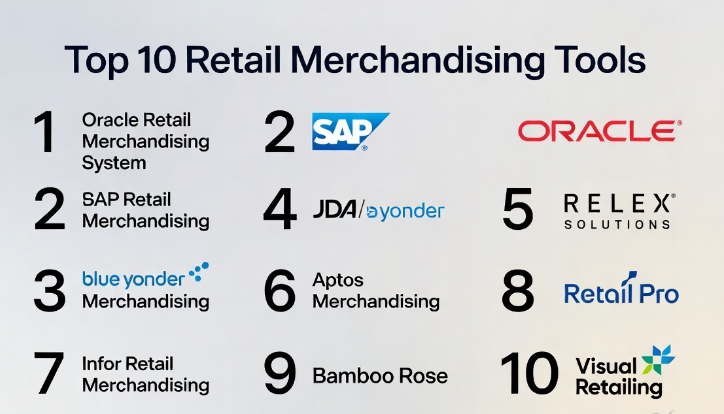
Top 10 Retail Merchandising Tools
#1 — Oracle Retail Merchandising System
Short description: A comprehensive enterprise-grade merchandising platform designed for large retailers. It supports inventory, pricing, promotions, and assortment planning in a unified system.
Key Features
- End-to-end merchandising lifecycle management
- Advanced pricing and promotion engine
- Inventory optimization
- AI-driven forecasting
- Multi-channel support
- Real-time analytics dashboards
Pros
- Highly scalable for enterprise retail
- Strong analytics and forecasting
Cons
- Complex implementation
- Higher cost
Platforms / Deployment
Cloud / Hybrid
Security & Compliance
SSO, RBAC, encryption, audit logs. Other certifications: Not publicly stated
Integrations & Ecosystem
Integrates with ERP, POS, supply chain systems, and Oracle ecosystem.
- ERP systems
- POS platforms
- Data warehouses
- APIs for extensibility
Support & Community
Strong enterprise support with structured onboarding and documentation
#2 — SAP Retail Merchandising
Short description: A robust merchandising solution integrated within SAP’s retail suite, ideal for businesses already using SAP ERP.
Key Features
- Assortment planning
- Pricing and promotion management
- Inventory tracking
- Demand forecasting
- Omnichannel support
Pros
- Deep ERP integration
- Strong data consistency
Cons
- Steep learning curve
- Expensive for smaller businesses
Platforms / Deployment
Cloud / On-premise
Security & Compliance
SSO, MFA, RBAC. Certifications: Not publicly stated
Integrations & Ecosystem
Strong integration with SAP ecosystem and third-party tools.
- SAP ERP
- CRM tools
- Analytics platforms
Support & Community
Extensive enterprise support and global partner network
#3 — Blue Yonder Merchandising
Short description: AI-powered merchandising platform focused on demand planning and supply chain alignment.
Key Features
- AI demand forecasting
- Assortment optimization
- Inventory planning
- Price optimization
- Real-time insights
Pros
- Strong AI capabilities
- Scalable for large retailers
Cons
- Complex configuration
- Requires data maturity
Platforms / Deployment
Cloud
Security & Compliance
Not publicly stated
Integrations & Ecosystem
Integrates with supply chain and ERP systems.
- ERP platforms
- Supply chain tools
- APIs
Support & Community
Enterprise-grade support with onboarding services
#4 — JDA Merchandising (Blue Yonder legacy)
Short description: A legacy but still widely used merchandising platform offering strong planning and execution features.
Key Features
- Merchandise planning
- Pricing optimization
- Inventory management
- Demand forecasting
Pros
- Proven reliability
- Strong planning features
Cons
- Outdated UI
- Limited flexibility
Platforms / Deployment
On-premise / Cloud
Security & Compliance
Not publicly stated
Integrations & Ecosystem
- ERP integrations
- POS systems
- APIs
Support & Community
Varies / Not publicly stated
#5 — RELEX Solutions
Short description: A modern retail optimization platform focusing on forecasting, replenishment, and merchandising.
Key Features
- AI-based forecasting
- Automated replenishment
- Assortment planning
- Promotion optimization
Pros
- Strong AI capabilities
- User-friendly interface
Cons
- Premium pricing
- Requires data setup
Platforms / Deployment
Cloud
Security & Compliance
Not publicly stated
Integrations & Ecosystem
- ERP integrations
- POS systems
- APIs
Support & Community
Strong onboarding and support
#6 — Aptos Merchandising
Short description: Designed for retail and fashion brands, Aptos provides merchandising and inventory management capabilities.
Key Features
- Merchandise planning
- Inventory visibility
- Pricing tools
- Omnichannel support
Pros
- Retail-focused design
- Good usability
Cons
- Limited advanced AI features
- Smaller ecosystem
Platforms / Deployment
Cloud
Security & Compliance
Not publicly stated
Integrations & Ecosystem
- POS integration
- ERP systems
Support & Community
Varies / Not publicly stated
#7 — Infor Retail Merchandising
Short description: A cloud-based merchandising solution integrated with Infor’s retail suite.
Key Features
- Inventory optimization
- Assortment planning
- Pricing management
- Analytics dashboards
Pros
- Cloud-native
- Good integration
Cons
- Learning curve
- Limited customization
Platforms / Deployment
Cloud
Security & Compliance
SSO, RBAC. Others: Not publicly stated
Integrations & Ecosystem
- ERP systems
- CRM tools
Support & Community
Enterprise support available
#8 — Retail Pro
Short description: A retail management platform with merchandising capabilities, suitable for mid-market retailers.
Key Features
- Inventory management
- POS integration
- Pricing tools
- Multi-store support
Pros
- Easy to use
- Affordable
Cons
- Limited advanced features
- Not enterprise-grade
Platforms / Deployment
Windows / Cloud
Security & Compliance
Not publicly stated
Integrations & Ecosystem
- POS systems
- APIs
Support & Community
Moderate support and documentation
#9 — Bamboo Rose
Short description: A retail product lifecycle and merchandising platform focused on sourcing and collaboration.
Key Features
- Product lifecycle management
- Supplier collaboration
- Merchandising insights
- Cost optimization
Pros
- Strong collaboration features
- Good for sourcing
Cons
- Niche focus
- Limited general merchandising features
Platforms / Deployment
Cloud
Security & Compliance
Not publicly stated
Integrations & Ecosystem
- Supplier systems
- ERP tools
Support & Community
Varies / Not publicly stated
#10 — Visual Retailing (Mi9 Retail)
Short description: A visual merchandising and planning tool focused on store layout and product placement.
Key Features
- Planogram design
- Store layout optimization
- Visual analytics
- Product placement tools
Pros
- Strong visual tools
- Easy to use
Cons
- Limited backend integration
- Not full-suite merchandising
Platforms / Deployment
Windows / Cloud
Security & Compliance
Not publicly stated
Integrations & Ecosystem
- POS systems
- Inventory tools
Support & Community
Moderate support availability
Comparison Table (Top 10)
| Tool Name | Best For | Platform(s) Supported | Deployment | Standout Feature | Public Rating |
|---|---|---|---|---|---|
| Oracle Retail Merchandising | Enterprise retailers | Web | Cloud/Hybrid | End-to-end merchandising | N/A |
| SAP Retail Merchandising | SAP users | Web | Cloud/On-prem | Deep ERP integration | N/A |
| Blue Yonder | AI-driven retailers | Web | Cloud | AI forecasting | N/A |
| JDA Merchandising | Legacy enterprise | Web | Hybrid | Proven planning tools | N/A |
| RELEX Solutions | Forecasting-focused | Web | Cloud | AI optimization | N/A |
| Aptos Merchandising | Fashion retail | Web | Cloud | Retail-specific workflows | N/A |
| Infor Retail Merchandising | Cloud retail ops | Web | Cloud | Integrated analytics | N/A |
| Retail Pro | Mid-market retail | Windows/Web | Cloud | Ease of use | N/A |
| Bamboo Rose | Sourcing-focused | Web | Cloud | Supplier collaboration | N/A |
| Visual Retailing | Store planning | Windows | Cloud | Planogram tools | N/A |
Evaluation & Scoring of Retail Merchandising Tools
| Tool Name | Core (25%) | Ease (15%) | Integrations (15%) | Security (10%) | Performance (10%) | Support (10%) | Value (15%) | Weighted Total |
|---|---|---|---|---|---|---|---|---|
| Oracle | 9 | 6 | 9 | 8 | 9 | 9 | 6 | 8.1 |
| SAP | 9 | 6 | 9 | 8 | 9 | 9 | 6 | 8.1 |
| Blue Yonder | 9 | 7 | 8 | 7 | 9 | 8 | 7 | 8.0 |
| JDA | 8 | 6 | 8 | 7 | 8 | 7 | 6 | 7.3 |
| RELEX | 9 | 8 | 8 | 7 | 9 | 8 | 7 | 8.3 |
| Aptos | 7 | 8 | 7 | 6 | 7 | 7 | 8 | 7.4 |
| Infor | 8 | 7 | 8 | 7 | 8 | 8 | 7 | 7.8 |
| Retail Pro | 6 | 8 | 6 | 6 | 7 | 6 | 8 | 6.9 |
| Bamboo Rose | 7 | 7 | 7 | 6 | 7 | 6 | 7 | 7.0 |
| Visual Retailing | 6 | 8 | 6 | 6 | 7 | 6 | 7 | 6.8 |
How to interpret scores:
These scores are comparative, not absolute. A higher score indicates better overall balance across features, usability, and ecosystem. Enterprise tools score higher on capability but may lag in usability or cost efficiency. SMB tools often score better in ease and value but lack depth.
Which Retail Merchandising Tools
Solo / Freelancer
Basic POS or inventory tools are sufficient. Full merchandising platforms are unnecessary.
SMB
Retail Pro or Aptos offers a good balance of features and affordability.
Mid-Market
Infor, RELEX, and Bamboo Rose provide scalability and better analytics.
Enterprise
Oracle, SAP, and Blue Yonder are best suited due to scalability and advanced features.
Budget vs Premium
- Budget: Retail Pro
- Premium: Oracle, SAP
Feature Depth vs Ease of Use
- Deep features: Oracle, SAP
- Ease of use: Retail Pro, RELEX
Integrations & Scalability
- Strong integration: SAP, Oracle
- Moderate: Infor, RELEX
Security & Compliance Needs
- Enterprise-grade: Oracle, SAP
- Basic: SMB tools
Frequently Asked Questions (FAQs)
1. What is a retail merchandising tool?
It is software that helps retailers manage product assortment, pricing, and placement across stores and channels.
2. How much do these tools cost?
Pricing varies widely depending on features and scale. Enterprise tools are significantly more expensive than SMB tools.
3. Are these tools cloud-based?
Most modern tools are cloud-based, though some still support on-premise deployment.
4. How long does implementation take?
Implementation can range from weeks (SMB tools) to several months (enterprise platforms).
5. Do these tools integrate with POS systems?
Yes, most tools support integration with POS, ERP, and inventory systems.
6. Can small retailers use these tools?
Some tools are suitable for SMBs, but many enterprise tools are too complex.
7. Are AI features important?
Yes, AI helps in forecasting demand and optimizing merchandising strategies.
8. What are common mistakes when choosing a tool?
Ignoring integration requirements and underestimating implementation complexity.
9. Is training required?
Yes, especially for enterprise-grade platforms.
10. Can businesses switch tools later?
Yes, but migration can be complex and requires data planning.
Conclusion
Retail merchandising tools are no longer optional—they are essential for businesses aiming to compete in a data-driven, omnichannel retail environment. From AI-powered forecasting to real-time inventory visibility and automated pricing strategies, these tools help retailers make smarter decisions and improve margins. However, the “best” tool depends heavily on your business size, complexity, and existing systems. Enterprise retailers may benefit from platforms like Oracle or SAP, while mid-market and SMB businesses can achieve strong results with tools like RELEX or Retail Pro. The smartest next step is to shortlist two or three tools that match your needs, run a pilot, validate integrations with your current systems, and ensure your team can effectively adopt the platform before full-scale deployment.
