Introduction
Data Contract Management Tools help organizations define, validate, monitor, and enforce agreements between data producers and data consumers. In simple words, a data contract explains what data should look like, where it comes from, what schema it must follow, what quality rules it must meet, and what happens if something changes or breaks.
These tools matter because modern businesses depend heavily on data pipelines, analytics dashboards, machine learning models, customer reporting, finance metrics, product insights, and operational systems. When upstream teams change a column name, remove a field, alter a data type, or send incomplete data, downstream teams may face broken dashboards, wrong reports, failed models, and poor decisions.
Common use cases include schema validation, data quality rules, pipeline testing, data product governance, API-style data agreements, analytics reliability, ML feature validation, data observability, data lineage, data ownership, and change management across data teams.
Buyers should evaluate schema contract support, data quality testing, ownership workflows, CI/CD integration, alerting, lineage, documentation, governance, platform compatibility, data catalog integration, data observability, version control, and enforcement options.
Best for: data engineering teams, analytics engineering teams, data platform teams, data governance leaders, data product owners, ML teams, BI teams, compliance teams, and enterprises that rely on trusted data pipelines.
Not ideal for: very small teams with simple spreadsheets, organizations with limited data pipeline complexity, or companies that only need basic dashboard reporting without formal data ownership, quality rules, or schema governance.
Key Trends in Data Contract Management Tools
- Data contracts are becoming part of data product thinking, where each dataset is treated like a reliable product with owners, rules, documentation, and service expectations.
- Shift-left data quality is gaining importance, meaning teams test schema and quality rules before bad data reaches production dashboards or ML models.
- CI/CD integration is becoming essential, especially for analytics engineering teams that want data contracts checked during code review and deployment.
- Schema change management is a major driver, because downstream teams need alerts before columns, data types, or business definitions change.
- Data observability platforms are expanding into contracts, helping teams connect quality rules, lineage, ownership, alerts, and incident workflows.
- Metadata management is becoming more contract-aware, with catalogs showing who owns a dataset, what rules apply, and which downstream assets depend on it.
- Data governance and engineering workflows are merging, as compliance teams want rules while engineers want automated enforcement.
- Open-source frameworks remain important, especially for teams that want flexible testing, version-controlled rules, and code-first data validation.
- Cloud data warehouses are influencing adoption, with many teams building contracts around Snowflake, BigQuery, Databricks, Redshift, and lakehouse environments.
- AI and ML pipelines are increasing the need for contracts, because model performance depends on stable, accurate, and well-defined data inputs.
How We Selected These Tools
The tools below were selected using practical business-focused evaluation logic.
- Market recognition: Tools known in data contracts, data quality, data observability, metadata management, lineage, and data governance were prioritized.
- Feature completeness: Schema validation, quality rules, alerting, documentation, ownership, lineage, and enforcement workflows were reviewed.
- Contract relevance: Tools that help define expectations between data producers and consumers were given stronger consideration.
- Engineering fit: Version control, CI/CD support, APIs, code-based configuration, and pipeline integration were considered important.
- Governance fit: Ownership, approvals, business definitions, auditability, and catalog integration were evaluated.
- Ease of adoption: Tools should help data teams create usable rules without creating unnecessary process burden.
- Integration ecosystem: Warehouses, orchestration tools, BI platforms, catalogs, dbt, notebooks, data lakes, and alerting tools were considered.
- Scalability: Tools suitable for startups, mid-market data teams, and enterprise data platforms were included.
- Operational value: Alerting, incident response, root-cause analysis, lineage, and monitoring were considered important for real-world reliability.
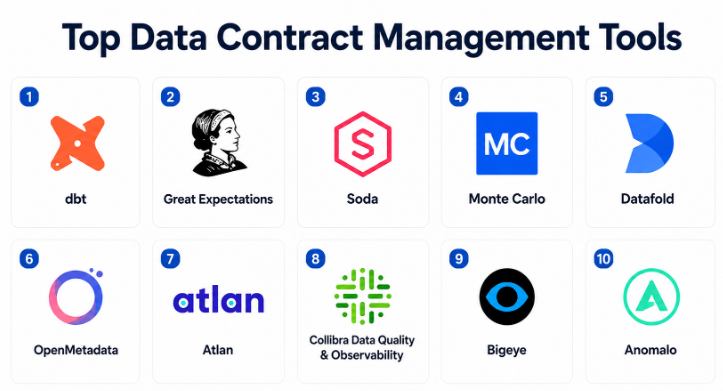
Top 10 Data Contract Management Tools
#1 — dbt
Short description :
dbt is an analytics engineering framework widely used to transform, test, document, and manage data models in modern data warehouses. While dbt is not only a data contract management tool, its model contracts, tests, documentation, and version-controlled workflows make it highly relevant for teams implementing data contracts. It helps analytics engineers define expected columns, data types, constraints, and tests around data models. dbt is especially useful for teams that want contracts close to transformation code. It is best for data teams building trusted analytics models in a code-first workflow.
Key Features
- Model contracts and schema definitions.
- Data tests for quality validation.
- Version-controlled project structure.
- Documentation generation.
- Data lineage through model dependencies.
- CI/CD-friendly workflows.
- Strong ecosystem for analytics engineering.
Pros
- Excellent fit for analytics engineering teams.
- Keeps contracts close to transformation code.
- Strong community and broad warehouse support.
Cons
- Mostly focused on transformed models, not every raw data source.
- Requires engineering discipline and project structure.
- Advanced observability may need additional tools.
Platforms / Deployment
Web / CLI / Cloud and local development workflows
Cloud / Self-managed options vary
Security & Compliance
Security depends on deployment, warehouse permissions, repository controls, and cloud configuration. Specific enterprise security features should be validated based on selected dbt environment.
Integrations & Ecosystem
dbt fits strongly into modern data stacks and engineering workflows.
- Cloud data warehouses.
- Git-based version control.
- CI/CD pipelines.
- Data orchestration tools.
- BI and semantic workflows.
- Data catalog and observability integrations.
Support & Community
dbt has strong documentation, a large community, enterprise support options, and broad adoption among analytics engineering teams.
#2 — Great Expectations
Short description :
Great Expectations is an open-source data quality framework that helps teams define, test, and validate expectations about data. It is highly relevant for data contract management because teams can express rules such as required columns, accepted values, data types, uniqueness, null thresholds, and row-level checks. Great Expectations is useful for data engineers, analytics engineers, ML teams, and governance teams that want programmable data validation. It works well when teams want contracts written as testable expectations. It is best for teams that want flexible, open-source data quality validation.
Key Features
- Data expectation suites.
- Schema and column validation.
- Data quality rule testing.
- Batch and pipeline validation.
- Data documentation.
- Integration with data pipelines.
- Open-source extensibility.
Pros
- Flexible and developer-friendly.
- Strong for defining detailed data expectations.
- Useful across warehouses, lakes, and pipeline workflows.
Cons
- Requires setup and maintenance effort.
- Non-technical users may need help from data engineers.
- Alerting and governance workflows may need additional tooling.
Platforms / Deployment
Python / CLI / Web options vary
Self-hosted / Cloud options vary
Security & Compliance
Security depends on deployment model, storage configuration, data access, and infrastructure controls. Sensitive data validation should be configured carefully.
Integrations & Ecosystem
Great Expectations connects well with data engineering and quality workflows.
- Data warehouses.
- Data lakes.
- Python pipelines.
- Orchestration tools.
- CI/CD workflows.
- Documentation and validation pipelines.
Support & Community
Great Expectations has an active open-source community, documentation, and commercial support options depending on deployment needs.
#3 — Soda
Short description :
Soda is a data quality and data contract platform that helps teams test, monitor, and validate data across pipelines and data products. It supports checks for schema, freshness, completeness, validity, uniqueness, and custom business rules. Soda is useful for data engineers, analytics engineers, data platform teams, and data product owners who want contract-style quality checks with monitoring and alerts. It supports code-based checks and cloud-based collaboration. It is best for teams that want practical data quality rules and contract validation across modern data platforms.
Key Features
- Data quality checks.
- Schema and freshness validation.
- Data contract-style rules.
- Monitoring and alerting.
- Code-based checks.
- Collaboration and dashboards.
- Warehouse and pipeline integrations.
Pros
- Strong for practical data quality monitoring.
- Good balance of engineering and collaboration features.
- Useful for data contract adoption across teams.
Cons
- Setup requires defining meaningful checks.
- Best value depends on integration with data workflows.
- Advanced governance may require additional catalog tools.
Platforms / Deployment
Web / CLI
Cloud / Self-managed options vary
Security & Compliance
Supports business security controls depending on deployment and plan. Specific certifications and compliance details should be validated directly with the vendor.
Integrations & Ecosystem
Soda connects with modern data platforms and engineering workflows.
- Cloud data warehouses.
- Data lakes.
- Orchestration tools.
- CI/CD workflows.
- Alerting tools.
- Data quality dashboards.
Support & Community
Soda provides documentation, community resources, and commercial support options. It is useful for teams that want data quality checks to become operational.
#4 — Monte Carlo
Short description :
Monte Carlo is a data observability platform that helps organizations monitor data freshness, volume, schema changes, lineage, anomalies, and reliability incidents. While it is broader than contract management, it supports many outcomes that data contracts require, such as detecting schema breaks, alerting owners, and showing downstream impact. Monte Carlo is useful for data teams that need automated monitoring across warehouses, lakes, pipelines, and BI systems. It is best for enterprises that want data contracts supported by observability, lineage, and incident management.
Key Features
- Data observability monitoring.
- Freshness, volume, and schema alerts.
- Lineage and impact analysis.
- Anomaly detection.
- Incident workflows.
- Ownership and alert routing.
- Data reliability dashboards.
Pros
- Strong for detecting data incidents early.
- Good lineage and impact visibility.
- Useful for enterprise-scale data reliability.
Cons
- Not primarily a code-first contract definition tool.
- May be more than smaller teams need.
- Contract enforcement may require pairing with testing frameworks.
Platforms / Deployment
Web
Cloud
Security & Compliance
Supports enterprise security features and data access controls depending on plan and configuration. Specific compliance details should be validated directly with the vendor.
Integrations & Ecosystem
Monte Carlo connects with many modern data systems.
- Data warehouses.
- Data lakes.
- BI tools.
- Orchestration tools.
- Data catalogs.
- Incident management and alerting tools.
Support & Community
Monte Carlo provides enterprise onboarding, documentation, support, and data reliability guidance. It is best for teams with mature data platform operations.
#5 — Datafold
Short description :
Datafold is a data quality and data diff platform focused on helping data teams understand how code and data changes affect downstream datasets. It is highly relevant for data contracts because it helps teams compare data before and after changes, validate transformation impact, and reduce broken analytics pipelines. Datafold is useful for analytics engineers and data engineers working with dbt, warehouses, and CI/CD workflows. It helps prevent unintended data changes before deployment. It is best for teams that want data contract validation during development and review.
Key Features
- Data diff and comparison.
- CI/CD validation for data changes.
- dbt workflow support.
- Column-level impact visibility.
- Data quality checks.
- Pull request review support.
- Change impact analysis.
Pros
- Strong for preventing bad data changes before production.
- Very useful for analytics engineering workflows.
- Helps enforce data expectations during code review.
Cons
- More focused on change validation than full governance.
- Best value depends on CI/CD and dbt maturity.
- May need other tools for broad observability and cataloging.
Platforms / Deployment
Web / CI workflows
Cloud
Security & Compliance
Supports business security controls depending on plan and configuration. Specific compliance details should be validated directly with the vendor.
Integrations & Ecosystem
Datafold fits strongly into data development and analytics engineering workflows.
- dbt.
- Git-based workflows.
- CI/CD pipelines.
- Cloud warehouses.
- Pull request review.
- Data quality workflows.
Support & Community
Datafold provides documentation, onboarding support, and technical guidance. It is useful for teams that want safer data model changes.
#6 — OpenMetadata
Short description :
OpenMetadata is an open-source metadata management platform that helps organizations catalog data assets, track lineage, define ownership, manage data quality, and document business context. It supports data contract-style governance by making datasets discoverable, owned, documented, and connected with quality rules. OpenMetadata is useful for data platform teams, governance teams, and engineering teams that want an open metadata foundation. It is best for teams that need data contracts connected with cataloging, lineage, and ownership.
Key Features
- Data catalog.
- Data lineage.
- Data ownership and documentation.
- Data quality tests.
- Glossary and business definitions.
- Metadata APIs.
- Open-source extensibility.
Pros
- Strong open-source metadata foundation.
- Useful for connecting contracts with ownership and lineage.
- Good for teams wanting flexibility and control.
Cons
- Requires deployment and administration effort.
- Contract enforcement may need integration with testing tools.
- Non-technical teams may require onboarding.
Platforms / Deployment
Web
Self-hosted / Cloud options vary
Security & Compliance
Security depends on deployment, access controls, authentication setup, and infrastructure configuration. Enterprise controls should be reviewed before rollout.
Integrations & Ecosystem
OpenMetadata connects with data platforms and governance workflows.
- Data warehouses.
- Data lakes.
- BI tools.
- Orchestration platforms.
- Data quality tools.
- Metadata APIs.
Support & Community
OpenMetadata has an active open-source community, documentation, and commercial support options depending on deployment needs.
#7 — Atlan
Short description :
Atlan is a data collaboration and metadata platform that helps teams discover, govern, document, and manage data assets. It supports ownership, lineage, business glossary, data quality context, and collaboration around data assets. While Atlan is not only a data contract tool, it helps organizations manage the metadata and collaboration layer needed for data contracts. It is useful for data teams that want a modern catalog where producers and consumers can align on definitions, owners, rules, and trust signals. It is best for organizations that want data contracts connected with active metadata and collaboration.
Key Features
- Data catalog and discovery.
- Ownership and stewardship workflows.
- Data lineage.
- Business glossary.
- Data quality context.
- Collaboration and comments.
- Integrations with modern data stack tools.
Pros
- Strong for data collaboration and governance.
- Useful for connecting technical and business users.
- Good active metadata experience.
Cons
- Contract enforcement usually requires integration with quality tools.
- May be more governance-focused than testing-focused.
- Requires adoption across data producers and consumers.
Platforms / Deployment
Web
Cloud
Security & Compliance
Supports enterprise security controls, permissions, and governance features depending on plan. Specific compliance details should be validated directly with the vendor.
Integrations & Ecosystem
Atlan connects with modern data stack and governance workflows.
- Data warehouses.
- BI tools.
- Data quality platforms.
- Orchestration systems.
- Data transformation tools.
- Collaboration workflows.
Support & Community
Atlan provides onboarding, documentation, customer support, and data governance guidance. It is useful for teams building a collaborative data culture.
#8 — Collibra Data Quality & Observability
Short description :
Collibra Data Quality & Observability helps organizations monitor, validate, and govern data quality across enterprise data environments. It is part of the broader Collibra data governance ecosystem, making it useful for teams that need data quality rules connected with governance, lineage, policies, and stewardship. It supports data quality monitoring, anomaly detection, rule management, and trust scoring. It is best for large organizations that need data contract-style quality controls within an enterprise governance program.
Key Features
- Data quality monitoring.
- Rule-based validation.
- Anomaly detection.
- Data observability.
- Governance alignment.
- Data quality dashboards.
- Enterprise stewardship workflows.
Pros
- Strong fit for enterprise governance environments.
- Good for connecting data quality with stewardship.
- Useful for large regulated organizations.
Cons
- May be too complex for small teams.
- Implementation can require governance planning.
- Contract workflows may need process design and integration.
Platforms / Deployment
Web
Cloud / Enterprise deployment options vary
Security & Compliance
Supports enterprise governance, access controls, stewardship workflows, and data quality management. Specific compliance details should be validated directly with the vendor.
Integrations & Ecosystem
Collibra connects data quality with governance and metadata workflows.
- Data governance platforms.
- Data catalogs.
- Data warehouses.
- Data lakes.
- BI systems.
- Stewardship workflows.
Support & Community
Collibra provides enterprise support, documentation, implementation resources, and governance guidance. It is best for mature enterprise data governance programs.
#9 — Bigeye
Short description :
Bigeye is a data observability platform that helps teams monitor data quality, freshness, volume, schema changes, and anomalies. It supports contract-style reliability goals by alerting teams when data breaks expectations or behaves differently than expected. Bigeye is useful for data engineering teams, platform teams, and analytics teams that want continuous monitoring of critical datasets. It helps teams reduce data downtime and improve trust in reporting and downstream systems. It is best for teams that need automated data quality monitoring with observability workflows.
Key Features
- Data observability monitoring.
- Freshness and volume checks.
- Schema change alerts.
- Anomaly detection.
- Data quality metrics.
- Alerting and incident workflows.
- Dataset reliability dashboards.
Pros
- Strong for monitoring data reliability.
- Useful for catching unexpected data issues.
- Helps operationalize data quality at scale.
Cons
- Not mainly a formal contract authoring system.
- May need other tools for metadata governance.
- Best value depends on monitoring critical datasets.
Platforms / Deployment
Web
Cloud
Security & Compliance
Supports business security controls depending on plan and configuration. Specific compliance details should be validated directly with the vendor.
Integrations & Ecosystem
Bigeye connects with data infrastructure and alerting workflows.
- Data warehouses.
- Data lakes.
- Orchestration tools.
- Alerting systems.
- BI workflows.
- Data quality processes.
Support & Community
Bigeye provides documentation, customer support, and data observability guidance. It is useful for data teams focused on reliability and monitoring.
#10 — Anomalo
Short description :
Anomalo is a data quality monitoring platform focused on detecting data issues, anomalies, freshness problems, and unexpected changes in enterprise data. It helps teams identify data quality problems before they affect reporting, business operations, or machine learning systems. Anomalo is relevant to data contract management because it monitors whether datasets continue to behave as expected over time. It is useful for large data teams and organizations that need automated monitoring across important data assets. It is best for teams that want machine-learning-assisted data quality monitoring.
Key Features
- Automated data quality monitoring.
- Anomaly detection.
- Freshness and volume monitoring.
- Schema and distribution change detection.
- Alerting workflows.
- Data issue investigation.
- Enterprise data platform support.
Pros
- Strong for automated anomaly detection.
- Useful for high-volume data environments.
- Helps reduce manual data quality monitoring effort.
Cons
- Not primarily a contract definition framework.
- May need pairing with catalog or testing tools.
- Best fit is organizations with enough data scale to justify monitoring depth.
Platforms / Deployment
Web
Cloud / Enterprise deployment options vary
Security & Compliance
Supports enterprise data monitoring and access controls depending on deployment and plan. Specific compliance details should be validated directly with the vendor.
Integrations & Ecosystem
Anomalo connects with data platforms and operational monitoring workflows.
- Data warehouses.
- Data lakes.
- Enterprise data platforms.
- Alerting tools.
- BI workflows.
- Data quality operations.
Support & Community
Anomalo provides customer support, onboarding, documentation, and data monitoring guidance. It is suitable for organizations that need automated quality detection at scale.
Comparison Table
| Tool Name | Best For | Platform(s) Supported | Deployment | Standout Feature | Public Rating |
|---|---|---|---|---|---|
| dbt | Analytics engineering contracts | Web / CLI / Cloud workflows | Cloud / Self-managed varies | Model contracts and version-controlled tests | N/A |
| Great Expectations | Open-source data validation | Python / CLI / Web varies | Self-hosted / Cloud varies | Flexible expectation-based data quality rules | N/A |
| Soda | Data quality and contract checks | Web / CLI | Cloud / Self-managed varies | Practical data checks and monitoring | N/A |
| Monte Carlo | Enterprise data observability | Web | Cloud | Freshness, schema, lineage, and incident workflows | N/A |
| Datafold | Data diff and CI validation | Web / CI workflows | Cloud | Change impact validation before deployment | N/A |
| OpenMetadata | Open-source metadata and quality governance | Web | Self-hosted / Cloud varies | Catalog, lineage, ownership, and quality context | N/A |
| Atlan | Data collaboration and active metadata | Web | Cloud | Collaborative catalog with ownership and lineage | N/A |
| Collibra Data Quality & Observability | Enterprise governance and data quality | Web | Cloud / Enterprise varies | Data quality connected with governance workflows | N/A |
| Bigeye | Data observability and reliability monitoring | Web | Cloud | Automated quality monitoring and alerts | N/A |
| Anomalo | Automated anomaly-based quality monitoring | Web | Cloud / Enterprise varies | Machine-learning-assisted issue detection | N/A |
Evaluation & Data Contract Management Tools
| Tool Name | Core (25%) | Ease (15%) | Integrations (15%) | Security (10%) | Performance (10%) | Support (10%) | Value (15%) | Weighted Total (0–10) |
|---|---|---|---|---|---|---|---|---|
| dbt | 9 | 8 | 9 | 8 | 9 | 9 | 9 | 8.75 |
| Great Expectations | 9 | 7 | 8 | 7 | 8 | 8 | 9 | 8.15 |
| Soda | 9 | 8 | 8 | 8 | 8 | 8 | 8 | 8.25 |
| Monte Carlo | 9 | 8 | 9 | 9 | 9 | 9 | 7 | 8.60 |
| Datafold | 8 | 8 | 9 | 8 | 8 | 8 | 8 | 8.25 |
| OpenMetadata | 8 | 7 | 9 | 8 | 8 | 8 | 9 | 8.10 |
| Atlan | 8 | 9 | 9 | 9 | 8 | 9 | 7 | 8.45 |
| Collibra Data Quality & Observability | 9 | 7 | 9 | 9 | 8 | 9 | 7 | 8.35 |
| Bigeye | 8 | 8 | 8 | 8 | 8 | 8 | 7 | 7.85 |
| Anomalo | 8 | 8 | 8 | 8 | 8 | 8 | 7 | 7.85 |
These scores are comparative and should be used as a practical guide, not a final ranking. dbt, Great Expectations, and Soda are strong for defining contract-style tests and rules. Monte Carlo, Bigeye, and Anomalo are stronger for monitoring and observability. OpenMetadata, Atlan, and Collibra help connect contracts with governance, ownership, and lineage. Datafold is especially useful when teams want to validate data changes before deployment.
Which Data Contract Management Tools
Solo / Freelancer
Solo data professionals usually do not need a large enterprise data contract platform. A lightweight setup using dbt, Great Expectations, or Soda may be enough for defining tests, schema checks, and quality rules.
A freelancer working with client analytics projects should focus on tools that are easy to explain, version-controlled, and simple to maintain. Overly complex governance platforms may slow down smaller projects.
SMB
Small and medium businesses should focus on practical data reliability before building heavy governance processes. dbt, Great Expectations, Soda, OpenMetadata, and Datafold can be useful depending on data maturity.
If the team already uses dbt, starting with dbt model contracts and tests is practical. If the team needs standalone validation, Great Expectations or Soda may fit better. If metadata and ownership are unclear, OpenMetadata can help.
Mid-Market
Mid-market organizations usually need better data ownership, schema validation, alerting, lineage, CI checks, and business glossary alignment. Soda, Datafold, Monte Carlo, OpenMetadata, and Atlan are strong candidates.
At this stage, companies should define which datasets need contracts first. Critical finance, revenue, product, customer, and ML datasets should be prioritized before trying to govern every table.
Enterprise
Enterprises should prioritize governance, lineage, observability, access control, auditability, alert routing, data stewardship, and integration with many platforms. Monte Carlo, Collibra Data Quality & Observability, Atlan, OpenMetadata, Anomalo, and dbt may be relevant depending on the architecture.
Large organizations should involve data engineering, analytics engineering, governance, security, compliance, platform engineering, and business data owners before standardizing contract workflows.
Budget vs Premium
Budget-conscious teams may start with dbt, Great Expectations, Soda open workflows, or OpenMetadata depending on internal skills and infrastructure.
Premium platforms such as Monte Carlo, Atlan, Collibra, Bigeye, and Anomalo are better when organizations need enterprise observability, governance, stewardship, lineage, support, and scalable monitoring.
Feature Depth vs Ease of Use
If ease of use matters most, Atlan, Monte Carlo, Soda, and Datafold may feel more approachable for teams that want guided workflows and dashboards.
If feature depth and engineering flexibility matter more, dbt, Great Expectations, OpenMetadata, and Collibra can support deeper customization, governance, and integration-heavy architectures.
Integrations & Scalability
Data contract management should connect with warehouses, lakes, transformation tools, orchestration systems, catalogs, BI tools, alerting systems, CI/CD pipelines, and incident management workflows.
For analytics engineering, dbt and Datafold are strong. For data validation, Great Expectations and Soda are useful. For observability, Monte Carlo, Bigeye, and Anomalo are strong. For metadata and governance, OpenMetadata, Atlan, and Collibra are better.
Security & Compliance Needs
Data contracts may involve sensitive customer data, financial data, healthcare data, employee data, product usage data, and regulated datasets. Security and access control should be reviewed before rollout.
Buyers should validate SSO, MFA, role-based access, warehouse permissions, metadata visibility, audit logs, data sampling behavior, data retention, alert routing, and whether sensitive values are exposed inside dashboards or logs.
Frequently Asked Questions
1. What is a Data Contract Management Tool?
A Data Contract Management Tool helps teams define, validate, monitor, and manage expectations for datasets. It can include schema rules, data quality checks, ownership, freshness requirements, allowed values, documentation, alerts, and change management.
2. How is a data contract different from a data quality test?
A data quality test checks whether data meets a specific rule. A data contract is broader because it defines an agreement between producers and consumers, including schema, ownership, quality expectations, documentation, and change rules.
3. What pricing models are common for Data Contract Management Tools?
Pricing may be open-source, usage-based, per-user, per-data-asset, per-warehouse, per-volume, or custom enterprise pricing. Observability and governance platforms often use custom pricing, while open-source frameworks may mainly require internal engineering effort.
4. What are common mistakes when implementing data contracts?
Common mistakes include trying to contract every dataset at once, writing too many rules, ignoring ownership, failing to integrate contracts into CI/CD, and not alerting the right people. Another mistake is treating contracts as documentation only instead of enforceable checks.
5. Which tool is best for dbt-based teams?
dbt is a natural starting point for dbt-based teams because model contracts and tests can live close to transformation code. Datafold is also useful for validating data changes during pull requests, while Soda and Great Expectations can add broader quality checks.
6. Which tool is best for open-source data contracts?
Great Expectations, dbt, and OpenMetadata are strong open-source-friendly options. Great Expectations is strong for validation rules, dbt is strong for analytics model contracts, and OpenMetadata is useful for cataloging, ownership, and metadata context.
7. Which tool is best for enterprise governance?
Collibra Data Quality & Observability, Atlan, OpenMetadata, Monte Carlo, and dbt can all support enterprise-style contract programs depending on architecture. The best choice depends on whether governance, observability, engineering workflows, or metadata management is the main priority.
8. Can Data Contract Management Tools prevent broken dashboards?
Yes, they can reduce broken dashboards by catching schema changes, missing fields, freshness issues, and data quality problems before or soon after they happen. However, prevention depends on good rules, proper integration, clear ownership, and alert response.
9. Do data contracts work for machine learning pipelines?
Yes, data contracts are useful for ML pipelines because models depend on stable features, correct data types, valid distributions, and reliable freshness. Contract checks can help detect feature drift, missing values, schema changes, and pipeline failures.
10. What integrations should buyers check?
Buyers should check data warehouses, data lakes, dbt, orchestration tools, BI platforms, catalogs, CI/CD systems, alerting tools, incident management platforms, notebooks, and data governance tools. Integration fit is one of the most important buying factors.
Conclusion
Data Contract Management Tools help organizations make data more reliable by defining clear expectations between data producers and consumers. They reduce the risk of broken dashboards, failed pipelines, incorrect metrics, and unstable machine learning inputs. The best tool depends on your data stack and maturity. dbt is strong for analytics engineering contracts, Great Expectations is powerful for open-source validation, Soda is practical for data quality checks, Datafold is useful for CI-based change validation, and Monte Carlo, Bigeye, and Anomalo support observability and incident detection.
