Introduction
Customer Consent & Preferences Centers are platforms that help businesses collect, manage, store, update, and honor customer permissions and communication choices. In simple English, these tools let customers decide what they want to receive, how they want to be contacted, and what data they allow a company to use.
A customer may agree to receive email offers but not SMS. Another customer may allow personalization but reject advertising cookies. Someone else may want product updates but not promotional messages. Without a proper consent and preference center, businesses may send unwanted messages, create poor customer experiences, or fail to respect privacy expectations.
These tools matter because customers expect more control over their data and communication choices. At the same time, marketing, product, legal, privacy, and data teams need a reliable way to prove consent, manage opt-ins, process opt-outs, and keep systems aligned.
Common use cases include cookie consent, email preferences, SMS consent, privacy request handling, marketing opt-ins, newsletter subscriptions, data sharing permissions, app permissions, regional compliance workflows, and customer communication management.
Buyers should evaluate consent capture, preference management, audit trails, integrations, data governance, customization, consent versioning, APIs, user experience, localization, security, reporting, and scalability.
Best for: Marketing teams, privacy teams, legal teams, ecommerce brands, SaaS companies, publishers, financial services, healthcare-adjacent organizations, enterprises, agencies, and companies managing customer communication across many channels.
Not ideal for: Very small websites with minimal data collection, companies that only need a basic newsletter unsubscribe form, or teams without clear privacy and communication policies.
Key Trends in Customer Consent & Preferences Centers
- Consent is becoming a customer experience issue: Customers do not only want legal forms. They want clear choices, simple language, and easy control over communication.
- Preference centers are moving beyond email: Modern tools manage SMS, push notifications, app messages, WhatsApp, newsletters, product updates, personalization, and partner data sharing.
- Consent records need stronger auditability: Businesses need proof of when, where, how, and under which policy version consent was collected.
- Cookie consent and communication preferences are becoming connected: Companies want one place to manage web tracking consent, marketing opt-ins, and customer communication choices.
- APIs are becoming important: Consent and preferences must sync with CRM, CDP, marketing automation, ecommerce, customer support, data warehouses, and advertising systems.
- Regional consent rules require flexibility: Businesses operating across countries need localized banners, preference language, consent models, and data handling workflows.
- Zero-party data is gaining value: Preference centers now help collect customer-selected interests, product choices, categories, and content preferences.
- Consent enforcement matters more than consent capture: It is not enough to collect consent. Businesses must ensure downstream systems respect it.
- Design and trust are key differentiators: Poorly designed preference centers can reduce opt-ins, while transparent choices can improve customer trust.
- Enterprise teams want central governance: Large organizations need one consent system across brands, regions, channels, and business units.
How We Selected These Tools
The following tools were selected based on practical use cases across consent management, preference centers, privacy operations, marketing compliance, and customer experience.
- Market recognition: Tools commonly known in privacy technology, consent management, customer data governance, and preference management were prioritized.
- Feature completeness: Platforms were evaluated for consent capture, preference management, audit logs, APIs, customization, localization, and reporting.
- Customer communication fit: Preference center capabilities across email, SMS, push, and marketing channels were considered important.
- Privacy governance: Tools with consent records, policy versioning, user rights workflows, and access controls were considered stronger.
- Integration ecosystem: Stronger platforms connect with CRM, CDP, marketing automation, tag managers, websites, apps, ecommerce systems, and data warehouses.
- Ease of use: Business-friendly setup, templates, visual editors, and manageable administration were considered valuable.
- Scalability: Preference was given to tools that can support multiple brands, regions, teams, languages, and customer databases.
- Security posture: Access controls, encryption, auditability, and enterprise review readiness were considered, but no certifications are assumed.
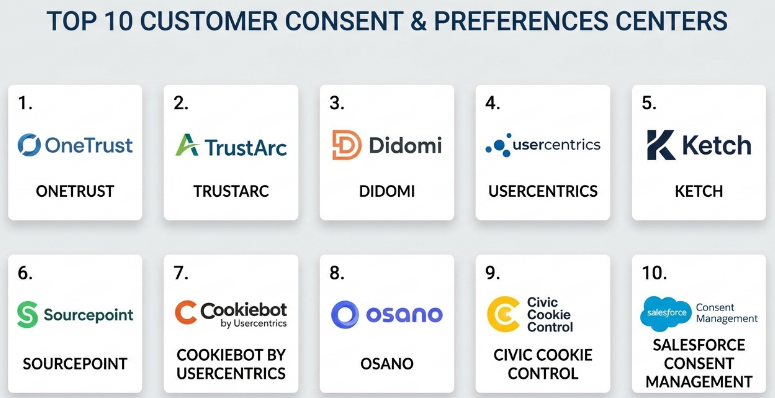
Top 10 Customer Consent & Preferences Centers
#1 — OneTrust
Short description :
OneTrust is a widely recognized privacy management platform that supports consent management, preference centers, cookie consent, privacy request workflows, and broader governance needs. It is suitable for enterprises that need centralized privacy operations across many brands, regions, websites, apps, and systems. OneTrust helps teams collect consent, maintain records, manage user choices, and connect privacy workflows with marketing and data systems. It is especially useful for companies with complex legal, privacy, and compliance needs. The platform is best for organizations that want an enterprise-grade privacy and consent management ecosystem.
Key Features
- Cookie consent management
- Customer preference center
- Consent recordkeeping and audit trails
- Privacy request workflows
- Policy and notice management
- Multi-region and multi-language support
- Integration with marketing and data systems
Pros
- Strong enterprise privacy management ecosystem.
- Useful for complex global consent and preference needs.
- Supports more than basic cookie banners.
Cons
- May be complex for small teams.
- Implementation can require legal, privacy, and technical involvement.
- Pricing may be more suitable for larger organizations.
Platforms / Deployment
Web-based platform.
Cloud deployment.
Security & Compliance
Enterprise-grade security and governance features may be available depending on plan and configuration. Buyers should validate exact security controls directly.
SOC 2, ISO 27001, HIPAA: Not publicly stated here.
Integrations & Ecosystem
OneTrust fits into enterprise privacy, marketing, data governance, and compliance workflows. It is commonly used where consent needs to be connected with multiple internal systems.
- Websites and apps
- Tag management systems
- CRM platforms
- Marketing automation tools
- Data warehouses
- Privacy operations workflows
Support & Community
OneTrust provides documentation, onboarding, enterprise support, training resources, and partner ecosystem support. It has strong recognition among privacy, legal, compliance, and enterprise data teams.
#2 — TrustArc
Short description :
TrustArc is a privacy management platform that helps organizations manage consent, preferences, privacy programs, and regulatory workflows. It is suitable for companies that need a structured approach to customer consent, cookie consent, privacy assessments, and compliance operations. TrustArc can support privacy teams, legal teams, marketing teams, and data governance teams. It is useful for organizations that want both consent management and broader privacy program support. The platform is best for mid-market and enterprise companies with formal privacy requirements.
Key Features
- Consent and preference management
- Cookie consent workflows
- Privacy program management
- Assessment and compliance workflows
- Audit and reporting support
- Multi-jurisdiction privacy support
- Data governance alignment
Pros
- Strong fit for privacy and compliance teams.
- Useful for organizations needing structured privacy workflows.
- Supports consent as part of a broader privacy program.
Cons
- May be more than small websites need.
- Setup may require privacy and legal input.
- Some capabilities may depend on package and configuration.
Platforms / Deployment
Web-based platform.
Cloud deployment.
Security & Compliance
Security and compliance controls should be validated directly during procurement.
SOC 2, ISO 27001, HIPAA: Not publicly stated here.
Integrations & Ecosystem
TrustArc supports privacy and consent workflows that may connect with websites, marketing tools, compliance systems, and data governance processes.
- Websites
- Cookie consent tools
- Privacy assessment workflows
- Marketing systems
- Data governance processes
- Compliance reporting
Support & Community
TrustArc provides support, privacy resources, onboarding, and professional guidance. It is recognized among privacy, legal, and compliance professionals.
#3 — Didomi
Short description :
Didomi is a consent and preference management platform designed to help organizations collect, store, and activate customer consent across websites, apps, and marketing systems. It is suitable for brands, publishers, ecommerce companies, and enterprises that need a customer-friendly way to manage privacy choices. Didomi supports cookie consent, preference centers, consent records, and integrations with business systems. It is especially useful when organizations want a strong user experience around consent and preferences. The platform is best for teams that want consent management connected with marketing activation.
Key Features
- Consent management platform
- Preference center
- Cookie consent banners
- Consent storage and auditability
- Cross-device and cross-channel consent workflows
- API and integration support
- Multi-language and regional configuration
Pros
- Strong focus on consent and preference user experience.
- Useful for marketing and privacy alignment.
- Good fit for websites, apps, and customer communication choices.
Cons
- Advanced enterprise use may require careful setup.
- Best value depends on integration with downstream systems.
- Pricing details may require vendor discussion.
Platforms / Deployment
Web-based platform.
Cloud deployment.
Security & Compliance
Security and privacy controls should be validated directly with the vendor.
SOC 2, ISO 27001, HIPAA: Not publicly stated.
Integrations & Ecosystem
Didomi fits into digital consent and preference workflows where customer choices must flow into marketing, data, and analytics tools.
- Websites and mobile apps
- Tag management systems
- CRM platforms
- Marketing automation tools
- Customer data platforms
- API-based workflows
Support & Community
Didomi provides documentation, onboarding, and support resources. It is recognized among privacy, marketing, and digital experience teams.
#4 — Usercentrics
Short description :
Usercentrics is a consent management platform that helps businesses manage cookie consent, app consent, privacy preferences, and consent records. It is suitable for websites, ecommerce businesses, agencies, SaaS companies, publishers, and enterprises that need configurable consent workflows. Usercentrics is commonly used to manage tracking technologies and user permissions across digital properties. It can support privacy-friendly customer experiences while helping teams control which tools are activated based on user choices. The platform is best for teams that need a strong consent management layer for websites and apps.
Key Features
- Cookie consent management
- App consent management
- Consent record storage
- Preference management
- Tag and script control
- Multi-language support
- Compliance-oriented consent workflows
Pros
- Strong fit for website and app consent needs.
- Useful for managing tracking technologies.
- Suitable for agencies and multi-site businesses.
Cons
- Broader preference center depth may vary by use case.
- Advanced integrations may require technical setup.
- Not a full privacy operations suite for every enterprise need.
Platforms / Deployment
Web-based platform.
Cloud deployment.
Security & Compliance
Security and compliance controls should be validated directly with the vendor.
SOC 2, ISO 27001, HIPAA: Not publicly stated.
Integrations & Ecosystem
Usercentrics connects consent choices with digital tracking, tag management, and marketing systems.
- Websites
- Mobile apps
- Tag managers
- Analytics tools
- Marketing pixels
- Consent reporting workflows
Support & Community
Usercentrics provides documentation, support, and implementation resources. It has strong visibility among website owners, digital teams, agencies, and privacy-focused marketers.
#5 — Ketch
Short description :
Ketch is a privacy operations and data control platform that helps organizations manage consent, preferences, privacy rights, and data governance workflows. It is designed for teams that want to automate privacy choices across systems and ensure customer preferences are enforced downstream. Ketch is suitable for modern digital businesses, SaaS companies, ecommerce brands, and enterprises managing customer data across many platforms. It is especially useful when consent must connect with data governance and automation. The platform is best for organizations that want privacy controls embedded into data operations.
Key Features
- Consent and preference management
- Privacy rights automation
- Data governance workflows
- Consent enforcement across systems
- Policy and jurisdiction support
- Customer data control
- API-driven privacy operations
Pros
- Strong focus on operationalizing privacy choices.
- Useful for connecting consent with data governance.
- Good fit for data-driven digital businesses.
Cons
- May require technical and data operations setup.
- Not ideal for teams wanting only a basic cookie banner.
- Full value depends on system integrations.
Platforms / Deployment
Web-based platform.
Cloud deployment.
Security & Compliance
Security and governance controls should be validated directly with the vendor.
SOC 2, ISO 27001, HIPAA: Not publicly stated.
Integrations & Ecosystem
Ketch fits into privacy operations, data governance, and customer preference workflows where choices must be applied across systems.
- Websites and apps
- Data platforms
- Marketing tools
- CRM systems
- Privacy request workflows
- API-based data control
Support & Community
Ketch provides onboarding, documentation, and support resources. It is relevant for privacy, data, marketing, and engineering teams working on operational privacy.
#6 — Sourcepoint
Short description :
Sourcepoint is a consent management and privacy experience platform used by publishers, media companies, brands, and digital businesses. It helps organizations manage user consent for advertising, cookies, tracking technologies, and privacy choices. Sourcepoint is especially relevant for publishers and media companies that depend on advertising revenue and need consent workflows across digital properties. It supports user-facing privacy experiences while helping teams manage vendor consent and tracking controls. The platform is best for organizations where advertising consent and user experience are tightly connected.
Key Features
- Consent management platform
- Privacy experience management
- Cookie and vendor consent workflows
- Publisher and media use cases
- Multi-property consent support
- Reporting and compliance workflows
- Advertising ecosystem alignment
Pros
- Strong fit for publishers and media businesses.
- Useful for ad tech consent workflows.
- Supports privacy experiences across multiple digital properties.
Cons
- May be less relevant for businesses without advertising use cases.
- Advanced setup may require privacy and ad operations expertise.
- Broader preference management may depend on configuration.
Platforms / Deployment
Web-based platform.
Cloud deployment.
Security & Compliance
Security and compliance details should be validated directly with the vendor.
SOC 2, ISO 27001, HIPAA: Not publicly stated.
Integrations & Ecosystem
Sourcepoint is strongest in publisher, media, and advertising consent workflows where vendor permissions and ad tech integrations matter.
- Publisher websites
- Advertising platforms
- Consent frameworks
- Tag management systems
- Analytics systems
- Privacy reporting workflows
Support & Community
Sourcepoint provides customer support, documentation, and implementation guidance. It has strong recognition in publisher, media, and ad tech privacy environments.
#7 — Cookiebot by Usercentrics
Short description :
Cookiebot by Usercentrics is a cookie consent and tracking technology management tool used by websites, SMBs, agencies, and digital teams. It helps scan websites for cookies, display consent banners, manage user choices, and block tracking until consent is given where required. Cookiebot is especially useful for businesses that need a practical way to manage cookie consent without building custom workflows. It is best for teams that need website-focused consent management rather than a broad enterprise privacy platform.
Key Features
- Cookie scanning
- Cookie consent banners
- Consent recordkeeping
- Automatic cookie declaration support
- Script blocking based on consent
- Multi-language banner support
- Website consent reporting
Pros
- Practical for website cookie consent.
- Good fit for SMBs and agencies.
- Easier to implement than large enterprise suites.
Cons
- Not a full customer preference center.
- Limited compared with broader privacy operations platforms.
- Best suited for website consent rather than complex data governance.
Platforms / Deployment
Web-based platform.
Cloud deployment.
Security & Compliance
Security and compliance details should be validated directly.
SOC 2, ISO 27001, HIPAA: Not publicly stated.
Integrations & Ecosystem
Cookiebot fits into website and tag management workflows where cookie consent must control tracking technologies.
- Websites
- CMS platforms
- Tag managers
- Analytics tools
- Marketing pixels
- Cookie reporting workflows
Support & Community
Cookiebot has documentation, support resources, and broad adoption among website owners, agencies, and SMBs.
#8 — Osano
Short description :
Osano is a privacy management platform that supports cookie consent, privacy notices, data subject requests, and privacy compliance workflows. It is suitable for SMBs, mid-market companies, SaaS businesses, and enterprises that need practical privacy management without unnecessary complexity. Osano helps teams manage website consent and broader privacy obligations from one platform. It is especially useful for organizations that want a privacy platform that is easier to operationalize than heavy enterprise suites. The platform is best for teams that need consent plus privacy operations support.
Key Features
- Cookie consent management
- Privacy notice management
- Data subject request workflows
- Vendor privacy management
- Consent reporting
- Multi-region privacy support
- Privacy compliance dashboard
Pros
- Practical privacy management platform.
- Good fit for SMB and mid-market teams.
- Combines consent with broader privacy workflows.
Cons
- Advanced preference center requirements may need validation.
- Enterprise customization may depend on plan.
- Not only focused on customer communication preferences.
Platforms / Deployment
Web-based platform.
Cloud deployment.
Security & Compliance
Security and privacy controls should be validated directly with the vendor.
SOC 2, ISO 27001, HIPAA: Not publicly stated here.
Integrations & Ecosystem
Osano fits into website privacy, consent, compliance, and vendor management workflows.
- Websites
- Cookie consent workflows
- Privacy request systems
- Vendor management
- Compliance reporting
- Marketing and analytics tools
Support & Community
Osano provides documentation, onboarding resources, and support. It is recognized among privacy teams, SMBs, SaaS companies, and compliance-focused businesses.
#9 — Civic Cookie Control
Short description :
Civic Cookie Control is a consent management tool designed to help websites manage cookie consent and user privacy choices. It is useful for organizations that need a clear, configurable consent interface for cookies and tracking technologies. Civic Cookie Control is suitable for websites, public sector organizations, agencies, and businesses that need practical consent controls without a large enterprise suite. It can help manage user choices, consent categories, and cookie declarations. The platform is best for teams that need straightforward website consent management.
Key Features
- Cookie consent management
- User consent interface
- Consent categories
- Cookie declarations
- Configurable consent behavior
- Website privacy controls
- Reporting support
Pros
- Practical for website cookie consent.
- Suitable for organizations needing straightforward implementation.
- Clear focus on consent choice management.
Cons
- Not a full enterprise preference center.
- Limited compared with large privacy platforms.
- Broader data governance requires additional tools.
Platforms / Deployment
Web-based platform.
Cloud deployment.
Security & Compliance
Security and compliance details should be validated directly with the vendor.
SOC 2, ISO 27001, HIPAA: Not publicly stated.
Integrations & Ecosystem
Civic Cookie Control fits into website, CMS, and tag management workflows where cookie categories and user choices must be managed.
- Websites
- CMS platforms
- Tag management workflows
- Analytics tools
- Marketing scripts
- Consent reporting
Support & Community
Support and documentation are available depending on plan. It is mainly relevant to website owners, public sector teams, and organizations needing cookie consent management.
#10 — Salesforce Consent Management
Short description :
Salesforce Consent Management helps organizations capture, store, and manage customer consent and privacy preferences within Salesforce environments. It is especially useful for businesses already using Salesforce CRM, Marketing Cloud, Service Cloud, or related customer data workflows. The platform helps connect consent records with customer profiles, communication preferences, and business processes. It is suitable for sales, service, marketing, privacy, and customer experience teams that rely heavily on Salesforce. The best fit is an organization that wants consent and preference management close to CRM and customer engagement workflows.
Key Features
- Consent and preference records
- CRM-connected customer permissions
- Communication preference management
- Customer profile alignment
- Salesforce ecosystem integration
- Privacy and data use workflows
- Support for customer data governance
Pros
- Strong fit for Salesforce users.
- Connects consent with CRM and customer engagement.
- Useful for sales, service, and marketing workflows.
Cons
- Best value depends on Salesforce adoption.
- May require configuration and admin expertise.
- Not ideal for companies outside the Salesforce ecosystem.
Platforms / Deployment
Web-based platform.
Cloud deployment.
Security & Compliance
Salesforce provides enterprise security capabilities across its platform, but exact controls for consent workflows should be validated directly.
SOC 2, ISO 27001, HIPAA: Not publicly stated here.
Integrations & Ecosystem
Salesforce Consent Management works best inside Salesforce-based business processes where customer permissions must connect with CRM, marketing, service, and data workflows.
- Salesforce CRM
- Marketing Cloud workflows
- Service workflows
- Customer profiles
- Communication preferences
- Reporting dashboards
Support & Community
Salesforce offers documentation, enterprise support, admin resources, partner support, and a large user community. Implementation quality depends on Salesforce configuration maturity.
Comparison Table Top 10
| Tool Name | Best For | Platform Supported | Deployment | Standout Feature | Public Rating |
|---|---|---|---|---|---|
| OneTrust | Enterprise privacy and preference management | Web | Cloud | Broad privacy platform with consent and preference workflows | N/A |
| TrustArc | Privacy program and consent management | Web | Cloud | Consent connected with privacy governance | N/A |
| Didomi | Customer-friendly consent and preference centers | Web | Cloud | Strong consent UX and preference workflows | N/A |
| Usercentrics | Website and app consent management | Web | Cloud | Consent management for digital tracking technologies | N/A |
| Ketch | Privacy operations and data control | Web | Cloud | Consent enforcement across data systems | N/A |
| Sourcepoint | Publisher and ad tech consent workflows | Web | Cloud | Advertising consent and privacy experience management | N/A |
| Cookiebot by Usercentrics | SMB website cookie consent | Web | Cloud | Cookie scanning and banner management | N/A |
| Osano | Practical privacy management for growing teams | Web | Cloud | Consent plus privacy operations workflows | N/A |
| Civic Cookie Control | Straightforward website cookie consent | Web | Cloud | Configurable cookie consent interface | N/A |
| Salesforce Consent Management | Salesforce-based customer permissions | Web | Cloud | Consent records inside CRM workflows | N/A |
Evaluation & Customer Consent & Preferences Centers
| Tool Name | Core 25% | Ease 15% | Integrations 15% | Security 10% | Performance 10% | Support 10% | Value 15% | Weighted Total 0–10 |
|---|---|---|---|---|---|---|---|---|
| OneTrust | 9 | 7 | 9 | 8 | 8 | 8 | 7 | 8.10 |
| TrustArc | 8 | 7 | 8 | 8 | 8 | 8 | 7 | 7.80 |
| Didomi | 8 | 8 | 8 | 7 | 8 | 7 | 8 | 7.80 |
| Usercentrics | 8 | 8 | 8 | 7 | 8 | 7 | 8 | 7.80 |
| Ketch | 8 | 7 | 8 | 8 | 8 | 7 | 8 | 7.75 |
| Sourcepoint | 8 | 7 | 8 | 7 | 8 | 7 | 7 | 7.55 |
| Cookiebot by Usercentrics | 7 | 9 | 7 | 7 | 8 | 7 | 9 | 7.70 |
| Osano | 8 | 8 | 7 | 7 | 8 | 7 | 8 | 7.65 |
| Civic Cookie Control | 7 | 8 | 6 | 6 | 7 | 7 | 8 | 7.05 |
| Salesforce Consent Management | 8 | 7 | 9 | 8 | 8 | 8 | 8 | 8.00 |
These scores are comparative and should be used as a shortlist guide, not as final buying advice. Enterprise privacy teams may value OneTrust, TrustArc, Ketch, or Salesforce Consent Management more highly. Publishers may prefer Sourcepoint. SMBs and agencies may find Cookiebot, Usercentrics, Osano, or Civic Cookie Control more practical. Always validate integrations, security, consent records, localization, and downstream enforcement before choosing.
Which Customer Consent & Preferences Centers
Solo / Freelancer
Solo users and freelancers usually do not need a heavy privacy operations platform. For small websites, Cookiebot, Civic Cookie Control, Usercentrics, or Osano may be enough depending on consent needs.
Freelancers helping clients should focus on clarity, correct implementation, and simple preference design. A small business does not need a complex enterprise system if it only needs cookie consent and basic communication preferences.
SMB
Small and mid-sized businesses should choose a tool that is easy to manage and integrates with their website, email platform, CRM, and analytics stack. Cookiebot, Usercentrics, Osano, Didomi, or Civic Cookie Control may be practical.
SMBs should avoid building a preference center without clear communication categories. They should define what customers can choose, such as newsletters, offers, product updates, SMS alerts, event updates, or personalization preferences.
Mid-Market
Mid-market companies often need more than a simple cookie banner. They may need cookie consent, email preferences, SMS consent, app preferences, data usage permissions, and privacy request workflows.
Didomi, Usercentrics, Osano, Ketch, Salesforce Consent Management, and TrustArc may fit depending on systems already in place. Teams should prioritize integrations and downstream enforcement so preferences are respected across marketing and customer systems.
Enterprise
Enterprise companies need centralized consent governance across regions, brands, languages, systems, and business units. They also need audit logs, access controls, legal review, privacy workflows, and integration with enterprise systems.
OneTrust, TrustArc, Ketch, Salesforce Consent Management, Sourcepoint, and Didomi may be stronger candidates depending on industry. Large companies should involve legal, privacy, data, marketing, IT, and security teams before implementation.
Budget vs Premium
Budget-focused teams should start with the minimum tool that handles consent correctly and clearly. A basic website consent tool may be enough for simple needs.
Premium tools are useful when consent must connect with many systems, brands, regions, customer databases, privacy requests, and compliance workflows. The right investment should reduce privacy risk, improve customer trust, and simplify operations.
Feature Depth vs Ease of Use
Cookiebot, Civic Cookie Control, Osano, and Usercentrics can be easier to adopt for common website consent needs. They are useful when implementation speed matters.
OneTrust, TrustArc, Ketch, Didomi, Sourcepoint, and Salesforce Consent Management offer deeper capabilities but require more planning. These tools are better when consent must connect with broader privacy, marketing, CRM, and governance workflows.
Integrations & Scalability
A good consent and preference center should connect with the systems that send messages, collect data, and activate customer profiles. Important integrations include CRM, CDP, email platforms, SMS tools, marketing automation, websites, apps, tag managers, analytics tools, ecommerce systems, and data warehouses.
Scalability matters when the company adds more brands, countries, languages, websites, mobile apps, customer segments, and communication channels. Buyers should check whether the tool can support consent versioning, preference categories, APIs, audit logs, and role-based access.
Security & Compliance Needs
Consent and preference platforms may store sensitive customer choices, identifiers, communication permissions, and privacy request records. Security review is important before implementation.
Buyers should evaluate SSO, SAML, MFA, RBAC, encryption, audit logs, data retention, data residency, consent proof, policy versioning, access permissions, and vendor security documentation. If certifications are not clearly published, request formal confirmation during procurement.
Frequently Asked Questions FAQs
1. What are Customer Consent & Preferences Centers?
Customer Consent & Preferences Centers are tools that let customers manage permissions and communication choices. They help businesses collect, store, update, and honor opt-ins, opt-outs, cookie choices, email preferences, SMS consent, and data usage permissions. They also help teams maintain proof of consent.
2. Why does a business need a consent and preference center?
A business needs one because customers expect control over how their data is used and how they are contacted. A preference center helps reduce unwanted messages, improve trust, and support privacy operations. It also helps marketing, legal, and data teams work from the same customer permission record.
3. What is the difference between consent management and preference management?
Consent management focuses on legal permission to collect, process, or use data. Preference management focuses on customer choices such as topics, channels, frequency, and message types. The best systems connect both so businesses know what they are allowed to do and what the customer actually prefers.
4. What channels should a preference center support?
A modern preference center may support email, SMS, push notifications, WhatsApp, phone calls, newsletters, product updates, event invites, promotions, personalization, cookie choices, and data sharing permissions. The right channels depend on the company’s customer journey and communication strategy.
5. How much do Customer Consent & Preferences Centers cost?
Pricing varies based on website traffic, number of users, domains, consent records, regions, integrations, support level, and enterprise features. Some tools are priced for SMB websites, while others use enterprise contracts. Buyers should ask about setup, API usage, domains, languages, and support costs.
6. How long does implementation usually take?
Implementation can be quick for a basic cookie banner, but a full preference center may take longer because it needs integrations with CRM, email, SMS, CDP, and data systems. The main work is not only installing the tool but ensuring all downstream systems honor customer choices.
7. What are common mistakes when implementing preference centers?
Common mistakes include using confusing language, offering too many unclear choices, failing to sync preferences across systems, ignoring mobile app consent, and not keeping audit records. Another mistake is collecting consent but not enforcing it in marketing and analytics tools.
8. Can a preference center improve marketing performance?
Yes, when designed well, it can improve trust and reduce unsubscribes by letting customers choose relevant topics and channels. Instead of losing a subscriber completely, a business may allow them to reduce frequency or select preferred content. This can improve long-term engagement quality.
9. Are consent and preference platforms secure?
Many platforms provide security controls, but details vary by vendor and plan. Buyers should verify SSO, MFA, RBAC, encryption, audit logs, data retention, data residency, and consent record protection. Do not assume certifications unless the vendor confirms them directly.
10. Can these tools integrate with CRM and marketing automation?
Yes, many consent and preference platforms integrate with CRM, CDP, email marketing, SMS, marketing automation, tag managers, websites, apps, and data warehouses. Integration quality is very important because customer choices must be respected across every system that uses customer data.
Conclusion
Customer Consent & Preferences Centers are important because customers want control, and businesses need reliable permission management. A good consent and preference system does more than display a cookie banner. It helps customers choose what they want, helps marketing teams communicate responsibly, helps privacy teams maintain records, and helps data teams enforce permissions across systems.
