Introduction
Preference Management Tools help organizations collect, store, update, and honor user choices across communication, privacy, marketing, and data-sharing touchpoints. In plain English, these tools let customers decide what they want to receive, how they want to be contacted, what data they allow, and which channels they prefer. This may include email preferences, SMS consent, cookie consent, data processing choices, newsletter subscriptions, product updates, and privacy rights requests.
Preference management matters more now because customers expect control, regulators expect proof, and businesses need cleaner consent data across CRM, marketing automation, websites, apps, and customer data platforms. A weak preference setup can lead to poor customer experience, compliance risk, duplicate communication, and lost trust.
Common real-world use cases include managing marketing subscriptions, capturing consent for cookies, syncing preferences to CRM, handling privacy requests, and creating customer self-service preference centers.
Buyers should evaluate ease of setup, consent audit history, integrations, API flexibility, privacy regulation support, identity matching, scalability, reporting, user experience, and admin controls.
Best for: marketing teams, privacy teams, legal teams, CRM owners, SaaS companies, eCommerce brands, financial services, healthcare-adjacent organizations, and enterprises that manage customer communication across multiple regions and channels.
Not ideal for: very small businesses with only one newsletter list, teams already using a simple email unsubscribe page, or companies that do not collect personal data across multiple systems. In those cases, built-in email marketing preferences or a basic CRM consent field may be enough.
Key Trends in Preference Management Tools
- Centralized consent and preference hubs are becoming standard because customer data now moves across CRM, CDP, email, SMS, support, product analytics, and advertising tools.
- Privacy-first customer experience is now a business requirement, not just a legal checkbox. Modern buyers want clear preference centers that are easy for users to understand.
- AI-assisted data mapping and automation are becoming more common, especially in larger privacy platforms that help classify data, detect consent gaps, and automate workflows.
- Omnichannel preference management is growing because customers may consent to email but not SMS, accept service alerts but reject promotions, or prefer app notifications over newsletters.
- Integration depth matters more than standalone features because preferences must be synchronized quickly across marketing, sales, support, analytics, and data platforms.
- Granular consent records are becoming more important for organizations that need proof of when, where, and how consent was captured.
- Self-service preference centers are replacing manual support workflows, allowing users to update preferences without contacting customer service.
- Developer-friendly APIs are gaining importance as SaaS companies and product teams need preference controls inside apps, portals, and custom workflows.
- Regional privacy requirements are shaping product selection, especially for companies operating across the US, EU, India, and other privacy-sensitive markets.
- Pricing is moving toward modular and usage-based models, especially for platforms that bundle cookie consent, privacy rights automation, data discovery, and preference management.
How We Selected These Tools
The tools below were selected using practical buyer-focused evaluation logic rather than a single public ranking.
- Market adoption and mindshare: Preference was given to tools commonly known in privacy, consent, customer preference, and trust management workflows.
- Feature completeness: Tools were evaluated for preference centers, consent capture, audit history, privacy workflows, and cross-channel preference handling.
- Reliability and performance signals: Preference was given to platforms suitable for business-critical customer data and web consent experiences.
- Security posture signals: Tools with enterprise-grade access controls, governance features, auditability, and privacy-focused architecture were prioritized.
- Integrations and ecosystem: CRM, CDP, marketing automation, tag management, website, API, and data platform integrations were considered.
- Customer fit across segments: The list balances enterprise platforms, mid-market tools, developer-friendly options, and practical SMB choices.
- Compliance readiness: Tools were assessed based on how well they support consent, privacy operations, and regulation-aligned workflows.
- User experience: Preference was given to platforms that help create clear, user-friendly consent and preference journeys.
- Scalability: Tools suitable for multi-brand, multi-region, multi-language, and high-volume customer environments were prioritized.
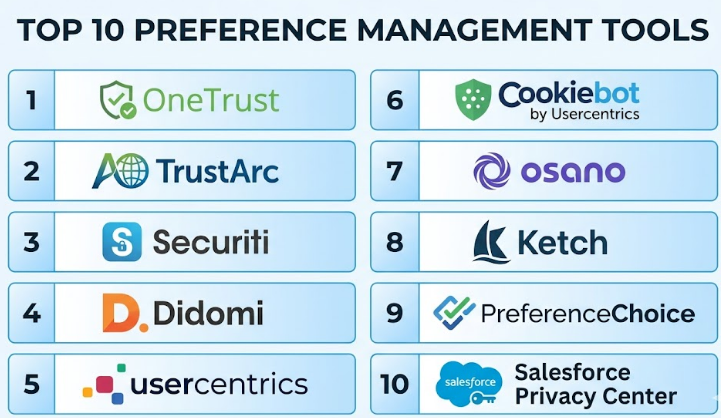
Top 10 Preference Management Tools
#1 — OneTrust
Short description :
OneTrust is one of the most recognized privacy, consent, and trust management platforms. It helps organizations manage consent, cookie preferences, privacy requests, data governance workflows, and customer trust programs. It is best suited for mid-market and enterprise teams that need a broad privacy operating system rather than a simple preference page. OneTrust is commonly used by legal, privacy, marketing, IT, and security teams. It can support complex global privacy programs across websites, apps, data systems, and customer channels.
Key Features
- Consent and preference management across websites and digital properties.
- Cookie consent and consent banner management.
- Privacy rights request workflows.
- Data mapping and governance capabilities.
- Consent records and audit trails.
- Multi-region and multi-language support.
- Integrations with marketing, CRM, and data systems.
Pros
- Strong fit for enterprise privacy and compliance teams.
- Broad platform covering more than preference management alone.
- Useful for companies operating across multiple regions and brands.
Cons
- Can be complex for smaller teams.
- Pricing and implementation may be heavy for simple use cases.
- Admin experience may require training and internal ownership.
Platforms / Deployment
Web / Cloud
Security & Compliance
Supports privacy workflows aligned with GDPR, CCPA/CPRA, and related data privacy requirements. Enterprise access controls, audit history, and role-based workflows are commonly associated with the platform. Specific certification details should be validated directly with the vendor.
Integrations & Ecosystem
OneTrust has a broad ecosystem for privacy, marketing, data governance, and consent workflows. It is designed to connect consent signals across different business systems.
- CRM platforms.
- Marketing automation tools.
- Tag management systems.
- Data governance platforms.
- Website and app consent layers.
- API-based custom integrations.
Support & Community
OneTrust provides enterprise-oriented documentation, onboarding, professional services, and customer support options. The platform is well known in privacy operations, but implementation success depends heavily on internal planning and configuration quality.
#2 — TrustArc
Short description :
TrustArc is a privacy management platform that helps organizations manage consent, privacy assessments, data governance, and compliance workflows. It is suitable for businesses that need structured privacy operations and user preference controls. TrustArc is often used by privacy, legal, compliance, and marketing teams. It supports organizations that need to document consent, manage user choices, and align privacy processes across systems. It is especially useful for regulated or privacy-sensitive businesses.
Key Features
- Consent and preference management capabilities.
- Cookie consent and website privacy controls.
- Privacy assessments and compliance workflows.
- Data inventory and privacy program support.
- User choice and consent record management.
- Support for global privacy operations.
- Reporting and governance features.
Pros
- Strong privacy governance orientation.
- Useful for companies that need more than a basic consent banner.
- Good fit for legal and compliance-led privacy programs.
Cons
- May feel broader than needed for small marketing teams.
- Implementation can require cross-functional coordination.
- Some advanced capabilities may depend on selected modules.
Platforms / Deployment
Web / Cloud
Security & Compliance
Supports privacy program workflows for regulations such as GDPR and CCPA/CPRA. Enterprise privacy governance, auditability, and compliance documentation are core strengths. Specific security certifications should be validated with the vendor.
Integrations & Ecosystem
TrustArc connects privacy workflows with business systems that collect or process personal data. It is useful when preferences must be managed beyond a single website.
- Cookie and consent tools.
- CRM and marketing systems.
- Data inventory workflows.
- Privacy assessment workflows.
- API-based integrations.
- Vendor and compliance management processes.
Support & Community
TrustArc provides professional support, onboarding resources, privacy guidance, and documentation. Community depth is more enterprise and privacy-professional oriented than developer-community driven.
#3 — Securiti
Short description :
Securiti is a data privacy, security, governance, and consent platform designed for organizations that need deep control over personal data and user rights. It is suitable for enterprises with complex data environments, privacy compliance needs, and data discovery requirements. Its preference and consent capabilities are often part of a broader data command center approach. Securiti is useful when consent needs to connect with data discovery, privacy rights, risk, and governance workflows. It is a strong option for data-heavy organizations.
Key Features
- Consent and preference management.
- Privacy rights automation.
- Data discovery and classification.
- Data mapping and governance.
- Cookie consent management.
- AI-assisted privacy and data workflows.
- Audit trails and reporting.
Pros
- Strong fit for data-heavy enterprises.
- Combines consent with broader privacy and data intelligence.
- Useful for organizations managing complex regulatory environments.
Cons
- May be more platform than smaller teams need.
- Requires careful implementation and governance ownership.
- Pricing and packaging may vary based on modules.
Platforms / Deployment
Web / Cloud / Hybrid options may vary by use case
Security & Compliance
Designed for privacy, data governance, and compliance workflows, including GDPR and CCPA/CPRA-aligned processes. Access controls, audit logs, and enterprise governance features are commonly expected. Specific certification status should be validated with the vendor.
Integrations & Ecosystem
Securiti is built for connecting privacy workflows with data systems, cloud environments, and business platforms.
- Cloud data platforms.
- Data warehouses and databases.
- CRM and marketing systems.
- Cookie and consent tools.
- Security and governance tools.
- APIs for custom workflows.
Support & Community
Securiti provides enterprise-grade support, implementation guidance, and technical documentation. It is best suited for teams that have privacy, data governance, and security stakeholders involved in the buying process.
#4 — Didomi
Short description :
Didomi is a consent and preference management platform focused on helping businesses collect, store, and activate user choices across digital channels. It is especially relevant for marketing, media, publishing, retail, and digital-first companies. Didomi supports consent banners, preference centers, privacy notices, and preference synchronization. It is useful for organizations that want strong user experience around consent and communication preferences. The platform is often considered by companies with European and global privacy needs.
Key Features
- Consent management platform capabilities.
- Preference center creation.
- Cookie consent and banner customization.
- User consent record storage.
- Multi-language and multi-region support.
- API and SDK support.
- Integrations with marketing and analytics systems.
Pros
- Strong focus on consent user experience.
- Good fit for digital businesses and marketing teams.
- Flexible for multi-channel preference collection.
Cons
- Some enterprise workflows may require deeper configuration.
- Broader privacy governance features may be less extensive than larger suites.
- Pricing may vary based on traffic, modules, and scale.
Platforms / Deployment
Web / Cloud
Security & Compliance
Supports GDPR and other privacy-aligned consent workflows. Provides consent recordkeeping and user choice management. Specific security certifications should be verified with the vendor.
Integrations & Ecosystem
Didomi offers integrations and APIs to connect consent choices with marketing, advertising, analytics, and customer systems.
- Tag management platforms.
- Marketing automation tools.
- Analytics platforms.
- CRM systems.
- Mobile SDKs.
- API-based custom integrations.
Support & Community
Didomi provides documentation, onboarding resources, and customer support options. It has a strong presence in privacy and consent management discussions, especially for digital businesses.
#5 — Usercentrics
Short description :
Usercentrics is a consent management and preference management platform used by organizations that need website, app, and privacy preference controls. It is suitable for SMBs, mid-market companies, agencies, and enterprises depending on the plan and deployment. Usercentrics is known for cookie consent, consent collection, and preference center capabilities. It helps businesses manage user choices in a structured and privacy-friendly way. It is practical for companies that want a focused consent solution without building everything internally.
Key Features
- Cookie consent management.
- Preference center capabilities.
- Consent storage and reporting.
- Website and app consent support.
- Multi-language consent experiences.
- Templates and consent configuration options.
- Integrations with common digital marketing tools.
Pros
- Practical for website and app consent needs.
- Suitable for agencies and growing digital teams.
- Easier to adopt than some large enterprise suites.
Cons
- Advanced enterprise governance may require higher-tier plans.
- Custom workflows may need technical setup.
- Some compliance depth depends on configuration quality.
Platforms / Deployment
Web / Cloud
Security & Compliance
Supports consent workflows aligned with GDPR, CCPA/CPRA, and related privacy requirements. Consent logging and privacy-friendly configuration are core parts of the platform. Specific security certifications should be validated directly.
Integrations & Ecosystem
Usercentrics integrates with common web, app, analytics, and marketing tools to help teams activate consent decisions.
- Website platforms.
- Tag managers.
- Analytics tools.
- Marketing platforms.
- Mobile app SDKs.
- API-based integrations.
Support & Community
Usercentrics offers documentation, support resources, and onboarding materials. It is commonly used by marketing, privacy, and web operations teams, with a practical ecosystem for consent implementation.
#6 — Cookiebot by Usercentrics
Short description :
Cookiebot by Usercentrics is a widely known cookie consent and website consent management solution. It is often used by small businesses, agencies, publishers, and growing companies that need cookie scanning, consent banners, and consent records. While it is more cookie-consent focused than full customer preference management, it is relevant for organizations starting with website-level preferences. It can help businesses manage user consent before activating cookies, analytics, and tracking scripts. It is best for teams that need a practical website consent layer.
Key Features
- Cookie scanning and categorization.
- Consent banner management.
- Consent logging.
- Script blocking based on consent.
- Multi-language support.
- Website privacy controls.
- Integration with common website and tag tools.
Pros
- Easy entry point for website consent management.
- Useful for agencies managing multiple websites.
- Strong fit for cookie consent and tracking control.
Cons
- Not a complete enterprise preference management system.
- Customer communication preferences may need another platform.
- Advanced CRM/CDP sync may require additional setup.
Platforms / Deployment
Web / Cloud
Security & Compliance
Supports cookie consent workflows aligned with GDPR and related privacy requirements. Consent records and script control help with privacy compliance. Specific security certifications are not confidently stated here.
Integrations & Ecosystem
Cookiebot works well with website builders, tag managers, analytics tools, and content platforms.
- Website CMS platforms.
- Tag management tools.
- Analytics tools.
- Advertising pixels.
- Consent-aware script management.
- Agency website workflows.
Support & Community
Cookiebot has accessible documentation and practical support resources. It is widely used in website consent projects, especially for teams needing a focused cookie consent tool.
#7 — Osano
Short description :
Osano is a privacy management platform that includes consent management, vendor risk support, and privacy program capabilities. It is suitable for growing businesses and mid-market companies that need clear privacy workflows without building a large internal privacy stack. Osano supports website consent, cookie management, consent records, and privacy operations. It is often attractive to teams that want a balanced combination of usability and compliance support. It can serve legal, marketing, and operations teams.
Key Features
- Consent management.
- Cookie consent and website privacy tools.
- Vendor privacy risk features.
- Privacy program workflows.
- Consent records and reporting.
- Policy and compliance support.
- User-friendly privacy operations interface.
Pros
- Balanced platform for growing companies.
- Easier to approach than some complex enterprise suites.
- Useful for privacy and marketing collaboration.
Cons
- May not cover every deep enterprise governance use case.
- Some features may vary by plan.
- Highly customized preference workflows may require additional configuration.
Platforms / Deployment
Web / Cloud
Security & Compliance
Supports privacy workflows for regulations such as GDPR and CCPA/CPRA. Consent logging and privacy operations are core functions. Specific security certifications should be verified with the vendor.
Integrations & Ecosystem
Osano connects consent and privacy workflows with websites, business systems, and vendor management processes.
- Website consent tools.
- Tag management systems.
- Privacy policy workflows.
- Vendor risk workflows.
- Marketing and analytics tools.
- API-based integrations.
Support & Community
Osano provides documentation, onboarding support, and privacy-focused educational resources. It is practical for teams that need guidance along with tooling.
#8 — Ketch
Short description :
Ketch is a privacy and data control platform designed to help businesses manage consent, preferences, privacy rights, and responsible data use. It is useful for digital companies that need to operationalize customer choices across systems. Ketch focuses on connecting privacy controls with data activation, customer experience, and governance. It is suitable for teams that want consent and preference data to flow into product, marketing, and data systems. It is especially relevant when privacy choices must be enforced across modern data stacks.
Key Features
- Consent and preference management.
- Privacy rights request workflows.
- Data control and governance capabilities.
- User preference orchestration.
- APIs and developer-friendly implementation options.
- Consent enforcement across systems.
- Reporting and audit support.
Pros
- Strong fit for modern data-driven companies.
- Good focus on operationalizing privacy choices.
- Developer-friendly approach for custom workflows.
Cons
- May require technical resources for best results.
- Less suitable for teams wanting only a basic banner.
- Implementation planning is important for multi-system enforcement.
Platforms / Deployment
Web / Cloud
Security & Compliance
Supports privacy workflows aligned with GDPR, CCPA/CPRA, and modern data privacy requirements. Consent enforcement, auditability, and governance are key platform themes. Specific certification details should be verified with the vendor.
Integrations & Ecosystem
Ketch is designed to connect privacy choices to operational systems, data flows, and customer experiences.
- Data platforms.
- Marketing systems.
- CRM and CDP tools.
- Web and app consent layers.
- APIs and SDKs.
- Privacy rights workflows.
Support & Community
Ketch provides documentation, implementation support, and enterprise onboarding resources. It is best suited for teams with privacy, engineering, and data stakeholders working together.
#9 — PreferenceChoice
Short description :
PreferenceChoice, from PossibleNOW, is a dedicated consent and preference management platform focused on helping organizations collect and manage customer communication choices. It is especially relevant for businesses that need centralized preference centers across email, SMS, phone, direct mail, and other channels. The platform is suitable for enterprises and regulated organizations that need to honor customer choices consistently. It is often used where communication compliance, customer trust, and channel-level preferences are important. It is a strong fit for companies that want purpose-built preference management.
Key Features
- Centralized customer preference management.
- Multi-channel communication preferences.
- Consent capture and recordkeeping.
- Customer self-service preference centers.
- Preference synchronization across business systems.
- Support for complex business rules.
- Reporting and audit support.
Pros
- Purpose-built for preference management.
- Strong fit for multi-channel communication control.
- Useful for organizations needing centralized customer choice records.
Cons
- May be less known than broader privacy suites.
- Implementation may require integration planning.
- Smaller teams may find it more specialized than needed.
Platforms / Deployment
Web / Cloud
Security & Compliance
Supports consent and communication preference workflows. Auditability and preference records are central capabilities. Specific compliance certifications are not publicly stated here.
Integrations & Ecosystem
PreferenceChoice is designed to connect customer choices across marketing, CRM, contact center, and operational systems.
- CRM platforms.
- Email marketing systems.
- SMS platforms.
- Contact center systems.
- Customer databases.
- API-based enterprise integrations.
Support & Community
PreferenceChoice provides vendor-led support and implementation guidance. Community visibility is more enterprise and specialist-focused than open community-driven.
#10 — Salesforce Privacy Center
Short description :
Salesforce Privacy Center helps organizations manage privacy-related data operations inside the Salesforce ecosystem. It is most relevant for companies already using Salesforce as a major customer system. While it may not replace every standalone preference management platform, it can support privacy operations, data subject requests, consent-related workflows, and customer data governance inside Salesforce environments. It is best for Salesforce-heavy businesses that want privacy and preference-related controls close to customer records. It can be useful for sales, marketing, service, legal, and privacy teams.
Key Features
- Privacy operations inside Salesforce.
- Customer data governance support.
- Consent and privacy-related workflow support.
- Data subject request handling.
- Alignment with Salesforce customer records.
- Reporting and operational visibility.
- Useful for Salesforce-centric organizations.
Pros
- Strong fit for companies already using Salesforce.
- Keeps privacy workflows close to customer data.
- Helpful for operational teams using Salesforce daily.
Cons
- Less suitable for companies outside the Salesforce ecosystem.
- May need additional tools for website cookie consent or broader preference centers.
- Capabilities depend on Salesforce setup and licensing.
Platforms / Deployment
Web / Cloud
Security & Compliance
Built within Salesforce’s enterprise cloud ecosystem. Supports privacy operations and customer data governance workflows. Specific controls and certifications depend on the Salesforce products and configuration in use.
Integrations & Ecosystem
Salesforce Privacy Center works naturally with Salesforce products and related enterprise workflows.
- Salesforce CRM.
- Salesforce Marketing Cloud.
- Salesforce Service Cloud.
- Data and reporting workflows.
- Customer record management.
- Salesforce ecosystem integrations.
Support & Community
Salesforce offers documentation, partner support, professional services, and a large ecosystem. Teams already using Salesforce may benefit from familiar administration and governance models.
Comparison Table
| Tool Name | Best For | Platform(s) Supported | Deployment | Standout Feature | Public Rating |
|---|---|---|---|---|---|
| OneTrust | Enterprise privacy and consent programs | Web | Cloud | Broad privacy, consent, and trust management suite | N/A |
| TrustArc | Privacy governance and compliance-led teams | Web | Cloud | Privacy assessments plus consent workflows | N/A |
| Securiti | Data-heavy enterprises | Web | Cloud / Hybrid varies | Consent connected with data discovery and governance | N/A |
| Didomi | Digital businesses and marketing teams | Web | Cloud | Strong consent UX and preference center capabilities | N/A |
| Usercentrics | SMB, mid-market, agencies, and web teams | Web | Cloud | Practical consent and preference management | N/A |
| Cookiebot by Usercentrics | Website cookie consent and tracking control | Web | Cloud | Cookie scanning and consent banner management | N/A |
| Osano | Growing companies needing privacy operations | Web | Cloud | Balanced privacy platform for consent and vendor workflows | N/A |
| Ketch | Modern data-driven companies | Web | Cloud | Privacy choice orchestration across systems | N/A |
| PreferenceChoice | Multi-channel communication preferences | Web | Cloud | Dedicated customer preference management | N/A |
| Salesforce Privacy Center | Salesforce-centric organizations | Web | Cloud | Privacy workflows close to Salesforce customer records | N/A |
Evaluation & Preference Management Tools
| Tool Name | Core (25%) | Ease (15%) | Integrations (15%) | Security (10%) | Performance (10%) | Support (10%) | Value (15%) | Weighted Total (0–10) |
|---|---|---|---|---|---|---|---|---|
| OneTrust | 9 | 7 | 9 | 9 | 8 | 9 | 7 | 8.25 |
| TrustArc | 8 | 7 | 8 | 8 | 8 | 8 | 7 | 7.65 |
| Securiti | 9 | 7 | 9 | 9 | 8 | 8 | 7 | 8.15 |
| Didomi | 8 | 8 | 8 | 8 | 8 | 8 | 8 | 8.00 |
| Usercentrics | 8 | 8 | 8 | 8 | 8 | 8 | 8 | 8.00 |
| Cookiebot by Usercentrics | 7 | 9 | 7 | 7 | 8 | 8 | 9 | 7.85 |
| Osano | 8 | 8 | 7 | 8 | 8 | 8 | 8 | 7.85 |
| Ketch | 8 | 7 | 8 | 8 | 8 | 8 | 7 | 7.65 |
| PreferenceChoice | 8 | 7 | 8 | 7 | 8 | 7 | 7 | 7.50 |
| Salesforce Privacy Center | 7 | 7 | 9 | 8 | 8 | 8 | 7 | 7.70 |
These scores are comparative and practical, not absolute. A higher score does not automatically mean the tool is the best choice for every organization. For example, Cookiebot may score lower on broad preference management but can be excellent for website cookie consent. OneTrust and Securiti are strong for complex enterprises, but smaller teams may prefer simpler tools. Always validate scores through a pilot, integration test, and security review.
Which Preference Management Tools
Solo / Freelancer
Solo operators and freelancers usually do not need a complex enterprise privacy platform. If the main need is website cookie consent or basic user choice capture, Cookiebot by Usercentrics or Usercentrics may be practical options. They are easier to understand and more suitable for small websites, client projects, and agency-style deployments.
For a freelancer managing multiple client sites, ease of setup, reusable templates, and clear consent banners matter more than deep enterprise governance. Avoid buying a broad privacy suite unless your clients have strict compliance requirements.
SMB
Small and medium businesses should focus on tools that balance usability, cost, and compliance readiness. Usercentrics, Osano, Didomi, and Cookiebot by Usercentrics are practical options depending on whether the business needs only website consent or broader preference management.
An SMB should ask: Can this tool sync preferences to my email platform? Can users update their choices easily? Can I prove when consent was captured? Can my marketing and legal teams manage it without heavy engineering support?
Mid-Market
Mid-market organizations often need more structure because they may operate across multiple brands, products, regions, or customer databases. Didomi, Osano, Ketch, TrustArc, and OneTrust are worth shortlisting depending on complexity.
At this stage, integration quality becomes very important. Preference data should flow into CRM, marketing automation, CDP, analytics, and customer service tools. A mid-market buyer should not choose only based on the banner design. The real value is in synchronization, audit history, and operational enforcement.
Enterprise
Enterprise teams should prioritize scalability, auditability, access control, privacy governance, and cross-system enforcement. OneTrust, Securiti, TrustArc, Ketch, and PreferenceChoice are strong candidates for larger environments.
Enterprises often need multi-region support, multi-language experiences, role-based administration, complex business rules, and clear reporting for legal and compliance stakeholders. They should run a formal proof of concept with privacy, security, legal, marketing, IT, and data teams.
Budget vs Premium
Budget-friendly decisions usually favor focused tools that solve one clear problem well. For example, Cookiebot by Usercentrics can be useful when the primary need is cookie consent. Usercentrics and Osano may offer a practical balance for growing teams.
Premium platforms are more suitable when preference management is part of a wider privacy, governance, and data control strategy. OneTrust, TrustArc, Securiti, and Ketch may require more budget, but they can reduce operational risk when used properly.
Feature Depth vs Ease of Use
If ease of use is the top priority, SMB-friendly tools such as Usercentrics, Cookiebot by Usercentrics, Osano, and Didomi may be easier to start with. These tools are useful when the team wants fast deployment and clear administration.
If feature depth is more important, OneTrust, Securiti, TrustArc, and Ketch provide broader capabilities. These tools are better when preferences need to connect with privacy rights, data discovery, governance, and enterprise audit workflows.
Integrations & Scalability
For integration-heavy environments, look closely at APIs, webhooks, SDKs, CRM connectors, CDP support, and marketing automation sync. A preference tool that cannot update downstream systems will create operational gaps.
Salesforce-heavy companies should evaluate Salesforce Privacy Center. Data-heavy companies may prefer Securiti or Ketch. Marketing-heavy companies may prefer Didomi, Usercentrics, Osano, or OneTrust depending on the complexity of their stack.
Security & Compliance Needs
If security and compliance are primary drivers, prioritize tools with strong access controls, audit logs, consent history, role-based permissions, and enterprise governance. Do not assume that a beautiful preference center equals compliance readiness.
Enterprises should validate SSO, MFA, encryption, audit logging, data residency options, retention controls, contract terms, and compliance documentation directly with vendors. For regulated industries, involve legal and security teams before final selection.
Frequently Asked Questions
1. What is a Preference Management Tool?
A Preference Management Tool helps users control how a company contacts them and how their data choices are handled. It may include email preferences, SMS consent, cookie choices, privacy permissions, and communication settings. The goal is to respect customer choice while keeping internal systems updated.
2. How is preference management different from consent management?
Consent management focuses on whether a user has allowed specific data collection or processing. Preference management is broader because it may include communication topics, channels, frequency, language, and product interests. In many modern platforms, both areas overlap.
3. What pricing models are common for Preference Management Tools?
Pricing usually depends on website traffic, number of users, consent records, modules, brands, regions, or enterprise features. Some tools offer tiered plans, while larger platforms use custom pricing. If pricing is not public, buyers should request a quote based on their exact use case.
4. How long does implementation usually take?
A simple website consent banner can be implemented quickly if the site structure is simple. A full preference center with CRM, CDP, email, SMS, and privacy workflow integrations can take much longer. The timeline depends on data complexity, number of systems, and approval processes.
5. What are the most common implementation mistakes?
Common mistakes include treating preference management as only a website banner, failing to sync preferences to downstream systems, using unclear language, and not testing consent enforcement. Another common issue is collecting preferences but not proving when and how they were captured.
6. Are Preference Management Tools secure?
Many established tools provide enterprise security controls, but the exact features vary by vendor and plan. Buyers should validate SSO, MFA, encryption, RBAC, audit logs, data residency, and incident response processes. Security review should happen before procurement, not after deployment.
7. Can these tools integrate with CRM and marketing automation platforms?
Yes, many preference management tools integrate with CRM, email marketing, CDP, analytics, and tag management systems. However, integration depth varies. Buyers should test whether preference updates sync in real time, whether custom fields are supported, and whether consent history is preserved.
8. Do small businesses need a dedicated Preference Management Tool?
Small businesses may not need a full platform if they only send one newsletter and collect limited data. A basic email unsubscribe page or built-in email marketing preference center may be enough. However, if the business uses tracking cookies, multiple channels, or customer segmentation, a dedicated tool becomes more useful.
9. What should enterprises prioritize when choosing a tool?
Enterprises should prioritize scalability, auditability, governance, integrations, multi-region support, access controls, and vendor reliability. They should also check whether the tool can support multiple brands, languages, consent types, and complex business rules across different systems.
10. Can Preference Management Tools help with GDPR and CCPA/CPRA?
They can support privacy-aligned workflows such as consent capture, preference records, opt-out handling, and user rights processes. However, a tool alone does not guarantee compliance. Legal policy, data governance, internal processes, and correct configuration are also required.
Conclusion
Preference Management Tools are now an important part of customer trust, privacy operations, and digital experience. The best tool is not simply the one with the most features or the biggest brand name. It depends on your business size, data complexity, customer channels, compliance needs, internal skills, and existing technology stack. A small website may only need a focused cookie consent tool, while a global enterprise may need a complete privacy and preference platform with audit trails, integrations, governance, and multi-region support.
