Introduction
Data Clean Rooms are secure environments where two or more organizations can match, analyze, and collaborate on data without directly exposing raw customer-level data to each other. In simple English, a data clean room allows companies to work together on shared insights while protecting sensitive customer information.
For example, a retailer and an advertising platform may want to understand whether an ad campaign influenced purchases. Instead of sharing full customer lists openly, both parties can bring data into a controlled environment where only approved, privacy-safe outputs are produced. This is especially important as businesses rely more on first-party data, consent-based marketing, privacy controls, and secure partner collaboration.
Common use cases include audience overlap analysis, campaign measurement, retail media collaboration, customer matching, media attribution, partner analytics, lookalike modeling, frequency analysis, and privacy-safe data collaboration.
Buyers should evaluate privacy controls, identity matching, data governance, supported data sources, query flexibility, partner ecosystem, ease of use, cloud compatibility, auditability, reporting, activation options, and pricing structure.
Best for: Retailers, advertisers, media networks, publishers, ecommerce brands, financial services, healthcare-adjacent analytics teams, agencies, data teams, and enterprise marketing teams that need privacy-safe collaboration.
Not ideal for: Very small businesses with limited first-party data, teams that only need basic campaign reports, or organizations without clear privacy, legal, and data governance readiness.
Key Trends in Data Clean Rooms
- First-party data collaboration is becoming more important: Brands, retailers, publishers, and platforms are using clean rooms to collaborate without freely exchanging raw customer data.
- Retail media is driving adoption: Retailers and CPG brands need privacy-safe ways to measure campaign impact, customer overlap, and purchase behavior.
- Cloud-native clean rooms are growing: Platforms like AWS, Snowflake, Databricks, and Google are making clean room workflows part of larger cloud data ecosystems.
- Identity resolution is becoming a key differentiator: Clean rooms are only useful when matching logic is accurate, consent-aware, and flexible across identifiers.
- Governance and permissions are now central: Buyers want role-based access, query controls, aggregation thresholds, audit logs, approved templates, and data usage policies.
- No-code and low-code workflows are improving: Business teams want clean room collaboration without always depending on data engineers for every query.
- Measurement and activation are merging: Some clean rooms not only analyze data but also help activate approved audience segments into media platforms.
- Interoperability is a growing concern: Companies do not want to be locked into one clean room if partners use different clouds, platforms, or data environments.
- Privacy-enhancing technologies are gaining attention: Techniques such as encryption, differential privacy, secure multi-party computation, and controlled query outputs are becoming more visible.
- Legal and compliance review is becoming part of implementation: Clean rooms require cooperation between marketing, data, legal, privacy, and security teams.
How We Selected These Tools
The tools below were selected based on practical enterprise and marketing data collaboration needs.
- Market adoption and recognition: Preference was given to platforms widely known in advertising, cloud data, retail media, identity, and privacy-safe analytics.
- Feature completeness: Tools were evaluated for matching, collaboration, privacy controls, data governance, analytics, activation, and reporting capabilities.
- Ecosystem strength: Stronger platforms support important partners, cloud data sources, ad platforms, publishers, retailers, and BI workflows.
- Privacy and governance model: Clean rooms were evaluated based on how well they support controlled access, restricted outputs, and safe collaboration.
- Business use-case coverage: The list includes tools for advertisers, retailers, publishers, app marketers, agencies, data teams, and enterprises.
- Deployment flexibility: Tools that support cloud-native, partner-led, or managed workflows were considered across different buyer needs.
- Ease of use: Platforms with templates, guided workflows, or business-friendly interfaces were considered useful for non-technical teams.
- Scalability: Preference was given to platforms that can support large datasets, multiple partners, frequent collaboration, and enterprise governance.
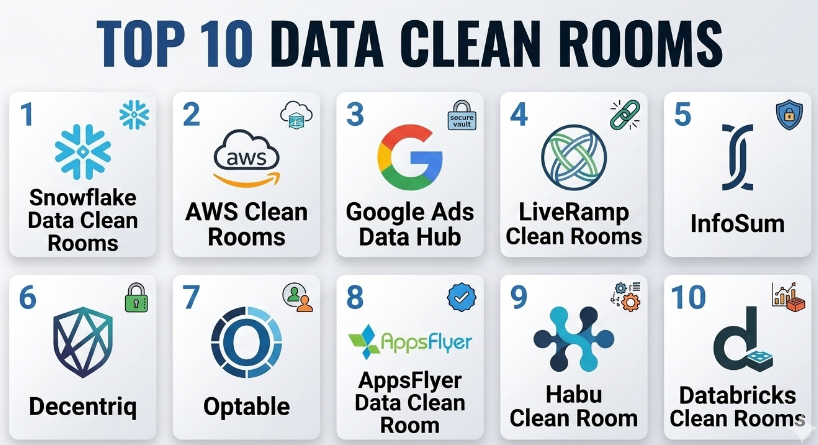
Top 10 Data Clean Rooms
#1 — Snowflake Data Clean Rooms
Short description :
Snowflake Data Clean Rooms help organizations collaborate on data securely within the Snowflake ecosystem. It is suitable for companies already using Snowflake as a cloud data platform and wanting to share insights with partners without exposing raw data. Brands, retailers, media companies, agencies, and data providers can use it for privacy-safe audience analysis, campaign measurement, and partner analytics. The platform works well for organizations that want clean room workflows connected to their existing warehouse and governance model. It is especially strong for enterprise data teams that already trust Snowflake for analytics and sharing.
Key Features
- Secure data collaboration inside Snowflake
- Privacy-safe partner analytics
- Data sharing and governance workflows
- Audience overlap and measurement use cases
- Query controls and approved collaboration logic
- Support for enterprise-scale data collaboration
- Integration with broader Snowflake data ecosystem
Pros
- Strong fit for companies already using Snowflake.
- Useful for enterprise-scale data collaboration.
- Reduces raw data movement between partners.
Cons
- Best value depends on Snowflake adoption.
- May require technical setup and data governance planning.
- Partner collaboration may depend on both sides’ data readiness.
Platforms / Deployment
Web-based platform.
Cloud deployment within Snowflake environment.
Security & Compliance
Snowflake generally supports enterprise-grade security, encryption, role-based access, and governance controls. Specific compliance requirements should be validated during procurement.
SOC 2, ISO 27001, HIPAA: Not publicly stated here for this specific clean room use case.
Integrations & Ecosystem
Snowflake Data Clean Rooms fit naturally into Snowflake’s broader cloud data ecosystem. They are useful when companies want analytics, data sharing, and collaboration workflows connected to warehouse data.
- Snowflake data platform
- BI and analytics tools
- Partner data sharing workflows
- Retail media collaboration
- Marketing measurement workflows
- Enterprise data governance processes
Support & Community
Snowflake has strong enterprise documentation, partner ecosystem support, and customer success resources. Support depth depends on contract, cloud environment, and implementation complexity.
#2 — AWS Clean Rooms
Short description :
AWS Clean Rooms allows organizations to collaborate and analyze shared datasets without directly revealing underlying raw data. It is suitable for companies already using AWS for data storage, analytics, advertising measurement, or partner collaboration. Brands, publishers, advertisers, and data providers can use AWS Clean Rooms for privacy-focused analysis across organizations. It is useful when companies want clean room collaboration close to their AWS data infrastructure. The platform is especially relevant for data engineering teams that prefer cloud-native control and integration with AWS services.
Key Features
- Privacy-safe data collaboration
- Configurable analysis rules
- Aggregated and controlled query outputs
- Collaboration across multiple parties
- Integration with AWS data services
- Support for advertising and partner analytics
- Cloud-native governance workflows
Pros
- Strong fit for organizations already using AWS.
- Flexible for technical teams building data collaboration workflows.
- Supports controlled analysis without broad raw data sharing.
Cons
- Requires AWS knowledge and data engineering support.
- May be less simple for business-only marketing users.
- Best results depend on proper access and query governance.
Platforms / Deployment
Web-based AWS console and cloud services.
Cloud deployment.
Security & Compliance
AWS generally provides cloud security capabilities such as IAM-based access, encryption options, monitoring, and governance services. Buyers should validate controls for their exact implementation.
SOC 2, ISO 27001, HIPAA: Not publicly stated here for this specific clean room configuration.
Integrations & Ecosystem
AWS Clean Rooms work well inside AWS-based data stacks and can connect with analytics, storage, governance, and reporting workflows.
- AWS data services
- Data lakes
- Analytics workflows
- Advertising measurement
- BI reporting
- Partner collaboration environments
Support & Community
AWS provides extensive cloud documentation, enterprise support options, partner ecosystem resources, and technical community knowledge. Implementation quality depends on internal AWS expertise.
#3 — Google Ads Data Hub
Short description :
Google Ads Data Hub is a privacy-focused measurement and analytics environment for advertisers working with Google advertising data. It helps teams analyze campaign performance using privacy-safe query controls and aggregated outputs. It is especially useful for advertisers that spend heavily across Google media and need more advanced measurement than standard ad reporting. Data Hub can help with campaign measurement, audience insights, reach analysis, and conversion analysis. It is best suited for larger advertisers, agencies, and analytics teams working deeply within the Google advertising ecosystem.
Key Features
- Privacy-safe analysis of Google advertising data
- Aggregated reporting controls
- Campaign measurement and reach analysis
- Audience and conversion insights
- Query-based analytics workflows
- Support for advanced advertisers and agencies
- Google ecosystem alignment
Pros
- Strong for advertisers using Google media heavily.
- Useful for privacy-safe campaign measurement.
- Supports deeper analysis than basic ad dashboards.
Cons
- Primarily centered around Google advertising ecosystem.
- Requires analytics and query knowledge.
- Not a universal clean room for all partner collaboration needs.
Platforms / Deployment
Web-based platform.
Cloud deployment.
Security & Compliance
Google provides privacy-focused controls and aggregation requirements for this environment. Buyers should validate specific compliance and governance requirements directly.
SOC 2, ISO 27001, HIPAA: Not publicly stated here.
Integrations & Ecosystem
Google Ads Data Hub is strongest for teams working with Google advertising, analytics, and cloud-aligned measurement workflows.
- Google advertising data
- Analytics workflows
- BigQuery-oriented analysis
- Campaign reporting
- Audience measurement
- Agency reporting processes
Support & Community
Support is usually strongest for qualified advertisers, agencies, and enterprise Google customers. Documentation and technical resources are available, but practical usage may require analytics expertise.
#4 — LiveRamp Clean Rooms
Short description :
LiveRamp Clean Rooms support privacy-focused data collaboration, identity resolution, audience measurement, and partner analytics. The platform is useful for brands, retailers, publishers, media networks, and advertisers that need to collaborate on customer data without direct exposure of raw records. LiveRamp is especially relevant where identity, addressability, and partner activation are important. It can help teams match audiences, measure campaign outcomes, build insights, and activate approved segments. It is best suited for enterprises that need both clean room collaboration and strong identity ecosystem support.
Key Features
- Privacy-safe data collaboration
- Identity resolution support
- Audience overlap analysis
- Campaign measurement workflows
- Partner and publisher collaboration
- Audience activation options
- Enterprise data governance support
Pros
- Strong identity and partner ecosystem.
- Useful for advertising, retail media, and publisher collaboration.
- Good fit for enterprises needing measurement and activation.
Cons
- May be complex for smaller teams.
- Pricing and packaging may require vendor consultation.
- Best results depend on data quality and partner participation.
Platforms / Deployment
Web-based platform.
Cloud / managed deployment options may vary.
Security & Compliance
LiveRamp is commonly used in privacy-sensitive advertising and identity workflows. Specific controls and certifications should be validated during procurement.
SOC 2, ISO 27001, HIPAA: Not publicly stated here.
Integrations & Ecosystem
LiveRamp’s ecosystem is focused on identity, media activation, publisher collaboration, and data partnership workflows.
- Media platforms
- Publisher partnerships
- Retail media networks
- Identity workflows
- Audience activation
- Measurement reporting
Support & Community
LiveRamp provides enterprise support, onboarding, professional services, and partner ecosystem guidance. It is widely recognized in advertising identity and data collaboration markets.
#5 — InfoSum
Short description :
InfoSum is a data collaboration platform focused on helping organizations connect and analyze data without moving or exposing raw data. It is used by brands, media owners, agencies, publishers, and data providers for privacy-safe collaboration. InfoSum’s approach is especially relevant for audience overlap, media planning, campaign measurement, and partner analytics. It is useful when companies want decentralized collaboration where data remains under each party’s control. The platform is a strong fit for privacy-conscious media and advertising partnerships.
Key Features
- Privacy-safe data collaboration
- Decentralized clean room approach
- Audience matching and overlap analysis
- Campaign measurement use cases
- Partner and media collaboration
- Identity and data connectivity workflows
- Controlled outputs and governance
Pros
- Strong privacy-focused positioning.
- Useful for publisher, advertiser, and media owner collaboration.
- Reduces the need to move raw data between parties.
Cons
- May require partner adoption for full value.
- Setup depends on data readiness and identity strategy.
- May be less familiar to smaller marketing teams.
Platforms / Deployment
Web-based platform.
Cloud / managed deployment approach may vary.
Security & Compliance
Privacy-safe collaboration is central to the platform. Specific security certifications and controls should be confirmed directly.
SOC 2, ISO 27001, HIPAA: Not publicly stated.
Integrations & Ecosystem
InfoSum fits into advertising, media, and data partnership environments where multiple organizations need to collaborate without raw data sharing.
- Publisher data collaboration
- Advertiser workflows
- Agency planning
- Audience overlap analysis
- Media measurement
- Partner analytics
Support & Community
InfoSum provides enterprise support and onboarding. Its community strength is strongest among media owners, advertisers, agencies, and privacy-focused data collaboration teams.
#6 — Decentriq
Short description :
Decentriq is a data clean room and privacy-enhancing technology platform designed for secure collaboration across organizations. It is suitable for industries where privacy, confidentiality, and data control are very important, including advertising, healthcare-adjacent analytics, financial services, and enterprise data collaboration. Decentriq supports secure analytics without exposing raw data to other participants. It is useful for teams that need stronger privacy guarantees and controlled collaboration workflows. The platform is especially relevant for organizations that want advanced privacy technology in their clean room approach.
Key Features
- Privacy-enhancing data collaboration
- Secure data clean room workflows
- Controlled analytics without raw data exposure
- Multi-party collaboration
- Strong confidentiality-focused architecture
- Enterprise governance support
- Use cases across regulated and sensitive industries
Pros
- Strong privacy and confidentiality positioning.
- Useful for sensitive data collaboration.
- Suitable for cross-company analytics where trust is limited.
Cons
- May be more advanced than basic marketing teams need.
- Implementation may require technical and legal involvement.
- Partner workflows may require careful setup.
Platforms / Deployment
Web-based platform.
Cloud / managed deployment options may vary.
Security & Compliance
Security and privacy are central to Decentriq’s positioning. Specific certifications should be validated directly during procurement.
SOC 2, ISO 27001, HIPAA: Not publicly stated here.
Integrations & Ecosystem
Decentriq can fit into enterprise data collaboration workflows where privacy, confidentiality, and analytics control are key requirements.
- Data collaboration workflows
- Enterprise analytics
- Partner measurement
- Sensitive data analysis
- Privacy-enhancing technology workflows
- Governance processes
Support & Community
Decentriq provides enterprise support and implementation guidance. Community visibility is stronger among privacy technology, secure analytics, and enterprise collaboration audiences.
#7 — Optable
Short description :
Optable is a data collaboration and clean room platform built with strong relevance for publishers, media companies, and advertising ecosystems. It helps organizations collaborate on audience data, identity, activation, and measurement while protecting sensitive information. Optable is suitable for media owners and advertisers that need privacy-safe audience matching and campaign analysis. It is especially useful in environments where publishers want to monetize first-party data responsibly. The platform fits teams that need clean room workflows connected to media and advertising use cases.
Key Features
- Data clean room collaboration
- Audience matching
- Publisher and media owner workflows
- Advertising measurement
- Identity and audience insights
- Activation support
- Privacy-focused data collaboration
Pros
- Strong fit for publishers and media networks.
- Useful for audience collaboration and activation.
- Designed around advertising data partnerships.
Cons
- May be less relevant outside media and advertising.
- Requires partner data and identity alignment.
- Advanced use may need technical setup.
Platforms / Deployment
Web-based platform.
Cloud deployment.
Security & Compliance
Privacy and governance controls are important to the platform’s use case. Specific certifications should be confirmed directly.
SOC 2, ISO 27001, HIPAA: Not publicly stated.
Integrations & Ecosystem
Optable is designed for media, publisher, and advertiser collaboration where audience data and campaign measurement need to be protected.
- Publisher data systems
- Advertiser workflows
- Identity solutions
- Audience activation
- Campaign measurement
- Media partner collaboration
Support & Community
Optable provides onboarding and customer support. Community visibility is strongest among publishers, media companies, and advertising data teams.
#8 — AppsFlyer Data Clean Room
Short description :
AppsFlyer Data Clean Room is designed for privacy-preserving marketing measurement, especially in mobile app and digital advertising environments. It helps advertisers and partners collaborate on performance insights while reducing exposure of user-level data. This is useful for app marketers, mobile-first brands, gaming companies, ecommerce apps, and agencies that need privacy-aware measurement. The clean room can support campaign analysis, partner measurement, and audience insights. It is best for teams already using AppsFlyer or working heavily in mobile attribution and app marketing.
Key Features
- Privacy-preserving marketing measurement
- Mobile attribution ecosystem alignment
- Campaign and partner analysis
- Controlled data collaboration
- Audience and performance insights
- App marketing use cases
- Aggregated reporting workflows
Pros
- Strong fit for mobile app marketers.
- Useful for privacy-aware partner measurement.
- Works well with mobile attribution workflows.
Cons
- Less relevant for businesses without mobile app activity.
- Best value depends on AppsFlyer ecosystem usage.
- May not replace broader enterprise cloud clean rooms.
Platforms / Deployment
Web-based platform.
Cloud deployment.
Security & Compliance
Security and privacy controls should be validated directly with the vendor.
SOC 2, ISO 27001, HIPAA: Not publicly stated here.
Integrations & Ecosystem
AppsFlyer Data Clean Room fits into mobile marketing and app attribution workflows where advertisers need better measurement while protecting user-level data.
- Mobile ad networks
- App attribution workflows
- Campaign reporting
- Partner measurement
- Audience insights
- Mobile analytics systems
Support & Community
AppsFlyer provides documentation, onboarding, and customer support. Community strength is strong among mobile growth, app marketing, and performance marketing teams.
#9 — Habu Clean Room
Short description :
Habu is a data clean room platform known for helping brands, agencies, and media companies collaborate on customer data, campaign measurement, and audience insights. It is suitable for enterprises that need privacy-safe data collaboration across different partners and platforms. Habu has been used for advertising, retail media, customer intelligence, and partner analytics use cases. Buyers should review current packaging and availability carefully because product positioning may depend on broader vendor ecosystem changes. It remains relevant as a recognized name in clean room conversations.
Key Features
- Privacy-safe data collaboration
- Audience overlap analysis
- Campaign measurement
- Partner analytics
- Clean room workflow management
- Marketing and media collaboration
- Data connectivity support
Pros
- Recognized in data clean room and advertising measurement use cases.
- Useful for brands and agencies collaborating with partners.
- Supports audience insights and campaign analytics.
Cons
- Current packaging and availability should be verified.
- May require enterprise support and implementation planning.
- Best fit depends on partner ecosystem and data readiness.
Platforms / Deployment
Web-based platform.
Cloud / managed deployment options may vary.
Security & Compliance
Security and compliance details should be validated directly during procurement.
SOC 2, ISO 27001, HIPAA: Not publicly stated.
Integrations & Ecosystem
Habu is relevant to enterprise marketing data collaboration workflows, especially where brands, agencies, publishers, and media partners need shared analytics.
- Media partner workflows
- Audience analysis
- Campaign measurement
- Retail media collaboration
- Data platform connections
- Executive reporting
Support & Community
Support and onboarding may vary based on current product packaging and vendor relationship. Buyers should confirm support model directly before purchase.
#10 — Databricks Clean Rooms
Short description :
Databricks Clean Rooms support secure data collaboration within the Databricks Lakehouse ecosystem. They are suitable for organizations that already use Databricks for data engineering, analytics, AI, and machine learning. The platform enables multiple parties to collaborate on data without exposing raw datasets directly. It is especially useful for enterprises that want clean room capabilities close to their lakehouse, governance, and AI workflows. Databricks Clean Rooms are a strong fit for technical data teams that need scalable analytics and privacy-aware collaboration.
Key Features
- Clean room collaboration in Databricks ecosystem
- Lakehouse-aligned data sharing
- Privacy-aware partner analytics
- Governance and access control workflows
- Scalable analytics and data engineering support
- AI and machine learning workflow alignment
- Enterprise data collaboration
Pros
- Strong fit for companies already using Databricks.
- Useful for data science and analytics-heavy teams.
- Supports scalable collaboration near enterprise data workflows.
Cons
- Best value depends on Databricks adoption.
- Requires technical setup and data governance planning.
- May be too complex for small marketing-only teams.
Platforms / Deployment
Web-based platform within Databricks environment.
Cloud deployment.
Security & Compliance
Databricks generally supports enterprise security and governance features, but exact clean room controls should be validated during procurement.
SOC 2, ISO 27001, HIPAA: Not publicly stated here.
Integrations & Ecosystem
Databricks Clean Rooms work well for companies using lakehouse architecture, data science workflows, and scalable analytics.
- Databricks Lakehouse
- BI tools
- Data engineering pipelines
- AI and machine learning workflows
- Partner analytics
- Enterprise governance systems
Support & Community
Databricks has strong documentation, enterprise support, partner resources, and a technical community. Implementation quality depends on internal data engineering maturity.
Comparison Table Top 10
| Tool Name | Best For | Platform Supported | Deployment | Standout Feature | Public Rating |
|---|---|---|---|---|---|
| Snowflake Data Clean Rooms | Snowflake-based enterprise collaboration | Web | Cloud | Secure collaboration inside Snowflake ecosystem | N/A |
| AWS Clean Rooms | AWS-native data collaboration | Web | Cloud | Configurable analysis rules for shared datasets | N/A |
| Google Ads Data Hub | Google advertising measurement | Web | Cloud | Privacy-safe analysis of Google ad data | N/A |
| LiveRamp Clean Rooms | Identity-driven advertising collaboration | Web | Cloud / Managed | Identity resolution and audience activation | N/A |
| InfoSum | Decentralized media data collaboration | Web | Cloud / Managed | Collaboration without moving raw data | N/A |
| Decentriq | Sensitive data collaboration | Web | Cloud / Managed | Privacy-enhancing secure analytics | N/A |
| Optable | Publisher and media clean rooms | Web | Cloud | Publisher-focused audience collaboration | N/A |
| AppsFlyer Data Clean Room | Mobile app marketing measurement | Web | Cloud | Privacy-preserving mobile campaign analysis | N/A |
| Habu Clean Room | Brand and agency collaboration | Web | Cloud / Managed | Marketing-focused partner analytics | N/A |
| Databricks Clean Rooms | Lakehouse-based enterprise analytics | Web | Cloud | Clean rooms inside Databricks Lakehouse | N/A |
Evaluation & Data Clean Rooms
| Tool Name | Core 25% | Ease 15% | Integrations 15% | Security 10% | Performance 10% | Support 10% | Value 15% | Weighted Total 0–10 |
|---|---|---|---|---|---|---|---|---|
| Snowflake Data Clean Rooms | 9 | 7 | 9 | 8 | 9 | 8 | 8 | 8.30 |
| AWS Clean Rooms | 9 | 7 | 9 | 8 | 9 | 8 | 8 | 8.30 |
| Google Ads Data Hub | 8 | 6 | 8 | 8 | 8 | 7 | 7 | 7.45 |
| LiveRamp Clean Rooms | 9 | 7 | 9 | 8 | 8 | 8 | 7 | 8.10 |
| InfoSum | 8 | 7 | 8 | 8 | 8 | 7 | 7 | 7.65 |
| Decentriq | 8 | 7 | 7 | 9 | 8 | 7 | 7 | 7.65 |
| Optable | 8 | 7 | 8 | 8 | 8 | 7 | 7 | 7.65 |
| AppsFlyer Data Clean Room | 8 | 7 | 8 | 7 | 8 | 8 | 7 | 7.60 |
| Habu Clean Room | 8 | 7 | 8 | 7 | 8 | 7 | 7 | 7.50 |
| Databricks Clean Rooms | 9 | 6 | 9 | 8 | 9 | 8 | 8 | 8.15 |
These scores are comparative and should be used as a shortlist guide, not as a final buying decision. Cloud-native enterprises may prefer Snowflake, AWS, or Databricks depending on their existing data platform. Advertising and media teams may find LiveRamp, InfoSum, Optable, AppsFlyer, Google Ads Data Hub, or Habu more practical. Security, pricing, integration depth, and partner adoption should always be validated before purchase.
Which Data Clean Rooms
Solo / Freelancer
Solo consultants and freelancers usually do not need a full data clean room unless they support enterprise media, retail, or analytics clients. For small consulting work, basic privacy-safe reporting, aggregated dashboards, and secure data sharing may be enough.
However, freelancers working with large advertisers, agencies, or retailers should understand clean room concepts because many enterprise clients now expect privacy-safe collaboration. In this case, learning AWS Clean Rooms, Snowflake Data Clean Rooms, Google Ads Data Hub, or Databricks Clean Rooms can be useful.
SMB
Small and mid-sized businesses should adopt data clean rooms only when they have enough first-party data and partner collaboration needs. A clean room is not useful if the company has very limited customer data or no clear partner measurement use case.
SMBs working with retail media, publishers, ad platforms, or larger enterprise partners may consider clean room access through partner-led environments. They should focus on ease of use, support, data preparation, and clear business outcomes rather than buying the most advanced platform.
Mid-Market
Mid-market companies often start needing clean rooms when they work with retailers, publishers, media networks, agencies, or strategic data partners. At this stage, they may need audience overlap analysis, campaign measurement, and privacy-safe insights.
Snowflake, AWS, LiveRamp, InfoSum, Optable, and AppsFlyer may be useful depending on business model. Ecommerce and app-focused companies should prioritize measurement and activation workflows, while data-heavy companies should prioritize cloud and governance compatibility.
Enterprise
Enterprise companies usually need clean rooms for large-scale data collaboration, customer matching, media measurement, retail media, publisher partnerships, and privacy-sensitive analytics. They also require strong governance, auditability, legal review, security documentation, and scalable data infrastructure.
Snowflake, AWS, Databricks, LiveRamp, InfoSum, Decentriq, and Google Ads Data Hub may be considered depending on ecosystem fit. Enterprises may use more than one clean room because different partners may operate in different environments.
Budget vs Premium
Budget-focused teams should first define whether a clean room is truly needed. If the use case is simple reporting, a clean room may be unnecessary. Clean rooms become more valuable when multiple parties need to collaborate on sensitive data without exposing raw records.
Premium platforms are worth considering when clean room collaboration directly supports revenue, media measurement, partner strategy, retail media, privacy compliance, or enterprise data sharing. The best value comes from business impact, not from technical features alone.
Feature Depth vs Ease of Use
Cloud-native platforms like Snowflake, AWS, and Databricks provide deep data infrastructure flexibility but may require technical expertise. They are better suited for organizations with strong data engineering and governance teams.
Marketing-focused platforms like LiveRamp, InfoSum, Optable, AppsFlyer, and Habu may be easier for advertising, media, and audience collaboration use cases. However, buyers should still validate how much technical setup is required.
Integrations & Scalability
A strong data clean room should connect with the systems where business data already lives. Important integration areas include cloud data warehouses, data lakes, identity platforms, ad platforms, publishers, retail media networks, BI tools, CRM systems, and analytics workflows.
Scalability matters when multiple partners, markets, datasets, and departments are involved. Buyers should check whether the platform can support growing collaboration volume, data governance rules, reusable templates, partner onboarding, and reporting needs.
Security & Compliance Needs
Security and compliance are central to data clean rooms. Buyers should evaluate role-based access, encryption, audit logs, aggregation thresholds, query restrictions, consent handling, data residency, identity controls, and approved output rules.
Legal, privacy, security, data, and marketing teams should all be involved before implementation. If a vendor does not clearly publish certifications or controls, buyers should request formal documentation during procurement.
Frequently Asked Questions FAQs
1. What are Data Clean Rooms?
Data Clean Rooms are secure environments where companies can collaborate on data without directly exposing raw customer records to each other. They allow approved analysis, matching, measurement, and reporting while applying privacy and governance controls. They are commonly used in advertising, retail media, analytics, and partner collaboration.
2. How do Data Clean Rooms work?
Each party brings data into a controlled environment, and the clean room applies rules around what can be joined, queried, and exported. Raw personal data is not freely shared between parties. Outputs are usually aggregated, restricted, or privacy-protected based on approved rules.
3. Why are Data Clean Rooms important?
They help companies collaborate while reducing privacy and data leakage risks. This is useful when brands, publishers, retailers, agencies, and ad platforms need shared insights but cannot exchange raw customer data openly. Clean rooms support safer measurement and partner analytics.
4. What are common use cases for Data Clean Rooms?
Common use cases include audience overlap analysis, campaign measurement, retail media reporting, customer matching, partner analytics, reach and frequency analysis, attribution support, audience segmentation, and privacy-safe activation. The best use case depends on the company’s data and partner ecosystem.
5. How much do Data Clean Rooms cost?
Pricing varies widely based on vendor, data volume, number of collaborators, cloud usage, identity matching, support level, and use cases. Some platforms are tied to cloud consumption, while others use enterprise contracts. Buyers should ask about storage, compute, partner access, query volume, and support fees.
6. Are Data Clean Rooms only for large enterprises?
No, but large enterprises usually benefit the most because they have more first-party data, more partners, and stronger privacy requirements. Smaller companies may use clean rooms through partner platforms, retail media networks, or managed vendor solutions. The key question is whether the business has enough data and partner collaboration needs.
7. What are common mistakes when using Data Clean Rooms?
Common mistakes include starting without a clear business use case, underestimating data preparation, ignoring legal review, choosing a platform without partner alignment, and expecting clean rooms to solve poor data quality. Another mistake is focusing only on technology while ignoring governance and consent.
8. Can Data Clean Rooms replace customer data platforms?
No. A customer data platform helps collect, unify, and activate customer data inside a company. A data clean room helps companies collaborate with other parties in a controlled way. They can work together, but they solve different problems.
9. Are Data Clean Rooms secure?
Data clean rooms are designed for safer collaboration, but security depends on the vendor, configuration, data handling, access controls, and governance rules. Buyers should validate encryption, RBAC, audit logs, query restrictions, identity controls, data retention, and compliance documentation before implementation.
10. Can Data Clean Rooms support marketing attribution?
Yes, clean rooms can support privacy-safe attribution and campaign measurement, especially when advertisers and media partners need to compare exposure and conversion data. However, clean rooms do not automatically solve attribution. Teams still need clean data, clear methodology, and agreed measurement rules.
Conclusion
Data Clean Rooms are becoming important because modern data collaboration requires a balance between insight and privacy. Companies want to work with retailers, publishers, media platforms, agencies, advertisers, and strategic partners, but they cannot freely exchange raw customer data. A clean room creates a controlled environment where useful analysis can happen while reducing exposure and improving governance.
