Introduction
Environmental Monitoring Platforms are software systems that help organizations collect, track, analyze, and report environmental data. In simple words, they help teams monitor air quality, water quality, emissions, waste, noise, energy use, weather conditions, soil data, and compliance activities from one place.
These platforms matter more now because businesses, cities, utilities, factories, mining companies, construction firms, and government agencies are under stronger pressure to prove environmental responsibility with reliable data. Manual spreadsheets are no longer enough when teams need real-time alerts, sensor data, audit trails, ESG reporting, and regulatory documentation.
Common use cases include:
- Air emissions monitoring for industrial facilities
- Water and wastewater compliance tracking
- Waste and hazardous material reporting
- IoT-based sensor monitoring across sites
- ESG, sustainability, and carbon reporting
- Environmental incident tracking and corrective actions
Buyers should evaluate:
- Data collection and sensor compatibility
- Reporting and compliance workflows
- Dashboards and analytics
- Alerts and threshold monitoring
- GIS or location-based monitoring
- Integrations and APIs
- Security and role-based access
- Ease of use for field and office teams
- Deployment flexibility
- Vendor support and implementation help
Best for: Environmental managers, EHS teams, sustainability leaders, compliance officers, government agencies, utilities, manufacturing companies, mining firms, energy companies, infrastructure operators, and large multi-site organizations.
Not ideal for: Very small teams that only need occasional manual reporting, companies with no regulatory or ESG reporting needs, or users who only need simple spreadsheet-based tracking.
Key Environmental Monitoring Platforms
- AI-assisted environmental analytics are becoming more useful for anomaly detection, trend analysis, and early warning signals.
- IoT sensor integration is now a major need for air, water, noise, weather, temperature, and emissions monitoring.
- ESG and sustainability reporting are increasingly connected with environmental monitoring workflows.
- Cloud deployment is common because teams need remote access across multiple sites and regions.
- Hybrid systems remain important for industries with strict operational, security, or offline requirements.
- Automated alerts help teams respond faster to permit breaches, pollution spikes, equipment issues, or abnormal readings.
- GIS and mapping integration is valuable for environmental consultants, governments, utilities, mining, and field operations.
- Audit-ready reporting is becoming essential for inspections, compliance checks, and internal governance.
- API-first ecosystems help connect environmental platforms with ERP, BI, SCADA, asset management, and sustainability systems.
- Pricing models often vary by modules, users, facilities, sensors, data volume, and support level.
How We Selected These Tools
The tools below were selected using a practical buyer-focused evaluation approach:
- Recognized presence in environmental, EHS, ESG, IoT, or environmental data management markets.
- Ability to support real environmental workflows such as air, water, waste, emissions, sensor data, or compliance.
- Suitability for different buyer types, including enterprise, mid-market, public sector, consultants, and field teams.
- Breadth of features across monitoring, analytics, reporting, alerts, dashboards, and documentation.
- Integration potential with sensors, business systems, reporting tools, GIS, and data platforms.
- Security posture based on visible enterprise software expectations where confidently known.
- Practical usability for both technical and non-technical environmental teams.
- Support for multi-site operations, audit trails, and structured reporting.
- Vendor maturity, ecosystem strength, and implementation readiness.
- Balanced inclusion of enterprise platforms, ESG platforms, IoT monitoring tools, and environmental data systems.
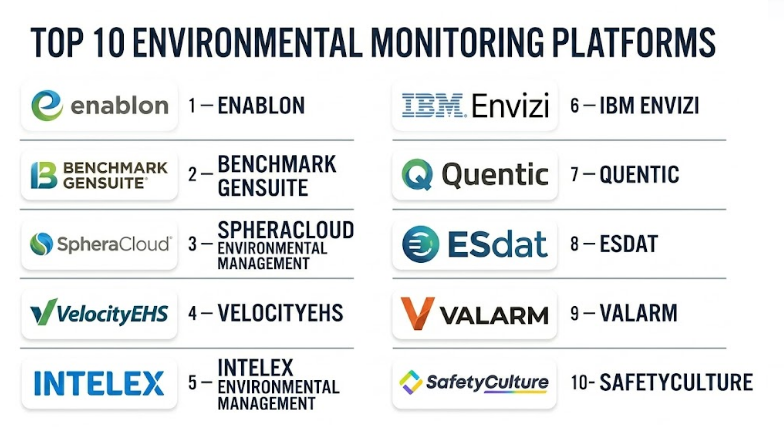
Top 10 Environmental Monitoring Platforms
#1 — Enablon
Short description :
Enablon is an enterprise-grade EHS, risk, sustainability, and environmental management platform. It is widely used by large organizations that need structured workflows for environmental compliance, emissions tracking, audits, incidents, and operational risk. The platform is best suited for complex businesses with multiple facilities, regulatory obligations, and cross-functional teams. Environmental managers can use it to centralize compliance data, manage corrective actions, and support sustainability reporting. It is stronger for enterprise governance than for very small teams.
Key Features
- Environmental compliance and permit management
- Air emissions, water, waste, and sustainability data workflows
- Audit, inspection, and corrective action management
- Enterprise reporting and dashboards
- Risk and incident management capabilities
- Multi-site data consolidation
- Workflow automation for compliance teams
Pros
- Strong fit for large enterprises with complex environmental obligations.
- Broad EHS and sustainability coverage in one platform.
- Useful for audit trails, governance, and structured compliance workflows.
Cons
- May be too complex for small teams.
- Implementation can require planning, configuration, and training.
- Pricing is typically enterprise-oriented and not simple to estimate publicly.
Platforms / Deployment
Cloud / Hybrid
Web-based access; mobile availability may vary by module.
Security & Compliance
Enterprise security features such as role-based access, audit trails, and access controls are commonly expected. Specific certifications and controls should be verified with the vendor. SOC 2, ISO 27001, HIPAA: Not publicly stated here.
Integrations & Ecosystem
Enablon fits best in organizations that need environmental data connected with EHS, risk, sustainability, audit, and business systems.
- APIs and enterprise system integrations
- Business intelligence integrations
- Sustainability and ESG reporting workflows
- EHS and risk management modules
- ERP or operational system connectivity where configured
Support & Community
Enterprise onboarding, implementation support, documentation, and professional services are typically available. Community strength is more vendor-led than open-source style.
#2 — Benchmark Gensuite
Short description :
Benchmark Gensuite is an enterprise EHS, ESG, and sustainability platform with environmental management capabilities. It helps organizations manage air compliance, water compliance, waste, permits, inspections, and sustainability performance. The platform is useful for global companies that want structured environmental workflows with dashboards, reporting, and operational oversight. It is especially relevant for manufacturing, chemicals, energy, logistics, and multi-site operations. It is best for teams that need mature environmental management processes rather than simple monitoring only.
Key Features
- Air, water, waste, and permit compliance modules
- Environmental reporting and workflow automation
- Sustainability and ESG-related data management
- Dashboards for performance visibility
- Corrective action and task management
- Multi-site environmental compliance tracking
- AI-assisted and analytics-focused capabilities where available
Pros
- Strong environmental compliance feature set.
- Good fit for enterprise and multi-site organizations.
- Supports environmental, sustainability, and EHS workflows together.
Cons
- May require module selection and implementation support.
- Smaller companies may find it more advanced than needed.
- Public pricing and detailed package structure are not always transparent.
Platforms / Deployment
Cloud
Web-based platform; mobile support may vary by module.
Security & Compliance
Role-based access, audit-oriented workflows, and enterprise controls are expected. Specific certifications such as SOC 2 or ISO 27001 should be confirmed directly. Not publicly stated here.
Integrations & Ecosystem
Benchmark Gensuite works well when environmental data must connect with safety, sustainability, compliance, and operational teams.
- EHS platform modules
- ESG and sustainability reporting workflows
- Business intelligence tools
- Enterprise data systems
- Configurable dashboards and reports
Support & Community
Vendor-led support, implementation assistance, customer success, and documentation are typically available. Community is mainly enterprise customer and vendor ecosystem based.
#3 — SpheraCloud Environmental Management
Short description :
SpheraCloud Environmental Management is designed for organizations that need to manage environmental compliance, operational risk, sustainability, and emissions-related data. It is used by industries where environmental performance and regulatory control are important. The platform helps teams collect data, standardize reporting, monitor obligations, and improve environmental decision-making. It is best suited for enterprise and mid-market organizations with structured EHS or sustainability teams. It is not usually the first choice for very small organizations with limited reporting needs.
Key Features
- Environmental compliance management
- Emissions and sustainability data support
- Risk and operational performance workflows
- Reporting and analytics dashboards
- Multi-site environmental data management
- Audit and documentation support
- Integration with broader EHS and risk programs
Pros
- Strong enterprise environmental and risk management orientation.
- Good fit for regulated industries.
- Useful for organizations connecting EHS, ESG, and operational risk data.
Cons
- May require implementation support.
- Can be more complex than lightweight monitoring tools.
- Public package and pricing details may be limited.
Platforms / Deployment
Cloud
Web-based platform; other platform support varies by module.
Security & Compliance
Enterprise access controls and audit-friendly workflows are expected. Specific security certifications should be validated with the vendor. Not publicly stated here.
Integrations & Ecosystem
SpheraCloud is strongest when used as part of a broader operational risk, EHS, and sustainability environment.
- EHS and operational risk modules
- Sustainability reporting systems
- Enterprise reporting tools
- Data connectors and APIs where available
- Multi-facility environmental workflows
Support & Community
Enterprise support, onboarding, consulting, and documentation are typically available. Community is vendor-led and enterprise-focused.
#4 — VelocityEHS
Short description :
VelocityEHS provides EHS, ESG, and environmental compliance software for organizations that need practical tools for managing workplace, environmental, chemical, and sustainability obligations. Its environmental capabilities can support reporting, emissions, waste, and compliance tracking depending on the modules selected. The platform is often suitable for mid-market and enterprise buyers who want a more guided EHS software experience. It is useful for companies moving away from spreadsheets and disconnected compliance records.
Key Features
- Environmental compliance workflows
- Air, water, waste, and emissions-related data support
- EHS and chemical management capabilities
- Dashboards and reporting tools
- Task management and corrective actions
- Sustainability and ESG-related modules
- User-friendly interface for operational teams
Pros
- Practical for teams modernizing EHS and environmental workflows.
- Broad EHS coverage beyond environmental monitoring.
- Good fit for organizations that need usability and structure.
Cons
- Depth may depend on selected modules.
- Highly specialized environmental data science needs may require additional tools.
- Pricing details are usually vendor-driven.
Platforms / Deployment
Cloud
Web-based platform; mobile capabilities may vary.
Security & Compliance
Role-based access and enterprise controls are expected. Specific certifications are not confidently stated here.
Integrations & Ecosystem
VelocityEHS can connect environmental management with broader EHS and operational programs.
- EHS management modules
- Chemical and safety data workflows
- ESG and reporting workflows
- APIs or configured integrations where available
- Export and reporting options
Support & Community
Vendor documentation, customer support, onboarding, and training resources are generally available. Community is primarily customer and vendor-support based.
#5 — Intelex Environmental Management
Short description :
Intelex Environmental Management is part of a broader EHSQ platform used by organizations to manage environmental compliance, incidents, audits, inspections, and performance data. It is suitable for companies that want environmental monitoring to connect with safety, quality, and operational improvement. The platform is useful for regulated industries, manufacturing, energy, and organizations with multiple facilities. It supports structured workflows and reporting rather than only raw sensor collection.
Key Features
- Environmental compliance and reporting workflows
- Incident, audit, inspection, and corrective action management
- Waste, emissions, and sustainability data support
- Dashboards and analytics
- Configurable forms and workflows
- Multi-site performance tracking
- EHSQ platform integration
Pros
- Strong fit for EHSQ-driven organizations.
- Configurable workflows support different industries.
- Useful for compliance, audits, and performance visibility.
Cons
- Configuration may require planning.
- May be more platform than small teams need.
- Public security and pricing details may need vendor confirmation.
Platforms / Deployment
Cloud
Web-based platform; mobile support may vary.
Security & Compliance
Role-based access and audit trails are commonly expected in enterprise EHSQ systems. Specific certifications are Not publicly stated here.
Integrations & Ecosystem
Intelex is useful when environmental data needs to connect with safety, quality, operations, and reporting programs.
- EHSQ modules
- Reporting and analytics tools
- Configurable workflows
- Enterprise system integrations
- Data import/export support
Support & Community
Vendor support, training, implementation services, and documentation are typically available. Community strength is mostly vendor and customer ecosystem based.
#6 — IBM Envizi
Short description :
IBM Envizi is mainly known as an ESG and sustainability data platform, but it is relevant to environmental monitoring because it helps organizations consolidate environmental performance data, emissions data, energy data, and reporting information. It is best for sustainability, ESG, finance, and enterprise reporting teams that need reliable environmental data for disclosure and decision-making. It may not replace specialized field sensor platforms, but it can become a central system for environmental and sustainability performance records.
Key Features
- ESG and sustainability data consolidation
- Emissions and environmental performance tracking
- Reporting workflows for sustainability teams
- Data quality and auditability support
- Analytics dashboards
- Enterprise-grade data management
- Integration with broader enterprise reporting systems
Pros
- Strong for ESG and sustainability reporting.
- Useful for consolidating environmental data from many sources.
- Good fit for large organizations with reporting pressure.
Cons
- Not a pure environmental sensor monitoring tool.
- May require data integration work.
- Best suited for mature sustainability programs.
Platforms / Deployment
Cloud
Web-based platform.
Security & Compliance
Enterprise security capabilities are expected as part of IBM’s platform ecosystem. Specific certifications for the exact deployment should be verified. Not publicly stated here.
Integrations & Ecosystem
IBM Envizi works best when environmental data must support ESG, sustainability, carbon, and executive reporting.
- Enterprise data systems
- Utility and emissions data sources
- BI and analytics workflows
- Sustainability reporting processes
- IBM ecosystem integrations
Support & Community
IBM provides enterprise support, documentation, onboarding services, and partner ecosystem support. Community is enterprise and partner-led.
#7 — Quentic
Short description :
Quentic is an EHS and sustainability management platform that supports environmental management, occupational safety, compliance, and sustainability workflows. It is useful for organizations that want to manage environmental data, legal obligations, tasks, audits, and reporting in a structured system. The platform is a good fit for European and global organizations with EHS and ISO-oriented management needs. It is especially useful where environmental management is connected with safety and sustainability programs.
Key Features
- Environmental and sustainability management
- Compliance task and obligation tracking
- Audit and inspection workflows
- Document and process management
- Reporting and dashboards
- Multi-site EHS management
- Support for structured management systems
Pros
- Good fit for EHS and sustainability teams.
- Practical for organizations managing ISO-style processes.
- Supports environmental workflows alongside safety and compliance.
Cons
- May not be a deep real-time sensor platform.
- Module scope and pricing should be verified.
- Best value comes when used across broader EHS workflows.
Platforms / Deployment
Cloud
Web-based platform; mobile capabilities may vary.
Security & Compliance
Enterprise security features are expected. Specific certifications are Not publicly stated here.
Integrations & Ecosystem
Quentic fits well when environmental management must connect with EHS, sustainability, and compliance processes.
- EHS modules
- Sustainability workflows
- Reporting tools
- Configurable process workflows
- Data import/export capabilities
Support & Community
Documentation, onboarding, vendor support, and training resources are typically available. Community is mainly vendor-led.
#8 — ESdat
Short description :
ESdat is an environmental data management platform focused on environmental, groundwater, laboratory, field, and monitoring data. It is especially useful for environmental consultants, contaminated land teams, mining, government agencies, and industries that work with complex environmental sampling programs. ESdat helps manage lab results, field chemistry, groundwater data, soil data, monitoring data, and reporting. It is more data-management-focused than broad EHS platforms.
Key Features
- Environmental and groundwater data management
- Laboratory and field data handling
- QA, validation, and reporting workflows
- Charts, tables, maps, and environmental standards comparison
- Support for sampling programs
- Data export and reporting capabilities
- Useful for consultants and technical environmental teams
Pros
- Strong for technical environmental datasets.
- Good fit for groundwater, soil, lab, and field monitoring.
- Useful for consultants and scientific reporting workflows.
Cons
- Less focused on broad enterprise EHS workflows.
- May require technical environmental knowledge.
- User experience may be more specialized than general business software.
Platforms / Deployment
Cloud / Desktop / Hybrid options may vary by edition.
Web and Windows availability may vary by product version.
Security & Compliance
Not publicly stated.
Integrations & Ecosystem
ESdat is useful when environmental data needs to move between labs, field teams, GIS, and reporting systems.
- Laboratory data imports
- GIS and mapping workflows
- Power BI-style reporting workflows
- Environmental standards comparison
- Data exports for regulatory formats
Support & Community
Support, documentation, and technical resources are available through the vendor. Community is strongest among environmental consultants and technical users.
#9 — Valarm
Short description :
Valarm is an industrial IoT and remote environmental monitoring platform used for sensor-based monitoring. It is relevant for teams tracking air quality, water levels, flooding, weather conditions, industrial equipment, and remote environmental conditions. Valarm is useful for municipalities, utilities, agriculture, water resource teams, and organizations that need sensor telemetry from distributed locations. It is more focused on real-time field monitoring than enterprise EHS documentation.
Key Features
- Remote IoT sensor monitoring
- Air, water, weather, and industrial condition tracking
- Alerts and telemetry dashboards
- Field and distributed asset monitoring
- Sensor connectivity support
- Environmental early warning use cases
- Remote infrastructure monitoring
Pros
- Strong fit for sensor-driven environmental monitoring.
- Useful for remote and distributed field conditions.
- Practical for municipalities, water teams, agriculture, and utilities.
Cons
- Not a full enterprise EHS compliance suite.
- Hardware and sensor setup may require technical planning.
- Compliance reporting depth may depend on configuration.
Platforms / Deployment
Cloud
Web-based platform; field sensor and device support varies.
Security & Compliance
Not publicly stated.
Integrations & Ecosystem
Valarm is useful when sensor data needs to be collected, visualized, and acted upon from remote environments.
- IoT sensors
- Telemetry devices
- Environmental monitoring hardware
- Alerts and dashboards
- Data exports and configured integrations
Support & Community
Vendor support and technical guidance are available. Community is more specialized around IoT and environmental monitoring projects.
#10 — SafetyCulture
Short description :
SafetyCulture is an operations, inspection, and checklist platform that can support environmental monitoring workflows through inspections, audits, issue reporting, corrective actions, and field data collection. It is not a deep environmental compliance platform like enterprise EHS suites, but it is useful for teams that need simple field inspections, environmental checklists, photo evidence, and task follow-up. It works well for SMBs, facilities, construction teams, field operations, and safety teams that want easy adoption.
Key Features
- Mobile inspections and environmental checklists
- Issue reporting and corrective actions
- Photo, note, and field evidence capture
- Team task management
- Dashboards and reports
- Template-based workflows
- Useful for field and operations teams
Pros
- Easy to adopt for field teams.
- Good for inspections, audits, and corrective action tracking.
- Practical for SMBs and operational teams.
Cons
- Not a specialized environmental data science platform.
- May not cover complex regulatory reporting needs.
- Sensor and compliance depth may require additional tools.
Platforms / Deployment
Web / iOS / Android
Cloud
Security & Compliance
Enterprise controls may be available depending on plan. Specific certifications should be verified with the vendor. Not publicly stated here.
Integrations & Ecosystem
SafetyCulture fits well where environmental monitoring starts with inspections, forms, field reports, and operational follow-up.
- Mobile inspection templates
- Task and issue workflows
- Reporting dashboards
- Data exports
- Integrations with operations and productivity tools
Support & Community
Documentation, templates, onboarding resources, and customer support are available. Community strength is good around inspection templates and operational use cases.
Comparison Table
| Tool Name | Best For | Platform(s) Supported | Deployment | Standout Feature | Public Rating |
|---|---|---|---|---|---|
| Enablon | Large enterprise environmental compliance | Web, varies by module | Cloud / Hybrid | Enterprise environmental, EHS, and risk workflows | N/A |
| Benchmark Gensuite | Multi-site environmental compliance | Web, varies by module | Cloud | Air, water, waste, and permit compliance modules | N/A |
| SpheraCloud Environmental Management | Regulated industries and enterprise risk teams | Web, varies by module | Cloud | Environmental management connected with operational risk | N/A |
| VelocityEHS | Mid-market and enterprise EHS teams | Web, varies by module | Cloud | Practical EHS and environmental workflow management | N/A |
| Intelex Environmental Management | EHSQ-driven organizations | Web, varies by module | Cloud | Configurable environmental and EHSQ workflows | N/A |
| IBM Envizi | ESG and sustainability data teams | Web | Cloud | Enterprise sustainability and environmental data consolidation | N/A |
| Quentic | EHS, compliance, and sustainability teams | Web, varies by module | Cloud | Environmental management connected with EHS processes | N/A |
| ESdat | Environmental consultants and technical monitoring teams | Web / Windows, varies by edition | Cloud / Hybrid | Groundwater, lab, field, and environmental data management | N/A |
| Valarm | IoT-based field environmental monitoring | Web, device support varies | Cloud | Remote sensor telemetry for environmental conditions | N/A |
| SafetyCulture | Field inspections and environmental checklists | Web / iOS / Android | Cloud | Easy mobile inspections and corrective actions | N/A |
Evaluation & Environmental Monitoring Platforms
| Tool Name | Core (25%) | Ease (15%) | Integrations (15%) | Security (10%) | Performance (10%) | Support (10%) | Value (15%) | Weighted Total (0–10) |
|---|---|---|---|---|---|---|---|---|
| Enablon | 9 | 7 | 8 | 8 | 8 | 8 | 7 | 7.95 |
| Benchmark Gensuite | 9 | 8 | 8 | 8 | 8 | 8 | 7 | 8.10 |
| SpheraCloud Environmental Management | 8 | 7 | 8 | 8 | 8 | 8 | 7 | 7.70 |
| VelocityEHS | 8 | 8 | 7 | 7 | 8 | 8 | 8 | 7.75 |
| Intelex Environmental Management | 8 | 7 | 7 | 7 | 8 | 8 | 7 | 7.45 |
| IBM Envizi | 8 | 7 | 8 | 8 | 8 | 8 | 7 | 7.70 |
| Quentic | 7 | 8 | 7 | 7 | 7 | 7 | 8 | 7.30 |
| ESdat | 8 | 7 | 7 | 6 | 8 | 7 | 8 | 7.35 |
| Valarm | 7 | 7 | 7 | 6 | 8 | 7 | 8 | 7.20 |
| SafetyCulture | 6 | 9 | 7 | 7 | 8 | 8 | 9 | 7.55 |
These scores are comparative, not absolute. A higher score does not always mean the tool is the best choice for every buyer. Enterprise platforms score higher for governance and compliance depth, while lighter tools may score better for usability and value. Buyers should use this table to shortlist options, then validate features, pricing, security, integrations, and implementation effort through a pilot.
Which Environmental Monitoring Platforms
Solo / Freelancer
Solo consultants and independent environmental professionals usually need tools that are easy to adopt, affordable, and flexible. SafetyCulture is useful for inspections, checklists, site visit reports, and issue tracking. ESdat is stronger if the work involves groundwater, soil, lab data, field chemistry, or technical environmental datasets.
For sensor-based field projects, Valarm may be useful when remote monitoring is required. A solo user should avoid heavy enterprise platforms unless working inside a client’s larger EHS environment.
SMB
Small and mid-sized businesses should focus on ease of use, reporting needs, and implementation effort. VelocityEHS, Quentic, and SafetyCulture can be practical choices depending on the complexity of the environmental program.
If the SMB needs structured environmental compliance, VelocityEHS or Quentic may be better. If the main need is inspections and field tasks, SafetyCulture may be simpler. If the company has technical environmental sampling needs, ESdat can be considered.
Mid-Market
Mid-market organizations often need more structure because they may have multiple facilities, regional compliance obligations, and sustainability reporting needs. Intelex, VelocityEHS, Benchmark Gensuite, and Quentic are strong candidates.
The right choice depends on whether the company wants a dedicated environmental compliance platform, a broader EHS system, or a sustainability-connected workflow. Mid-market teams should pay close attention to integrations, user training, and reporting flexibility.
Enterprise
Large enterprises should prioritize scalability, governance, compliance depth, audit trails, role-based access, and integration with existing systems. Enablon, Benchmark Gensuite, SpheraCloud, Intelex, and IBM Envizi are more suitable for enterprise needs.
For organizations focused heavily on ESG and sustainability reporting, IBM Envizi can be highly relevant. For operational environmental compliance, Enablon, Benchmark Gensuite, and SpheraCloud are stronger candidates.
Budget vs Premium
Budget-conscious teams should consider whether they truly need a full enterprise platform. SafetyCulture, ESdat, or Valarm may offer better practical value for focused needs. Premium buyers with complex compliance obligations should look at Enablon, Benchmark Gensuite, SpheraCloud, or Intelex.
The lowest-cost option is not always the best if it creates manual work later. Buyers should compare license cost, implementation cost, training effort, reporting effort, and long-term scalability.
Feature Depth vs Ease of Use
For feature depth, enterprise platforms such as Enablon, Benchmark Gensuite, SpheraCloud, and Intelex are stronger. They support broader workflows, governance, and multi-site reporting.
For ease of use, SafetyCulture, VelocityEHS, and Quentic may feel more approachable depending on the use case. Technical teams handling environmental datasets may prefer ESdat, even if it requires more domain knowledge.
Integrations & Scalability-
Organizations with many sites, sensors, ERP systems, BI tools, and sustainability reporting workflows should prioritize integration readiness. IBM Envizi, Enablon, Benchmark Gensuite, and SpheraCloud are better suited for complex enterprise ecosystems.
For field sensor scalability, Valarm may be a better fit. For lab and environmental data exchange, ESdat is more relevant. Buyers should validate APIs, data exports, user permissions, and reporting pipelines before signing.
Security & Compliance Needs
Security-focused buyers should ask vendors about SSO, SAML, MFA, encryption, audit logs, RBAC, data residency, backup practices, and certification status. Enterprise buyers should not rely only on marketing pages.
For regulated organizations, Enablon, Benchmark Gensuite, SpheraCloud, Intelex, and IBM Envizi should be evaluated carefully. For smaller teams, security still matters, but the main focus may be access control, clean audit history, and reliable data storage.
Frequently Asked Questions
1. What is an Environmental Monitoring Platform?
An Environmental Monitoring Platform is software that helps teams collect, organize, analyze, and report environmental data. It can support air quality, water quality, waste, emissions, sensor readings, compliance tasks, and sustainability reporting.
2. How much do Environmental Monitoring Platforms cost?
Pricing varies widely. Some tools charge by user, site, module, sensor, data volume, or enterprise contract. Many enterprise platforms do not publish pricing, so buyers should request a quote based on their exact requirements.
3. How long does implementation usually take?
Implementation depends on the platform size and complexity. A checklist-based tool may be adopted quickly, while an enterprise EHS or ESG platform may require data migration, workflow design, integrations, permissions, and user training.
4. What common mistakes should buyers avoid?
A common mistake is buying a platform before defining reporting requirements, data sources, and compliance workflows. Another mistake is ignoring field user adoption, which can lead to incomplete or poor-quality environmental data.
5. Are these platforms secure enough for enterprise use?
Many enterprise platforms offer access controls and audit-friendly workflows, but buyers should verify security details directly. Important checks include SSO, MFA, encryption, audit logs, RBAC, data residency, and security certifications.
6. Can Environmental Monitoring Platforms integrate with sensors?
Some platforms support direct or configured sensor integration, especially IoT-focused tools like Valarm. Enterprise platforms may integrate sensor data through APIs, middleware, data lakes, or connected reporting workflows.
7. Can these platforms support ESG reporting?
Yes, several platforms support ESG and sustainability reporting directly or indirectly. IBM Envizi is especially focused on ESG data consolidation, while Enablon, Benchmark Gensuite, SpheraCloud, Intelex, and Quentic can support environmental and sustainability workflows.
8. What is the difference between EHS software and environmental monitoring software?
EHS software covers environment, health, and safety workflows together. Environmental monitoring software is more focused on environmental data such as air, water, waste, emissions, soil, weather, and compliance reporting.
9. Can small companies use these platforms?
Yes, but they should choose carefully. Small companies may not need a large enterprise platform. Tools like SafetyCulture, VelocityEHS, Quentic, ESdat, or Valarm may be better depending on whether the need is inspections, compliance, data management, or sensors.
10. How do companies switch from spreadsheets to an environmental platform?
The best approach is to start with one or two high-value workflows, such as inspections, emissions reporting, or water compliance. Clean the existing data, define owners, test reporting, train users, and then expand gradually.
Conclusion
Environmental Monitoring Platforms are becoming important for organizations that need better control over environmental data, compliance, sustainability performance, and field operations. The best platform depends on the buyer’s exact needs. A large enterprise may need Enablon, Benchmark Gensuite, SpheraCloud, Intelex, or IBM Envizi for governance, reporting, and multi-site scale. A technical environmental team may prefer ESdat for lab, groundwater, and field data. A team focused on remote sensors may consider Valarm. A smaller operations team may find SafetyCulture easier for inspections and corrective actions.
