Introduction
Privacy-preserving Analytics Tools help organizations collect, process, analyze, and report data while reducing the exposure of sensitive user, customer, employee, or partner information. In simple English, these tools help teams learn from data without unnecessarily revealing personal details.
This category matters because businesses now depend heavily on analytics, personalization, experimentation, marketing measurement, product insights, fraud detection, and operational reporting. At the same time, customers, regulators, platforms, and enterprises expect stronger privacy controls. Teams need analytics systems that support consent, anonymization, aggregation, data minimization, secure collaboration, and controlled access.
Real-world use cases include privacy-friendly product analytics, secure data collaboration, customer behavior analysis, marketing measurement, healthcare analytics, financial analytics, internal reporting, synthetic data testing, and compliance-focused data sharing.
Buyers should evaluate privacy methods, data governance, ease of implementation, analytics depth, deployment model, integrations, role-based access, audit controls, scalability, compliance support, and reporting flexibility.
Best for: Data teams, product teams, marketing teams, privacy teams, security teams, healthcare-adjacent analytics groups, financial services, SaaS companies, enterprises, and organizations handling sensitive customer or partner data.
Not ideal for: Very small teams that only need basic website reporting, companies without sensitive data concerns, or teams that are not ready to define consent, governance, and data handling policies.
Key Trends in Privacy-preserving Analytics Tools
- First-party data governance is becoming central: Companies want better control over how data is collected, stored, shared, and analyzed inside their own systems.
- Differential privacy is gaining attention: More analytics teams are exploring noise-based privacy methods to reduce the risk of identifying individuals in aggregate reports.
- Data clean rooms are becoming mainstream: Brands, publishers, retailers, and platforms are using controlled environments to collaborate without exposing raw customer records.
- Synthetic data is becoming practical: Teams use synthetic datasets for testing, development, machine learning, and analytics without using real production data.
- Consent-aware analytics is now expected: Analytics tools increasingly need to respect user consent, regional privacy expectations, and data minimization rules.
- Secure multi-party computation is growing: Some platforms allow multiple organizations to compute shared insights without revealing their private datasets.
- On-premise and self-hosted analytics are still important: Privacy-focused teams often prefer tools that allow tighter control over infrastructure and data storage.
- Privacy and AI governance are becoming linked: As companies use AI models on business data, they need analytics tools that protect sensitive inputs and outputs.
- Auditability is becoming a buying requirement: Enterprises want logs, role controls, data lineage, approved queries, and clear governance reports.
- Privacy is moving from legal-only to product design: Product, data, marketing, and engineering teams are now expected to build privacy into analytics workflows from the start.
How We Selected These Tools
The following tools were selected based on practical use cases across analytics, privacy engineering, data governance, secure collaboration, synthetic data, and product analytics.
- Market recognition: Tools with strong mindshare in privacy-focused analytics, data collaboration, data governance, and product analytics were prioritized.
- Privacy capability: Tools were evaluated for features such as anonymization, aggregation, differential privacy, synthetic data, clean rooms, self-hosting, or controlled data access.
- Analytics usefulness: A tool must help teams generate meaningful insights, not only restrict data.
- Deployment flexibility: Preference was given to tools with cloud, self-hosted, hybrid, or enterprise deployment choices where relevant.
- Integration ecosystem: Stronger tools connect with data warehouses, BI tools, marketing systems, cloud platforms, APIs, and engineering workflows.
- Security and governance: Role-based access, audit logs, encryption, permission controls, and compliance workflows were considered important.
- Customer fit: The list includes tools for startups, SMBs, enterprises, data teams, product teams, regulated industries, and partner collaboration.
- Practical adoption: Tools were selected based on real-world usability, not only technical privacy theory.
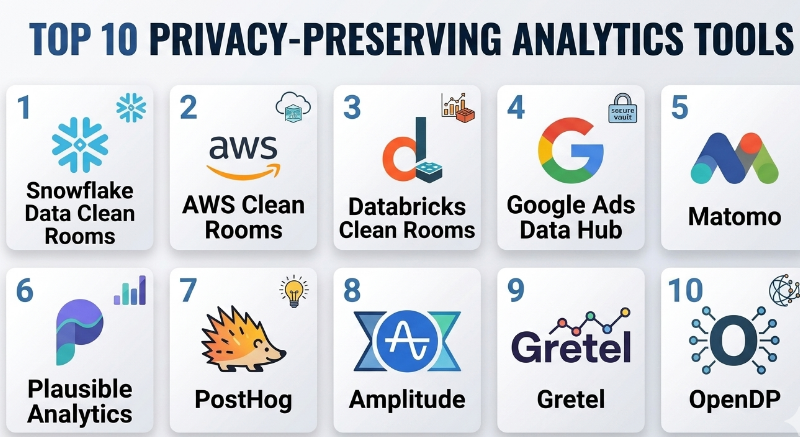
Top 10 Privacy-preserving Analytics Tools
#1 — Snowflake Data Clean Rooms
Short description :
Snowflake Data Clean Rooms help organizations collaborate and analyze shared data while reducing exposure of raw records. It is useful for enterprises that already use Snowflake as a cloud data platform and want privacy-safe analytics with partners. Brands, retailers, publishers, agencies, and data providers can use it for audience overlap, campaign measurement, and partner analytics. The tool works well when companies want analytics close to their existing warehouse and governance controls. It is especially useful for teams that need secure collaboration at enterprise scale.
Key Features
- Secure data collaboration within Snowflake
- Privacy-safe audience and partner analytics
- Controlled data sharing workflows
- Governance and permission controls
- Campaign measurement use cases
- Enterprise-scale analytics support
- Strong fit with cloud data warehouse workflows
Pros
- Strong choice for companies already using Snowflake.
- Reduces the need to move raw data between partners.
- Suitable for enterprise data collaboration and measurement.
Cons
- Best value depends on Snowflake adoption.
- Requires data governance planning.
- May be complex for small marketing-only teams.
Platforms / Deployment
Web-based platform.
Cloud deployment.
Security & Compliance
Snowflake generally supports enterprise security, encryption, access controls, and governance capabilities. Specific compliance requirements should be validated during procurement.
SOC 2, ISO 27001, HIPAA: Not publicly stated here for this specific use case.
Integrations & Ecosystem
Snowflake Data Clean Rooms fit naturally into Snowflake’s broader analytics and data sharing ecosystem. It is useful when privacy-preserving analytics needs to connect with enterprise data warehouses and BI workflows.
- Snowflake data platform
- BI dashboards
- Data sharing workflows
- Retail media analytics
- Partner collaboration
- Enterprise governance systems
Support & Community
Snowflake has strong documentation, enterprise support, partner resources, and a large data community. Support depth depends on contract and implementation complexity.
#2 — AWS Clean Rooms
Short description :
AWS Clean Rooms helps organizations collaborate on shared datasets without exposing underlying raw data to each other. It is suitable for companies already using AWS data infrastructure and needing privacy-preserving analytics across partners. Advertisers, publishers, data teams, and enterprises can use it for controlled analysis, campaign measurement, and partner insights. It is especially useful when analytics teams want cloud-native control over data collaboration workflows. AWS Clean Rooms is best for technical teams with strong AWS knowledge.
Key Features
- Privacy-safe data collaboration
- Configurable analysis rules
- Controlled query outputs
- Multi-party collaboration
- AWS-native analytics workflows
- Aggregated reporting support
- Partner measurement use cases
Pros
- Strong fit for AWS-based organizations.
- Useful for technical teams building controlled analytics workflows.
- Supports collaboration without broad raw data sharing.
Cons
- Requires AWS and data engineering knowledge.
- May not be simple for non-technical users.
- Governance rules must be carefully configured.
Platforms / Deployment
Web-based AWS console.
Cloud deployment.
Security & Compliance
AWS generally provides cloud security capabilities such as identity access controls, encryption options, monitoring, and governance tools. Buyers should validate exact implementation controls.
SOC 2, ISO 27001, HIPAA: Not publicly stated here for this specific configuration.
Integrations & Ecosystem
AWS Clean Rooms fit into AWS data, analytics, and cloud workflows. It is useful where teams already use AWS storage, data lakes, analytics tools, and reporting systems.
- AWS data services
- Data lakes
- Analytics pipelines
- BI reporting
- Advertising measurement
- Partner collaboration workflows
Support & Community
AWS has extensive documentation, enterprise support, technical partners, and a strong cloud community. Implementation quality depends on internal AWS skills.
#3 — Databricks Clean Rooms
Short description :
Databricks Clean Rooms support privacy-aware collaboration within the Databricks Lakehouse ecosystem. They help teams analyze data with partners without directly sharing raw datasets. This is useful for enterprises that already use Databricks for analytics, machine learning, data engineering, or AI workflows. The platform is suitable for technical teams that need scalable analytics, governance, and collaboration close to their lakehouse architecture. It is a strong choice when privacy-preserving analytics must support advanced data science and enterprise data operations.
Key Features
- Clean room collaboration inside Databricks
- Lakehouse-aligned analytics
- Secure partner analytics
- Governance and access controls
- Scalable data engineering support
- AI and machine learning workflow alignment
- Privacy-aware data collaboration
Pros
- Strong fit for Databricks users.
- Useful for analytics-heavy and AI-focused teams.
- Supports scalable data collaboration.
Cons
- Best value depends on Databricks adoption.
- Requires technical setup and governance planning.
- May be too advanced for simple reporting needs.
Platforms / Deployment
Web-based platform within Databricks environment.
Cloud deployment.
Security & Compliance
Databricks generally supports enterprise security and governance capabilities. Exact clean room controls should be validated during procurement.
SOC 2, ISO 27001, HIPAA: Not publicly stated here for this specific use case.
Integrations & Ecosystem
Databricks Clean Rooms fit well into data engineering, analytics, AI, and machine learning workflows. They are useful when privacy-preserving analytics must connect with lakehouse data.
- Databricks Lakehouse
- BI tools
- Data engineering pipelines
- AI and machine learning workflows
- Partner analytics
- Enterprise governance
Support & Community
Databricks has strong documentation, enterprise support, technical partners, and a large data engineering community. Internal data team maturity is important for success.
#4 — Google Ads Data Hub
Short description :
Google Ads Data Hub is a privacy-focused analytics environment for advertisers working with Google advertising data. It helps teams analyze campaign performance using aggregated outputs and controlled query logic. It is useful for agencies, large advertisers, and analytics teams that need deeper campaign measurement while respecting privacy restrictions. The platform is most relevant when a company spends significantly across Google media and needs advanced reporting beyond standard dashboards. It is not a universal privacy analytics tool, but it is strong for Google advertising measurement.
Key Features
- Privacy-focused advertising analytics
- Aggregated reporting controls
- Campaign measurement
- Audience and conversion insights
- Query-based analysis
- Google advertising ecosystem alignment
- Advanced measurement workflows
Pros
- Strong for Google advertising measurement.
- Useful for privacy-safe campaign analysis.
- Better for advanced advertisers than basic ad reporting.
Cons
- Mostly centered around Google advertising data.
- Requires analytics and query skills.
- Not suitable for every privacy-preserving analytics use case.
Platforms / Deployment
Web-based platform.
Cloud deployment.
Security & Compliance
Google provides privacy-focused controls and aggregation requirements for this environment. Specific compliance requirements should be validated directly.
SOC 2, ISO 27001, HIPAA: Not publicly stated here.
Integrations & Ecosystem
Google Ads Data Hub fits into Google advertising, analytics, and cloud-aligned measurement workflows.
- Google advertising data
- BigQuery-oriented analytics
- Campaign reporting
- Audience measurement
- Agency workflows
- Analytics dashboards
Support & Community
Support is stronger for qualified advertisers, agencies, and enterprise Google customers. Practical usage may require analytics expertise.
#5 — Matomo
Short description :
Matomo is a privacy-focused web analytics platform that helps organizations track website and user behavior while giving more control over data ownership. It is suitable for businesses, publishers, public-sector organizations, and privacy-conscious teams that want an alternative to traditional third-party analytics. Matomo can be self-hosted or used in the cloud depending on requirements. It supports website analytics, event tracking, goals, ecommerce tracking, and reporting. It is especially useful when teams want analytics while keeping stronger control over data storage and consent practices.
Key Features
- Privacy-focused web analytics
- Self-hosted and cloud options
- Website traffic and behavior tracking
- Goal and event tracking
- Ecommerce analytics
- Consent-friendly analytics workflows
- Data ownership control
Pros
- Strong fit for privacy-conscious website analytics.
- Self-hosting gives more control over data.
- Useful alternative to third-party analytics platforms.
Cons
- Advanced enterprise use may require setup and maintenance.
- Self-hosting needs technical responsibility.
- Not a full data clean room or partner analytics platform.
Platforms / Deployment
Web-based platform.
Cloud / Self-hosted.
Security & Compliance
Security depends on deployment and configuration. Privacy-focused analytics and data ownership are key strengths.
SOC 2, ISO 27001, HIPAA: Not publicly stated.
Integrations & Ecosystem
Matomo fits well into website, CMS, ecommerce, and reporting workflows where privacy-friendly web analytics is required.
- Websites and CMS platforms
- Ecommerce systems
- Tag management workflows
- BI exports
- Custom events
- Reporting dashboards
Support & Community
Matomo has documentation, community resources, and support options depending on deployment and plan. It has strong recognition among privacy-focused web analytics users.
#6 — Plausible Analytics
Short description :
Plausible Analytics is a lightweight, privacy-friendly website analytics tool designed for teams that want simple traffic insights without heavy tracking. It focuses on essential metrics such as visitors, page views, referral sources, goals, devices, locations, and campaigns. Plausible is especially useful for small businesses, content websites, SaaS teams, founders, and privacy-conscious organizations. It avoids overly complex dashboards and focuses on clean, easy-to-understand analytics. It is best for teams that want simple web analytics with a privacy-first approach.
Key Features
- Lightweight web analytics
- Privacy-friendly tracking approach
- Simple dashboard
- Goal tracking
- Referral and campaign tracking
- Fast implementation
- Minimal analytics interface
Pros
- Very easy to use.
- Good for privacy-conscious small and mid-sized websites.
- Lightweight compared with traditional analytics tools.
Cons
- Not suitable for deep product analytics.
- Limited compared with enterprise analytics suites.
- Not designed for data clean rooms or advanced collaboration.
Platforms / Deployment
Web-based platform.
Cloud / Self-hosted options may vary.
Security & Compliance
Privacy-focused analytics is a core positioning. Specific enterprise certifications should be validated directly.
SOC 2, ISO 27001, HIPAA: Not publicly stated.
Integrations & Ecosystem
Plausible works best as a simple analytics layer for websites and content platforms. It can be used with campaign links, goal tracking, and basic reporting workflows.
- Websites
- CMS platforms
- Campaign tracking
- Goal tracking
- Lightweight reporting
- Custom events
Support & Community
Plausible has documentation and a strong privacy-focused user community. Support options may vary by plan and deployment model.
#7 — PostHog
Short description :
PostHog is a product analytics platform that supports event tracking, funnels, session replay, feature flags, experiments, and product insights. It is relevant to privacy-preserving analytics because teams can choose deployment models and manage product data with stronger control. PostHog is useful for SaaS companies, product teams, engineering teams, and startups that want product analytics with flexibility. It can be self-hosted or cloud-based depending on requirements. It is especially useful for technical teams that want analytics, experimentation, and product observability in one place.
Key Features
- Product analytics
- Event tracking and funnels
- Session replay
- Feature flags
- Experimentation tools
- Cloud and self-hosted options
- Developer-friendly analytics workflows
Pros
- Strong fit for product and engineering teams.
- Flexible deployment options.
- Combines analytics with experimentation and feature management.
Cons
- May require technical setup for advanced use.
- Session replay needs careful privacy configuration.
- Not focused only on privacy analytics.
Platforms / Deployment
Web-based platform.
Cloud / Self-hosted.
Security & Compliance
Security depends on deployment and configuration. Self-hosting can provide more infrastructure control.
SOC 2, ISO 27001, HIPAA: Not publicly stated here.
Integrations & Ecosystem
PostHog fits into product-led engineering environments where event analytics, experiments, feature flags, and user behavior insights are connected.
- Web and app products
- Data warehouses
- Feature flag workflows
- Experimentation systems
- Developer tools
- Product reporting
Support & Community
PostHog has strong documentation, open-source community visibility, and support resources. It is popular among technical product teams and startups.
#8 — Amplitude
Short description :
Amplitude is a product analytics platform used by product, growth, data, and marketing teams to understand user behavior across digital products. It helps teams analyze funnels, retention, cohorts, journeys, experiments, and product performance. While not only a privacy-preserving tool, it supports enterprise analytics workflows where governance, access control, and responsible data handling matter. Amplitude is suitable for SaaS companies, apps, marketplaces, and digital businesses that need deep behavioral analytics. It is best for organizations that want advanced product insights with structured data governance.
Key Features
- Product analytics
- Funnel and retention analysis
- Cohort analysis
- Behavioral segmentation
- Experimentation support
- Journey analysis
- Enterprise analytics workflows
Pros
- Strong product analytics depth.
- Useful for growth, product, and data teams.
- Good fit for digital businesses with complex user behavior.
Cons
- Requires strong event taxonomy planning.
- May be more than small teams need.
- Privacy depends on implementation and governance.
Platforms / Deployment
Web-based platform.
Cloud deployment.
Security & Compliance
Enterprise-grade access controls and governance features may be available depending on plan. Specific compliance requirements should be verified directly.
SOC 2, ISO 27001, HIPAA: Not publicly stated here.
Integrations & Ecosystem
Amplitude fits into product analytics and growth workflows where user behavior data must connect with experimentation, data warehouses, and customer systems.
- Data warehouses
- Customer data platforms
- Experimentation workflows
- Product analytics pipelines
- Marketing systems
- BI dashboards
Support & Community
Amplitude provides documentation, learning resources, customer success, and enterprise support options. It has strong recognition among product and growth teams.
#9 — Gretel
Short description :
Gretel is a synthetic data and privacy engineering platform that helps teams create artificial datasets that preserve useful patterns while reducing exposure of real sensitive data. It is useful for analytics testing, machine learning development, software testing, data sharing, and privacy-safe experimentation. Data teams can use Gretel when production data is too sensitive to share with developers, partners, or external tools. It is especially relevant for companies working with regulated or sensitive datasets. Gretel is best for teams that need privacy-preserving data generation and transformation rather than traditional dashboards.
Key Features
- Synthetic data generation
- Data anonymization and transformation
- Privacy engineering workflows
- Data sharing support
- Testing and development datasets
- Machine learning data preparation
- Sensitive data reduction
Pros
- Useful for reducing risk when working with sensitive data.
- Strong fit for testing, development, and ML workflows.
- Helps avoid unnecessary use of raw production data.
Cons
- Not a traditional analytics dashboard.
- Synthetic data quality must be validated.
- Requires data team understanding for best use.
Platforms / Deployment
Web-based platform and developer workflows.
Cloud / Hybrid options may vary.
Security & Compliance
Privacy engineering is central to the platform. Specific certifications and compliance details should be verified directly.
SOC 2, ISO 27001, HIPAA: Not publicly stated.
Integrations & Ecosystem
Gretel fits into data engineering, software development, machine learning, and privacy workflows where synthetic or transformed data is needed.
- Data warehouses
- Developer tools
- Machine learning pipelines
- Testing environments
- Data sharing workflows
- Privacy engineering systems
Support & Community
Gretel provides documentation, developer resources, and support options. It has strong relevance among data engineers, ML teams, and privacy engineering teams.
#10 — OpenDP
Short description :
OpenDP is an open-source project focused on differential privacy and privacy-preserving data analysis. It is suitable for researchers, data scientists, public-sector teams, academic users, and technical organizations that need mathematically grounded privacy methods. OpenDP is not a standard SaaS dashboard. Instead, it provides tools and libraries that help teams build privacy-preserving statistical analysis workflows. It is especially useful when teams need stronger formal privacy guarantees and have the technical skill to implement them correctly.
Key Features
- Differential privacy tooling
- Open-source privacy-preserving analysis
- Statistical privacy methods
- Research and technical workflows
- Custom analytics development
- Strong privacy theory foundation
- Suitable for sensitive aggregate analysis
Pros
- Strong formal privacy foundation.
- Useful for research and technical privacy teams.
- Open-source and transparent.
Cons
- Not a plug-and-play analytics product.
- Requires technical and statistical expertise.
- Business dashboards must be built separately.
Platforms / Deployment
Developer libraries and technical environments.
Self-hosted / custom deployment depending on implementation.
Security & Compliance
Security depends on implementation. Differential privacy methods can support privacy-preserving analysis when used correctly.
SOC 2, ISO 27001, HIPAA: Not publicly stated.
Integrations & Ecosystem
OpenDP can be integrated into custom analytics systems, research workflows, and privacy-preserving data pipelines.
- Python and technical workflows
- Statistical analysis pipelines
- Research systems
- Custom analytics products
- Data governance workflows
- Internal privacy tools
Support & Community
OpenDP has open-source documentation and a technical community. Support depends on internal expertise, research partners, or implementation specialists.
Comparison Table Top 10
| Tool Name | Best For | Platform Supported | Deployment | Standout Feature | Public Rating |
|---|---|---|---|---|---|
| Snowflake Data Clean Rooms | Enterprise data collaboration | Web | Cloud | Privacy-safe collaboration inside Snowflake | N/A |
| AWS Clean Rooms | AWS-native privacy-safe analytics | Web | Cloud | Configurable analysis rules | N/A |
| Databricks Clean Rooms | Lakehouse-based secure analytics | Web | Cloud | Clean rooms inside Databricks ecosystem | N/A |
| Google Ads Data Hub | Google advertising measurement | Web | Cloud | Privacy-safe ad campaign analysis | N/A |
| Matomo | Privacy-focused web analytics | Web | Cloud / Self-hosted | Data ownership and self-hosting | N/A |
| Plausible Analytics | Simple privacy-friendly website analytics | Web | Cloud / Self-hosted | Lightweight privacy-first dashboard | N/A |
| PostHog | Product analytics with deployment control | Web | Cloud / Self-hosted | Product analytics plus feature flags | N/A |
| Amplitude | Enterprise product analytics | Web | Cloud | Deep behavioral analytics | N/A |
| Gretel | Synthetic data and privacy engineering | Web / Developer workflows | Cloud / Hybrid | Synthetic data generation | N/A |
| OpenDP | Differential privacy research and development | Developer libraries | Self-hosted / Custom | Formal differential privacy tooling | N/A |
Evaluation & Privacy-preserving Analytics Tools
| Tool Name | Core 25% | Ease 15% | Integrations 15% | Security 10% | Performance 10% | Support 10% | Value 15% | Weighted Total 0–10 |
|---|---|---|---|---|---|---|---|---|
| Snowflake Data Clean Rooms | 9 | 7 | 9 | 8 | 9 | 8 | 8 | 8.30 |
| AWS Clean Rooms | 9 | 7 | 9 | 8 | 9 | 8 | 8 | 8.30 |
| Databricks Clean Rooms | 9 | 6 | 9 | 8 | 9 | 8 | 8 | 8.15 |
| Google Ads Data Hub | 8 | 6 | 8 | 8 | 8 | 7 | 7 | 7.45 |
| Matomo | 8 | 8 | 7 | 7 | 8 | 7 | 9 | 7.80 |
| Plausible Analytics | 7 | 9 | 6 | 7 | 8 | 7 | 9 | 7.60 |
| PostHog | 8 | 8 | 8 | 7 | 8 | 8 | 9 | 8.05 |
| Amplitude | 9 | 8 | 9 | 8 | 9 | 8 | 7 | 8.35 |
| Gretel | 8 | 7 | 8 | 8 | 8 | 7 | 8 | 7.80 |
| OpenDP | 8 | 5 | 7 | 8 | 7 | 6 | 9 | 7.20 |
These scores are comparative and should not be treated as universal rankings. A website owner may find Plausible or Matomo more useful than an enterprise clean room. A product team may prefer PostHog or Amplitude. A data collaboration team may prefer Snowflake, AWS, or Databricks. A privacy engineering team may value Gretel or OpenDP more highly than business dashboard tools.
Which Privacy-preserving Analytics Tools
Solo / Freelancer
Solo users and freelancers usually need simple, low-maintenance privacy-friendly analytics. Plausible Analytics and Matomo can be practical choices for website reporting without unnecessary complexity.
For technical freelancers working with product teams, PostHog may be useful because it supports product analytics and flexible deployment. OpenDP and Gretel are more suitable when the freelancer is working on privacy engineering, synthetic data, or technical analytics projects.
SMB
Small and mid-sized businesses should focus on tools that are easy to implement and maintain. Plausible Analytics, Matomo, PostHog, and Amplitude can be useful depending on whether the business needs website analytics or product analytics.
SMBs should avoid adopting complex clean room platforms unless they have a clear partner data collaboration use case. Before buying advanced tools, they should define consent practices, event tracking standards, user access rules, and reporting goals.
Mid-Market
Mid-market companies usually need stronger governance, better integrations, and deeper analytics. PostHog and Amplitude may be strong choices for product analytics. Matomo can work when data ownership and self-hosting are priorities.
If the company collaborates with retailers, media partners, advertisers, or external data partners, Snowflake Data Clean Rooms, AWS Clean Rooms, or Databricks Clean Rooms may become relevant. Gretel can help when teams need safe data for development, testing, or machine learning.
Enterprise
Enterprise organizations need scalable analytics, access controls, governance, auditability, integrations, and privacy reviews. Amplitude, Snowflake Data Clean Rooms, AWS Clean Rooms, Databricks Clean Rooms, and Google Ads Data Hub can be useful depending on the use case.
Enterprises may use multiple tools together. For example, product analytics may run in Amplitude, web analytics may use Matomo, partner analytics may use Snowflake or AWS Clean Rooms, and synthetic data workflows may use Gretel.
Budget vs Premium
Budget-focused teams should start with tools that solve a clear need without creating unnecessary operational overhead. Plausible, Matomo, PostHog, and OpenDP may be practical depending on technical capability.
Premium tools are useful when the business needs enterprise governance, large-scale analytics, partner collaboration, advanced product analytics, or privacy engineering workflows. The right investment depends on risk reduction, business impact, and data maturity.
Feature Depth vs Ease of Use
Plausible is very easy to use but not deep enough for complex analytics. Matomo provides more analytics control while remaining accessible for privacy-conscious website owners.
PostHog and Amplitude provide deeper product analytics but require strong event planning. Snowflake, AWS, and Databricks clean rooms provide powerful collaboration features but require data engineering and governance maturity. OpenDP provides strong privacy methods but requires technical expertise.
Integrations & Scalability
Privacy-preserving analytics tools should connect with the systems where business data already lives. Important integrations include websites, apps, cloud data warehouses, data lakes, BI dashboards, CRM systems, marketing platforms, product tools, development environments, and machine learning pipelines.
Scalability depends on data volume, number of users, reporting complexity, governance needs, and collaboration requirements. Buyers should check whether the tool can support growing data pipelines, more teams, more events, more partners, and stronger audit requirements.
Security & Compliance Needs
Security and compliance are central to privacy-preserving analytics. Buyers should evaluate SSO, SAML, MFA, RBAC, encryption, audit logs, consent handling, data retention, data residency, anonymization, aggregation controls, and privacy review workflows.
A tool should not be selected only because it claims to be privacy-friendly. Teams should validate how the tool stores data, who can access it, how reports are generated, what data is exported, and how privacy controls are enforced.
Frequently Asked Questions FAQs
1. What are Privacy-preserving Analytics Tools?
Privacy-preserving Analytics Tools help organizations analyze data while reducing the exposure of sensitive personal or business information. They may use methods such as aggregation, anonymization, clean rooms, synthetic data, consent controls, self-hosting, or differential privacy. The goal is to create useful insights without unnecessary data risk.
2. How are privacy-preserving analytics different from normal analytics?
Normal analytics often collects and stores detailed user-level behavior by default. Privacy-preserving analytics focuses on limiting exposure, reducing unnecessary collection, controlling access, and protecting individuals or sensitive groups. It gives teams insights while applying stronger data protection principles.
3. Are privacy-preserving analytics tools only for regulated industries?
No. Regulated industries like finance, healthcare, and government may need them more urgently, but any company handling customer data can benefit. SaaS companies, ecommerce brands, publishers, media companies, and product teams also use privacy-focused analytics to build trust and reduce risk.
4. What is the role of consent in privacy-preserving analytics?
Consent helps define what data can be collected, processed, and used. Privacy-preserving analytics tools should work with consent rules rather than bypass them. Teams still need clear policies, consent management, and legal guidance before collecting or analyzing user data.
5. What is differential privacy?
Differential privacy is a mathematical approach that adds controlled noise to data or query results so individual users are harder to identify. It is useful for aggregate reporting and sensitive datasets. However, it requires technical expertise to implement correctly.
6. What is synthetic data?
Synthetic data is artificially generated data that looks similar to real data in structure or patterns but does not directly expose real customer records. It is useful for testing, development, analytics practice, and machine learning workflows. Teams should still validate quality before relying on it.
7. Do privacy-preserving tools reduce analytics accuracy?
Sometimes there is a trade-off. Privacy methods such as aggregation, anonymization, or differential privacy can reduce detail but improve safety. The goal is to find the right balance between useful insights and acceptable privacy risk.
8. Can privacy-preserving analytics tools integrate with BI platforms?
Yes, many tools can connect with BI dashboards, data warehouses, product analytics systems, and reporting workflows. Integration depth varies by product. Buyers should check connector availability, export controls, API access, and governance rules.
9. Are self-hosted analytics tools more private?
Self-hosting can provide more control over data storage and infrastructure, but it does not automatically guarantee privacy. Teams must still configure security, access controls, backups, encryption, retention, and compliance processes correctly. Poorly managed self-hosting can create risk.
10. What are common mistakes when implementing privacy-preserving analytics?
Common mistakes include collecting too much data, ignoring consent, failing to define access controls, using production data unnecessarily, and choosing tools without legal or security review. Another mistake is assuming that a privacy-focused tool removes the need for governance.
Conclusion
Privacy-preserving Analytics Tools are becoming essential because organizations need insights, but they also need stronger responsibility around data. Customers expect privacy, regulators expect control, and business partners expect secure collaboration. The best tool depends on the type of analytics problem. Plausible and Matomo are practical for privacy-friendly website analytics. PostHog and Amplitude are stronger for product analytics. Snowflake, AWS, Databricks, and Google Ads Data Hub are useful for controlled data collaboration and advanced measurement. Gretel is valuable for synthetic data and privacy engineering, while OpenDP is suitable for teams that need formal differential privacy methods.
