Introduction
Brand Tracking Tools are software platforms that help businesses measure how people recognize, remember, trust, compare, and talk about a brand over time. In simple English, these tools show whether your brand is becoming stronger, weaker, more trusted, more visible, or more preferred in the market.
In a modern marketing environment, brand tracking matters because customers interact with brands across search, social media, ads, review sites, communities, news, podcasts, influencers, and AI-driven discovery channels. A campaign may increase awareness, but it may not improve trust. A product launch may create buzz, but it may also create negative sentiment. Brand tracking tools help teams connect these signals into a clear view of brand health.
Common use cases include measuring brand awareness, tracking sentiment, comparing competitor share of voice, monitoring campaign impact, understanding customer perception, and detecting reputation risks early.
Buyers should evaluate tools based on data coverage, survey quality, social listening depth, sentiment accuracy, competitor benchmarking, dashboard usability, integrations, reporting flexibility, privacy controls, and pricing transparency.
Best for: Marketing teams, brand managers, growth teams, research teams, agencies, founders, customer experience teams, and enterprise communication teams that need continuous visibility into brand health.
Not ideal for: Very small teams that only need basic mention alerts, companies without enough brand activity to track, or teams that only need one-time customer surveys instead of ongoing brand measurement.
Key Trends in Brand Tracking Tools
- AI-assisted sentiment analysis is becoming more practical: Modern tools increasingly use AI to classify sentiment, topics, emotions, intent, and emerging themes across large volumes of brand conversations.
- Brand tracking is moving beyond surveys only: Traditional survey-based tracking is now often combined with social listening, search visibility, review monitoring, media tracking, and competitive intelligence.
- Real-time alerts are becoming important: Teams want early warnings when negative sentiment, viral complaints, competitor campaigns, or media mentions start moving quickly.
- AI search visibility is becoming a new brand metric: Brands now care about how they appear in AI-generated answers, search snippets, comparison content, and recommendation engines.
- Privacy and compliance expectations are higher: Buyers increasingly expect clear data handling, role-based access, encryption, consent-aware research methods, and regional privacy support.
- Dashboards are becoming more executive-friendly: Teams want simple scorecards that explain brand health without forcing leaders to read complex research reports.
- Competitive benchmarking is now a core requirement: Most buyers want to compare awareness, consideration, sentiment, share of voice, and category perception against competitors.
- Integrated workflows matter more: Brand tracking tools are expected to connect with CRM, BI tools, ad platforms, social media management platforms, customer feedback systems, and reporting tools.
- Pricing is shifting toward flexible models: Some vendors use enterprise contracts, while others offer usage-based, response-based, seat-based, or modular pricing.
- More teams want always-on tracking: Instead of quarterly research only, companies are moving toward continuous or frequent brand health measurement.
How We Selected These Tools
The tools below were selected using practical buyer-focused criteria rather than one single popularity metric.
- Market adoption and mindshare: Preference was given to platforms that are widely recognized in brand research, social listening, consumer intelligence, media monitoring, or customer experience.
- Feature completeness: Tools were evaluated based on their ability to support brand awareness, sentiment, competitor tracking, campaign measurement, dashboards, and reporting.
- Use-case fit: The list includes tools suitable for enterprise research teams, SMB marketers, agencies, social teams, and growth teams.
- Data coverage: Stronger tools cover multiple sources such as surveys, social media, news, reviews, forums, web mentions, and competitor signals.
- Reliability and reporting depth: Tools with mature dashboards, recurring reports, alerts, and exportable insights were prioritized.
- Security posture signals: Platforms with enterprise access controls, privacy practices, and compliance visibility were considered stronger.
- Integration ecosystem: Tools that can connect with analytics, BI, CRM, marketing, and social platforms received higher consideration.
- Practical buyer value: The final list balances premium enterprise platforms with tools that are easier for smaller teams to adopt.
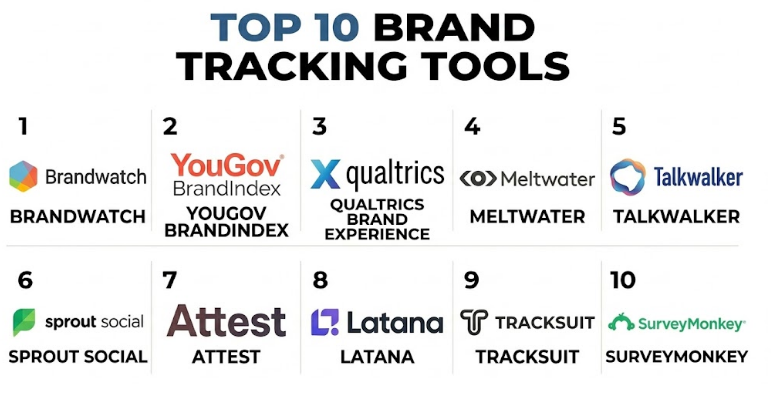
Top 10 Brand Tracking Tools
#1 — Brandwatch
Short description :
Brandwatch is a well-known consumer intelligence and social listening platform used by brands, agencies, and enterprise marketing teams. It helps track online conversations, sentiment, audience behavior, brand perception, competitor activity, and campaign performance. The platform is suitable for organizations that need deep social and digital intelligence rather than only survey-based brand tracking. It is especially useful for teams managing large brand portfolios, global markets, and high-volume online conversations. Brandwatch is strong for real-time listening, trend discovery, and reputation monitoring.
Key Features
- Social listening and online conversation tracking
- Sentiment and emotion analysis
- Competitor and category monitoring
- Audience intelligence and segmentation
- Campaign performance tracking
- Trend detection and topic clustering
- Custom dashboards and reporting
Pros
- Strong data coverage for social and digital brand conversations.
- Useful for large brands that need real-time visibility.
- Good fit for agencies and enterprise marketing teams.
Cons
- May be expensive or complex for small teams.
- Requires proper setup to avoid noisy data.
- Survey-based brand tracking may require additional tools.
Platforms / Deployment
Web-based platform.
Cloud deployment.
Security & Compliance
Enterprise-grade access controls are commonly expected. Specific certifications and compliance details vary by contract and region.
SOC 2, ISO 27001, HIPAA: Not publicly stated.
Integrations & Ecosystem
Brandwatch is commonly used inside broader marketing intelligence and social media workflows. It can support reporting, analytics, and campaign analysis use cases where brand teams need to connect social insights with business decisions.
- Social media platforms
- Reporting dashboards
- BI and analytics workflows
- Agency reporting processes
- Exportable datasets
- Marketing research workflows
Support & Community
Brandwatch offers enterprise-style onboarding, documentation, training resources, and support options. Community strength is stronger among social intelligence, agency, and enterprise marketing users. Support level may vary by package.
#2 — YouGov BrandIndex
Short description :
YouGov BrandIndex is a brand tracking platform focused on continuous consumer perception measurement. It helps companies understand awareness, consideration, purchase intent, satisfaction, impression, quality perception, value perception, and competitor position. It is best suited for brands that need survey-based, market-level brand health tracking across countries and categories. The platform is useful for consumer brands, media companies, agencies, financial services, retail, travel, and public-facing organizations. It is more research-oriented than social listening tools.
Key Features
- Continuous brand health measurement
- Consumer perception tracking
- Competitive benchmarking
- Market and category comparisons
- Brand funnel metrics
- Trend analysis over time
- Research-backed dashboards
Pros
- Strong for long-term brand health tracking.
- Useful for benchmarking against competitors.
- Good fit for large consumer-facing brands.
Cons
- May not be ideal for real-time social listening.
- Pricing may be more suitable for larger organizations.
- Custom research flexibility may vary by plan.
Platforms / Deployment
Web-based platform.
Cloud deployment.
Security & Compliance
Privacy and data handling are important due to consumer research methodology. Specific enterprise controls and certifications should be verified with the vendor.
SOC 2, ISO 27001, HIPAA: Not publicly stated.
Integrations & Ecosystem
YouGov BrandIndex is often used as a research intelligence layer for brand and strategy teams. It works best when combined with media planning, campaign tracking, and market research workflows.
- Research dashboards
- Market intelligence workflows
- Consumer insight reporting
- Brand strategy planning
- Competitive benchmarking
- Executive reporting
Support & Community
Support is generally aligned with professional research and enterprise customer needs. Onboarding, methodology guidance, and account support may vary based on region and contract.
#3 — Qualtrics Brand Experience
Short description :
Qualtrics Brand Experience helps organizations measure brand health through surveys, feedback programs, and experience data. It is designed for companies that want structured brand perception tracking connected with customer experience, employee experience, and market research. Qualtrics is often used by enterprises that need flexible survey design, advanced analytics, segmentation, dashboards, and governance. It is suitable for brand teams that want to connect brand tracking with broader experience management.
Key Features
- Brand health survey tracking
- Customer and market research tools
- Advanced survey logic and segmentation
- Dashboards and reporting
- Experience management workflows
- Audience targeting and panel options
- Text analytics and insight discovery
Pros
- Strong enterprise research and survey capabilities.
- Flexible enough for complex brand measurement programs.
- Useful when brand tracking must connect with customer experience.
Cons
- Can be complex for small teams.
- Requires research knowledge for best results.
- Pricing is often enterprise-oriented.
Platforms / Deployment
Web-based platform.
Cloud deployment.
Security & Compliance
Qualtrics commonly supports enterprise security needs such as access management and data governance. Specific certifications should be validated directly during procurement.
HIPAA and regional compliance capabilities may vary by product and configuration.
Integrations & Ecosystem
Qualtrics has a broad ecosystem for experience management and analytics. It can connect brand research with customer feedback, CRM, and business intelligence workflows.
- CRM systems
- BI platforms
- Customer experience workflows
- Survey panels
- Data exports
- Marketing and research dashboards
Support & Community
Qualtrics provides documentation, enterprise onboarding, customer success support, and training resources. Support quality and depth may depend on contract level.
#4 — Meltwater
Short description :
Meltwater is a media intelligence, social listening, and brand monitoring platform used by PR, communication, marketing, and brand teams. It helps companies track media mentions, social conversations, sentiment, competitor visibility, campaign impact, and reputation signals. Meltwater is especially useful for teams that need both media monitoring and social intelligence in one platform. It supports brand tracking from a communication and public perception angle.
Key Features
- Media monitoring across news and digital channels
- Social listening and sentiment analysis
- PR and communication reporting
- Competitor tracking
- Campaign performance dashboards
- Influencer and media contact intelligence
- Alerts and reputation monitoring
Pros
- Strong for PR, communications, and media monitoring.
- Useful for reputation management and crisis tracking.
- Good mix of social and editorial media coverage.
Cons
- May be more PR-focused than survey-focused.
- Setup and query design require care.
- Pricing may not fit all small businesses.
Platforms / Deployment
Web-based platform.
Cloud deployment.
Security & Compliance
Enterprise access controls and data governance options may be available depending on plan. Specific certifications should be confirmed directly.
SOC 2, ISO 27001, HIPAA: Not publicly stated.
Integrations & Ecosystem
Meltwater fits into PR, social, and marketing intelligence workflows. It can help teams connect earned media, social mentions, and brand sentiment into reporting.
- Social media platforms
- PR reporting workflows
- Media databases
- Dashboards and exports
- Campaign reporting
- Communication team workflows
Support & Community
Meltwater generally provides onboarding, customer support, and training resources. It is widely known among PR and communication professionals, which helps with user familiarity.
#5 — Talkwalker
Short description :
Talkwalker is a consumer intelligence and social listening platform used for brand monitoring, sentiment tracking, audience insights, competitive intelligence, and trend analysis. It is suitable for large brands, agencies, and communication teams that need broad digital coverage and advanced analytics. Talkwalker is often selected by teams that want to understand brand conversations across social, news, blogs, forums, video, and other online sources. It is strong for reputation monitoring and global brand visibility.
Key Features
- Social listening and brand monitoring
- Sentiment and emotion analytics
- Trend and topic detection
- Competitor benchmarking
- Visual and image recognition capabilities
- Campaign tracking
- Custom reporting dashboards
Pros
- Strong digital conversation coverage.
- Useful for global brand and reputation teams.
- Good for tracking trends and emerging risks.
Cons
- May require expert setup for accurate insights.
- Can be more advanced than smaller teams need.
- Pricing details are often not fully public.
Platforms / Deployment
Web-based platform.
Cloud deployment.
Security & Compliance
Enterprise security controls may be available. Specific certifications and compliance details should be validated during vendor review.
SOC 2, ISO 27001, HIPAA: Not publicly stated.
Integrations & Ecosystem
Talkwalker is commonly used alongside brand strategy, PR, social media, and market intelligence workflows. It supports reporting and data exports for broader analysis.
- Social media channels
- News and web monitoring
- BI and analytics workflows
- Campaign reports
- Data exports
- Agency dashboards
Support & Community
Talkwalker provides support, onboarding, and knowledge resources. It has stronger adoption among enterprise, agency, PR, and social intelligence teams.
#6 — Sprout Social
Short description :
Sprout Social is a social media management and social listening platform that helps teams monitor brand conversations, measure sentiment, manage engagement, and report on social performance. While it is not only a brand tracking platform, it is useful for teams that view social media as a major brand signal. It is especially suitable for social media teams, marketing teams, agencies, and mid-market companies that want listening, publishing, engagement, and reporting in one environment.
Key Features
- Social listening and sentiment tracking
- Social publishing and engagement management
- Brand mention monitoring
- Competitor and topic tracking
- Reporting dashboards
- Team collaboration workflows
- Customer care and inbox management
Pros
- Combines social management with listening.
- Easier to adopt than many enterprise research platforms.
- Good fit for teams that manage social engagement daily.
Cons
- Not a full survey-based brand tracking tool.
- Advanced listening may require higher-tier plans.
- May not cover all research-heavy brand metrics.
Platforms / Deployment
Web-based platform.
Mobile apps may be available for iOS and Android.
Cloud deployment.
Security & Compliance
Common enterprise features may include user permissions and access controls. Specific compliance details should be checked by buyers.
SOC 2, ISO 27001, HIPAA: Not publicly stated.
Integrations & Ecosystem
Sprout Social connects naturally with social media workflows and customer engagement processes. It can support marketing, care, and reporting teams.
- Social networks
- CRM and customer care workflows
- Reporting exports
- Analytics dashboards
- Team collaboration workflows
- Social inbox tools
Support & Community
Sprout Social has documentation, product education, onboarding resources, and customer support options. It has a strong community among social media managers and marketing teams.
#7 — Attest
Short description :
Attest is a consumer research platform that helps brands run surveys and understand customer perception, awareness, positioning, demand, and market trends. It is suitable for marketing, research, product, and growth teams that want faster consumer feedback without building a full research operation. For brand tracking, Attest can help measure awareness, consideration, preference, and audience attitudes over time. It is a good option for teams that want survey-based insights with a simpler workflow.
Key Features
- Consumer survey research
- Brand awareness and perception tracking
- Audience targeting
- Market and category insights
- Concept and campaign testing
- Reporting dashboards
- Repeatable research workflows
Pros
- Easier for marketing teams to use than traditional research methods.
- Good for quick consumer insight collection.
- Useful for brand, product, and campaign validation.
Cons
- Not a full social listening platform.
- Depth may depend on survey design quality.
- May not replace enterprise research teams for complex programs.
Platforms / Deployment
Web-based platform.
Cloud deployment.
Security & Compliance
Data privacy and research governance should be reviewed during procurement. Specific security certifications are not clearly known.
SOC 2, ISO 27001, HIPAA: Not publicly stated.
Integrations & Ecosystem
Attest works well as a research layer inside marketing and product decision-making. It is typically used for insight generation rather than operational social monitoring.
- Survey workflows
- Market research reporting
- Brand strategy planning
- Product research
- Campaign testing
- Dashboard exports
Support & Community
Attest generally provides onboarding, research guidance, and support resources. Community visibility is stronger among marketing insight and consumer research teams.
#8 — Latana
Short description :
Latana is a brand tracking platform focused on helping companies measure brand awareness, audience perception, and brand performance across target groups. It is built for brand teams that want structured brand tracking without manually managing complex research operations. Latana is suitable for growing companies, consumer brands, and marketing teams that need recurring insight into brand health. It is more focused on brand research than general social monitoring.
Key Features
- Brand awareness tracking
- Audience segmentation
- Brand funnel measurement
- Competitor comparison
- Market and category insights
- Dashboard-based reporting
- Recurring brand health measurement
Pros
- Focused specifically on brand tracking.
- Useful for tracking perception by audience segment.
- Good fit for teams that need recurring brand health reports.
Cons
- Less suitable for real-time social media monitoring.
- Pricing details may not be fully public.
- May need complementary tools for media and social intelligence.
Platforms / Deployment
Web-based platform.
Cloud deployment.
Security & Compliance
Specific enterprise security and compliance details should be verified with the vendor.
SOC 2, ISO 27001, HIPAA: Not publicly stated.
Integrations & Ecosystem
Latana is commonly used as a brand research and measurement tool. It can support marketing planning, brand strategy, and performance reporting.
- Brand dashboards
- Market research workflows
- Campaign evaluation
- Audience segmentation
- Executive reports
- Data exports
Support & Community
Support and onboarding are likely available for customers, especially for research setup and brand tracking programs. Public community strength is moderate compared with larger enterprise platforms.
#9 — Tracksuit
Short description :
Tracksuit is a brand tracking platform designed to make brand health measurement more accessible and easier to understand. It focuses on helping teams track awareness, consideration, preference, and other brand funnel metrics through simple dashboards. It is suitable for growth brands, marketing teams, founders, and agencies that want clear brand tracking without overly complex research systems. Tracksuit is often attractive to teams that want board-friendly brand metrics and simple visual reporting.
Key Features
- Brand funnel tracking
- Awareness and consideration measurement
- Competitor benchmarking
- Simple dashboards
- Market and audience segmentation
- Recurring tracking
- Executive-friendly reporting
Pros
- Easy-to-understand brand health dashboards.
- Good fit for growing brands and marketing leaders.
- Makes brand metrics easier to explain internally.
Cons
- May not offer the depth of large enterprise research suites.
- Not designed as a full social listening platform.
- Advanced customization may vary by plan.
Platforms / Deployment
Web-based platform.
Cloud deployment.
Security & Compliance
Specific security controls and certifications should be confirmed directly.
SOC 2, ISO 27001, HIPAA: Not publicly stated.
Integrations & Ecosystem
Tracksuit fits well into brand planning and executive reporting workflows. It is often used alongside analytics, campaign reporting, and creative performance tools.
- Brand dashboards
- Marketing reports
- Board and investor reporting
- Competitor benchmarks
- Market segmentation
- Data exports
Support & Community
Tracksuit provides support and onboarding for brand tracking setup. It has growing recognition among brand marketers and growth-stage companies.
#10 — SurveyMonkey
Short description :
SurveyMonkey is a widely used online survey platform that can support brand tracking through custom surveys, audience research, brand awareness studies, customer feedback, and recurring research programs. It is not only a brand tracking tool, but it can be used effectively by teams that need flexible surveys and simple reporting. SurveyMonkey is suitable for SMBs, agencies, marketers, founders, and teams that want a practical way to collect brand perception data without adopting a complex enterprise platform.
Key Features
- Custom survey creation
- Brand awareness and perception surveys
- Audience feedback collection
- Survey templates
- Basic reporting and dashboards
- Panel and response collection options
- Exportable survey data
Pros
- Easy to use for general survey-based brand research.
- Familiar platform for many teams.
- Flexible for many feedback and research use cases.
Cons
- Not a dedicated full-scale brand tracking platform.
- Advanced analytics may be limited compared with research suites.
- Survey quality depends heavily on question design and sample quality.
Platforms / Deployment
Web-based platform.
Mobile access may be available.
Cloud deployment.
Security & Compliance
Security features may vary by plan. Buyers should validate SSO, permissions, encryption, data retention, and compliance needs before purchase.
SOC 2, ISO 27001, HIPAA: Not publicly stated.
Integrations & Ecosystem
SurveyMonkey has a broad ecosystem and can connect survey data with marketing, CRM, analytics, and productivity workflows depending on plan and configuration.
- CRM tools
- Productivity platforms
- Analytics exports
- Marketing workflows
- Data downloads
- Survey panels
Support & Community
SurveyMonkey has strong documentation, templates, help resources, and broad user familiarity. Support level may vary by plan.
Comparison Table (Top 10)
| Tool Name | Best For | Platform(s) Supported | Deployment (Cloud/Self-hosted/Hybrid) | Standout Feature | Public Rating |
|---|---|---|---|---|---|
| Brandwatch | Enterprise social intelligence and reputation monitoring | Web | Cloud | Deep social listening and consumer intelligence | N/A |
| YouGov BrandIndex | Continuous consumer perception tracking | Web | Cloud | Survey-based brand health benchmarking | N/A |
| Qualtrics Brand Experience | Enterprise brand and experience research | Web | Cloud | Flexible research and experience management | N/A |
| Meltwater | PR, media intelligence, and brand monitoring | Web | Cloud | Media monitoring plus social listening | N/A |
| Talkwalker | Global social listening and consumer intelligence | Web | Cloud | Broad digital conversation tracking | N/A |
| Sprout Social | Social teams needing listening plus engagement | Web, iOS, Android | Cloud | Social listening with publishing and inbox workflows | N/A |
| Attest | Fast consumer research and brand perception surveys | Web | Cloud | Accessible consumer insight collection | N/A |
| Latana | Dedicated brand health tracking | Web | Cloud | Brand funnel and audience segment tracking | N/A |
| Tracksuit | Simple brand tracking for growth teams | Web | Cloud | Easy executive-friendly brand dashboards | N/A |
| SurveyMonkey | Flexible survey-based brand feedback | Web | Cloud | Custom surveys and broad usability | N/A |
Evaluation & Brand Tracking Tools
| Tool Name | Core (25%) | Ease (15%) | Integrations (15%) | Security (10%) | Performance (10%) | Support (10%) | Value (15%) | Weighted Total (0–10) |
|---|---|---|---|---|---|---|---|---|
| Brandwatch | 9 | 7 | 8 | 7 | 8 | 8 | 7 | 7.95 |
| YouGov BrandIndex | 9 | 7 | 7 | 7 | 8 | 8 | 7 | 7.80 |
| Qualtrics Brand Experience | 9 | 7 | 9 | 8 | 8 | 8 | 7 | 8.10 |
| Meltwater | 8 | 7 | 8 | 7 | 8 | 8 | 7 | 7.65 |
| Talkwalker | 8 | 7 | 8 | 7 | 8 | 8 | 7 | 7.65 |
| Sprout Social | 7 | 8 | 8 | 7 | 8 | 8 | 8 | 7.65 |
| Attest | 7 | 8 | 6 | 6 | 7 | 7 | 8 | 7.05 |
| Latana | 8 | 8 | 6 | 6 | 7 | 7 | 7 | 7.20 |
| Tracksuit | 8 | 9 | 6 | 6 | 7 | 7 | 8 | 7.45 |
| SurveyMonkey | 6 | 9 | 7 | 6 | 7 | 7 | 8 | 7.10 |
These scores are comparative, not absolute. A higher score does not mean the tool is the best choice for every company. For example, Qualtrics may score highly for enterprise research depth, while Tracksuit may be more practical for a growth-stage brand that wants simple brand health dashboards. Buyers should use this table as a shortlist guide, then validate pricing, integrations, security, data coverage, and reporting needs through a pilot.
Which Brand Tracking Tools
Solo / Freelancer
Solo consultants, freelancers, and independent marketers usually do not need a heavy enterprise brand tracking system. A practical starting point is SurveyMonkey for custom surveys, Sprout Social for social visibility, or Attest if consumer research is important.
The main goal at this stage is not advanced modeling. The goal is to understand whether the target audience recognizes the brand, trusts the offer, remembers the message, and prefers it over alternatives.
SMB
Small and mid-sized businesses should look for tools that are easy to use, affordable enough to maintain, and strong enough to support regular reporting. Tracksuit, Latana, Attest, SurveyMonkey, and Sprout Social can be strong options depending on the brand’s maturity.
If the business depends heavily on social visibility, Sprout Social may be useful. If the company wants recurring brand health dashboards, Tracksuit or Latana may be better. If flexible research is the priority, Attest or SurveyMonkey may fit well.
Mid-Market
Mid-market teams usually need more structure. They may have multiple campaigns, markets, customer segments, and competitors to track. At this level, a combination of brand survey tracking and digital monitoring often works best.
Good options may include Brandwatch, Meltwater, Talkwalker, Qualtrics, Latana, and Tracksuit. The right choice depends on whether the company needs social intelligence, research depth, media monitoring, or simple executive reporting.
Enterprise
Enterprise teams need scalability, governance, role-based access, consistent reporting, multi-market support, and strong data handling. They also need tools that can support multiple departments such as marketing, PR, insights, customer experience, and executive leadership.
Qualtrics, Brandwatch, YouGov BrandIndex, Meltwater, and Talkwalker are often stronger fits for enterprise environments. Large organizations may use more than one tool because survey-based brand tracking and real-time social intelligence solve different problems.
Budget vs Premium
Budget-conscious teams should avoid buying more complexity than they can use. SurveyMonkey, Sprout Social, Attest, Tracksuit, or Latana may be better starting points depending on the required use case.
Premium buyers should focus less on tool price alone and more on data quality, benchmarking depth, service support, compliance, integrations, and decision impact. A premium platform is only worth it if the insights are used regularly.
Feature Depth vs Ease of Use
Feature-rich platforms like Brandwatch, Qualtrics, Meltwater, and Talkwalker can provide deeper intelligence, but they may require skilled users and careful configuration.
Ease-focused platforms like Tracksuit, SurveyMonkey, Attest, and Sprout Social may help teams move faster. These tools are often better when the team needs clear reporting instead of highly customized research complexity.
Integrations & Scalability-
If brand data must connect with CRM, BI, campaign analytics, social workflows, or customer experience programs, integration depth becomes very important. Qualtrics, Brandwatch, Sprout Social, and Meltwater may be better fits for integrated enterprise workflows.
For simpler reporting needs, CSV exports, dashboard sharing, and scheduled reports may be enough. Smaller teams should not over-prioritize integrations they will not actually use.
Security & Compliance Needs
Enterprises, regulated industries, healthcare, finance, and global brands should evaluate security carefully. Important checks include SSO, SAML, MFA, RBAC, audit logs, encryption, data residency, retention controls, and privacy compliance.
If a vendor does not clearly publish certifications or compliance details, buyers should request formal documentation during procurement. Do not assume SOC 2, ISO 27001, HIPAA, or GDPR readiness unless the vendor confirms it.
Frequently Asked Questions (FAQs)
1. What are Brand Tracking Tools?
Brand Tracking Tools help companies measure how people see, remember, trust, and compare a brand over time. They can track awareness, sentiment, preference, share of voice, reputation, and competitor position. Some tools use surveys, while others use social listening, media monitoring, or online conversation analysis.
2. How much do Brand Tracking Tools usually cost?
Pricing varies widely based on the vendor, number of users, markets, survey responses, data sources, dashboards, and support level. Some tools use custom enterprise pricing, while others offer packaged plans or response-based pricing. Buyers should ask for clear pricing around seats, usage limits, exports, panels, and add-ons.
3. Are Brand Tracking Tools only for large companies?
No. Large companies use them for multi-market brand health tracking, but smaller teams can also benefit from simpler tools. SMBs may use survey tools, social listening platforms, or lightweight brand dashboards to understand awareness and sentiment without buying a complex enterprise suite.
4. What is the difference between brand tracking and social listening?
Brand tracking measures long-term brand health, including awareness, consideration, trust, preference, and loyalty. Social listening focuses more on online conversations, mentions, sentiment, trends, and real-time public reaction. Many companies use both because surveys and social signals answer different questions.
5. How long does implementation take?
Implementation depends on the tool and use case. A simple survey or social monitoring setup can be started quickly, while enterprise tracking across multiple markets may require planning, taxonomy design, competitor selection, dashboard setup, and stakeholder alignment. The most important step is defining the right metrics before collecting data.
6. What are common mistakes when choosing a Brand Tracking Tool?
A common mistake is choosing a tool based only on dashboards without checking data quality. Another mistake is tracking too many metrics without knowing which ones support business decisions. Teams should also avoid comparing survey data and social data as if they measure the exact same thing.
7. Are Brand Tracking Tools secure?
Many established platforms offer security features such as user permissions, encryption, and access controls, but details vary by vendor and plan. Buyers should verify SSO, MFA, RBAC, audit logs, data residency, and compliance documentation before purchase. Do not assume certifications unless they are confirmed by the vendor.
8. Can Brand Tracking Tools integrate with CRM and analytics systems?
Yes, many tools support integrations, APIs, exports, or reporting connectors. However, integration depth varies. Enterprise tools may connect better with BI, CRM, customer experience, and marketing systems, while smaller tools may rely on exports or simple dashboard sharing.
9. How often should a company track brand health?
The right frequency depends on brand size, campaign activity, market speed, and budget. Fast-moving consumer brands may need frequent or continuous tracking, while smaller businesses may track monthly, quarterly, or around major campaigns. Consistency matters more than measuring too many times without action.
10. What metrics should brand teams track first?
Useful starting metrics include awareness, consideration, preference, sentiment, share of voice, purchase intent, trust, recall, and competitor comparison. Teams should also track changes over time rather than focusing only on one snapshot. The best metrics are those that help improve strategy, messaging, media, and customer experience.
Conclusion
Brand Tracking Tools are important because brand strength is no longer measured only by advertising reach or campaign impressions. A brand is shaped by customer experience, public conversations, search visibility, competitor movement, reviews, social media, media coverage, and trust signals across many channels. The best tool depends on what the team needs to measure. A company that wants deep consumer perception benchmarking may choose YouGov BrandIndex or Qualtrics. A team focused on online conversations and reputation may prefer Brandwatch, Meltwater, Talkwalker, or Sprout Social. A growth-stage company that wants simple recurring brand health dashboards may find Tracksuit, Latana, Attest, or SurveyMonkey more practical.
