Introduction
ESG Reporting Platforms help organizations collect, manage, validate, analyze, and report Environmental, Social, and Governance data. In simple English, these platforms help companies organize sustainability, climate, workforce, ethics, diversity, risk, supplier, and governance information in one structured system.
ESG reporting is no longer only a branding activity. Companies now need reliable ESG data for investors, regulators, customers, suppliers, boards, and internal leadership. Manual spreadsheets can become risky because ESG data often comes from many departments, locations, systems, suppliers, and business units.
Common use cases include:
- Sustainability and ESG disclosure reporting
- Carbon emissions and climate data reporting
- Supplier ESG data collection
- Workforce, diversity, safety, and social metrics tracking
- Governance, ethics, and risk reporting
- Board-level ESG dashboards
- Audit-ready sustainability data management
Buyers should evaluate:
- ESG framework and disclosure support
- Carbon accounting and climate reporting depth
- Data collection workflows
- Supplier and value chain data management
- Dashboard and analytics quality
- Approval workflows and audit trails
- Security and role-based access
- Integration with ERP, HR, finance, procurement, EHS, and carbon systems
- Ease of use for non-technical teams
- Vendor support and implementation guidance
Best for: ESG leaders, sustainability teams, finance teams, risk officers, compliance teams, investor relations teams, procurement teams, enterprise reporting teams, and organizations preparing structured ESG disclosures.
Not ideal for: Very small businesses that only need a basic internal sustainability summary, teams with no ESG data collection process, or organizations that only need one simple report and do not require ongoing ESG governance.
Key ESG Reporting Platform Trends
- Audit-ready ESG data is becoming more important as companies face stronger expectations for evidence, traceability, and internal controls.
- Climate and carbon reporting integration is now a major requirement because environmental data is often central to ESG disclosures.
- Supplier ESG data collection is becoming important for Scope 3 emissions, human rights risk, procurement governance, and supply chain transparency.
- Finance-grade reporting workflows are growing because ESG reporting is increasingly connected with annual reports, risk disclosures, and investor communication.
- AI-assisted data classification is helping teams map ESG data, detect gaps, and improve reporting efficiency.
- Framework mapping is important because companies may need to report across multiple ESG standards and stakeholder requirements.
- Board-level dashboards are becoming common as executives want simple visibility into ESG progress, risk, and targets.
- Integration with enterprise systems is now essential because ESG data often lives in HR, finance, EHS, ERP, procurement, and carbon tools.
- Governance and approval workflows are becoming key differentiators because ESG numbers must be reviewed before disclosure.
- Modular platforms are popular because some companies only need ESG reporting, while others need carbon accounting, supplier engagement, risk, and compliance modules together.
How We Selected These Tools
The tools below were selected using a practical buyer-focused evaluation approach:
- Recognized presence in ESG reporting, sustainability management, carbon accounting, EHS, governance, or enterprise disclosure workflows.
- Ability to collect, organize, report, or manage ESG data across environmental, social, and governance categories.
- Support for structured reporting, dashboards, workflows, approvals, and audit-ready evidence.
- Fit for different organization sizes, including SMB, mid-market, enterprise, financial services, and regulated industries.
- Strength of integrations with finance, HR, ERP, EHS, procurement, carbon, and business intelligence systems.
- Usability for sustainability, finance, compliance, risk, and business teams.
- Depth of carbon, climate, supplier, and ESG data workflows where relevant.
- Vendor maturity, implementation support, documentation, and advisory ecosystem.
- Security and governance signals where confidently known.
- Balanced inclusion of specialist ESG platforms, enterprise sustainability suites, and broader EHS or governance platforms.
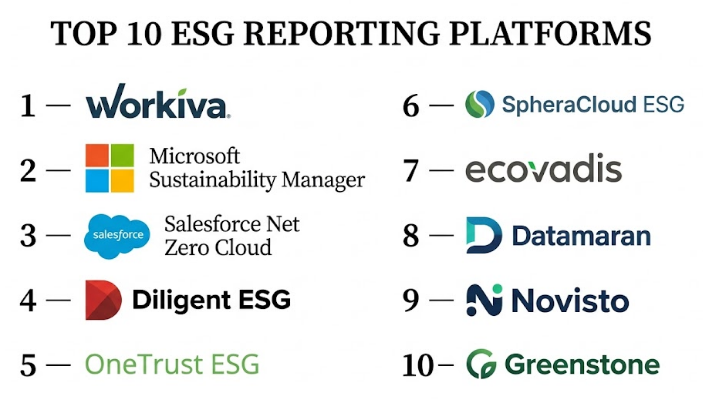
Top 10 ESG Reporting Platforms
#1 — Workiva
Short description :
Workiva is an enterprise reporting and compliance platform used by organizations for financial reporting, ESG reporting, audit, risk, and regulatory workflows. It is suitable for companies that need strong governance, collaboration, data control, and disclosure management. For ESG reporting, Workiva helps teams collect data, connect reporting workflows, manage approvals, and prepare stakeholder-ready disclosures. It is especially useful for organizations where ESG reporting must align closely with finance, audit, and legal teams. Workiva is best for mature reporting environments that require control and traceability.
Key Features
- ESG disclosure and reporting workflows
- Collaboration and approval management
- Audit trails and evidence management
- Data linking across reports and documents
- Dashboards and reporting controls
- Strong fit for finance and compliance teams
- Support for enterprise reporting processes
Pros
- Strong governance and reporting control.
- Useful for ESG, finance, audit, and risk teams working together.
- Good fit for enterprise disclosure and board-level reporting.
Cons
- May be more advanced than small teams need.
- Implementation requires clear reporting ownership.
- Pricing and full package details are usually not simple publicly.
Platforms / Deployment
Web
Cloud
Security & Compliance
Enterprise-grade security controls are expected, including access controls and audit-supporting workflows. Specific certifications should be verified directly with the vendor. Not publicly stated here.
Integrations & Ecosystem
Workiva fits well when ESG data must connect with finance, audit, legal, risk, and enterprise reporting processes.
- Finance and reporting systems
- Data import workflows
- ESG disclosure workflows
- Audit and risk workflows
- Business reporting tools
Support & Community
Workiva offers enterprise support, onboarding resources, documentation, and a strong professional ecosystem. Community strength is strong among finance, compliance, audit, and ESG reporting teams.
#2 — Microsoft Sustainability Manager
Short description :
Microsoft Sustainability Manager is a sustainability data management and reporting platform within the Microsoft Cloud for Sustainability ecosystem. It helps organizations collect, calculate, analyze, and report sustainability and emissions data. It is useful for companies already using Microsoft technologies and wanting ESG and sustainability data connected with enterprise data systems. The platform can support carbon accounting, environmental data tracking, dashboards, and reporting workflows. It is best for organizations that want ESG data connected with Power BI, Azure, and Microsoft business applications.
Key Features
- Sustainability and emissions data management
- ESG and environmental reporting workflows
- Dashboards and analytics
- Microsoft ecosystem integration
- Data model for sustainability information
- Reporting and calculation support
- Enterprise data connectivity
Pros
- Strong fit for Microsoft-centric organizations.
- Good integration potential with enterprise data systems.
- Useful for sustainability data consolidation and analytics.
Cons
- Best value depends on Microsoft ecosystem fit.
- Implementation may require data architecture planning.
- Some teams may need partner support for setup.
Platforms / Deployment
Web
Cloud
Security & Compliance
Microsoft enterprise security capabilities may apply depending on configuration and licensing. Specific compliance details should be verified in the customer’s own environment.
Integrations & Ecosystem
Microsoft Sustainability Manager is strongest when ESG and sustainability data must connect with Microsoft data and business tools.
- Power BI
- Microsoft Power Platform
- Azure data services
- Microsoft business applications
- Enterprise data connectors
Support & Community
Documentation, enterprise support, partner services, and Microsoft community resources are available. Community strength is strong due to the wider Microsoft ecosystem.
#3 — Salesforce Net Zero Cloud
Short description :
Salesforce Net Zero Cloud is a sustainability and ESG data platform built within the Salesforce ecosystem. It helps organizations track emissions, supplier data, sustainability performance, and climate-related progress. It is useful for companies already using Salesforce and wanting ESG workflows connected with business processes. The platform can support carbon accounting, reporting dashboards, supplier engagement, and reduction tracking. It is best for enterprises that want sustainability data inside a familiar CRM and enterprise application environment.
Key Features
- ESG and sustainability data management
- Carbon accounting and emissions workflows
- Supplier data collection support
- Dashboards and analytics
- Target tracking and progress monitoring
- Salesforce ecosystem integration
- Reporting and business workflow support
Pros
- Strong fit for Salesforce-based organizations.
- Useful for linking ESG data with business workflows.
- Good for enterprise reporting and supplier-related processes.
Cons
- Best value depends on Salesforce ecosystem adoption.
- Implementation may require Salesforce expertise.
- Not ideal for companies wanting a lightweight standalone ESG tool.
Platforms / Deployment
Web
Cloud
Security & Compliance
Salesforce enterprise controls may apply depending on plan and configuration. Specific certifications and compliance scope should be verified directly.
Integrations & Ecosystem
Net Zero Cloud works well when ESG data must connect with customer, supplier, sales, service, and enterprise workflows.
- Salesforce ecosystem
- Supplier and customer data workflows
- ESG dashboards
- Reporting processes
- Enterprise app integrations
Support & Community
Salesforce documentation, partner support, admin community resources, and enterprise support options are available. Community strength is strong due to the wider Salesforce ecosystem.
#4 — Diligent ESG
Short description :
Diligent ESG is an ESG reporting and governance solution connected with the broader Diligent governance, risk, compliance, and board management ecosystem. It is suitable for organizations that want ESG reporting connected with board oversight, risk management, and governance accountability. The platform helps teams collect ESG data, track progress, organize disclosures, and communicate results to leadership. It is especially useful for companies where ESG is closely linked with board reporting and enterprise governance. Diligent ESG is a strong option for governance-focused organizations.
Key Features
- ESG data collection and reporting
- Board-level ESG visibility
- Governance and risk workflow alignment
- Dashboards and performance tracking
- Disclosure management support
- ESG program management
- Enterprise oversight and accountability workflows
Pros
- Strong connection between ESG and governance.
- Useful for board reporting and leadership visibility.
- Good fit for risk, compliance, and governance teams.
Cons
- May be less suitable for teams needing only carbon accounting.
- Best value comes when governance workflows are important.
- Package and pricing details may require vendor discussion.
Platforms / Deployment
Web
Cloud
Security & Compliance
Enterprise security features are expected. Specific certifications are Not publicly stated here and should be verified directly.
Integrations & Ecosystem
Diligent ESG is useful when ESG reporting must connect with governance, risk, compliance, and board processes.
- Governance and board reporting workflows
- Risk and compliance systems
- ESG data collection workflows
- Dashboard and disclosure processes
- Enterprise reporting workflows
Support & Community
Vendor support, onboarding, documentation, and governance-focused resources are available. Community strength is strong among board, governance, risk, and compliance professionals.
#5 — OneTrust ESG
Short description :
OneTrust ESG is part of the broader OneTrust platform, which focuses on trust, privacy, risk, ethics, compliance, and ESG management. The ESG capabilities help companies manage sustainability data, reporting workflows, supplier information, and ESG program requirements. It is useful for organizations that want ESG reporting connected with broader risk, compliance, privacy, and governance operations. The platform is especially relevant for companies that already use OneTrust for trust and compliance programs. It is best for cross-functional governance environments.
Key Features
- ESG data management and reporting
- Program and workflow management
- Supplier and third-party data workflows
- Risk and compliance alignment
- Dashboards and analytics
- Evidence and documentation support
- Connection with broader trust and governance programs
Pros
- Strong fit for organizations already using OneTrust.
- Useful for ESG programs connected with risk and compliance.
- Good for supplier and third-party data workflows.
Cons
- May be more platform than ESG-only teams need.
- Implementation depends on internal process maturity.
- Buyers should validate depth of carbon accounting if needed.
Platforms / Deployment
Web
Cloud
Security & Compliance
Enterprise security controls are expected. Specific certifications and compliance scope should be verified directly with the vendor.
Integrations & Ecosystem
OneTrust ESG fits well when ESG reporting is part of a broader trust, risk, privacy, and supplier governance environment.
- Third-party risk workflows
- Compliance and privacy systems
- Supplier data collection
- ESG reporting workflows
- Enterprise governance processes
Support & Community
Vendor support, onboarding, documentation, and training resources are available. Community strength is strong in privacy, risk, trust, and compliance ecosystems.
#6 — SpheraCloud ESG
Short description :
SpheraCloud ESG is part of Sphera’s broader operational risk, EHS, sustainability, and product stewardship ecosystem. It helps organizations manage ESG data, sustainability reporting, environmental metrics, risk workflows, and operational performance. It is especially relevant for industrial, manufacturing, chemical, energy, and regulated organizations. SpheraCloud ESG is useful when ESG reporting must connect with environmental compliance, safety, risk, and operational data. It is best for enterprises that need ESG reporting with strong operational context.
Key Features
- ESG and sustainability data management
- Environmental and operational risk workflows
- Reporting and dashboard support
- EHS and sustainability integration
- Multi-site data collection
- Audit and documentation support
- Enterprise performance tracking
Pros
- Strong fit for industrial and regulated organizations.
- Useful when ESG connects with EHS and operational risk.
- Good for multi-site sustainability programs.
Cons
- May be too advanced for small teams.
- Implementation can require planning and configuration.
- Public pricing and module details may be limited.
Platforms / Deployment
Web
Cloud
Security & Compliance
Enterprise access controls and audit-friendly workflows are expected. Specific certifications are Not publicly stated here.
Integrations & Ecosystem
SpheraCloud ESG works well when ESG data must connect with EHS, risk, environmental compliance, and operational systems.
- EHS and risk modules
- Sustainability reporting workflows
- Environmental data systems
- Enterprise reporting tools
- Operational data sources
Support & Community
Enterprise support, onboarding, consulting, and documentation are typically available. Community strength is strongest in EHS, risk, industrial sustainability, and regulated sectors.
#7 — EcoVadis
Short description :
EcoVadis is widely used for sustainability ratings, supplier ESG assessment, and responsible procurement programs. It helps organizations evaluate suppliers and business partners on sustainability, ethics, labor, environment, and responsible sourcing practices. While it is not only an internal ESG reporting platform, it is highly relevant for companies that need supply chain ESG visibility. EcoVadis is especially useful for procurement, sourcing, compliance, and supplier management teams. It is best for organizations where supplier ESG performance is a major reporting and risk concern.
Key Features
- Supplier ESG assessment and ratings
- Sustainability scorecards
- Responsible sourcing workflows
- Supplier engagement and improvement plans
- Risk and performance visibility
- Procurement sustainability support
- Benchmarking and supplier comparison
Pros
- Strong for supplier ESG and responsible procurement.
- Useful for supply chain risk visibility.
- Recognized in many enterprise procurement programs.
Cons
- Not a complete internal ESG reporting platform by itself.
- Best value depends on supplier participation.
- May need to be paired with internal ESG or carbon tools.
Platforms / Deployment
Web
Cloud
Security & Compliance
Enterprise platform security controls may be available. Specific certifications are Not publicly stated here.
Integrations & Ecosystem
EcoVadis is useful when ESG reporting depends heavily on supplier and third-party sustainability performance.
- Procurement workflows
- Supplier assessment processes
- Risk management systems
- Responsible sourcing programs
- ESG and sustainability reporting workflows
Support & Community
Vendor support, onboarding, supplier engagement resources, and assessment guidance are available. Community strength is strong across procurement, supplier risk, and sustainability networks.
#8 — Datamaran
Short description :
Datamaran is an ESG risk, materiality, and external intelligence platform. It helps organizations monitor ESG issues, regulatory signals, peer activity, stakeholder priorities, and materiality trends. The platform is useful for ESG strategy, risk monitoring, and materiality assessment rather than only data collection. Datamaran is especially valuable for leadership, sustainability, risk, and strategy teams that need to understand which ESG topics matter most. It is best used alongside reporting tools when organizations need deeper ESG intelligence.
Key Features
- ESG materiality analysis
- External ESG risk monitoring
- Regulatory and peer intelligence
- Stakeholder and issue tracking
- ESG strategy support
- Dashboards and insights
- Materiality and disclosure planning support
Pros
- Strong for ESG materiality and external intelligence.
- Useful for strategy and risk teams.
- Helps organizations understand emerging ESG priorities.
Cons
- Not a full operational ESG data collection platform.
- May need to be paired with reporting or carbon tools.
- Best suited for mature ESG programs.
Platforms / Deployment
Web
Cloud
Security & Compliance
Not publicly stated.
Integrations & Ecosystem
Datamaran is useful when ESG teams need intelligence to guide reporting focus, risk oversight, and materiality decisions.
- ESG materiality workflows
- Risk and strategy planning
- Regulatory monitoring
- Peer benchmarking workflows
- Disclosure planning support
Support & Community
Vendor support, onboarding, and ESG intelligence guidance are available. Community strength is strongest among ESG strategy, governance, and risk professionals.
#9 — Novisto
Short description :
Novisto is an ESG data management and reporting platform designed to help companies collect, manage, validate, and report ESG information. It is useful for organizations that need structured ESG data workflows, reporting controls, and stakeholder-ready disclosures. The platform is designed for sustainability and reporting teams that want to improve data quality and reduce spreadsheet dependency. Novisto can support ESG strategy, performance tracking, and reporting preparation. It is best for organizations that need stronger ESG data governance without building a fully custom system.
Key Features
- ESG data collection and management
- Reporting workflow support
- Data validation and control features
- Dashboards and analytics
- Framework and disclosure preparation support
- Collaboration across departments
- Evidence and documentation management
Pros
- Strong focus on ESG data quality and structure.
- Useful for reducing spreadsheet-based reporting.
- Good fit for sustainability and reporting teams.
Cons
- May require process setup and ownership mapping.
- Carbon accounting depth should be validated by buyers.
- Pricing and detailed packages may not be public.
Platforms / Deployment
Web
Cloud
Security & Compliance
Enterprise controls may be available. Specific certifications are Not publicly stated here.
Integrations & Ecosystem
Novisto works well when ESG reporting requires structured data collection, collaboration, and disclosure preparation.
- ESG data workflows
- Reporting frameworks
- Internal department data collection
- Dashboard and analytics tools
- Evidence and documentation workflows
Support & Community
Vendor support, onboarding, documentation, and ESG reporting guidance are available. Community strength is growing among ESG data and sustainability reporting teams.
#10 — Greenstone
Short description :
Greenstone provides sustainability, ESG, carbon, and supply chain reporting software for organizations that need structured environmental and ESG data management. It is used by companies looking to manage sustainability performance, carbon data, supplier data, and stakeholder reporting. The platform can support ESG reporting, emissions tracking, data collection, and performance dashboards. Greenstone is useful for organizations that need a practical sustainability management platform with multiple reporting capabilities. It is suitable for mid-market and enterprise sustainability teams.
Key Features
- ESG and sustainability reporting
- Carbon and emissions data management
- Supply chain and supplier data support
- Dashboards and performance tracking
- Data collection workflows
- Reporting and disclosure support
- Multi-site sustainability data management
Pros
- Good fit for ESG and carbon reporting together.
- Useful for sustainability teams managing multiple data types.
- Supports supplier and performance reporting workflows.
Cons
- Buyers should validate exact framework and module support.
- Implementation depends on data readiness.
- Public pricing and detailed security information may be limited.
Platforms / Deployment
Web
Cloud
Security & Compliance
Not publicly stated.
Integrations & Ecosystem
Greenstone is useful when sustainability teams need ESG, carbon, and supplier reporting in one structured environment.
- ESG reporting workflows
- Carbon accounting workflows
- Supplier data collection
- Sustainability dashboards
- Data exports and reporting
Support & Community
Vendor support, onboarding, and sustainability guidance are available. Community strength is strongest among ESG, carbon, and sustainability reporting professionals.
Comparison Table
| Tool Name | Best For | Platform(s) Supported | Deployment | Standout Feature | Public Rating |
|---|---|---|---|---|---|
| Workiva | Enterprise ESG disclosure and reporting control | Web | Cloud | ESG reporting connected with finance and audit workflows | N/A |
| Microsoft Sustainability Manager | Microsoft-centric sustainability teams | Web | Cloud | Sustainability data connected with Microsoft ecosystem | N/A |
| Salesforce Net Zero Cloud | Salesforce-based enterprises | Web | Cloud | ESG and carbon data inside Salesforce workflows | N/A |
| Diligent ESG | Board and governance-focused ESG reporting | Web | Cloud | ESG reporting connected with governance oversight | N/A |
| OneTrust ESG | ESG connected with risk, trust, and compliance | Web | Cloud | ESG workflows aligned with broader governance programs | N/A |
| SpheraCloud ESG | Industrial and EHS-linked ESG reporting | Web | Cloud | ESG connected with EHS and operational risk | N/A |
| EcoVadis | Supplier ESG and responsible procurement | Web | Cloud | Supplier sustainability ratings and scorecards | N/A |
| Datamaran | ESG materiality and risk intelligence | Web | Cloud | External ESG risk and materiality intelligence | N/A |
| Novisto | ESG data management and reporting governance | Web | Cloud | Structured ESG data collection and validation | N/A |
| Greenstone | ESG, carbon, and sustainability reporting | Web | Cloud | Combined ESG, carbon, and supplier reporting workflows | N/A |
Evaluation & ESG Reporting Platforms
| Tool Name | Core (25%) | Ease (15%) | Integrations (15%) | Security (10%) | Performance (10%) | Support (10%) | Value (15%) | Weighted Total (0–10) |
|---|---|---|---|---|---|---|---|---|
| Workiva | 9 | 7 | 8 | 9 | 8 | 8 | 7 | 8.10 |
| Microsoft Sustainability Manager | 8 | 7 | 9 | 9 | 8 | 8 | 7 | 8.05 |
| Salesforce Net Zero Cloud | 8 | 7 | 9 | 9 | 8 | 8 | 7 | 8.05 |
| Diligent ESG | 8 | 8 | 7 | 8 | 8 | 8 | 7 | 7.75 |
| OneTrust ESG | 8 | 7 | 8 | 8 | 8 | 8 | 7 | 7.75 |
| SpheraCloud ESG | 8 | 7 | 8 | 8 | 8 | 8 | 7 | 7.75 |
| EcoVadis | 7 | 8 | 8 | 7 | 8 | 8 | 8 | 7.70 |
| Datamaran | 7 | 8 | 7 | 7 | 8 | 8 | 7 | 7.40 |
| Novisto | 8 | 8 | 7 | 7 | 8 | 8 | 8 | 7.75 |
| Greenstone | 8 | 8 | 7 | 7 | 8 | 8 | 8 | 7.75 |
These scores are comparative and should be used for shortlisting, not as final purchasing advice. ESG reporting needs vary by company size, industry, reporting maturity, investor pressure, and regulatory exposure. A platform with strong governance may not be the easiest for a small team, while a supplier-focused solution may not replace a full ESG disclosure platform. Buyers should validate reporting frameworks, integrations, audit trails, security, support, and total cost before choosing.
Which ESG Reporting Platforms
Solo / Freelancer
Solo ESG consultants need platforms that help organize data, create repeatable reporting workflows, and support client deliverables. Novisto, Greenstone, or Datamaran may be useful depending on whether the work focuses on reporting, sustainability data, or materiality analysis.
Freelancers working with enterprise clients may need familiarity with Workiva, Microsoft Sustainability Manager, Salesforce Net Zero Cloud, or Diligent ESG, because larger clients may already use these platforms internally.
SMB
Small and mid-sized businesses should focus on ease of use, guided reporting, carbon data, supplier data, and practical dashboards. Greenstone, Novisto, and OneTrust ESG may be practical depending on the organization’s reporting needs.
SMBs should avoid overcomplicating ESG reporting in the beginning. The first priority should be clean data ownership, basic environmental and social metrics, clear reporting calendars, and practical evidence collection.
Mid-Market
Mid-market companies often need stronger ESG data governance, better supplier visibility, and more formal reporting workflows. Workiva, Novisto, Greenstone, OneTrust ESG, Diligent ESG, and EcoVadis can all be relevant.
A company with strong procurement pressure may need EcoVadis. A governance-heavy organization may need Diligent ESG. A reporting-focused company may prefer Workiva or Novisto. A company already using Microsoft or Salesforce may prefer the platform that fits its existing technology stack.
Enterprise
Enterprise buyers should prioritize scalability, internal controls, approval workflows, audit trails, data lineage, security, and integration with existing systems. Workiva, Microsoft Sustainability Manager, Salesforce Net Zero Cloud, Diligent ESG, OneTrust ESG, and SpheraCloud ESG are strong candidates.
Large industrial organizations should also consider whether ESG reporting connects with EHS, operational risk, carbon, and environmental compliance. In that case, SpheraCloud ESG may be especially relevant.
Budget vs Premium
Budget-conscious teams should choose a platform that solves their immediate reporting problem without unnecessary complexity. Novisto, Greenstone, or focused supplier tools may be practical depending on scope.
Premium buyers with complex disclosures, multiple entities, many suppliers, and board-level governance needs should evaluate Workiva, Diligent ESG, Microsoft Sustainability Manager, Salesforce Net Zero Cloud, OneTrust ESG, or SpheraCloud ESG.
Feature Depth vs Ease of Use
For feature depth, Workiva, Microsoft Sustainability Manager, Salesforce Net Zero Cloud, OneTrust ESG, and SpheraCloud ESG are stronger because they support enterprise workflows and integrations.
For ease of use and ESG reporting focus, Novisto, Greenstone, and Datamaran may feel more approachable depending on the use case. EcoVadis is easier to justify when supplier ESG assessment is the main requirement.
Integrations & Scalability
Organizations using Microsoft heavily should evaluate Microsoft Sustainability Manager. Salesforce-based organizations should evaluate Salesforce Net Zero Cloud. Companies with finance and disclosure workflows should consider Workiva.
For supplier-heavy organizations, EcoVadis and OneTrust ESG may be useful. For industrial companies, SpheraCloud ESG may offer better alignment with EHS and operational data.
Security & Compliance Needs
Security-focused buyers should ask vendors about SSO, SAML, MFA, encryption, RBAC, audit logs, data residency, backup controls, approval workflows, and evidence storage. ESG data may be reviewed by finance, legal, auditors, investors, and board members, so weak controls can create reporting risk.
For companies preparing formal ESG disclosures, security should be evaluated together with data governance, calculation logic, version history, ownership mapping, and assurance readiness.
Frequently Asked Questions
1. What is an ESG Reporting Platform?
An ESG Reporting Platform is software that helps organizations collect, manage, validate, and report environmental, social, and governance data. It replaces scattered spreadsheets with structured workflows, dashboards, approvals, and reporting controls.
2. How much does ESG Reporting Software cost?
Pricing varies by company size, users, modules, data volume, reporting scope, integrations, and support level. Many enterprise vendors use custom pricing, so buyers should request quotes based on real reporting needs.
3. Can ESG reporting be done in spreadsheets?
Yes, small teams can start with spreadsheets, but spreadsheets become risky when data grows across departments, sites, suppliers, and reporting frameworks. Platforms provide better control, repeatability, audit trails, and collaboration.
4. What is the biggest mistake buyers make?
The biggest mistake is buying software before defining ESG ownership and data sources. A platform cannot fix unclear responsibilities, poor data quality, or missing internal review processes.
5. Do ESG platforms support carbon accounting?
Many ESG platforms include carbon accounting or integrate with carbon tools, but depth varies. Buyers should verify Scope 1, Scope 2, Scope 3, emissions factors, supplier workflows, and reduction tracking before choosing.
6. Can ESG platforms help with supplier data?
Yes, many platforms support supplier ESG data collection, third-party risk workflows, or responsible procurement reporting. EcoVadis is especially focused on supplier sustainability assessment and scorecards.
7. Are ESG Reporting Platforms secure?
Many enterprise ESG platforms offer security controls, but buyers should verify details directly. Important features include SSO, MFA, encryption, RBAC, audit logs, data residency, backups, and access review controls.
8. Can ESG platforms integrate with ERP, HR, and finance systems?
Yes, many platforms offer integrations or data import workflows. Buyers should test integrations with ERP, HR, finance, procurement, EHS, carbon, BI, and supplier systems during evaluation.
9. Which ESG platform is best for small companies?
Small companies may prefer practical ESG data management tools such as Novisto or Greenstone, depending on needs. The best choice is the one that helps the team collect accurate data without creating unnecessary complexity.
10. Which ESG platform is best for enterprises?
Enterprises may evaluate Workiva, Microsoft Sustainability Manager, Salesforce Net Zero Cloud, Diligent ESG, OneTrust ESG, or SpheraCloud ESG. The best option depends on reporting maturity, technology ecosystem, security needs, and disclosure complexity.
Conclusion
ESG Reporting Platforms help companies move from scattered, manual, and risky sustainability reporting toward structured, traceable, and decision-ready ESG data management. The best platform depends on the organization’s maturity, reporting pressure, internal systems, supplier complexity, and governance needs. Workiva is strong for disclosure control and finance-aligned reporting. Microsoft Sustainability Manager and Salesforce Net Zero Cloud are strong for organizations already invested in those ecosystems. Diligent ESG is useful for governance and board oversight. OneTrust ESG fits organizations connecting ESG with trust, risk, and compliance. SpheraCloud ESG is strong for industrial and EHS-linked environments.
