Introduction
Creator Monetization Platforms help creators earn money from their content, audience, knowledge, community, digital products, subscriptions, memberships, courses, newsletters, videos, livestreams, podcasts, music, art, coaching, and fan relationships. In simple words, these platforms give creators tools to turn attention and trust into income.
Creators today are not only posting content for reach. They are building small businesses around loyal audiences. A creator may earn through memberships, paid communities, tips, donations, digital downloads, sponsorships, exclusive content, courses, paid newsletters, merchandise, affiliate offers, livestream support, and brand collaborations. A good monetization platform helps creators collect payments, manage subscribers, publish paid content, understand earnings, and build long-term revenue.
Real-world use cases include:
- Selling memberships and exclusive content
- Accepting tips, donations, and fan support
- Launching paid newsletters or private communities
- Selling digital downloads, templates, courses, and guides
- Hosting paid livestreams or events
- Managing creator subscriptions and fan relationships
- Offering coaching, consulting, and premium content access
Buyers should evaluate:
- Monetization model support
- Subscription and membership tools
- Digital product selling features
- Community and engagement features
- Payment processing and payout options
- Platform fees and revenue share
- Audience ownership and email access
- Content publishing tools
- Analytics and revenue reporting
- Branding and customization
- Integration with email, social, website, and marketing tools
- Support quality and creator education
Best for: content creators, influencers, educators, coaches, podcasters, writers, artists, musicians, YouTubers, livestreamers, newsletter creators, course creators, community builders, and solo entrepreneurs who want to earn directly from their audience.
Not ideal for: creators who only want social reach without selling anything, teams that need full enterprise ecommerce infrastructure, or creators who are not ready to offer consistent value. Monetization works best when the creator has a clear audience, strong positioning, and a repeatable content or product strategy.
Key Trends in Creator Monetization Platforms
- Audience ownership is becoming more important: Creators want email lists, subscriber data, and direct relationships instead of relying only on social media algorithms.
- Membership revenue is growing: Monthly subscriptions, paid communities, exclusive posts, and fan memberships help creators build predictable income.
- Digital products are a major income stream: Templates, ebooks, guides, presets, courses, toolkits, and downloadable resources are popular because they can scale without constant delivery work.
- Community-led monetization is rising: Creators are moving from one-way content to private communities, group learning, events, and direct fan interaction.
- Video and livestream monetization are expanding: Paid livestreams, fan badges, subscriptions, and exclusive video content are becoming common.
- All-in-one creator platforms are gaining traction: Creators want publishing, payments, email, analytics, products, memberships, and community tools in one place.
- Lower-friction payments matter: Faster checkout, global payment support, local currency support, and simple payout workflows improve conversion.
- Brand deals are becoming platformized: Some tools help creators connect with brands, manage sponsorships, or package audience data for partnerships.
- AI-assisted creator workflows are growing: AI tools can help with content planning, product ideas, audience segmentation, email writing, and customer support.
- Creators are diversifying revenue: Successful creators increasingly combine ads, memberships, courses, products, sponsorships, affiliates, and fan support rather than depending on one income source.
How We Selected These Tools Methodology
The tools below were selected based on creator monetization relevance, market recognition, practical feature depth, audience fit, payment capabilities, and usefulness across different creator business models.
- Monetization depth: Platforms were reviewed for subscriptions, memberships, tips, digital products, paid posts, courses, and fan support.
- Creator usability: Simple setup, clean dashboards, fast publishing, and easy payment workflows were considered.
- Audience ownership: Email access, subscriber management, community tools, and customer data control were evaluated.
- Revenue model flexibility: Tools that support multiple income streams were rated higher.
- Payment and payout workflows: Fees, payout flexibility, global payment support, and creator earnings visibility were considered.
- Content and community features: Publishing, video, newsletters, private posts, groups, and engagement tools were reviewed.
- Scalability: Platforms suitable for beginners, growing creators, and professional creator businesses were included.
- Branding and customization: Ability to build a creator storefront, profile, landing page, or branded experience was considered.
- Analytics and reporting: Subscriber growth, revenue data, product sales, audience behavior, and campaign visibility were evaluated.
- Practical buyer fit: The goal is not one universal winner, but a useful comparison based on creator type and monetization strategy.
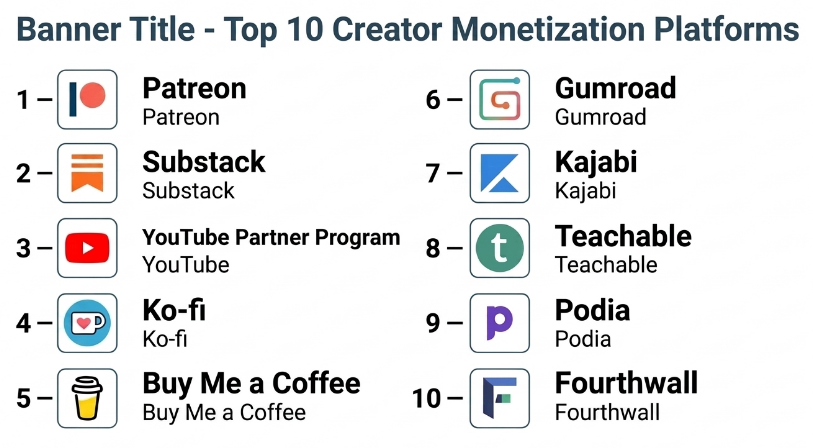
Top 10 Creator Monetization Platforms
#1 — Patreon
Short description :
Patreon is a creator monetization platform focused on memberships, paid subscriptions, exclusive content, and direct fan support. It is widely used by podcasters, YouTubers, artists, writers, musicians, educators, and community-based creators who want recurring income from loyal supporters. Creators can offer membership tiers, behind-the-scenes content, early access, private posts, digital rewards, and community experiences. Patreon is especially useful for creators with an existing audience that wants to support ongoing work. It is a strong option for recurring fan-funded revenue.
Key Features
- Paid membership tiers
- Exclusive posts and content access
- Fan subscription management
- Community and member engagement tools
- Digital rewards and benefits
- Creator analytics
- Payment and payout workflows
Pros
- Strong fit for recurring fan support
- Widely recognized by creator audiences
- Useful for creators with loyal communities
Cons
- Platform fees and payment fees affect earnings
- Discovery is not guaranteed
- Creators still need to bring their own audience
Platforms / Deployment
Web / mobile app availability
Cloud deployment
Security & Compliance
Creator platforms handle payments, subscriber data, tax details, and private content. Specific certifications such as SOC 2, ISO 27001, GDPR, or other compliance details should be verified directly.
Not publicly stated.
Integrations & Ecosystem
Patreon works well as a membership layer connected with a creator’s broader content channels.
- Video and podcast communities
- Social media audience funnels
- Community tools
- Email communication workflows
- Discord-style community access
- Digital reward delivery
Support & Community
Patreon has a large creator community and strong market awareness. Support resources are available, though creators should still plan their own retention and audience engagement strategy.
#2 — Substack
Short description :
Substack is a publishing and monetization platform mainly used by writers, journalists, analysts, educators, podcasters, and newsletter creators. It helps creators publish free and paid newsletters, grow subscribers, manage paid memberships, and build direct audience relationships. Substack is especially useful for creators whose main product is writing, commentary, analysis, storytelling, or educational content. It also supports podcasts and community-style engagement features. Substack is a strong choice for creators who want to monetize expertise through email-first publishing.
Key Features
- Free and paid newsletters
- Subscriber management
- Paid membership support
- Email publishing tools
- Podcast publishing support
- Comments and discussion features
- Revenue and subscriber analytics
Pros
- Strong for writers and newsletter creators
- Simple publishing and paid subscription workflow
- Helps creators build direct email audiences
Cons
- Best suited for content-led creators, not all product sellers
- Platform fees apply to paid subscriptions
- Design and storefront customization may be limited
Platforms / Deployment
Web / mobile app availability
Cloud deployment
Security & Compliance
Substack handles subscriber data, payments, private content, and creator account data. Specific certifications and compliance details should be verified directly.
Not publicly stated.
Integrations & Ecosystem
Substack is strongest for email-first audience monetization.
- Newsletter publishing
- Podcast distribution workflows
- Subscriber email lists
- Paid content access
- Community discussion
- Creator analytics
Support & Community
Substack has a strong creator and writer ecosystem. It is useful for creators who can publish consistently and build trust through long-form content.
#3 — YouTube Partner Program
Short description :
YouTube Partner Program helps video creators monetize through ads, channel memberships, Super Chat, Super Thanks, shopping features, and other creator revenue options where eligible. It is especially relevant for video creators, educators, entertainers, reviewers, streamers, musicians, and media-style creators. YouTube is not only a monetization platform but also a major discovery engine. Creators can earn from public content while building long-term audience reach. It is a strong option for creators who can produce consistent video content and grow watch time.
Key Features
- Ad revenue monetization
- Channel memberships
- Super Chat and Super Thanks
- Livestream monetization
- Shopping and product features where available
- Video analytics and audience insights
- Long-form and short-form video monetization options
Pros
- Strong discovery and audience reach
- Multiple video monetization options
- Good analytics for content performance
Cons
- Eligibility requirements apply
- Revenue can fluctuate based on views and ad rates
- Platform policy changes can affect creators
Platforms / Deployment
Web / iOS / Android
Cloud deployment
Security & Compliance
YouTube monetization involves account security, payment data, copyright policies, ad policies, and creator compliance rules. Specific certifications should be verified directly.
Not publicly stated here for creator-facing monetization.
Integrations & Ecosystem
YouTube works well for creators who monetize video and use other tools for deeper audience ownership.
- Video publishing
- Livestreaming
- Channel memberships
- Advertising revenue
- Shopping workflows
- Analytics and audience insights
Support & Community
YouTube has a large creator education ecosystem and broad community knowledge. Support access may depend on channel status and eligibility.
#4 — Ko-fi
Short description :
Ko-fi is a creator monetization platform that helps creators accept tips, donations, memberships, commissions, shop sales, and supporter payments. It is popular among artists, writers, streamers, designers, indie creators, and small creator businesses because it is simple and flexible. Creators can set up a page, receive one-time support, sell digital products, offer memberships, and accept commissions. Ko-fi is especially useful for creators who want lightweight monetization without building a full ecommerce website. It is a practical option for creators who combine fan support with small product sales.
Key Features
- One-time tips and donations
- Membership tiers
- Digital product shop
- Commission request support
- Creator profile page
- Supporter messaging
- Payment integration workflows
Pros
- Simple and friendly for small creators
- Supports tips, memberships, shops, and commissions
- Good for artists and independent creators
Cons
- Not as advanced as full ecommerce platforms
- Discovery depends on creator promotion
- Larger creator businesses may need deeper automation
Platforms / Deployment
Web
Cloud deployment
Security & Compliance
Ko-fi handles payments, supporter data, creator content, and digital product transactions. Specific certifications and compliance details should be verified directly.
Not publicly stated.
Integrations & Ecosystem
Ko-fi works well as a lightweight creator monetization page.
- Social media links
- Digital downloads
- Fan support payments
- Membership access
- Commission workflows
- Creator storefronts
Support & Community
Ko-fi has strong awareness among independent creators and artists. It is best for creators who want simple monetization without heavy technical setup.
#5 — Buy Me a Coffee
Short description :
Buy Me a Coffee is a creator support platform that helps creators receive one-time support, memberships, and simple payments from fans. It is useful for writers, developers, designers, podcasters, educators, open-source contributors, and small creators who want a lightweight way to accept support. The platform is easy to set up and works well as a simple support page linked from social profiles, newsletters, blogs, or videos. Buy Me a Coffee is especially practical for creators who do not need complex product selling or course hosting. It is a strong option for simple fan funding and supporter relationships.
Key Features
- One-time supporter payments
- Membership options
- Creator profile page
- Supporter messages
- Simple content updates
- Payment and payout workflows
- Social-friendly support links
Pros
- Very simple to start
- Good for tips and supporter payments
- Useful for creators without complex monetization needs
Cons
- Limited compared with full creator business platforms
- Not ideal for large digital product catalogs
- Audience growth still depends on the creator
Platforms / Deployment
Web
Cloud deployment
Security & Compliance
The platform handles payments, supporter information, and creator account data. Specific security and compliance details should be verified directly.
Not publicly stated.
Integrations & Ecosystem
Buy Me a Coffee is useful as a simple support layer.
- Blog and newsletter links
- Social media creator profiles
- Supporter payments
- Membership updates
- Simple creator pages
- Payment workflows
Support & Community
Buy Me a Coffee is popular with independent creators who want easy fan support. It is best for creators seeking low-friction monetization.
#6 — Gumroad
Short description :
Gumroad is a creator commerce platform that helps creators sell digital products, memberships, courses, ebooks, templates, software, music, art, and downloadable resources. It is useful for creators who want to monetize knowledge, files, and digital assets without building a full online store. Gumroad supports product pages, payments, discount codes, email updates, affiliates, and simple customer management. It is especially strong for creators selling digital products directly to an audience. Gumroad is a practical option for creators who want fast product monetization with minimal setup.
Key Features
- Digital product selling
- Membership and subscription support
- Product pages and checkout
- Discount codes and offers
- Affiliate support
- Email updates to customers
- Sales and revenue analytics
Pros
- Strong for digital downloads and creator products
- Easy setup for solo creators
- Good for ebooks, templates, courses, and files
Cons
- Store customization is limited compared with full ecommerce platforms
- Platform fees affect margins
- Not ideal for complex operations or large storefronts
Platforms / Deployment
Web
Cloud deployment
Security & Compliance
Gumroad handles customer data, payments, digital files, and creator earnings. Specific certifications and compliance details should be verified directly.
Not publicly stated.
Integrations & Ecosystem
Gumroad works well for creators selling directly from social, email, or content channels.
- Digital downloads
- Creator storefronts
- Email lists
- Affiliate workflows
- Payment processing
- Product analytics
Support & Community
Gumroad has a strong creator community and many examples of solo creator businesses. It is best for digital product sellers who want speed and simplicity.
#7 — Kajabi
Short description :
Kajabi is an all-in-one creator business platform for selling online courses, memberships, coaching programs, digital products, communities, landing pages, and email campaigns. It is useful for educators, coaches, consultants, experts, and creators who want a professional business platform rather than only a simple tip or subscription page. Kajabi includes course hosting, sales funnels, checkout, email marketing, website tools, and customer management. It is especially strong for knowledge-based creators who sell premium learning experiences. Kajabi is a good fit for creators ready to build a serious digital education business.
Key Features
- Online course hosting
- Membership and community tools
- Coaching and digital product sales
- Landing pages and website builder
- Email marketing workflows
- Checkout and payment support
- Sales funnels and analytics
Pros
- Strong all-in-one platform for knowledge creators
- Good for premium courses and coaching programs
- Reduces need for many separate tools
Cons
- More expensive than lightweight creator tools
- May be too much for beginners
- Requires strong content and offer strategy
Platforms / Deployment
Web
Cloud deployment
Security & Compliance
Kajabi handles customer accounts, payments, course content, email lists, and business data. Specific certifications and compliance details should be verified directly.
Not publicly stated.
Integrations & Ecosystem
Kajabi works well for creators building a structured education or coaching business.
- Course delivery
- Membership programs
- Email marketing
- Landing pages
- Payment workflows
- Sales funnels
Support & Community
Kajabi provides creator education, support resources, and business-building guidance. It is best for creators ready to sell structured offers at a higher level.
#8 — Teachable
Short description :
Teachable is a course and digital product platform that helps creators sell online courses, coaching, memberships, and downloadable products. It is popular among educators, coaches, experts, consultants, and creators who want to package knowledge into paid learning experiences. Teachable supports course pages, student management, payments, quizzes, certificates depending on plan, and sales tools. It is more focused on education products than general fan funding. Teachable is a strong option for creators whose monetization strategy is built around teaching and structured learning.
Key Features
- Online course creation
- Coaching product support
- Digital downloads
- Student management
- Checkout and payment workflows
- Course completion tools
- Sales and revenue reporting
Pros
- Strong for online course creators
- Easier than building a custom learning platform
- Good for educators and coaches
Cons
- Less suitable for casual fan memberships
- Advanced marketing may require integrations
- Plan differences should be reviewed carefully
Platforms / Deployment
Web
Cloud deployment
Security & Compliance
Teachable handles student data, payments, course content, and creator business records. Specific certifications and compliance details should be verified directly.
Not publicly stated.
Integrations & Ecosystem
Teachable works well for creators selling structured education products.
- Course delivery
- Coaching workflows
- Payment processing
- Email marketing integrations
- Student records
- Sales analytics
Support & Community
Teachable has a strong creator education ecosystem. It is best for creators who want to monetize through courses, coaching, and digital learning products.
#9 — Podia
Short description :
Podia is a creator platform for selling digital products, courses, memberships, coaching, webinars, and downloads. It is designed for creators who want a simple all-in-one setup without heavy technical complexity. Podia includes storefront pages, product hosting, email marketing, checkout, affiliate features, and customer management depending on plan. It is useful for solo creators, educators, coaches, and small creator businesses. Podia is a strong option when a creator wants to sell multiple digital offers from one simple platform.
Key Features
- Digital product sales
- Online courses
- Membership and community options
- Coaching and webinar support
- Email marketing tools
- Affiliate support
- Creator storefront and checkout
Pros
- Simple all-in-one creator selling platform
- Good for digital products and courses
- Easier than complex ecommerce systems
Cons
- May not be as advanced as specialist course platforms
- Large-scale customization may be limited
- Advanced automation needs may require integrations
Platforms / Deployment
Web
Cloud deployment
Security & Compliance
Podia handles payments, customer data, digital products, email lists, and creator content. Specific security and compliance details should be verified directly.
Not publicly stated.
Integrations & Ecosystem
Podia fits creators who want product sales, email, and customer management in one place.
- Digital downloads
- Course hosting
- Membership products
- Email marketing
- Affiliate workflows
- Customer checkout
Support & Community
Podia provides support and creator-focused resources. It is best for solo creators and small creator businesses that value simplicity.
#10 — Fourthwall
Short description :
Fourthwall is a creator monetization platform focused on merchandise, memberships, digital products, shops, and fan engagement. It is especially useful for YouTubers, streamers, podcasters, artists, and internet creators who want to sell branded products and build a direct fan business. Fourthwall supports creator storefronts, product fulfillment, memberships, and audience engagement tools. It is practical for creators who want to monetize through merchandise without managing all logistics themselves. Fourthwall is a strong choice for creators whose audience wants physical products and branded fan items.
Key Features
- Creator storefronts
- Merchandise selling and fulfillment support
- Membership options
- Digital product selling
- Fan engagement tools
- Checkout and payment workflows
- Creator analytics
Pros
- Strong for merchandise-based monetization
- Useful for creators with loyal fan communities
- Reduces operational burden around product fulfillment
Cons
- Best value depends on audience demand for merch
- Product margins should be reviewed carefully
- Not mainly a course or newsletter platform
Platforms / Deployment
Web
Cloud deployment
Security & Compliance
Fourthwall handles customer data, payments, order details, memberships, and creator storefront data. Specific certifications and compliance details should be verified directly.
Not publicly stated.
Integrations & Ecosystem
Fourthwall works well for creators who monetize fan demand through shops and memberships.
- Merchandise storefronts
- Product fulfillment workflows
- Membership access
- Digital product sales
- Fan engagement
- Creator analytics
Support & Community
Fourthwall provides creator-focused support and product fulfillment workflows. It is best for creators with strong personal brands and audiences willing to buy merchandise.
Comparison Table Top 10
| Tool Name | Best For | Platform(s) Supported | Deployment | Standout Feature | Public Rating |
|---|---|---|---|---|---|
| Patreon | Recurring fan memberships | Web, mobile app availability | Cloud | Membership tiers and exclusive creator content | N/A |
| Substack | Paid newsletters and writing-based monetization | Web, mobile app availability | Cloud | Email-first paid publishing | N/A |
| YouTube Partner Program | Video creators and livestreamers | Web, iOS, Android | Cloud | Ad revenue, memberships, and video monetization | N/A |
| Ko-fi | Tips, memberships, commissions, and small shops | Web | Cloud | Lightweight creator support page | N/A |
| Buy Me a Coffee | Simple fan support and memberships | Web | Cloud | Fast one-time supporter payments | N/A |
| Gumroad | Digital product sellers | Web | Cloud | Simple digital product storefronts | N/A |
| Kajabi | Course creators and coaching businesses | Web | Cloud | All-in-one course, funnel, and email platform | N/A |
| Teachable | Online courses and coaching products | Web | Cloud | Structured course selling platform | N/A |
| Podia | Digital products, courses, and simple creator stores | Web | Cloud | Simple all-in-one creator commerce | N/A |
| Fourthwall | Creator merchandise and fan products | Web | Cloud | Merch stores and fulfillment support | N/A |
Evaluation & Creator Monetization Platforms
| Tool Name | Core 25% | Ease 15% | Integrations 15% | Security 10% | Performance 10% | Support 10% | Value 15% | Weighted Total 0–10 |
|---|---|---|---|---|---|---|---|---|
| Patreon | 9.0 | 8.5 | 8.0 | 8.0 | 8.5 | 8.0 | 8.2 | 8.43 |
| Substack | 8.7 | 9.0 | 7.5 | 8.0 | 8.5 | 8.0 | 8.4 | 8.36 |
| YouTube Partner Program | 9.0 | 8.0 | 8.5 | 8.5 | 9.0 | 7.8 | 8.0 | 8.45 |
| Ko-fi | 8.2 | 9.0 | 7.5 | 7.8 | 8.2 | 7.8 | 8.6 | 8.20 |
| Buy Me a Coffee | 7.8 | 9.2 | 7.2 | 7.8 | 8.0 | 7.6 | 8.5 | 8.01 |
| Gumroad | 8.7 | 8.8 | 8.0 | 8.0 | 8.5 | 7.8 | 8.4 | 8.36 |
| Kajabi | 9.2 | 7.8 | 8.5 | 8.3 | 8.7 | 8.5 | 7.6 | 8.44 |
| Teachable | 8.8 | 8.2 | 8.2 | 8.2 | 8.5 | 8.2 | 8.0 | 8.35 |
| Podia | 8.5 | 8.8 | 8.0 | 8.0 | 8.4 | 8.0 | 8.3 | 8.31 |
| Fourthwall | 8.3 | 8.5 | 7.8 | 8.0 | 8.4 | 8.0 | 8.2 | 8.19 |
These scores are comparative and should be used as a starting point. A writer may rate Substack higher because email-first publishing matters. A YouTuber may rate YouTube Partner Program and Fourthwall higher because video and merchandise matter. A course creator may prefer Kajabi, Teachable, or Podia. A digital product seller may prefer Gumroad. A fan-funded creator may prefer Patreon, Ko-fi, or Buy Me a Coffee.
Which Creator Monetization Platform Should You Choose?
Solo / Beginner Creator
A beginner creator should start with the simplest monetization model. If the goal is to accept support from fans, Ko-fi or Buy Me a Coffee can be easy starting points. If the creator writes regularly, Substack may be better. If the creator already makes videos, YouTube Partner Program should be part of the long-term plan.
The main goal at this stage is not to build a complex business system. It is to test whether the audience is willing to support, subscribe, buy, or pay for deeper value.
Small Creator Business
A small creator business usually needs more than tips. It may sell digital products, memberships, courses, or paid communities. Gumroad, Podia, Patreon, Substack, and Teachable are strong options to compare.
Creators at this stage should focus on audience ownership, repeatable offers, clear pricing, and simple customer experience.
Mid-Market Creator Brand
A growing creator brand may need multiple revenue streams such as courses, memberships, merchandise, newsletters, sponsorships, and digital products. Kajabi, Podia, Teachable, Fourthwall, Patreon, and Gumroad can be useful depending on the main business model.
At this stage, the creator should think like a business owner. Email lists, customer support, analytics, product quality, and retention matter more than only content views.
Enterprise / Creator-Led Media Business
A larger creator-led business may need team access, advanced email marketing, course systems, merchandise fulfillment, customer support, analytics, tax workflows, and integrations. Kajabi, Teachable, Fourthwall, YouTube Partner Program, and dedicated ecommerce or CRM systems may be required.
Enterprise-style creator businesses should involve operations, finance, marketing, content, and customer support teams before choosing core platforms.
Budget vs Premium
Budget-focused creators can start with free or low-cost tools such as Substack, Ko-fi, Buy Me a Coffee, Gumroad, or creator platform monetization features. These are useful for testing demand before investing heavily.
Premium tools like Kajabi may be worth it when the creator has a proven offer, a serious audience, and a clear plan to sell courses, coaching, or memberships at scale.
Feature Depth vs Ease of Use
Ko-fi and Buy Me a Coffee are easy for support payments. Gumroad is strong for digital product selling. Substack is strong for paid newsletters. Patreon is strong for memberships. Kajabi, Teachable, and Podia are stronger for courses and structured creator businesses. Fourthwall is better for merchandise.
The best platform depends on what the creator is selling, not just the number of features.
Integrations & Scalability
Creator monetization platforms may need to connect with email marketing, analytics, payment systems, social media, community platforms, fulfillment services, course tools, CRM systems, and automation tools.
Scalability also means handling more customers, more products, more support requests, more payouts, more taxes, more content, and more audience segments without chaos.
Security & Compliance Needs
Creator platforms handle payments, customer data, private content, email lists, tax information, subscriber records, and digital products. Creators should review account security, payout settings, refund policies, data exports, and customer privacy.
Creators selling courses, communities, or memberships should also write clear refund rules, content access rules, and customer communication policies.
Frequently Asked Questions FAQs
1. What is a Creator Monetization Platform?
A Creator Monetization Platform helps creators earn money from their audience through memberships, tips, paid content, digital products, courses, subscriptions, merchandise, newsletters, videos, and fan support.
2. Which platform is best for beginner creators?
Beginner creators may start with Ko-fi, Buy Me a Coffee, Substack, Gumroad, or YouTube monetization depending on content type. The best choice depends on whether the creator wants tips, newsletters, videos, or digital product sales.
3. Which platform is best for paid memberships?
Patreon is one of the strongest options for recurring fan memberships. Ko-fi, Substack, Podia, Kajabi, and Circle-style community tools can also support membership models depending on creator needs.
4. Which platform is best for selling digital products?
Gumroad is strong for digital downloads, templates, ebooks, presets, and simple product sales. Podia and Kajabi are better when digital products are part of a larger course or membership business.
5. Which platform is best for course creators?
Kajabi, Teachable, and Podia are strong options for course creators. Kajabi is more all-in-one, Teachable is strong for structured courses, and Podia is simple for creators selling multiple digital offers.
6. Which platform is best for writers?
Substack is a strong choice for writers, journalists, analysts, and newsletter creators. Writers can also use Patreon, Gumroad, or Podia if they want to sell memberships, ebooks, or premium resources.
7. Can creators earn without a large audience?
Yes, but the offer must be clear and valuable. A small audience can generate income if the creator solves a real problem, builds trust, and offers useful products, services, memberships, or content.
8. What are common mistakes creators make?
Common mistakes include monetizing too early without a clear offer, choosing too many platforms, ignoring email list building, underpricing valuable work, relying only on ads, and not communicating consistently with paying supporters.
9. Do creator platforms take fees?
Most platforms charge platform fees, payment processing fees, subscription fees, or revenue share. Creators should compare total cost before choosing a platform.
10. Should creators use one platform or multiple platforms?
Creators should start with one main monetization platform and add more only when needed. Using too many platforms too early can create confusion, extra admin work, and a poor audience experience.
Conclusion
Creator Monetization Platforms help creators turn audience trust into income through memberships, tips, paid newsletters, courses, digital products, merchandise, videos, communities, and fan support. The best platform depends on the creator’s content type, audience size, business model, and long-term goals. Patreon is strong for recurring fan memberships. Substack is ideal for paid newsletters and writing. YouTube Partner Program works well for video creators. Ko-fi and Buy Me a Coffee are simple for supporter payments. Gumroad is strong for digital products. Kajabi, Teachable, and Podia are better for courses and knowledge businesses. Fourthwall is useful for creator merchandise and fan products.
