Introduction
Business Intelligence (BI) for Finance refers to software platforms that help finance teams collect, analyze, and visualize financial data to support better decision-making. These tools transform raw financial data into meaningful insights through dashboards, reports, and predictive analytics.
In today’s data-driven financial environment, BI tools are essential for CFOs, finance analysts, and business leaders who need real-time visibility into cash flow, profitability, forecasting, and risk. With increasing regulatory pressure, complex data sources, and demand for faster insights, modern BI platforms are evolving with AI-powered analytics, automation, and deep integrations.
Real-world use cases:
- Financial forecasting and budgeting
- Profitability and cost analysis
- Cash flow monitoring
- Financial reporting and compliance tracking
- Scenario modeling and risk analysis
What buyers should evaluate:
- Financial data modeling capabilities
- Real-time reporting and dashboards
- Integration with ERP, accounting, and CRM systems
- Data security and compliance features
- Scalability and performance
- Ease of use for non-technical users
- AI-driven insights and forecasting
- Customization and flexibility
- Cost vs value
- Collaboration and sharing features
Best for: CFOs, finance teams, FP&A analysts, and business leaders in SMBs, mid-market companies, and enterprises that rely on accurate financial insights.
Not ideal for: Individuals or small teams needing only basic spreadsheets or simple accounting tools without advanced analytics needs.
Key Trends in Business Intelligence for Finance Tools
- AI-driven forecasting: Tools increasingly use machine learning for predictive financial modeling.
- Real-time financial dashboards: Instant visibility into key financial metrics.
- Embedded analytics: BI integrated directly into ERP and financial systems.
- Self-service BI: Finance teams can create reports without IT dependency.
- Cloud-first platforms: SaaS-based BI dominates the market.
- Data governance focus: Stronger controls for compliance and auditing.
- Automation of reporting: Reduced manual effort in financial reporting.
- Integration ecosystems: Seamless data flow across finance and operations tools.
- Natural language queries: Users can ask questions in plain English.
- Scalable data architectures: Handling large financial datasets efficiently.
How We Selected These Tools (Methodology)
- Evaluated market adoption and enterprise usage
- Assessed financial analytics capabilities and depth
- Reviewed performance and scalability signals
- Considered security and compliance readiness
- Analyzed integration ecosystems with financial systems
- Checked ease of use for finance professionals
- Evaluated AI and automation capabilities
- Considered fit across SMB, mid-market, and enterprise segments
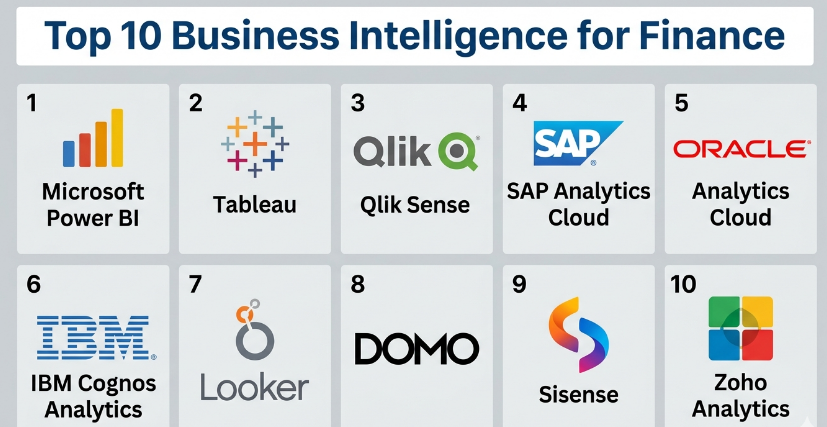
Top 10 Business Intelligence for Finance Tools
#1 — Microsoft Power BI
Short description:
Power BI is a widely adopted BI platform offering strong financial analytics, reporting, and visualization capabilities. It is ideal for organizations already using Microsoft ecosystems.
Key Features
- Financial dashboards
- Data modeling and transformation
- Real-time analytics
- AI insights
- Custom reporting
Pros
- Strong integration with Microsoft tools
- Affordable entry pricing
Cons
- Learning curve for advanced features
- Requires setup for complex models
Platforms / Deployment
Web / Windows / Mobile
Cloud / Hybrid
Security & Compliance
SSO, RBAC, encryption (specific certifications not publicly stated)
Integrations & Ecosystem
Deep integration with enterprise tools.
- Excel
- Azure
- Dynamics
- APIs
Support & Community
Large global community and strong documentation.
#2 — Tableau
Short description:
Tableau is a leading data visualization tool widely used in finance for creating advanced dashboards and insights.
Key Features
- Interactive dashboards
- Financial analytics
- Data blending
- Advanced visualization
- AI-powered insights
Pros
- Powerful visualization
- Flexible data handling
Cons
- Expensive
- Steeper learning curve
Platforms / Deployment
Web / Desktop / Mobile
Cloud / On-premise
Security & Compliance
SSO, encryption (details not fully stated)
Integrations & Ecosystem
- Salesforce
- Databases
- APIs
Support & Community
Strong community support.
#3 — Qlik Sense
Short description:
Qlik Sense offers associative data modeling, enabling finance teams to explore data relationships easily.
Key Features
- Associative analytics
- Self-service dashboards
- AI insights
- Data integration
- Reporting
Pros
- Flexible analytics
- Strong data exploration
Cons
- UI complexity
- Requires training
Platforms / Deployment
Web / Mobile
Cloud / Hybrid
Security & Compliance
Not publicly stated
Integrations & Ecosystem
- Databases
- APIs
- ERP systems
Support & Community
Enterprise support available.
#4 — SAP Analytics Cloud
Short description:
SAP Analytics Cloud combines BI, planning, and predictive analytics, making it strong for enterprise finance.
Key Features
- Financial planning
- Predictive analytics
- Data visualization
- Integration with SAP systems
- Collaboration
Pros
- Strong enterprise integration
- End-to-end planning
Cons
- Expensive
- Complex setup
Platforms / Deployment
Web
Cloud
Security & Compliance
Enterprise-grade security (details not fully stated)
Integrations & Ecosystem
- SAP ERP
- APIs
Support & Community
Enterprise-level support.
#5 — Oracle Analytics Cloud
Short description:
Oracle Analytics Cloud provides advanced analytics and reporting for finance teams using Oracle ecosystems.
Key Features
- Financial dashboards
- Machine learning
- Data preparation
- Reporting tools
- Forecasting
Pros
- Strong enterprise features
- AI capabilities
Cons
- Complex deployment
- High cost
Platforms / Deployment
Web
Cloud
Security & Compliance
Not publicly stated
Integrations & Ecosystem
- Oracle ERP
- Databases
Support & Community
Enterprise support available.
#6 — IBM Cognos Analytics
Short description:
IBM Cognos is a traditional BI platform with strong reporting and governance features for finance.
Key Features
- Financial reporting
- Data governance
- AI insights
- Dashboarding
- Forecasting
Pros
- Strong governance
- Reliable reporting
Cons
- Outdated UI
- Complex implementation
Platforms / Deployment
Web / Desktop
Cloud / On-premise
Security & Compliance
Not publicly stated
Integrations & Ecosystem
- IBM ecosystem
- Databases
Support & Community
Enterprise-level support.
#7 — Looker
Short description:
Looker focuses on data modeling and real-time analytics, often used for financial data insights.
Key Features
- Data modeling
- Real-time dashboards
- Embedded analytics
- API-driven architecture
- Reporting
Pros
- Strong modeling
- Developer-friendly
Cons
- Requires technical expertise
- Pricing not transparent
Platforms / Deployment
Web
Cloud
Security & Compliance
Not publicly stated
Integrations & Ecosystem
- Google Cloud
- APIs
Support & Community
Good support with developer focus.
#8 — Domo
Short description:
Domo is a cloud-based BI platform focused on real-time analytics and business visibility.
Key Features
- Real-time dashboards
- Data integration
- Mobile BI
- Alerts and notifications
- Collaboration
Pros
- Real-time insights
- Easy visualization
Cons
- Expensive
- Limited customization
Platforms / Deployment
Web / Mobile
Cloud
Security & Compliance
Not publicly stated
Integrations & Ecosystem
- Cloud apps
- APIs
Support & Community
Strong support for enterprise users.
#9 — Sisense
Short description:
Sisense provides embedded analytics and strong data processing capabilities for finance teams.
Key Features
- Embedded BI
- Data modeling
- Dashboards
- AI insights
- APIs
Pros
- Scalable
- Developer-friendly
Cons
- Requires setup
- Learning curve
Platforms / Deployment
Web
Cloud / Hybrid
Security & Compliance
Not publicly stated
Integrations & Ecosystem
- APIs
- Databases
Support & Community
Reliable enterprise support.
#10 — Zoho Analytics
Short description:
Zoho Analytics is an affordable BI tool suitable for SMB finance teams.
Key Features
- Financial dashboards
- Data integration
- Reporting
- AI assistant
- Collaboration
Pros
- Cost-effective
- Easy to use
Cons
- Limited enterprise features
- Basic customization
Platforms / Deployment
Web / Mobile
Cloud
Security & Compliance
Not publicly stated
Integrations & Ecosystem
- Zoho apps
- CRM
- APIs
Support & Community
Good SMB support.
Comparison Table (Top 10)
| Tool Name | Best For | Platform(s) Supported | Deployment | Standout Feature | Public Rating |
|---|---|---|---|---|---|
| Power BI | Microsoft ecosystem | Web, Windows, Mobile | Cloud/Hybrid | Affordable analytics | N/A |
| Tableau | Data visualization | Web, Desktop, Mobile | Cloud/On-prem | Advanced dashboards | N/A |
| Qlik Sense | Data exploration | Web, Mobile | Cloud/Hybrid | Associative analytics | N/A |
| SAP Analytics Cloud | Enterprise finance | Web | Cloud | Planning + BI | N/A |
| Oracle Analytics Cloud | Oracle users | Web | Cloud | AI analytics | N/A |
| IBM Cognos | Governance reporting | Web, Desktop | Cloud/On-prem | Strong reporting | N/A |
| Looker | Data modeling | Web | Cloud | Embedded analytics | N/A |
| Domo | Real-time BI | Web, Mobile | Cloud | Live dashboards | N/A |
| Sisense | Embedded BI | Web | Cloud/Hybrid | Scalable analytics | N/A |
| Zoho Analytics | SMB finance | Web, Mobile | Cloud | Affordable BI | N/A |
Evaluation & Scoring of Business Intelligence for Finance Tools
| Tool Name | Core | Ease | Integrations | Security | Performance | Support | Value | Weighted Total |
|---|---|---|---|---|---|---|---|---|
| Power BI | 9 | 8 | 9 | 8 | 8 | 9 | 9 | 8.7 |
| Tableau | 9 | 7 | 8 | 8 | 9 | 9 | 7 | 8.2 |
| Qlik Sense | 8 | 7 | 8 | 7 | 8 | 8 | 7 | 7.8 |
| SAP Analytics Cloud | 9 | 6 | 8 | 8 | 8 | 8 | 6 | 7.9 |
| Oracle Analytics | 9 | 6 | 8 | 8 | 8 | 8 | 6 | 7.9 |
| IBM Cognos | 8 | 6 | 7 | 8 | 7 | 8 | 7 | 7.4 |
| Looker | 8 | 6 | 9 | 7 | 8 | 8 | 6 | 7.6 |
| Domo | 8 | 7 | 8 | 7 | 8 | 8 | 6 | 7.5 |
| Sisense | 8 | 6 | 8 | 7 | 8 | 8 | 7 | 7.6 |
| Zoho Analytics | 7 | 9 | 7 | 6 | 7 | 7 | 9 | 7.8 |
How to interpret scores:
- Scores are relative comparisons across tools.
- Higher scores indicate stronger overall financial BI capability.
- Enterprise tools prioritize depth over ease.
- SMB tools prioritize usability and cost-effectiveness.
- Choose based on your business context, not just score.
Which Business Intelligence for Finance Tools
Solo / Freelancer
Zoho Analytics and Power BI are ideal for affordability and ease.
SMB
Zoho Analytics and Domo provide good balance.
Mid-Market
Power BI and Qlik Sense offer scalability.
Enterprise
SAP Analytics Cloud, Oracle Analytics, and Tableau are best choices.
Budget vs Premium
- Budget: Zoho Analytics, Power BI
- Premium: Tableau, SAP, Oracle
Feature Depth vs Ease of Use
- Deep: SAP, Oracle
- Easy: Zoho, Power BI
Integrations & Scalability
- Best integrations: Power BI, Looker
- Scalable: SAP, Oracle
Security & Compliance Needs
- Enterprise: SAP, Oracle
- Basic: Zoho, Domo
Frequently Asked Questions (FAQs)
1. What is BI for finance?
It is the use of analytics tools to monitor and improve financial performance through data insights.
2. How much do these tools cost?
Pricing varies from affordable SMB plans to expensive enterprise subscriptions.
3. Are these tools secure?
Most offer standard security features; compliance details vary.
4. Can they integrate with ERP systems?
Yes, most tools integrate with ERP and accounting platforms.
5. Do I need technical skills?
Some tools require technical knowledge, others are user-friendly.
6. What are common mistakes?
Poor data quality and lack of adoption are common issues.
7. Can startups use BI tools?
Yes, many tools are designed for SMBs and startups.
8. How scalable are they?
Enterprise tools scale well; simpler tools may have limits.
9. Are AI features important?
Yes, especially for forecasting and anomaly detection.
10. Can I switch tools later?
Yes, but migration can be complex.
Conclusion
Business Intelligence tools for finance are no longer optional—they are critical for making informed, data-driven decisions in a fast-moving business environment. From real-time dashboards to AI-powered forecasting, these platforms enable finance teams to move beyond static reporting and toward proactive strategy. However, the “best” tool depends heavily on your organization’s size, existing systems, and analytical maturity. A startup may benefit from a lightweight, cost-effective tool, while an enterprise may require deep integrations and advanced analytics. The smartest approach is to shortlist two or three tools that align with your needs, test them with real financial scenarios, and validate their performance, usability, and integration capabilities before committing long-term.
