Introduction
Restaurant Delivery Dispatch Tools are software platforms that help restaurants manage, assign, and optimize delivery orders in real time. These tools connect kitchen operations, delivery staff, and customers into a single system, ensuring orders are dispatched efficiently and delivered on time. In simple terms, they act as the “brain” behind delivery logistics.
With the rapid growth of food delivery ecosystems and customer expectations for faster service, these tools have become critical. In a 2026+ landscape, where AI-driven logistics and real-time tracking are becoming standard, dispatch systems are no longer optional—they are operational necessities.
Real-world use cases include:
- Managing high-volume delivery orders during peak hours
- Assigning drivers based on location and availability
- Optimizing delivery routes to reduce delays and fuel costs
- Tracking deliveries in real time for customer transparency
- Integrating with POS and online ordering platforms
What buyers should evaluate:
- Real-time dispatch and routing capabilities
- Driver tracking and management features
- Integration with POS, payment, and ordering systems
- Scalability for multi-location operations
- Ease of use for staff and drivers
- Automation and AI capabilities
- Security and data protection
- Reporting and analytics
- Pricing and ROI
- Customer experience features
Best for: Multi-location restaurants, cloud kitchens, delivery-first brands, and growing food chains that rely heavily on logistics efficiency.
Not ideal for: Small dine-in restaurants with minimal delivery volume or those relying entirely on third-party delivery platforms.
Key Trends in Restaurant Delivery Dispatch Tools
- AI-powered route optimization improving delivery speed and cost efficiency
- Integration with multiple delivery channels (own fleet + aggregators)
- Real-time GPS tracking and predictive ETAs for customers
- Automation in driver assignment and load balancing
- Rise of cloud kitchens driving demand for centralized dispatch systems
- API-first platforms enabling custom integrations
- Focus on contactless delivery and customer experience
- Subscription-based pricing models replacing one-time licenses
- Enhanced analytics for delivery performance and cost tracking
- Increased focus on data security and compliance
How We Selected These Tools (Methodology)
- Strong market presence and adoption in restaurant delivery operations
- Comprehensive feature sets covering dispatch, tracking, and analytics
- Proven reliability and performance under high order volumes
- Availability of integrations with POS, payment, and aggregator platforms
- Security and operational stability indicators
- Fit across different business sizes (SMB to enterprise)
- Ease of onboarding and usability for non-technical teams
- Vendor ecosystem and extensibility through APIs
- Customer support quality and documentation availability
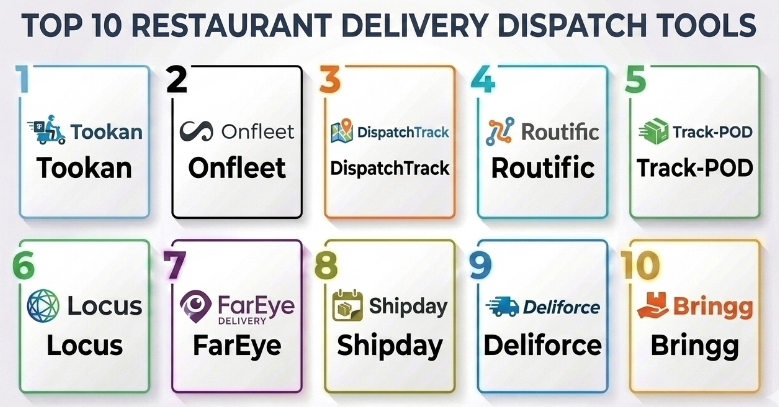
Top 10 Restaurant Delivery Dispatch Tools
#1 — Tookan
Short description (5-6 lines): Tookan is a delivery management and dispatch platform designed for businesses managing last-mile logistics. It is widely used by restaurants and food delivery services to automate order assignments and track deliveries in real time. The platform focuses on route optimization and workforce management. It is suitable for SMBs and enterprises with delivery fleets. It also supports analytics and customer notifications.
Key Features
- Automated task assignment
- Real-time driver tracking
- Route optimization
- Customer notifications
- Analytics dashboard
- Multi-location support
Pros
- Easy to deploy and scale
- Strong tracking capabilities
Cons
- UI may feel complex for beginners
- Pricing varies based on usage
Platforms / Deployment
Web / iOS / Android
Cloud
Security & Compliance
Not publicly stated
Integrations & Ecosystem
Tookan integrates with POS systems, CRM platforms, and APIs for custom workflows.
- POS systems
- Payment gateways
- API integrations
Support & Community
Offers documentation, onboarding support, and ticket-based assistance. Community presence is moderate.
#2 — Onfleet
Short description (5-6 lines): Onfleet is a last-mile delivery management platform known for its clean interface and strong analytics. It helps restaurants manage delivery operations efficiently with real-time tracking. The tool is ideal for delivery-first businesses and cloud kitchens. It focuses on driver efficiency and customer communication. It is widely adopted globally.
Key Features
- Route optimization
- Driver assignment automation
- Customer notifications
- Delivery analytics
- Proof of delivery
- Real-time tracking
Pros
- Intuitive UI
- Strong analytics capabilities
Cons
- Limited customization
- Pricing may be high for small teams
Platforms / Deployment
Web / iOS / Android
Cloud
Security & Compliance
Not publicly stated
Integrations & Ecosystem
Supports integrations with POS systems and APIs for automation.
- API access
- CRM tools
- Order management systems
Support & Community
Strong documentation and onboarding support with enterprise plans.
#3 — DispatchTrack
Short description (5-6 lines): DispatchTrack provides delivery tracking and logistics optimization tools. It is designed for businesses requiring precise delivery scheduling. Restaurants use it to improve delivery accuracy and customer satisfaction. It supports advanced analytics and routing. It is more suited for mid-market to enterprise users.
Key Features
- Real-time delivery tracking
- Route optimization
- Delivery scheduling
- Customer communication
- Analytics tools
Pros
- Accurate delivery tracking
- Good reporting features
Cons
- Complex setup
- Higher cost
Platforms / Deployment
Web / Mobile
Cloud
Security & Compliance
Not publicly stated
Integrations & Ecosystem
Integrates with ERP and POS systems.
- POS integrations
- CRM tools
- API support
Support & Community
Enterprise-level support with onboarding assistance.
#4 — Routific
Short description (5-6 lines): Routific focuses on route planning and optimization. It helps restaurants reduce delivery time and fuel costs. The platform is simple and effective for SMBs. It supports scheduling and driver management. It is widely used for logistics efficiency.
Key Features
- Route optimization
- Delivery scheduling
- Driver management
- Real-time updates
- Analytics
Pros
- Easy to use
- Cost-effective
Cons
- Limited advanced features
- Not enterprise-focused
Platforms / Deployment
Web
Cloud
Security & Compliance
Not publicly stated
Integrations & Ecosystem
Supports integrations with delivery apps and APIs.
- API integrations
- Spreadsheet imports
Support & Community
Basic support with documentation.
#5 — Track-POD
Short description (5-6 lines): Track-POD is a delivery management solution with proof-of-delivery capabilities. It is used by restaurants to ensure delivery accuracy. The platform provides route optimization and tracking. It is suitable for SMBs and mid-sized businesses. It emphasizes transparency.
Key Features
- Proof of delivery
- Route optimization
- Driver tracking
- Delivery analytics
- Customer notifications
Pros
- Strong delivery confirmation features
- Good reporting
Cons
- Limited customization
- UI could be improved
Platforms / Deployment
Web / Mobile
Cloud
Security & Compliance
Not publicly stated
Integrations & Ecosystem
Supports integration with business tools and APIs.
- API support
- POS integrations
Support & Community
Offers onboarding and documentation support.
#6 — Locus
Short description (5-6 lines): Locus is an AI-driven logistics optimization platform. It helps restaurants automate delivery planning and execution. It is designed for enterprises with high delivery volumes. The platform focuses on efficiency and scalability. It supports predictive analytics.
Key Features
- AI route optimization
- Automated dispatch
- Real-time tracking
- Predictive analytics
- Fleet management
Pros
- Advanced AI capabilities
- Highly scalable
Cons
- Expensive
- Complex implementation
Platforms / Deployment
Web / Mobile
Cloud
Security & Compliance
Not publicly stated
Integrations & Ecosystem
Integrates with enterprise systems and APIs.
- ERP integrations
- API ecosystem
Support & Community
Enterprise-grade support with onboarding.
#7 — FarEye
Short description (5-6 lines): FarEye is a logistics platform focused on delivery visibility and automation. It helps restaurants manage delivery operations efficiently. It is suited for large-scale operations. The platform supports AI and analytics. It enhances customer experience.
Key Features
- Delivery tracking
- Route optimization
- Analytics
- Automation
- Customer communication
Pros
- Strong enterprise features
- Good analytics
Cons
- Complex setup
- High cost
Platforms / Deployment
Web / Mobile
Cloud
Security & Compliance
Not publicly stated
Integrations & Ecosystem
Supports integration with enterprise systems.
- API integrations
- CRM systems
Support & Community
Enterprise support available.
#8 — Shipday
Short description (5-6 lines): Shipday is a delivery management platform designed for restaurants and small businesses. It simplifies dispatch and tracking. It is user-friendly and affordable. It supports real-time updates and driver management. It is ideal for SMBs.
Key Features
- Order dispatch
- Driver tracking
- Notifications
- Analytics
- Integration support
Pros
- Affordable
- Easy to use
Cons
- Limited advanced features
- Not ideal for large enterprises
Platforms / Deployment
Web / Mobile
Cloud
Security & Compliance
Not publicly stated
Integrations & Ecosystem
Supports POS and delivery integrations.
- POS systems
- API support
Support & Community
Basic support with documentation.
#9 — Deliforce
Short description (5-6 lines): Deliforce is a logistics and delivery management platform. It helps restaurants manage delivery operations efficiently. It supports route optimization and tracking. It is suitable for SMBs and growing businesses. It focuses on automation.
Key Features
- Delivery tracking
- Route optimization
- Driver management
- Analytics
- Notifications
Pros
- Scalable
- Good automation features
Cons
- UI could be improved
- Limited enterprise features
Platforms / Deployment
Web / Mobile
Cloud
Security & Compliance
Not publicly stated
Integrations & Ecosystem
Supports integration with business tools.
- API integrations
- POS systems
Support & Community
Moderate support with onboarding.
#10 — Bringg
Short description (5-6 lines): Bringg is a delivery orchestration platform for enterprises. It helps restaurants manage complex delivery operations. It supports multiple delivery channels. It focuses on scalability and automation. It is widely used by large organizations.
Key Features
- Delivery orchestration
- Real-time tracking
- Route optimization
- Analytics
- Multi-channel support
Pros
- Enterprise-grade capabilities
- Strong scalability
Cons
- Expensive
- Complex implementation
Platforms / Deployment
Web / Mobile
Cloud
Security & Compliance
Not publicly stated
Integrations & Ecosystem
Integrates with enterprise systems and APIs.
- API integrations
- ERP systems
Support & Community
Enterprise-level support.
Comparison Table (Top 10)
| Tool Name | Best For | Platform(s) Supported | Deployment | Standout Feature | Public Rating |
|---|---|---|---|---|---|
| Tookan | SMB & Enterprise | Web, Mobile | Cloud | Workforce management | N/A |
| Onfleet | Delivery-first businesses | Web, Mobile | Cloud | Analytics & tracking | N/A |
| DispatchTrack | Enterprise | Web, Mobile | Cloud | Delivery scheduling | N/A |
| Routific | SMB | Web | Cloud | Route optimization | N/A |
| Track-POD | SMB | Web, Mobile | Cloud | Proof of delivery | N/A |
| Locus | Enterprise | Web, Mobile | Cloud | AI optimization | N/A |
| FarEye | Enterprise | Web, Mobile | Cloud | Automation | N/A |
| Shipday | SMB | Web, Mobile | Cloud | Easy dispatch | N/A |
| Deliforce | SMB | Web, Mobile | Cloud | Automation | N/A |
| Bringg | Enterprise | Web, Mobile | Cloud | Delivery orchestration | N/A |
Evaluation & Scoring of Restaurant Delivery Dispatch Tools
| Tool Name | Core (25%) | Ease (15%) | Integrations (15%) | Security (10%) | Performance (10%) | Support (10%) | Value (15%) | Weighted Total |
|---|---|---|---|---|---|---|---|---|
| Tookan | 8 | 7 | 8 | 6 | 8 | 7 | 8 | 7.6 |
| Onfleet | 8 | 9 | 7 | 6 | 8 | 8 | 7 | 7.8 |
| DispatchTrack | 9 | 6 | 8 | 7 | 9 | 8 | 6 | 7.9 |
| Routific | 7 | 9 | 6 | 6 | 7 | 7 | 8 | 7.3 |
| Track-POD | 7 | 7 | 7 | 6 | 7 | 7 | 7 | 7.0 |
| Locus | 9 | 6 | 9 | 7 | 9 | 8 | 6 | 8.1 |
| FarEye | 9 | 6 | 8 | 7 | 9 | 8 | 6 | 8.0 |
| Shipday | 7 | 9 | 6 | 6 | 7 | 7 | 9 | 7.6 |
| Deliforce | 7 | 8 | 7 | 6 | 7 | 7 | 8 | 7.4 |
| Bringg | 9 | 6 | 9 | 7 | 9 | 8 | 6 | 8.1 |
How to interpret scores:
These scores are comparative, not absolute. A higher score indicates better overall balance across features, usability, and value. Enterprise tools score higher on capabilities but may rank lower on ease and cost efficiency. SMB tools often score high in usability and value but may lack advanced features.
Which Restaurant Delivery Dispatch Tools
Solo / Freelancer
Simple tools like Shipday or Routific are ideal due to ease of use and affordability.
SMB
Tookan, Deliforce, and Track-POD offer a balance of features and cost.
Mid-Market
Onfleet and DispatchTrack provide better analytics and scalability.
Enterprise
Locus, FarEye, and Bringg are suitable for large-scale operations.
Budget vs Premium
Budget tools prioritize simplicity, while premium tools focus on automation and AI.
Feature Depth vs Ease of Use
Advanced tools offer deeper features but require training; simpler tools are easier to adopt.
Integrations & Scalability
Choose tools with strong API ecosystems for future growth.
Security & Compliance Needs
Enterprise users should prioritize tools with strong compliance signals.
Frequently Asked Questions (FAQs)
1. What is a restaurant delivery dispatch tool?
It is software that helps manage delivery orders, assign drivers, and track deliveries in real time.
2. How much do these tools cost?
Pricing varies widely based on features, usage, and business size.
3. Are these tools suitable for small restaurants?
Yes, many tools offer SMB-friendly plans with essential features.
4. Do they integrate with POS systems?
Most modern tools support POS integrations or APIs.
5. Can I manage multiple locations?
Yes, many tools support multi-location operations.
6. Is training required?
Basic tools require minimal training; advanced platforms may need onboarding.
7. How secure are these platforms?
Security varies; always evaluate encryption, access controls, and compliance.
8. Can I switch tools easily?
Switching is possible but may require data migration and integration setup.
9. Do they support third-party delivery apps?
Many tools integrate with external delivery platforms.
10. What is the biggest mistake when choosing a tool?
Ignoring scalability and integration needs.
Conclusion
Restaurant delivery dispatch tools have become essential for modern food businesses operating in a delivery-first environment. From improving delivery speed to enhancing customer satisfaction, these platforms play a central role in operational efficiency. However, the “best” tool is not universal—it depends heavily on your business size, delivery volume, budget, and technical requirements. SMBs may prioritize ease of use and affordability, while enterprises need advanced automation and scalability. The most practical next step is to shortlist two or three tools that align with your needs, test them through a pilot, and validate integrations, performance, and usability before committing long term.