Introduction
Restaurant Menu Engineering Tools are specialized software solutions that help restaurants analyze, design, and optimize their menus for maximum profitability and operational efficiency. These tools go beyond basic menu creation—they use data analytics to evaluate item performance based on profitability, popularity, and contribution margins. The goal is simple: increase revenue while improving customer experience.
In today’s highly competitive food industry, especially with rising ingredient costs and digital ordering growth, menu engineering has become a strategic function rather than a one-time design task. Modern tools now integrate with POS systems, track real-time sales data, and even suggest pricing and layout changes.
Real-world use cases:
- Identifying high-profit and low-performing menu items
- Optimizing pricing strategies for better margins
- Designing digital menus for kiosks and apps
- Improving upselling and cross-selling strategies
- Managing seasonal or location-specific menus
What buyers should evaluate:
- Integration with POS and analytics systems
- Profitability and contribution margin analysis
- Ease of use and reporting dashboards
- Menu design flexibility
- Real-time data updates
- AI-driven recommendations
- Multi-location support
- Customization and segmentation
- Cost vs ROI
Best for: Restaurant owners, chain operators, cloud kitchens, QSRs, and food service consultants aiming to improve profitability and customer experience.
Not ideal for: Small food vendors with static menus or businesses not using digital POS systems.
Key Trends in Restaurant Menu Engineering Tools
- AI-driven menu optimization for pricing and placement
- Dynamic menu pricing models based on demand and costs
- Real-time performance analytics integrated with POS
- Digital menu design for kiosks and mobile apps
- Personalization using customer behavior data
- Integration with delivery platforms and aggregators
- Cloud-based deployment for multi-location chains
- Predictive analytics for demand forecasting
- Automated menu categorization (stars, plowhorses, etc.)
- Subscription-based pricing models
How We Selected These Tools (Methodology)
- Evaluated market popularity and adoption in restaurant industry
- Reviewed depth of analytics and menu optimization capabilities
- Assessed integration with POS and data sources
- Considered ease of use and reporting features
- Analyzed scalability across multiple locations
- Evaluated AI and automation capabilities
- Compared cost vs value across business sizes
- Considered support quality and documentation
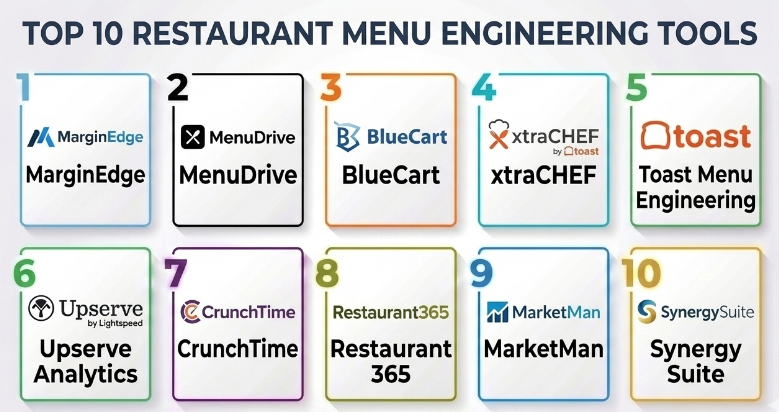
Top 10 Restaurant Menu Engineering Tools
#1 — MarginEdge
Short description (5-6 lines):
MarginEdge is a powerful back-office and menu engineering tool designed for restaurant operators who want deep insights into food costs and profitability. It automates invoice processing, tracks ingredient costs, and connects directly to POS systems. It is widely used by mid-sized and multi-location restaurants.
Key Features
- Food cost tracking and analysis
- Automated invoice processing
- Menu profitability reports
- POS integration
- Inventory tracking
- Real-time cost updates
Pros
- Strong cost analytics
- Automation reduces manual work
Cons
- Learning curve
- Pricing may be high for small businesses
Platforms / Deployment
- Web / Cloud
Security & Compliance
- Not publicly stated
Integrations & Ecosystem
MarginEdge integrates with POS and accounting systems to provide full financial visibility.
- POS systems
- Accounting tools
- Inventory systems
Support & Community
Strong support with onboarding assistance and documentation.
#2 — MenuDrive
Short description (5-6 lines):
MenuDrive is focused on online ordering and menu optimization for restaurants. It combines menu engineering with digital ordering capabilities.
Key Features
- Online ordering integration
- Menu analytics
- Custom branding
- Delivery optimization
- Pricing adjustments
Pros
- Good for online-focused restaurants
- Easy to use
Cons
- Limited deep analytics
- Not ideal for enterprise
Platforms / Deployment
- Web / Cloud
Security & Compliance
- Not publicly stated
Integrations & Ecosystem
- POS systems
- Delivery platforms
- APIs
Support & Community
Moderate support with documentation.
#3 — BlueCart
Short description (5-6 lines):
BlueCart is a procurement and menu cost optimization tool that helps restaurants manage suppliers and pricing.
Key Features
- Supplier management
- Cost analysis
- Menu pricing optimization
- Inventory integration
- Reporting dashboards
Pros
- Strong supplier integration
- Good cost control
Cons
- Limited UI flexibility
- Learning curve
Platforms / Deployment
- Web / Cloud
Security & Compliance
- Not publicly stated
Integrations & Ecosystem
- Supplier systems
- POS
- Inventory tools
Support & Community
Reliable support with onboarding.
#4 — xtraCHEF
Short description (5-6 lines):
xtraCHEF provides automated data entry and analytics for restaurant finances and menu performance.
Key Features
- Automated invoice capture
- Menu costing
- Profitability reports
- Vendor analytics
- Data dashboards
Pros
- Automation saves time
- Detailed insights
Cons
- Limited customization
- Requires data accuracy
Platforms / Deployment
- Cloud
Security & Compliance
- Not publicly stated
Integrations & Ecosystem
- POS
- Accounting tools
- APIs
Support & Community
Strong onboarding support.
#5 — Toast Menu Engineering
Short description (5-6 lines):
Toast offers built-in menu engineering tools within its POS ecosystem, providing real-time insights and optimization features.
Key Features
- POS-integrated analytics
- Menu performance tracking
- Pricing tools
- Sales analytics
- Real-time reporting
Pros
- Seamless integration
- Easy to use
Cons
- Limited outside Toast ecosystem
- Feature depth varies
Platforms / Deployment
- Cloud / Android
Security & Compliance
- Not publicly stated
Integrations & Ecosystem
- POS
- Payments
- Reporting tools
Support & Community
Strong ecosystem support.
#6 — Upserve Analytics
Short description (5-6 lines):
Upserve Analytics focuses on actionable insights for menu performance and customer behavior.
Key Features
- Menu item tracking
- Customer analytics
- Sales reports
- Staff performance insights
Pros
- Strong reporting
- Easy insights
Cons
- Limited customization
- Cost considerations
Platforms / Deployment
- Cloud
Security & Compliance
- Not publicly stated
Integrations & Ecosystem
- POS
- Analytics tools
Support & Community
Moderate support availability.
#7 — CrunchTime
Short description (5-6 lines):
CrunchTime is an enterprise-level restaurant management platform with strong menu engineering and cost control features.
Key Features
- Food cost management
- Menu optimization
- Forecasting tools
- Inventory management
- Multi-location support
Pros
- Enterprise-ready
- Strong forecasting
Cons
- Complex implementation
- High cost
Platforms / Deployment
- Cloud
Security & Compliance
- Not publicly stated
Integrations & Ecosystem
- POS
- ERP
- Inventory tools
Support & Community
Enterprise-level support.
#8 — Restaurant365
Short description (5-6 lines):
Restaurant365 is a comprehensive restaurant management solution with menu engineering and financial tracking capabilities.
Key Features
- Financial analytics
- Menu costing
- Inventory tracking
- Reporting tools
- Multi-location support
Pros
- All-in-one solution
- Strong financial visibility
Cons
- Complex setup
- Higher cost
Platforms / Deployment
- Cloud
Security & Compliance
- Not publicly stated
Integrations & Ecosystem
- POS
- Accounting
- Payroll systems
Support & Community
Strong enterprise support.
#9 — MarketMan
Short description (5-6 lines):
MarketMan focuses on inventory and cost management, helping optimize menu pricing and profitability.
Key Features
- Inventory tracking
- Menu costing
- Supplier management
- Reporting dashboards
Pros
- Strong cost control
- Easy to use
Cons
- Limited design features
- Moderate scalability
Platforms / Deployment
- Cloud
Security & Compliance
- Not publicly stated
Integrations & Ecosystem
- POS
- Inventory systems
Support & Community
Reliable support.
#10 — SynergySuite
Short description (5-6 lines):
SynergySuite is an enterprise restaurant management tool offering menu engineering, analytics, and operational insights.
Key Features
- Menu optimization
- Reporting dashboards
- Labor management
- Inventory tracking
Pros
- Comprehensive features
- Scalable
Cons
- Expensive
- Requires training
Platforms / Deployment
- Cloud
Security & Compliance
- Not publicly stated
Integrations & Ecosystem
- POS
- ERP systems
Support & Community
Enterprise-grade support.
Comparison Table (Top 10)
| Tool Name | Best For | Platform(s) Supported | Deployment | Standout Feature | Public Rating |
|---|---|---|---|---|---|
| MarginEdge | Mid-market | Web | Cloud | Food cost automation | N/A |
| MenuDrive | Online restaurants | Web | Cloud | Online ordering integration | N/A |
| BlueCart | Supplier management | Web | Cloud | Procurement optimization | N/A |
| xtraCHEF | Data automation | Cloud | Cloud | Invoice automation | N/A |
| Toast Menu Engineering | POS users | Android | Cloud | POS integration | N/A |
| Upserve Analytics | Insights-driven users | Cloud | Cloud | Customer analytics | N/A |
| CrunchTime | Enterprise | Cloud | Cloud | Forecasting | N/A |
| Restaurant365 | Full management | Cloud | Cloud | Financial tracking | N/A |
| MarketMan | Cost control | Cloud | Cloud | Inventory optimization | N/A |
| SynergySuite | Enterprise | Cloud | Cloud | Comprehensive platform | N/A |
Evaluation & Scoring of Restaurant Menu Engineering Tools
| Tool Name | Core (25%) | Ease (15%) | Integrations (15%) | Security (10%) | Performance (10%) | Support (10%) | Value (15%) | Weighted Total |
|---|---|---|---|---|---|---|---|---|
| MarginEdge | 9 | 7 | 8 | 6 | 8 | 8 | 7 | 8.0 |
| MenuDrive | 7 | 8 | 7 | 6 | 7 | 7 | 8 | 7.4 |
| BlueCart | 8 | 7 | 7 | 6 | 8 | 7 | 7 | 7.5 |
| xtraCHEF | 8 | 7 | 7 | 6 | 8 | 8 | 7 | 7.6 |
| Toast Menu Engineering | 8 | 8 | 8 | 6 | 8 | 8 | 7 | 7.9 |
| Upserve Analytics | 7 | 8 | 7 | 6 | 7 | 7 | 7 | 7.3 |
| CrunchTime | 9 | 6 | 8 | 7 | 9 | 9 | 6 | 8.1 |
| Restaurant365 | 9 | 6 | 8 | 7 | 9 | 9 | 6 | 8.1 |
| MarketMan | 7 | 8 | 7 | 6 | 7 | 7 | 8 | 7.4 |
| SynergySuite | 9 | 6 | 8 | 7 | 9 | 9 | 6 | 8.1 |
How to interpret:
These scores compare tools relative to each other. Higher scores indicate stronger overall capabilities, but the best choice depends on your business size and needs.
Which Restaurant Menu Engineering Tools
Solo / Freelancer
Use simple tools like MarketMan or MenuDrive for basic cost tracking and pricing.
SMB
MarginEdge and Toast provide a strong balance of analytics and usability.
Mid-Market
BlueCart and xtraCHEF offer deeper cost and supplier insights.
Enterprise
CrunchTime, Restaurant365, and SynergySuite are best for complex operations.
Budget vs Premium
Budget tools focus on essentials; premium tools offer deep analytics and automation.
Feature Depth vs Ease of Use
Simpler tools are easier to adopt; advanced tools require training but deliver deeper insights.
Integrations & Scalability
Choose tools with strong POS and ERP integrations for growth.
Security & Compliance Needs
Enterprise users should prioritize role-based access and audit capabilities.
Frequently Asked Questions (FAQs)
1. What is menu engineering?
Menu engineering is analyzing menu items based on profitability and popularity to optimize performance.
2. Do I need a menu engineering tool?
If you want to maximize profits and reduce costs, these tools are highly valuable.
3. How much do these tools cost?
Pricing varies from affordable subscriptions to enterprise-level pricing.
4. Can these tools integrate with POS systems?
Yes, most tools integrate with POS for real-time data.
5. Are these tools useful for small restaurants?
Yes, but simpler tools are recommended.
6. What are common mistakes?
Ignoring data insights and not updating menus regularly.
7. Do these tools support multi-location businesses?
Yes, most mid-market and enterprise tools do.
8. Can I switch tools easily?
Switching requires data migration and retraining.
9. Are these tools secure?
Security varies; check for encryption and access controls.
10. What alternatives exist?
Manual spreadsheets or POS reports, but less efficient.
Conclusion
Restaurant Menu Engineering Tools have evolved into essential business intelligence platforms that directly impact profitability, operational efficiency, and customer satisfaction. Whether you are running a small café or managing a global restaurant chain, choosing the right tool depends on your scale, complexity, and data maturity. Tools like MarginEdge and Toast offer strong mid-market solutions, while enterprise platforms such as CrunchTime and Restaurant365 provide deep analytics and scalability. Smaller businesses can still gain value from simpler tools like MarketMan. The smartest approach is to shortlist two or three options, test them in real-world conditions, and evaluate how effectively they integrate with your POS, improve decision-making, and drive measurable ROI.
