Introduction
Vector database platforms are specialized databases designed to store, index, and search high-dimensional vectors—numerical representations of data such as text, images, audio, and video. These vectors are commonly generated using machine learning models, especially in AI-driven applications.
In the current AI-first landscape, vector databases have become essential infrastructure. They power semantic search, recommendation systems, and large language model (LLM) applications by enabling similarity-based retrieval instead of exact matching. As organizations adopt generative AI and Retrieval-Augmented Generation (RAG) architectures, vector databases are no longer optional—they are foundational.
Real-world use cases include:
- Semantic search and AI-powered chatbots
- Recommendation engines (e-commerce, streaming platforms)
- Image and video similarity search
- Fraud detection and anomaly detection
- Knowledge base retrieval for LLM applications
What buyers should evaluate:
- Indexing algorithms (HNSW, IVF, etc.)
- Query latency and throughput
- Scalability (horizontal and vertical)
- Hybrid search (vector + keyword)
- Integration with AI/ML frameworks
- Security and access controls
- Deployment flexibility (cloud vs self-hosted)
- Cost and pricing model
- Observability and monitoring tools
Best for: AI engineers, data scientists, developers building LLM applications, startups building intelligent products, and enterprises deploying AI-driven services.
Not ideal for: Traditional transactional systems, relational workloads, or applications requiring complex joins and strict schema enforcement.
Key Trends in Vector Database Platforms
- AI-native architecture: Built specifically for embeddings and LLM workloads
- Hybrid search capabilities: Combining vector similarity with keyword search
- Serverless and managed services: Simplifying deployment and scaling
- Multi-modal data support: Text, image, audio, and video embeddings
- Integration with LLM frameworks: Native connectors for AI pipelines
- Real-time indexing and streaming ingestion
- Security-first approach: Role-based access, encryption, audit logging
- Cost optimization models: Usage-based pricing gaining traction
- Edge deployment for low-latency inference
- Observability improvements: Metrics, tracing, and debugging tools
How We Selected These Tools (Methodology)
- High adoption in AI and machine learning ecosystems
- Proven performance in vector similarity search
- Feature completeness including indexing, querying, and scaling
- Integration with modern AI/ML tools and frameworks
- Security posture and enterprise readiness
- Flexibility across deployment models
- Strong developer and community support
- Suitability for both startups and large enterprises
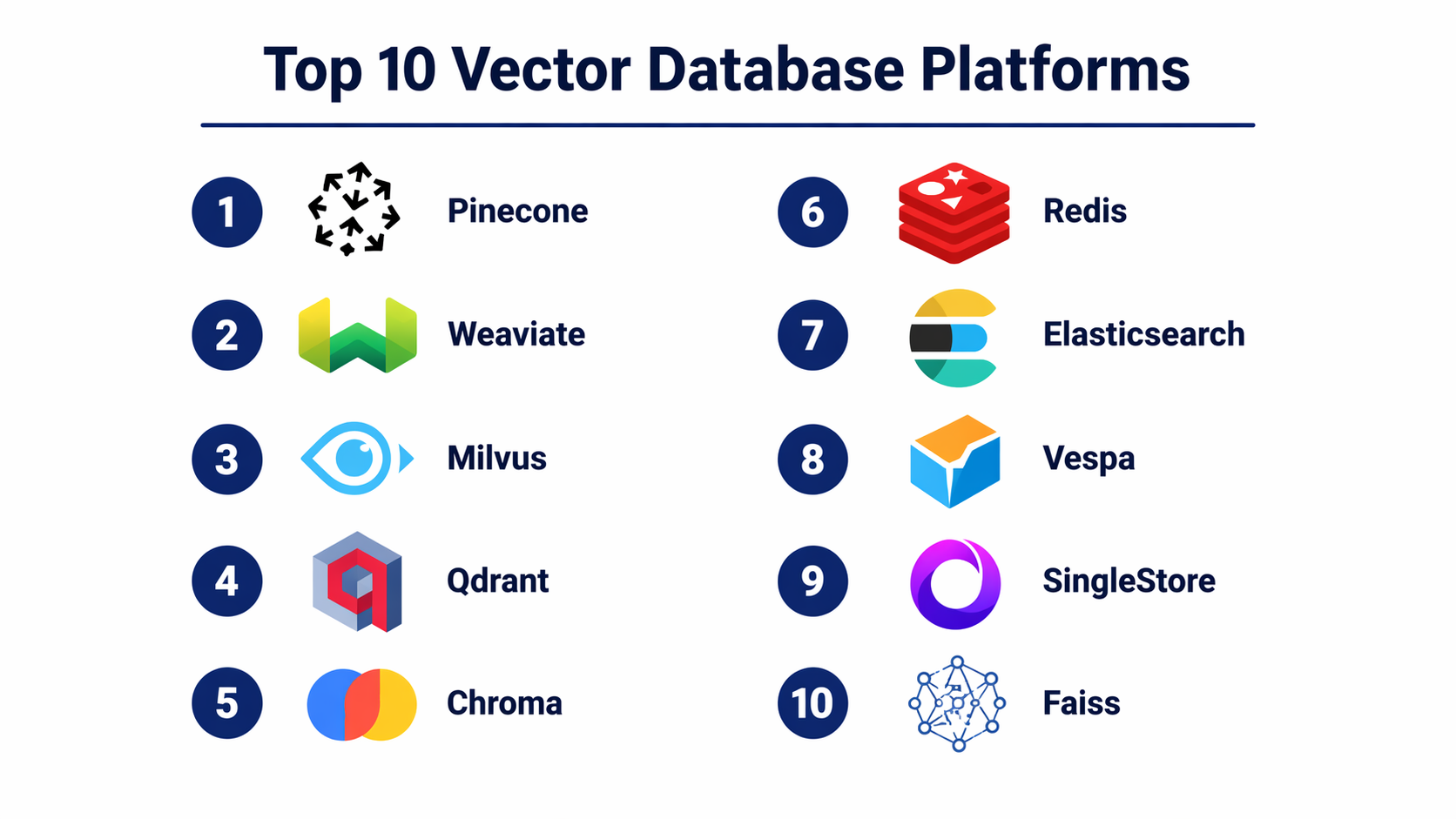
Top 10 NoSQL Database Platforms
#1 — Pinecone
Short description: A fully managed vector database designed for production-scale AI applications and fast similarity search.
Key Features
- Fully managed infrastructure
- Low-latency vector search
- Automatic scaling
- Real-time updates
- Metadata filtering
- High availability
- Optimized indexing
Pros
- Easy to use and deploy
- Excellent performance for AI workloads
Cons
- Limited control over infrastructure
- Pricing can scale quickly
Platforms / Deployment
Cloud
Security & Compliance
Encryption, RBAC; certifications: Not publicly stated
Integrations & Ecosystem
Strong integration with AI tools and frameworks
- LLM frameworks
- APIs and SDKs
- Data pipelines
Support & Community
Growing community with strong documentation
#2 — Weaviate
Short description: An open-source vector database with built-in machine learning modules and semantic search capabilities.
Key Features
- Hybrid search (vector + keyword)
- GraphQL API
- Built-in ML models
- Modular architecture
- Real-time indexing
- Multi-tenant support
- Extensible plugins
Pros
- Flexible and open-source
- Strong hybrid search capabilities
Cons
- Setup complexity for beginners
- Resource-intensive
Platforms / Deployment
Cloud / Self-hosted
Security & Compliance
RBAC, encryption; certifications: Not publicly stated
Integrations & Ecosystem
- AI frameworks
- APIs
- Kubernetes
Support & Community
Active open-source community
#3 — Milvus
Short description: A high-performance open-source vector database designed for large-scale similarity search.
Key Features
- Distributed architecture
- GPU acceleration
- Multiple indexing algorithms
- High throughput
- Real-time ingestion
- Scalable clustering
- Cloud-native design
Pros
- High performance
- Open-source flexibility
Cons
- Complex deployment
- Requires tuning
Platforms / Deployment
Cloud / Self-hosted
Security & Compliance
Authentication, encryption; certifications: Not publicly stated
Integrations & Ecosystem
- AI/ML pipelines
- Data platforms
- APIs
Support & Community
Strong open-source ecosystem
#4 — Qdrant
Short description: A vector database focused on performance and filtering with modern APIs and real-time search.
Key Features
- HNSW indexing
- Payload filtering
- REST and gRPC APIs
- High performance
- Real-time updates
- Distributed support
- Snapshot backups
Pros
- Developer-friendly APIs
- Efficient filtering
Cons
- Smaller ecosystem
- Limited enterprise tooling
Platforms / Deployment
Cloud / Self-hosted
Security & Compliance
Encryption, authentication; certifications: Not publicly stated
Integrations & Ecosystem
- APIs
- ML frameworks
- Data pipelines
Support & Community
Growing community
#5 — Chroma
Short description: A lightweight vector database optimized for LLM applications and prototyping.
Key Features
- Simple setup
- Embedded database
- LLM-friendly design
- Fast indexing
- Local deployment
- Python-first API
- Lightweight architecture
Pros
- Easy for beginners
- Great for prototyping
Cons
- Limited scalability
- Not enterprise-ready
Platforms / Deployment
Self-hosted
Security & Compliance
Not publicly stated
Integrations & Ecosystem
- Python ecosystem
- LLM frameworks
- APIs
Support & Community
Moderate community support
#6 — Redis (Vector Search)
Short description: Extends Redis with vector similarity search capabilities for real-time applications.
Key Features
- In-memory performance
- Vector indexing
- Hybrid search
- Real-time updates
- High throughput
- Data structures
- Caching capabilities
Pros
- Extremely fast
- Multi-purpose platform
Cons
- Memory cost
- Limited persistence
Platforms / Deployment
Cloud / Self-hosted
Security & Compliance
Authentication, encryption; certifications: Not publicly stated
Integrations & Ecosystem
- Microservices
- APIs
- Streaming tools
Support & Community
Very strong ecosystem
#7 — Elasticsearch (Vector Search)
Short description: A search engine platform with added vector search capabilities for hybrid search use cases.
Key Features
- Hybrid search
- Distributed architecture
- Full-text search
- Vector similarity
- Analytics tools
- Scalable clusters
- REST APIs
Pros
- Mature ecosystem
- Strong search capabilities
Cons
- Complex setup
- Resource-heavy
Platforms / Deployment
Cloud / Self-hosted
Security & Compliance
RBAC, encryption; certifications: Varies
Integrations & Ecosystem
- Logging tools
- Analytics platforms
- APIs
Support & Community
Very strong community
#8 — Vespa
Short description: A platform for serving AI-driven applications with built-in vector search and ranking.
Key Features
- Real-time indexing
- Custom ranking
- Distributed system
- Hybrid search
- High scalability
- AI integration
- Query optimization
Pros
- Powerful ranking capabilities
- Handles large-scale workloads
Cons
- Steep learning curve
- Complex setup
Platforms / Deployment
Cloud / Self-hosted
Security & Compliance
Not publicly stated
Integrations & Ecosystem
- AI pipelines
- APIs
- Data systems
Support & Community
Moderate community
#9 — SingleStore (Vector Capabilities)
Short description: A distributed SQL database with vector search support for hybrid workloads.
Key Features
- Hybrid SQL + vector search
- Real-time analytics
- Distributed architecture
- High performance
- Multi-model support
- Streaming ingestion
- Cloud-native
Pros
- Combines SQL and vector
- High performance
Cons
- Complexity
- Licensing cost
Platforms / Deployment
Cloud / Hybrid
Security & Compliance
Encryption, RBAC; certifications: Not publicly stated
Integrations & Ecosystem
- BI tools
- APIs
- Data pipelines
Support & Community
Enterprise support
#10 — Faiss
Short description: A library for efficient similarity search, widely used for building custom vector search systems.
Key Features
- High-performance indexing
- GPU acceleration
- Custom algorithms
- Open-source
- Flexible usage
- Scalable
- Efficient similarity search
Pros
- Very fast
- Highly customizable
Cons
- Not a full database
- Requires engineering effort
Platforms / Deployment
Self-hosted
Security & Compliance
Not publicly stated
Integrations & Ecosystem
- ML frameworks
- Custom pipelines
- APIs
Support & Community
Strong research and developer community
Comparison Table (Top 10)
| Tool Name | Best For | Platform(s) Supported | Deployment | Standout Feature | Public Rating |
|---|---|---|---|---|---|
| Pinecone | Production AI apps | Web | Cloud | Managed vector DB | N/A |
| Weaviate | Hybrid search apps | Cross-platform | Hybrid | Built-in ML modules | N/A |
| Milvus | Large-scale AI | Linux | Hybrid | GPU acceleration | N/A |
| Qdrant | Fast search | Cross-platform | Hybrid | Efficient filtering | N/A |
| Chroma | Prototyping | Cross-platform | Self-hosted | Lightweight design | N/A |
| Redis | Real-time apps | Cross-platform | Hybrid | In-memory speed | N/A |
| Elasticsearch | Search + vector | Cross-platform | Hybrid | Hybrid search | N/A |
| Vespa | AI ranking systems | Linux | Hybrid | Ranking engine | N/A |
| SingleStore | Hybrid workloads | Cloud | Hybrid | SQL + vector | N/A |
| Faiss | Custom systems | Cross-platform | Self-hosted | High performance | N/A |
Evaluation & Scoring of Vector Database Platforms
| Tool Name | Core | Ease | Integrations | Security | Performance | Support | Value | Weighted Total |
|---|---|---|---|---|---|---|---|---|
| Pinecone | 9 | 9 | 8 | 8 | 9 | 8 | 7 | 8.5 |
| Weaviate | 8 | 7 | 8 | 7 | 8 | 8 | 8 | 7.9 |
| Milvus | 9 | 6 | 8 | 7 | 9 | 8 | 8 | 8.1 |
| Qdrant | 8 | 8 | 7 | 7 | 8 | 7 | 8 | 7.8 |
| Chroma | 7 | 9 | 7 | 6 | 7 | 7 | 9 | 7.7 |
| Redis | 8 | 9 | 9 | 7 | 10 | 9 | 7 | 8.6 |
| Elasticsearch | 8 | 7 | 9 | 8 | 8 | 9 | 7 | 8.0 |
| Vespa | 8 | 6 | 7 | 7 | 9 | 7 | 7 | 7.6 |
| SingleStore | 8 | 7 | 8 | 8 | 9 | 8 | 7 | 8.0 |
| Faiss | 9 | 6 | 7 | 6 | 10 | 8 | 8 | 8.0 |
How to interpret:
These scores provide a comparative view based on practical usage, not absolute ranking. Higher scores indicate better balance across features, performance, and usability. Always validate based on your workload and architecture needs.
Which Vector Database Platforms Right for You?
Solo / Freelancer
Chroma, Qdrant — easy setup and lightweight usage
SMB
Weaviate, Redis — balanced performance and cost
Mid-Market
Milvus, Elasticsearch — scalable and flexible
Enterprise
Pinecone, SingleStore, Vespa — production-ready platforms
Budget vs Premium
Open-source vs managed cloud services
Feature Depth vs Ease of Use
Chroma (ease) vs Milvus (depth)
Integrations & Scalability
Redis, Elasticsearch, Pinecone
Security & Compliance Needs
Enterprise platforms with managed services
Frequently Asked Questions (FAQs)
What is a vector database?
A database designed to store and search embeddings using similarity instead of exact matches.
Why are vector databases important?
They power AI applications like chatbots, search, and recommendations.
Are vector databases scalable?
Yes, most are designed for distributed environments.
Do they support real-time queries?
Yes, many support low-latency real-time search.
Are they expensive?
Costs vary based on usage and deployment.
Can I use vector DB with LLMs?
Yes, they are essential for RAG architectures.
Do they support hybrid search?
Many modern platforms do.
Is security strong?
Depends on the platform and configuration.
Can I self-host vector databases?
Yes, many offer self-hosted options.
What is the best vector database?
It depends on your use case and scale.
Conclusion
Vector database platforms are becoming a core component of modern AI systems. Whether you are building semantic search, recommendation engines, or LLM-powered applications, choosing the right vector database can significantly impact performance, scalability, and cost efficiency. Each platform offers unique strengths—from managed simplicity in Pinecone to flexibility in Milvus and hybrid capabilities in Elasticsearch. The key is to align your selection with your technical requirements, team expertise, and long-term scalability goals.
