Introduction
Graph database platforms are designed to store and analyze relationships between data points. Instead of using tables like traditional databases, they use nodes (entities) and edges (relationships), making it easier to understand complex connections. This approach is especially useful when relationships are dynamic, deeply connected, or constantly changing.
In today’s AI-driven and data-intensive environment, graph databases are gaining strong relevance. Organizations are moving toward real-time insights, fraud detection, recommendation engines, and knowledge graphs—all of which depend heavily on relationship-based data modeling. As AI systems evolve, graph databases are increasingly used alongside machine learning and vector search to provide deeper context and explainability.
Real-world use cases include:
- Fraud detection in banking and fintech
- Recommendation engines in e-commerce and media
- Network and IT infrastructure mapping
- Knowledge graphs for enterprise search
- Identity and access management systems
What buyers should evaluate:
- Graph model (property graph vs RDF)
- Query language support (Cypher, Gremlin, SPARQL)
- Scalability and performance
- Ease of deployment and management
- Security features (RBAC, encryption, auditing)
- Integration with AI and analytics tools
- Multi-region and cloud support
- Cost and licensing model
- Developer experience and documentation
Best for: Data engineers, AI engineers, security teams, fintech organizations, and enterprises working with complex relationships and large-scale connected datasets.
Not ideal for: Simple CRUD applications, flat datasets, or traditional reporting workloads where relational databases are more efficient.
Key Trends in Graph Database Platforms
- Growing integration with AI and machine learning pipelines
- Increasing demand for real-time graph analytics
- Rise of managed cloud graph services
- Hybrid use with vector and knowledge graph systems
- Improved security and compliance capabilities
- Expansion of multi-model databases supporting graph + document
- Adoption in cybersecurity and fraud detection use cases
- More developer-friendly APIs and query languages
- Growing focus on distributed and scalable graph processing
- Enhanced observability and performance monitoring tools
How We Selected These Tools (Methodology)
- Strong industry adoption and enterprise usage
- Proven scalability and performance in production
- Feature completeness for graph modeling and querying
- Availability of security and compliance features
- Integration capabilities with cloud and AI ecosystems
- Flexibility in deployment (cloud, hybrid, self-hosted)
- Active community and documentation support
- Suitability for multiple business sizes and industries
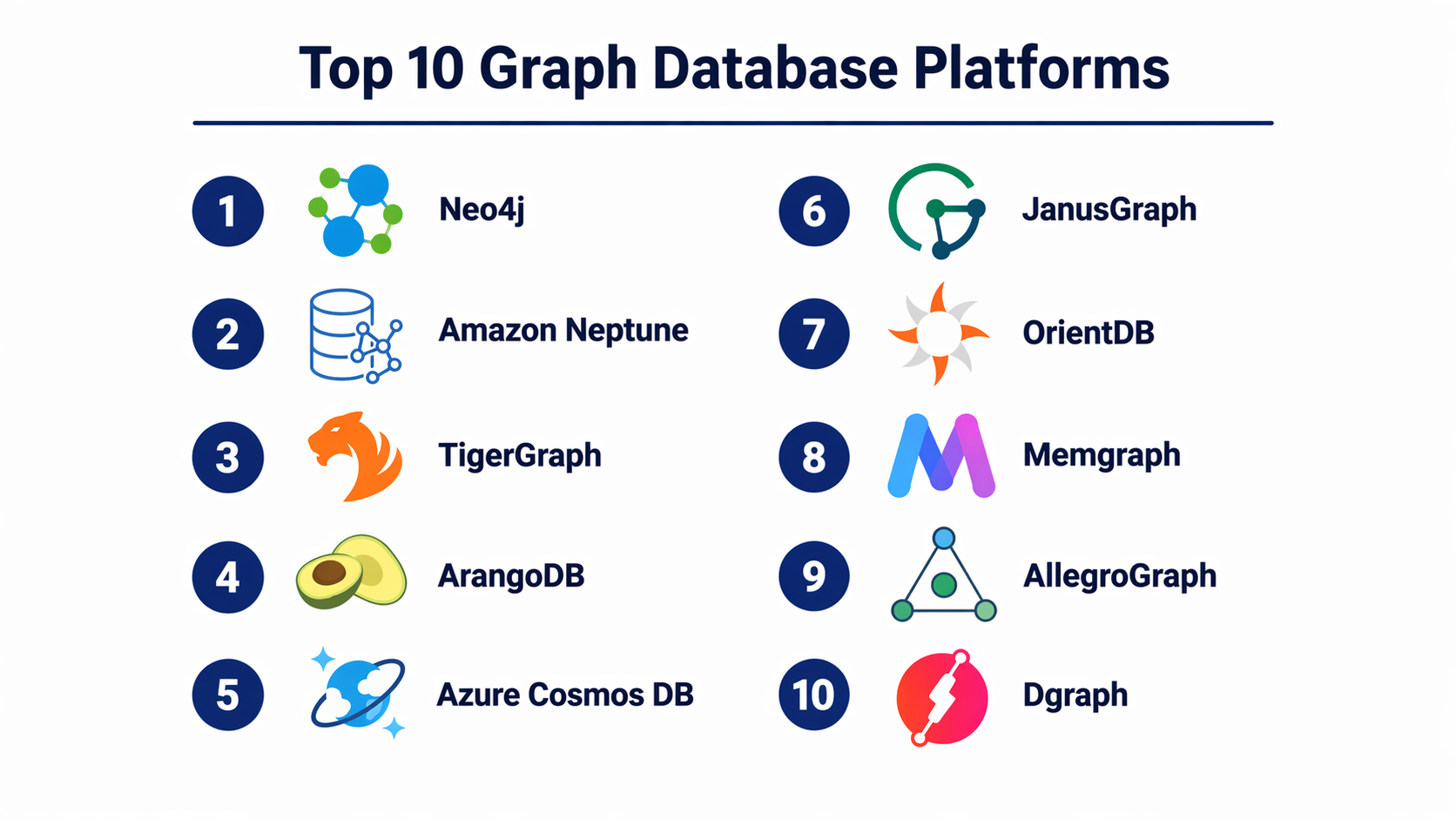
Top 10 Graph Database Platforms
#1 — Neo4j
Short description (2–3 lines): A widely adopted graph database platform known for its property graph model and strong developer ecosystem. Suitable for both startups and enterprises.
Key Features
- Property graph model
- Cypher query language
- Managed cloud option
- High-performance traversal
- Built-in visualization tools
- ACID compliance
- Scalable architecture
Pros
- Easy to learn and use
- Strong community and ecosystem
- Excellent documentation
Cons
- Enterprise features can be costly
- Scaling requires planning
Platforms / Deployment
Cloud / Self-hosted / Hybrid
Security & Compliance
RBAC, encryption, SSO, MFA; certifications: Varies
Integrations & Ecosystem
Supports modern development workflows and integrations across analytics and applications
- APIs and drivers
- Cloud platforms
- Data pipelines
- Visualization tools
Support & Community
Large global community with strong enterprise support
#2 — Amazon Neptune
Short description (2–3 lines): A fully managed graph database service optimized for high availability and scalability within cloud environments.
Key Features
- Fully managed service
- High availability and replication
- Backup and recovery
- Distributed architecture
- Support for graph queries
- Low-latency performance
- Cloud-native design
Pros
- No infrastructure management
- High reliability
Cons
- Vendor dependency
- Cost complexity
Platforms / Deployment
Cloud
Security & Compliance
Encryption, IAM-based access, audit logs
Integrations & Ecosystem
Deep integration with cloud-native services and data pipelines
- Monitoring tools
- Analytics services
- APIs
- Event-driven architectures
Support & Community
Strong enterprise support and documentation
#3 — TigerGraph
Short description (2–3 lines): A high-performance distributed graph database designed for large-scale analytics and enterprise workloads.
Key Features
- Distributed architecture
- Real-time analytics
- High scalability
- Built-in graph algorithms
- Visualization tools
- API support
- Parallel processing
Pros
- Excellent performance at scale
- Strong analytics capabilities
Cons
- Steep learning curve
- Higher operational complexity
Platforms / Deployment
Cloud / Self-hosted / Hybrid
Security & Compliance
RBAC, encryption, SSO
Integrations & Ecosystem
Built for enterprise-scale integration and analytics pipelines
- Data ingestion tools
- APIs
- Streaming platforms
- Visualization interfaces
Support & Community
Enterprise-focused support with growing community
#4 — ArangoDB
Short description (2–3 lines): A multi-model database combining graph, document, and key-value capabilities in a single platform.
Key Features
- Multi-model support
- Flexible queries
- Graph traversal
- Distributed architecture
- High availability
- REST APIs
- JSON storage
Pros
- Versatile data modeling
- Reduces need for multiple databases
Cons
- Less specialized for pure graph workloads
- Smaller ecosystem
Platforms / Deployment
Cloud / Self-hosted / Hybrid
Security & Compliance
Encryption, authentication; certifications: Not publicly stated
Integrations & Ecosystem
Flexible integrations for mixed workloads
- APIs
- Microservices
- Data pipelines
Support & Community
Moderate community with enterprise support options
#5 — Azure Cosmos DB (Gremlin API)
Short description (2–3 lines): A globally distributed graph database service offering graph capabilities as part of a multi-model cloud platform.
Key Features
- Gremlin API support
- Global distribution
- Low-latency access
- Multi-model architecture
- Automatic scaling
- High availability
- Integrated analytics
Pros
- Strong enterprise capabilities
- Global scalability
Cons
- Pricing complexity
- Vendor lock-in
Platforms / Deployment
Cloud
Security & Compliance
Encryption, RBAC, compliance certifications
Integrations & Ecosystem
Seamless integration with cloud and analytics ecosystems
- AI tools
- DevOps pipelines
- APIs
- Data services
Support & Community
Enterprise-grade support and documentation
#6 — JanusGraph
Short description (2–3 lines): An open-source distributed graph database optimized for large-scale graph processing.
Key Features
- Distributed architecture
- Scalable storage
- Graph traversal
- Backend storage support
- High availability
- Flexible data modeling
- Open-source
Pros
- Highly scalable
- Open-source flexibility
Cons
- Complex setup
- Requires backend configuration
Platforms / Deployment
Self-hosted
Security & Compliance
Not publicly stated
Integrations & Ecosystem
Supports integration with big data ecosystems
- Hadoop
- Spark
- APIs
- Storage backends
Support & Community
Strong open-source community
#7 — OrientDB
Short description (2–3 lines): A multi-model database supporting graph and document storage with SQL-like querying.
Key Features
- Graph + document model
- SQL-like query language
- ACID transactions
- Distributed architecture
- Indexing support
- High performance
- Schema flexibility
Pros
- Easy transition from SQL
- Multi-model capabilities
Cons
- Smaller ecosystem
- Limited enterprise adoption
Platforms / Deployment
Self-hosted / Cloud
Security & Compliance
Authentication, encryption; certifications: Not publicly stated
Integrations & Ecosystem
Flexible integration options for hybrid workloads
- APIs
- Data tools
- Applications
Support & Community
Moderate community support
#8 — Memgraph
Short description (2–3 lines): A real-time graph database focused on streaming data and analytics use cases.
Key Features
- Real-time graph processing
- Streaming support
- Cypher query language
- High performance
- In-memory processing
- Graph algorithms
- Developer-friendly APIs
Pros
- Strong real-time capabilities
- Easy to use for developers
Cons
- Smaller ecosystem
- Limited enterprise maturity
Platforms / Deployment
Cloud / Self-hosted
Security & Compliance
RBAC, encryption; certifications: Not publicly stated
Integrations & Ecosystem
Built for streaming and real-time systems
- Kafka
- APIs
- Analytics tools
Support & Community
Growing developer community
#9 — AllegroGraph
Short description (2–3 lines): A semantic graph database designed for knowledge graphs and reasoning-based applications.
Key Features
- RDF support
- SPARQL query language
- Reasoning capabilities
- Knowledge graph focus
- Scalable architecture
- Data federation
- Analytics tools
Pros
- Strong semantic capabilities
- Ideal for knowledge graphs
Cons
- Niche use cases
- Learning curve
Platforms / Deployment
Cloud / Self-hosted
Security & Compliance
Not publicly stated
Integrations & Ecosystem
Optimized for semantic data and reasoning systems
- Knowledge graphs
- APIs
- Data integration tools
Support & Community
Smaller but specialized community
#10 — Dgraph
Short description (2–3 lines): A distributed graph database designed for fast queries and GraphQL-based applications.
Key Features
- GraphQL support
- Distributed architecture
- Horizontal scaling
- ACID transactions
- High performance
- Native graph storage
- Real-time queries
Pros
- Developer-friendly GraphQL
- Good performance
Cons
- Smaller ecosystem
- Limited enterprise adoption
Platforms / Deployment
Cloud / Self-hosted
Security & Compliance
Authentication, encryption; certifications: Not publicly stated
Integrations & Ecosystem
Strong integration with modern app development
- GraphQL APIs
- Microservices
- Cloud environments
Support & Community
Active developer community
Comparison Table (Top 10)
| Tool Name | Best For | Platform(s) Supported | Deployment | Standout Feature | Public Rating |
|---|---|---|---|---|---|
| Neo4j | General graph use | Cross-platform | Hybrid | Cypher language | N/A |
| Amazon Neptune | Cloud-native graph | Cloud | Cloud | Managed service | N/A |
| TigerGraph | Large-scale analytics | Cross-platform | Hybrid | Distributed engine | N/A |
| ArangoDB | Multi-model use | Cross-platform | Hybrid | Multi-model | N/A |
| Cosmos DB | Global apps | Cloud | Cloud | Global distribution | N/A |
| JanusGraph | Big data graph | Linux | Self-hosted | Backend flexibility | N/A |
| OrientDB | Hybrid workloads | Cross-platform | Hybrid | SQL-like queries | N/A |
| Memgraph | Real-time analytics | Cross-platform | Hybrid | Streaming graph | N/A |
| AllegroGraph | Knowledge graphs | Cross-platform | Hybrid | Semantic reasoning | N/A |
| Dgraph | GraphQL apps | Cross-platform | Hybrid | GraphQL-native | N/A |
Evaluation & Scoring of Graph Database Platforms
| Tool Name | Core | Ease | Integrations | Security | Performance | Support | Value | Weighted Total |
|---|---|---|---|---|---|---|---|---|
| Neo4j | 9 | 9 | 9 | 8 | 9 | 9 | 8 | 8.7 |
| Neptune | 9 | 8 | 9 | 9 | 9 | 9 | 7 | 8.6 |
| TigerGraph | 9 | 7 | 8 | 8 | 10 | 8 | 7 | 8.4 |
| ArangoDB | 8 | 8 | 8 | 7 | 8 | 7 | 8 | 7.9 |
| Cosmos DB | 9 | 8 | 9 | 9 | 9 | 9 | 7 | 8.7 |
| JanusGraph | 8 | 6 | 7 | 6 | 8 | 7 | 8 | 7.3 |
| OrientDB | 7 | 8 | 7 | 6 | 7 | 7 | 8 | 7.3 |
| Memgraph | 8 | 8 | 7 | 7 | 9 | 7 | 8 | 7.9 |
| AllegroGraph | 8 | 6 | 7 | 7 | 8 | 7 | 7 | 7.3 |
| Dgraph | 8 | 8 | 7 | 7 | 8 | 7 | 8 | 7.8 |
How to interpret:
These scores are comparative indicators, not absolute rankings. A higher score reflects a better balance of features, usability, and performance. Always evaluate based on your specific use case rather than relying only on totals.
Which Graph Database Platforms Right for You?
Solo / Freelancer
Dgraph, Memgraph — easy to start and developer-friendly
SMB
Neo4j, ArangoDB — balanced performance and usability
Mid-Market
TigerGraph, Neptune — scalable and reliable
Enterprise
Neo4j, Cosmos DB, TigerGraph — strong enterprise features
Budget vs Premium
Open-source tools vs managed cloud services
Feature Depth vs Ease of Use
Neo4j (ease) vs TigerGraph (depth)
Integrations & Scalability
Neptune, Cosmos DB, Neo4j
Security & Compliance Needs
Enterprise cloud platforms offer stronger compliance
Frequently Asked Questions (FAQs)
What is a graph database?
A database designed to store and analyze relationships using nodes and edges.
Why use graph databases?
They simplify complex relationship queries and improve performance for connected data.
Are graph databases scalable?
Yes, many support distributed and cloud-native scaling.
What industries use graph databases?
Finance, healthcare, cybersecurity, retail, and telecom.
Are graph databases expensive?
Costs vary depending on deployment and scale.
Do graph databases support real-time analytics?
Yes, many are optimized for real-time processing.
Can graph databases work with AI?
Yes, they are increasingly used in AI and knowledge graph systems.
Are graph databases secure?
Security depends on configuration and platform capabilities.
Can I migrate from SQL to graph?
Yes, but it requires a data model redesign.
Which graph database is best?
It depends on your use case, scale, and technical requirements.
Conclusion
Graph database platforms have become essential for handling complex, relationship-driven data in modern applications. Whether you are building fraud detection systems, recommendation engines, or enterprise knowledge graphs, these platforms offer capabilities that traditional databases cannot easily match. Each tool in this list serves a different purpose—from developer-friendly solutions like Neo4j to enterprise-scale systems like TigerGraph and cloud-native services like Amazon Neptune. There is no single “best” option; the right choice depends on your data structure, scalability needs, and operational constraints.
