Introduction
Time Series Database (TSDB) platforms are specialized databases optimized for handling time-stamped data. Unlike general-purpose databases, they are built to efficiently store, query, and analyze sequences of data points indexed by time—such as metrics, logs, sensor readings, and financial data.
In today’s data-driven environment, time series databases are essential for real-time monitoring, observability, IoT systems, and AI-driven analytics. With the rise of microservices, cloud-native applications, and edge computing, organizations need systems that can process high-frequency data streams with low latency and high reliability. TSDBs enable teams to detect anomalies, forecast trends, and maintain system health in real time.
Real-world use cases include:
- Infrastructure monitoring and observability
- IoT and sensor data analytics
- Financial market analysis and trading systems
- Application performance monitoring (APM)
- Predictive maintenance and anomaly detection
What buyers should evaluate:
- Write and query performance
- Data retention and compression
- Real-time analytics capabilities
- Scalability and distributed architecture
- Query language and ease of use
- Integration with monitoring and analytics tools
- Security and access controls
- Deployment flexibility (cloud vs self-hosted)
- Cost efficiency for high-volume data
Best for: DevOps teams, SREs, data engineers, IoT developers, fintech companies, and enterprises managing large-scale time-based data streams.
Not ideal for: Applications that require complex relational queries, transactional workloads, or datasets without a time-based dimension.
Key Trends in Time Series Database Platforms
- Increasing adoption of real-time analytics and streaming ingestion
- Integration with AI/ML for anomaly detection and forecasting
- Growth of cloud-native and serverless TSDB platforms
- Expansion of edge computing support for IoT workloads
- Improved data compression techniques for cost optimization
- Rising demand for observability and monitoring integrations
- Hybrid support for metrics, logs, and traces in one platform
- Enhanced security and compliance features
- Flexible pricing models based on usage and storage
- Growing ecosystem integrations with DevOps and analytics tools
How We Selected These Tools (Methodology)
- Strong adoption in observability, IoT, and analytics domains
- Proven ability to handle high-ingestion workloads
- Feature completeness for time-series storage and querying
- Support for distributed and scalable architectures
- Availability of security and compliance features
- Integration with cloud-native and DevOps ecosystems
- Active community and documentation quality
- Suitability for startups, SMBs, and enterprises
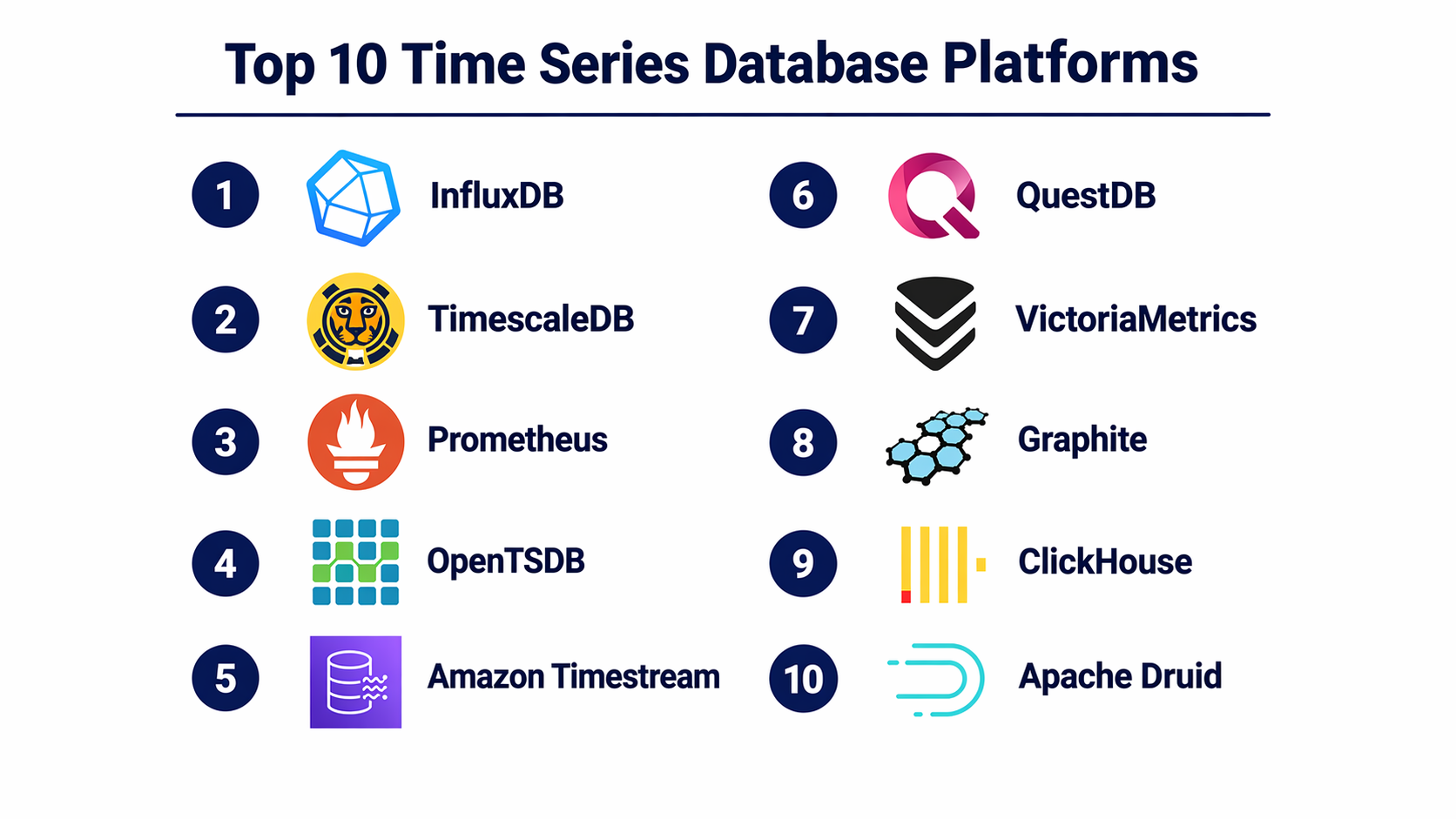
Top 10 Time Series Database Platforms
#1 — InfluxDB
Short description (2–3 lines): A widely used time series database optimized for high-performance data ingestion and real-time analytics.
Key Features
- High write throughput
- Time-series optimized storage engine
- Built-in query language
- Data compression
- Real-time analytics
- Visualization tools
- Retention policies
Pros
- Easy to use for monitoring workloads
- Strong ecosystem
Cons
- Advanced features may require paid tiers
- Query complexity for large datasets
Platforms / Deployment
Cloud / Self-hosted
Security & Compliance
RBAC, encryption; certifications: Not publicly stated
Integrations & Ecosystem
Supports monitoring, analytics, and DevOps pipelines
- Monitoring tools
- APIs
- Visualization platforms
- Data pipelines
Support & Community
Large community with extensive documentation
#2 — TimescaleDB
Short description (2–3 lines): A PostgreSQL-based time series database combining relational and time-series capabilities.
Key Features
- SQL support
- Time-series extensions
- Data partitioning
- Compression
- Continuous aggregates
- High scalability
- Integration with PostgreSQL
Pros
- Familiar SQL interface
- Strong flexibility
Cons
- Requires PostgreSQL knowledge
- Scaling needs planning
Platforms / Deployment
Cloud / Self-hosted
Security & Compliance
PostgreSQL-based security; certifications: Not publicly stated
Integrations & Ecosystem
Works well with existing relational ecosystems
- SQL tools
- Analytics platforms
- APIs
Support & Community
Strong open-source and enterprise support
#3 — Prometheus
Short description (2–3 lines): A monitoring-focused time series database widely used for metrics collection in cloud-native environments.
Key Features
- Pull-based data collection
- Time-series storage
- Alerting system
- Query language
- Service discovery
- Integration with Kubernetes
- Visualization support
Pros
- Excellent for monitoring
- Strong Kubernetes integration
Cons
- Limited long-term storage
- Not general-purpose TSDB
Platforms / Deployment
Self-hosted / Cloud
Security & Compliance
Not publicly stated
Integrations & Ecosystem
Core component of modern observability stacks
- Kubernetes
- Grafana
- APIs
Support & Community
Very strong community support
#4 — OpenTSDB
Short description (2–3 lines): A scalable time series database built on top of distributed storage systems.
Key Features
- Distributed storage
- High scalability
- Time-series indexing
- Real-time queries
- Data aggregation
- Fault tolerance
- Open-source
Pros
- Handles large-scale data
- Flexible architecture
Cons
- Complex setup
- Requires backend configuration
Platforms / Deployment
Self-hosted
Security & Compliance
Not publicly stated
Integrations & Ecosystem
Works with distributed systems and analytics pipelines
- Big data tools
- APIs
- Data ingestion tools
Support & Community
Moderate open-source community
#5 — Amazon Timestream
Short description (2–3 lines): A managed time series database service designed for IoT and operational analytics.
Key Features
- Fully managed
- Automatic scaling
- Data lifecycle management
- Query engine
- Real-time analytics
- Serverless architecture
- Integration with cloud services
Pros
- No infrastructure management
- Scalable
Cons
- Vendor lock-in
- Pricing complexity
Platforms / Deployment
Cloud
Security & Compliance
Encryption, access control; certifications: Varies
Integrations & Ecosystem
Deep integration with cloud ecosystems
- Analytics tools
- APIs
- Data pipelines
Support & Community
Enterprise support available
#6 — QuestDB
Short description (2–3 lines): A high-performance time series database optimized for financial and real-time analytics.
Key Features
- High ingestion rate
- SQL support
- Column-oriented storage
- Real-time queries
- Data compression
- Open-source
- Streaming support
Pros
- Fast performance
- Developer-friendly
Cons
- Smaller ecosystem
- Limited enterprise features
Platforms / Deployment
Cloud / Self-hosted
Security & Compliance
Not publicly stated
Integrations & Ecosystem
Supports real-time data pipelines
- APIs
- Streaming tools
- Analytics systems
Support & Community
Growing developer community
#7 — VictoriaMetrics
Short description (2–3 lines): A scalable and cost-efficient time series database designed for monitoring and observability.
Key Features
- High performance
- Scalable architecture
- Data compression
- Metrics storage
- Query language compatibility
- Cluster support
- Cost optimization
Pros
- Cost-efficient
- High scalability
Cons
- Focused mainly on metrics
- Limited general TSDB use
Platforms / Deployment
Cloud / Self-hosted
Security & Compliance
Not publicly stated
Integrations & Ecosystem
Works well with observability stacks
- Monitoring tools
- APIs
- Visualization tools
Support & Community
Active community
#8 — Graphite
Short description (2–3 lines): A long-standing time series database used for monitoring and visualization.
Key Features
- Metrics storage
- Visualization support
- Query engine
- Data aggregation
- Historical analysis
- Simple architecture
- Open-source
Pros
- Easy to deploy
- Mature tool
Cons
- Limited scalability
- Outdated architecture
Platforms / Deployment
Self-hosted
Security & Compliance
Not publicly stated
Integrations & Ecosystem
Integrates with monitoring tools
- Visualization tools
- APIs
- Data collectors
Support & Community
Stable but declining community
#9 — ClickHouse
Short description (2–3 lines): A columnar database used for analytics and time-series workloads at scale.
Key Features
- Columnar storage
- High-speed queries
- Real-time analytics
- Distributed architecture
- Compression
- SQL support
- Scalable
Pros
- Extremely fast analytics
- Scales well
Cons
- Not purely TSDB
- Requires tuning
Platforms / Deployment
Cloud / Self-hosted
Security & Compliance
RBAC, encryption; certifications: Not publicly stated
Integrations & Ecosystem
Strong analytics ecosystem
- BI tools
- APIs
- Data pipelines
Support & Community
Strong community
#10 — Apache Druid
Short description (2–3 lines): A real-time analytics database optimized for event-driven time series data.
Key Features
- Real-time ingestion
- High-speed queries
- Distributed system
- Data indexing
- Analytics engine
- Scalability
- Integration with big data
Pros
- Strong real-time analytics
- Scalable
Cons
- Complex setup
- Operational overhead
Platforms / Deployment
Cloud / Self-hosted
Security & Compliance
Authentication, RBAC; certifications: Not publicly stated
Integrations & Ecosystem
Supports large-scale analytics pipelines
- Streaming tools
- APIs
- BI platforms
Support & Community
Active community
Comparison Table (Top 10)
| Tool Name | Best For | Platform(s) Supported | Deployment | Standout Feature | Public Rating |
|---|---|---|---|---|---|
| InfluxDB | Monitoring & IoT | Cross-platform | Hybrid | High ingestion | N/A |
| TimescaleDB | SQL + time series | Cross-platform | Hybrid | PostgreSQL support | N/A |
| Prometheus | Metrics monitoring | Linux | Hybrid | Kubernetes integration | N/A |
| OpenTSDB | Big data workloads | Linux | Self-hosted | Distributed storage | N/A |
| Timestream | Managed TSDB | Cloud | Cloud | Serverless design | N/A |
| QuestDB | Real-time analytics | Cross-platform | Hybrid | Fast ingestion | N/A |
| VictoriaMetrics | Cost-efficient metrics | Linux | Hybrid | Compression | N/A |
| Graphite | Legacy monitoring | Linux | Self-hosted | Simplicity | N/A |
| ClickHouse | Analytics | Cross-platform | Hybrid | Columnar storage | N/A |
| Apache Druid | Event analytics | Cross-platform | Hybrid | Real-time ingestion | N/A |
Evaluation & Scoring of Time Series Database Platforms
| Tool Name | Core | Ease | Integrations | Security | Performance | Support | Value | Weighted Total |
|---|---|---|---|---|---|---|---|---|
| InfluxDB | 9 | 9 | 8 | 7 | 9 | 9 | 8 | 8.6 |
| TimescaleDB | 9 | 8 | 9 | 8 | 9 | 9 | 8 | 8.7 |
| Prometheus | 8 | 9 | 9 | 6 | 8 | 9 | 8 | 8.1 |
| OpenTSDB | 8 | 6 | 7 | 6 | 8 | 7 | 8 | 7.3 |
| Timestream | 9 | 8 | 9 | 8 | 9 | 9 | 7 | 8.6 |
| QuestDB | 8 | 8 | 7 | 6 | 9 | 7 | 8 | 7.8 |
| VictoriaMetrics | 8 | 8 | 7 | 6 | 9 | 8 | 9 | 8.0 |
| Graphite | 7 | 8 | 6 | 5 | 7 | 7 | 8 | 7.0 |
| ClickHouse | 9 | 7 | 9 | 8 | 10 | 9 | 8 | 8.7 |
| Apache Druid | 9 | 7 | 8 | 7 | 9 | 8 | 8 | 8.2 |
How to interpret:
These scores provide a comparative view of the tools based on real-world usage scenarios. A higher score indicates a better balance across features, performance, and usability. However, the best tool depends on your specific use case, scale, and technical requirements.
Which Time Series Database Platforms Right for You?
Solo / Freelancer
InfluxDB, QuestDB — easy to start and developer-friendly
SMB
TimescaleDB, Prometheus — balanced flexibility and cost
Mid-Market
ClickHouse, VictoriaMetrics — scalable and cost-efficient
Enterprise
Timestream, Druid, InfluxDB — strong performance and scalability
Budget vs Premium
Open-source tools vs managed cloud services
Feature Depth vs Ease of Use
InfluxDB (ease) vs Druid (depth)
Integrations & Scalability
ClickHouse, Prometheus, Timestream
Security & Compliance Needs
Cloud-managed platforms provide stronger compliance
Frequently Asked Questions (FAQs)
What is a time series database?
A database optimized for storing and analyzing time-stamped data.
Why use TSDB instead of SQL?
TSDBs are optimized for high-frequency data and real-time analytics.
Are TSDBs scalable?
Yes, most support distributed and cloud-native scaling.
What industries use TSDB?
Finance, IoT, DevOps, healthcare, and analytics.
Are TSDBs expensive?
Costs vary based on scale and deployment.
Can TSDBs handle real-time data?
Yes, they are designed for real-time ingestion and querying.
Are TSDBs secure?
Security depends on the platform and configuration.
Can I integrate TSDB with AI tools?
Yes, many support AI and analytics integration.
Do TSDBs support SQL?
Some platforms like TimescaleDB and ClickHouse do.
What is the best TSDB?
It depends on your workload, scale, and requirements.
Conclusion
Time series database platforms are critical for handling modern data workloads that rely on continuous, time-based data streams. Whether you are monitoring infrastructure, analyzing financial trends, or processing IoT sensor data, these databases provide the performance and scalability required for real-time insights. Each platform has its strengths—from developer-friendly options like InfluxDB to analytics-focused systems like ClickHouse and enterprise-ready solutions like Amazon Timestream and Apache Druid. Instead of choosing based on popularity, focus on your specific use case, data volume, and operational needs.
