Introduction
A data warehouse platform is a system designed to collect, store, and analyze large volumes of structured and semi-structured data from multiple sources. In simple terms, it acts as a central place where organizations bring all their data together to make better decisions using analytics and reporting.
In today’s data-driven world, especially in modern cloud-first environments, data warehouses are no longer optional. They power dashboards, AI models, forecasting systems, and business intelligence tools. As organizations generate more data than ever, having a scalable and reliable warehouse becomes critical for performance, cost control, and insight generation.
Common use cases:
- Business intelligence and reporting dashboards
- Customer analytics and personalization
- Financial forecasting and planning
- Data consolidation from multiple systems
- AI and machine learning model training
What buyers should evaluate:
- Scalability and performance
- Cost model (usage-based vs fixed)
- Integration with existing tools
- Query performance and concurrency
- Data security and compliance
- Ease of use and onboarding
- Automation and AI features
- Data governance capabilities
Best for: Data engineers, analysts, IT managers, and organizations handling large-scale data across industries like finance, e-commerce, SaaS, and healthcare.
Not ideal for: Small teams with minimal data needs or businesses that rely on simple spreadsheets or lightweight databases where a full warehouse may be unnecessary.
Key Trends in Data Warehouse Platforms
- Cloud-native architectures dominating over traditional on-prem systems
- Separation of storage and compute for better scalability and cost efficiency
- AI-powered query optimization improving performance automatically
- Real-time and near real-time analytics becoming standard expectations
- Data lakehouse convergence combining warehouses and data lakes
- Serverless data warehouses reducing infrastructure management overhead
- Enhanced security controls including fine-grained access and encryption
- Multi-cloud and hybrid deployments increasing flexibility
- Integration with AI/ML tools for advanced analytics workflows
- Usage-based pricing models replacing traditional licensing
How We Selected These Tools (Methodology)
- Strong market adoption and industry recognition
- Feature completeness across analytics, ingestion, and governance
- Proven performance and scalability in production environments
- Security and compliance readiness for enterprise use
- Rich integration ecosystem with BI and ETL tools
- Suitability across startups, SMBs, and enterprises
- Developer and analyst experience
- Support quality and community adoption
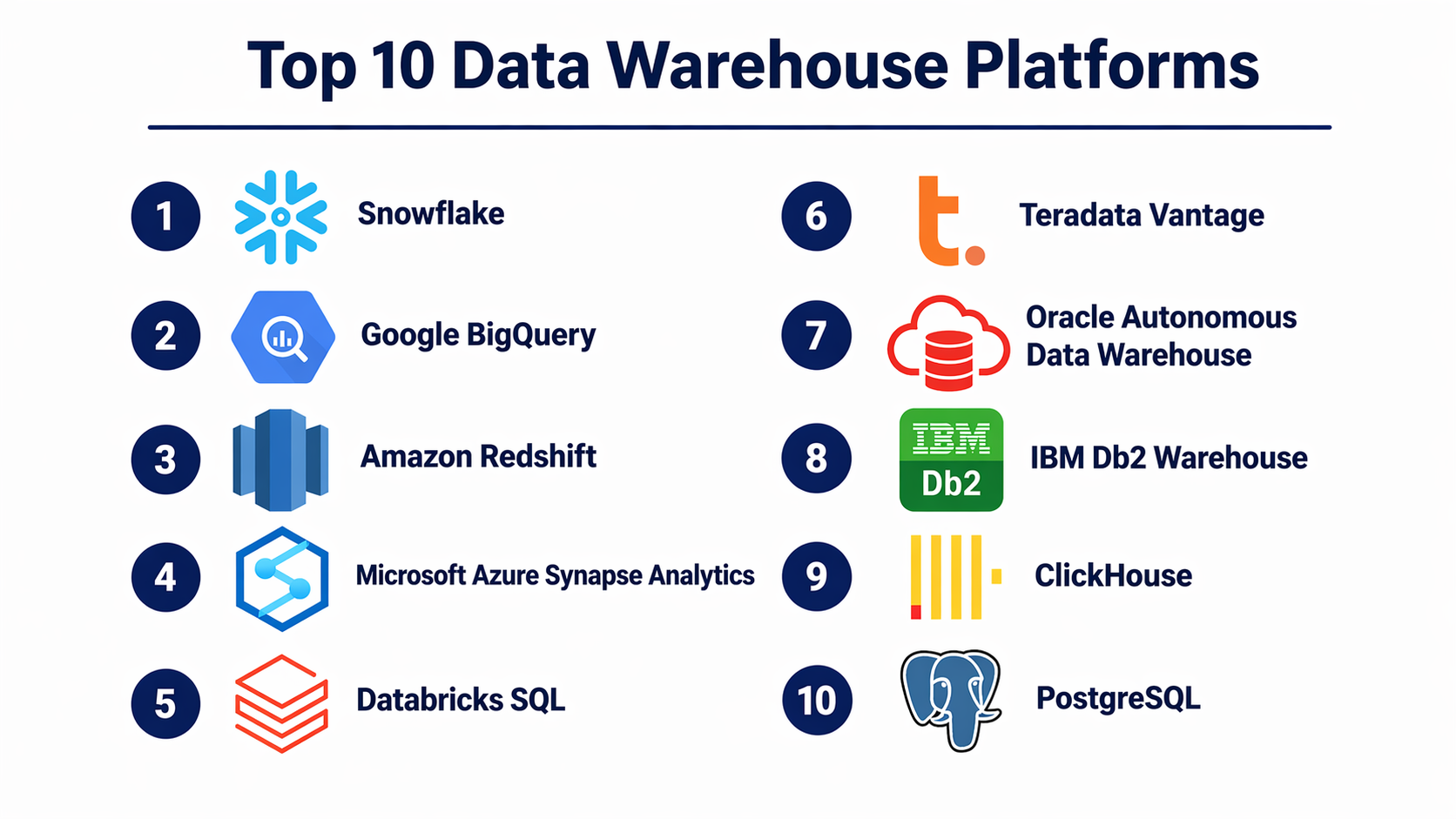
Top 10 Data Warehouse Platforms
#1 — Snowflake
Short description: A fully managed cloud data warehouse designed for scalability, performance, and ease of use across enterprises.
Key Features
- Separation of storage and compute
- Multi-cloud support
- Automatic scaling and concurrency handling
- Data sharing across organizations
- Built-in data marketplace
- Zero-copy cloning
- Semi-structured data support
Pros
- Highly scalable and performant
- Minimal infrastructure management
- Strong ecosystem
Cons
- Can become expensive with heavy usage
- Learning curve for cost optimization
Platforms / Deployment
Cloud
Security & Compliance
Supports encryption, RBAC, audit logs, SSO/SAML; SOC 2 and GDPR support
Integrations & Ecosystem
Snowflake integrates with major BI tools and ETL platforms.
- Tableau, Power BI
- dbt
- Apache Airflow
- Python and SQL APIs
Support & Community
Strong enterprise support and growing community ecosystem
#2 — Google BigQuery
Short description: A serverless data warehouse optimized for fast SQL analytics and large-scale data processing.
Key Features
- Serverless architecture
- Built-in machine learning
- Real-time analytics
- Automatic scaling
- Columnar storage
- Data sharing capabilities
Pros
- No infrastructure management
- Fast query performance
- Integrated AI/ML features
Cons
- Pricing complexity
- Query costs can increase quickly
Platforms / Deployment
Cloud
Security & Compliance
Encryption, IAM controls, audit logs; compliance standards supported
Integrations & Ecosystem
- Google Cloud services
- Looker, Data Studio
- Python SDK
- Streaming data tools
Support & Community
Strong documentation and enterprise support
#3 — Amazon Redshift
Short description: A fully managed data warehouse from AWS designed for large-scale analytics workloads.
Key Features
- Columnar storage
- Massively parallel processing
- Redshift Spectrum for querying external data
- Integration with AWS ecosystem
- Data sharing features
- Query optimization
Pros
- Strong AWS integration
- Mature platform
- Scalable architecture
Cons
- Requires tuning for optimal performance
- Can be complex to manage
Platforms / Deployment
Cloud
Security & Compliance
Encryption, IAM, audit logging; supports major compliance frameworks
Integrations & Ecosystem
- AWS services
- BI tools
- ETL pipelines
- SQL clients
Support & Community
Enterprise-grade support and extensive AWS documentation
#4 — Microsoft Azure Synapse Analytics
Short description: A unified analytics platform combining data warehousing and big data processing.
Key Features
- SQL and Spark integration
- Data pipelines
- Real-time analytics
- Integration with Azure ecosystem
- Serverless and dedicated models
- AI integration
Pros
- Unified analytics experience
- Strong integration with Microsoft tools
- Flexible architecture
Cons
- Complexity for beginners
- Cost management challenges
Platforms / Deployment
Cloud
Security & Compliance
Supports encryption, RBAC, compliance frameworks
Integrations & Ecosystem
- Power BI
- Azure Data Factory
- Machine learning tools
Support & Community
Strong enterprise support
#5 — Databricks SQL (Lakehouse)
Short description: A lakehouse platform combining data warehousing and data lake capabilities.
Key Features
- Unified lakehouse architecture
- AI/ML integration
- Delta Lake storage
- Real-time data processing
- Collaborative notebooks
- SQL analytics
Pros
- Strong AI and ML capabilities
- Flexible data handling
- Unified platform
Cons
- Complex setup
- Higher learning curve
Platforms / Deployment
Cloud
Security & Compliance
Encryption, access controls; compliance support varies
Integrations & Ecosystem
- Apache Spark
- ML frameworks
- BI tools
- APIs
Support & Community
Large community and enterprise support
#6 — Teradata Vantage
Short description: An enterprise-grade data warehouse platform known for high performance and advanced analytics.
Key Features
- Advanced analytics
- Multi-cloud deployment
- Parallel processing
- Data integration tools
- Workload management
Pros
- High performance
- Enterprise reliability
Cons
- Expensive
- Complex implementation
Platforms / Deployment
Cloud / Hybrid
Security & Compliance
Not publicly stated
Integrations & Ecosystem
- BI tools
- Data integration tools
- APIs
Support & Community
Enterprise-level support
#7 — Oracle Autonomous Data Warehouse
Short description: A self-driving data warehouse with automation and AI-driven optimization.
Key Features
- Autonomous tuning
- Automated backups
- AI-driven performance optimization
- Elastic scaling
- Built-in security
Pros
- Minimal manual management
- Strong performance
Cons
- Vendor lock-in concerns
- Pricing complexity
Platforms / Deployment
Cloud
Security & Compliance
Encryption, RBAC; compliance support available
Integrations & Ecosystem
- Oracle ecosystem
- BI tools
- APIs
Support & Community
Strong enterprise support
#8 — IBM Db2 Warehouse
Short description: A scalable data warehouse solution designed for enterprise analytics.
Key Features
- In-memory processing
- Advanced analytics
- Hybrid deployment
- Data compression
- SQL support
Pros
- High performance
- Hybrid flexibility
Cons
- Limited ecosystem compared to competitors
- Complexity
Platforms / Deployment
Cloud / Self-hosted
Security & Compliance
Not publicly stated
Integrations & Ecosystem
- IBM tools
- BI tools
- APIs
Support & Community
Enterprise support
#9 — ClickHouse
Short description: An open-source columnar database optimized for real-time analytics.
Key Features
- High-speed analytics
- Columnar storage
- Real-time ingestion
- Open-source flexibility
- Scalability
Pros
- Fast query performance
- Cost-effective
Cons
- Requires technical expertise
- Limited enterprise features
Platforms / Deployment
Self-hosted / Cloud
Security & Compliance
Not publicly stated
Integrations & Ecosystem
- BI tools
- APIs
- Data pipelines
Support & Community
Strong open-source community
#10 — PostgreSQL (with extensions like Citus)
Short description: A relational database extended for data warehousing and analytics use cases.
Key Features
- Open-source
- Extensible architecture
- Distributed scaling
- SQL compatibility
- Rich ecosystem
Pros
- Cost-effective
- Flexible
Cons
- Not a native warehouse
- Scaling complexity
Platforms / Deployment
Self-hosted / Cloud
Security & Compliance
Not publicly stated
Integrations & Ecosystem
- BI tools
- Extensions
- APIs
Support & Community
Very strong open-source community
Comparison Table (Top 10)
| Tool Name | Best For | Platform(s) Supported | Deployment | Standout Feature | Public Rating |
|---|---|---|---|---|---|
| Snowflake | Enterprise analytics | Web | Cloud | Storage-compute separation | N/A |
| BigQuery | Serverless analytics | Web | Cloud | Serverless architecture | N/A |
| Redshift | AWS users | Web | Cloud | AWS ecosystem integration | N/A |
| Azure Synapse | Microsoft ecosystem | Web | Cloud | Unified analytics | N/A |
| Databricks SQL | AI/ML workloads | Web | Cloud | Lakehouse architecture | N/A |
| Teradata | Large enterprises | Web | Hybrid | High performance | N/A |
| Oracle ADW | Automated warehousing | Web | Cloud | Autonomous optimization | N/A |
| IBM Db2 | Hybrid deployments | Web | Hybrid | In-memory analytics | N/A |
| ClickHouse | Real-time analytics | Web/Linux | Self-hosted | High speed | N/A |
| PostgreSQL | Flexible workloads | All major OS | Self-hosted | Open-source extensibility | N/A |
Evaluation & Scoring of Data Warehouse Platforms
| Tool Name | Core (25%) | Ease (15%) | Integrations (15%) | Security (10%) | Performance (10%) | Support (10%) | Value (15%) | Weighted Total |
|---|---|---|---|---|---|---|---|---|
| Snowflake | 9 | 8 | 9 | 9 | 9 | 8 | 7 | 8.5 |
| BigQuery | 9 | 9 | 8 | 9 | 9 | 8 | 7 | 8.6 |
| Redshift | 8 | 7 | 9 | 9 | 8 | 8 | 7 | 8.0 |
| Synapse | 8 | 7 | 9 | 8 | 8 | 8 | 7 | 7.9 |
| Databricks | 9 | 7 | 9 | 8 | 9 | 8 | 7 | 8.2 |
| Teradata | 9 | 6 | 7 | 8 | 9 | 8 | 6 | 7.8 |
| Oracle ADW | 9 | 8 | 7 | 9 | 9 | 8 | 7 | 8.3 |
| IBM Db2 | 8 | 6 | 7 | 8 | 8 | 8 | 7 | 7.6 |
| ClickHouse | 8 | 6 | 7 | 6 | 9 | 7 | 9 | 7.7 |
| PostgreSQL | 7 | 7 | 8 | 7 | 7 | 9 | 9 | 7.8 |
How to interpret scores:
- Scores are comparative across tools, not absolute.
- Higher total indicates better overall balance.
- Choose based on your use case rather than highest score alone.
- Enterprise tools score higher in security and performance.
- Open-source tools often score higher in value.
Which Data Warehouse Platforms Right for You?
Solo / Freelancer
Use PostgreSQL or ClickHouse for cost-effective setups.
SMB
BigQuery or Snowflake for simplicity and scalability.
Mid-Market
Redshift or Synapse for balanced features and integrations.
Enterprise
Snowflake, Databricks, or Teradata for large-scale workloads.
Budget vs Premium
- Budget: PostgreSQL, ClickHouse
- Premium: Snowflake, Databricks
Feature Depth vs Ease of Use
- Easy: BigQuery
- Advanced: Databricks
Integrations & Scalability
Choose platforms with strong ecosystems like AWS, Azure, or Google Cloud.
Security & Compliance Needs
Enterprise-grade tools like Snowflake and Oracle are preferred.
Frequently Asked Questions (FAQs)
What is a data warehouse platform?
A system designed to store and analyze large amounts of structured data for reporting and analytics.
How is it different from a database?
Databases handle transactions; warehouses handle analytics.
Are data warehouses expensive?
Costs vary based on usage and scale.
Can small businesses use data warehouses?
Yes, especially with serverless options like BigQuery.
What is a lakehouse?
A combination of data warehouse and data lake capabilities.
How long does implementation take?
From days to months depending on complexity.
What are common mistakes?
Poor cost management and lack of data governance.
Can I migrate between platforms?
Yes, but it requires planning and data transformation.
Do they support AI workloads?
Many modern platforms include built-in AI features.
Are they secure?
Most enterprise platforms offer strong security controls.
Conclusion
Data warehouse platforms have become the backbone of modern analytics and data-driven decision-making. From startups to large enterprises, the need to manage and analyze growing data volumes continues to rise. While tools like Snowflake and BigQuery focus on simplicity and scalability, others like Databricks and Teradata emphasize advanced analytics and performance. Open-source options like ClickHouse and PostgreSQL offer flexibility and cost advantages but require more expertise.
