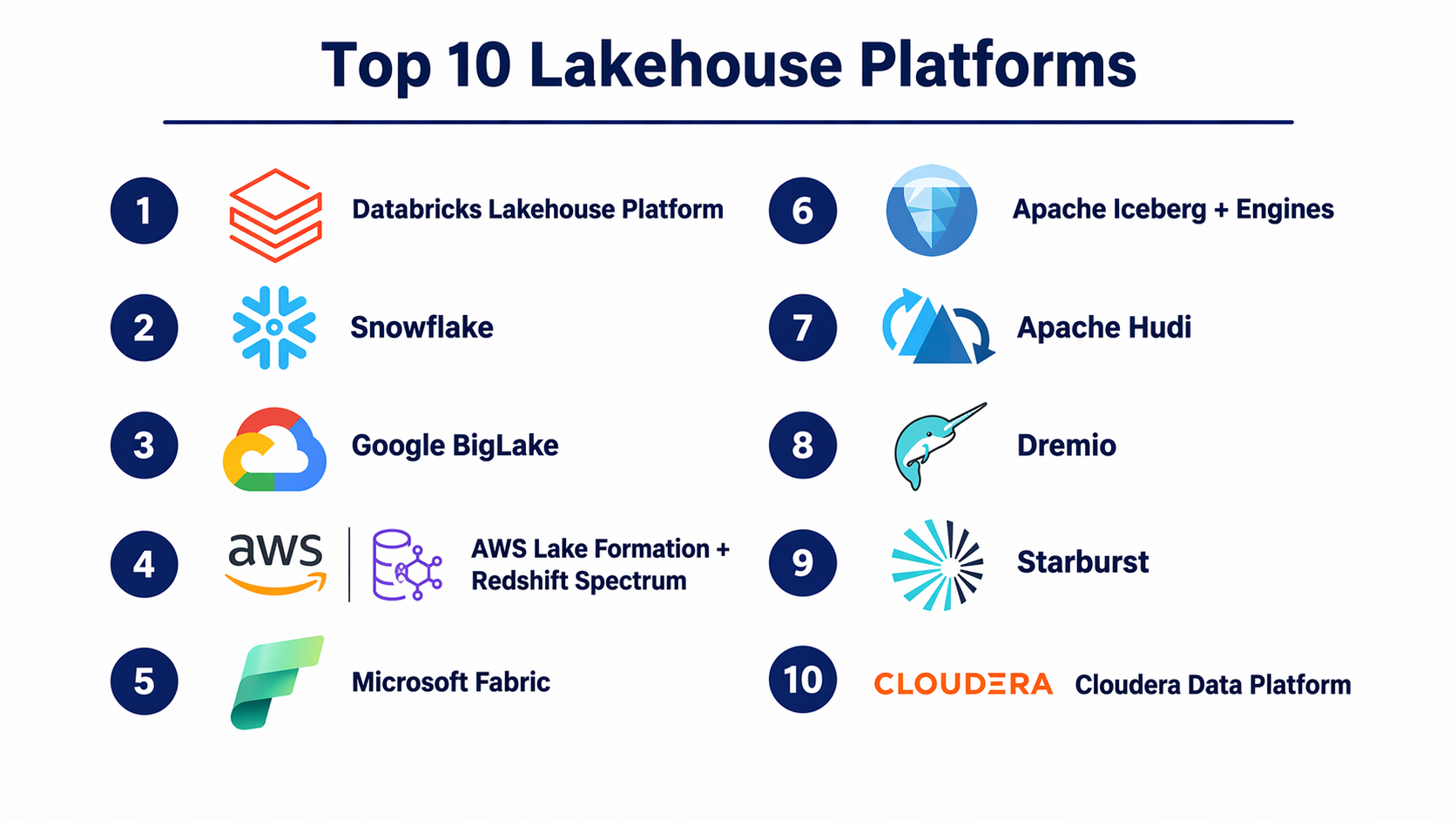
Introduction
A lakehouse platform is a modern data architecture that combines the best of data lakes (low-cost storage for raw data) and data warehouses (structured analytics and fast queries). In simple terms, it allows organizations to store all types of data—structured, semi-structured, and unstructured—in one place while still enabling high-performance analytics and reporting.
In the current data landscape, lakehouse platforms are becoming critical because businesses are dealing with massive data volumes, real-time processing needs, and AI-driven insights. Traditional data warehouses struggle with flexibility, while data lakes lack performance and governance. Lakehouses bridge this gap by offering scalability, cost efficiency, and unified analytics.
Common use cases:
- Real-time analytics and dashboards
- AI and machine learning model training
- Data engineering pipelines and ETL/ELT workflows
- Unified analytics across structured and unstructured data
- Customer behavior and product analytics
What buyers should evaluate:
- Performance and query speed
- Data format support (Parquet, Delta, Iceberg, etc.)
- Integration with BI and ML tools
- Governance and data security
- Cost model and scalability
- Ease of use for analysts and engineers
- Real-time processing capabilities
- Multi-cloud or hybrid support
- Automation and AI features
Best for: Data engineers, ML engineers, analytics teams, and enterprises handling diverse and large-scale datasets across industries like SaaS, finance, healthcare, and e-commerce.
Not ideal for: Small teams with limited data complexity, or organizations that only need simple reporting where a traditional database or warehouse is sufficient.
Key Trends in Lakehouse Platforms
- Lakehouse standardization with formats like Delta Lake, Apache Iceberg, and Hudi
- AI-native analytics embedded directly into platforms
- Real-time data streaming integration becoming default
- Serverless lakehouse architectures reducing infrastructure overhead
- Unified governance layers across structured and unstructured data
- Multi-cloud interoperability increasing vendor flexibility
- Separation of storage and compute for cost efficiency
- Data mesh adoption influencing decentralized data ownership
- Automated data optimization and tuning using AI
- Stronger compliance frameworks for enterprise-grade security
How We Selected These Tools (Methodology)
- High adoption across enterprise and cloud-native environments
- Support for modern lakehouse architectures and formats
- Proven scalability and performance benchmarks
- Strong integration ecosystem with analytics and ML tools
- Availability across multiple deployment models
- Security and governance capabilities
- Developer and analyst usability
- Community support and ecosystem growth
- Balance between open-source and commercial offerings
Top 10 Lakehouse Platforms
#1 — Databricks Lakehouse Platform
Short description: A leading lakehouse platform built on Apache Spark, designed for unified analytics, data engineering, and machine learning.
Key Features
- Delta Lake storage layer
- Unified analytics and ML platform
- Real-time data processing
- Collaborative notebooks
- Auto-scaling clusters
- Built-in AI tools
- Data governance features
Pros
- Strong AI/ML integration
- Highly scalable
- Unified data platform
Cons
- Complex for beginners
- Cost management can be challenging
Platforms / Deployment
Cloud
Security & Compliance
Encryption, RBAC, audit logs; supports enterprise compliance frameworks
Integrations & Ecosystem
Databricks integrates with a wide range of data and analytics tools.
- Apache Spark ecosystem
- BI tools like Power BI and Tableau
- ML frameworks
- REST APIs
Support & Community
Large community and strong enterprise support
#2 — Snowflake (Lakehouse Capabilities)
Short description: A cloud data platform evolving into a lakehouse with support for structured and semi-structured data.
Key Features
- Separation of storage and compute
- Data sharing capabilities
- Support for semi-structured data
- Integrated analytics
- Secure data collaboration
- Multi-cloud support
Pros
- Easy to use
- Strong performance
- Scalable architecture
Cons
- Not a pure lakehouse originally
- Cost can scale quickly
Platforms / Deployment
Cloud
Security & Compliance
Encryption, RBAC, SSO/SAML, audit logs; SOC 2 and GDPR support
Integrations & Ecosystem
- BI tools
- ETL pipelines
- APIs
- Data sharing ecosystem
Support & Community
Strong enterprise support
#3 — Google BigLake
Short description: A unified data lakehouse solution built on top of Google Cloud storage and BigQuery.
Key Features
- Unified access control
- Multi-engine analytics
- Real-time processing
- Serverless architecture
- Integration with BigQuery
- Data governance
Pros
- Strong integration with Google ecosystem
- Serverless simplicity
- Scalable
Cons
- Ecosystem dependency
- Pricing complexity
Platforms / Deployment
Cloud
Security & Compliance
IAM controls, encryption, audit logs
Integrations & Ecosystem
- Google Cloud services
- AI/ML tools
- BI tools
Support & Community
Strong documentation and support
#4 — AWS Lake Formation + Redshift Spectrum
Short description: AWS solution combining data lake and warehouse capabilities for analytics.
Key Features
- Centralized data governance
- Integration with Redshift
- Data catalog
- Fine-grained access control
- Scalable storage
- ETL support
Pros
- Strong AWS ecosystem
- Flexible architecture
- Secure
Cons
- Complex setup
- Requires AWS expertise
Platforms / Deployment
Cloud
Security & Compliance
IAM, encryption, audit logs; supports compliance standards
Integrations & Ecosystem
- AWS services
- BI tools
- ETL tools
Support & Community
Extensive AWS support
#5 — Microsoft Fabric (Lakehouse)
Short description: A unified analytics platform combining data lakehouse, BI, and AI capabilities.
Key Features
- Integrated lakehouse storage
- Real-time analytics
- Power BI integration
- AI capabilities
- Data pipelines
- Unified workspace
Pros
- Strong Microsoft integration
- Unified platform
- Easy for Power BI users
Cons
- Still evolving
- Ecosystem dependency
Platforms / Deployment
Cloud
Security & Compliance
Encryption, RBAC; compliance support available
Integrations & Ecosystem
- Power BI
- Azure services
- APIs
Support & Community
Growing ecosystem
#6 — Apache Iceberg + Engines (Trino/Presto)
Short description: Open table format enabling scalable lakehouse architectures across engines.
Key Features
- Open table format
- Schema evolution
- ACID transactions
- Multi-engine support
- Partitioning
- Data versioning
Pros
- Open-source flexibility
- Vendor neutrality
Cons
- Requires engineering expertise
- Not a complete platform
Platforms / Deployment
Self-hosted / Cloud
Security & Compliance
Not publicly stated
Integrations & Ecosystem
- Trino, Presto
- Spark
- BI tools
Support & Community
Strong open-source community
#7 — Apache Hudi
Short description: Open-source data lake platform providing transactional capabilities for streaming data.
Key Features
- Incremental data processing
- ACID transactions
- Streaming ingestion
- Data versioning
- Schema evolution
Pros
- Strong for streaming use cases
- Open-source
Cons
- Requires setup and maintenance
- Learning curve
Platforms / Deployment
Self-hosted / Cloud
Security & Compliance
Not publicly stated
Integrations & Ecosystem
- Spark
- Flink
- Kafka
Support & Community
Active open-source community
#8 — Dremio
Short description: A data lakehouse platform focused on fast SQL analytics and self-service data access.
Key Features
- SQL acceleration
- Data reflections
- Open table format support
- Data catalog
- Query optimization
Pros
- Fast query performance
- Self-service analytics
Cons
- Limited compared to full platforms
- Requires setup
Platforms / Deployment
Cloud / Self-hosted
Security & Compliance
Encryption, RBAC
Integrations & Ecosystem
- BI tools
- Data sources
- APIs
Support & Community
Growing ecosystem
#9 — Starburst (Trino-based)
Short description: A distributed SQL query engine enabling lakehouse analytics across multiple data sources.
Key Features
- Distributed query engine
- Multi-source querying
- Open architecture
- High performance
- Scalability
Pros
- Flexible architecture
- Strong performance
Cons
- Not a full lakehouse platform
- Requires integration
Platforms / Deployment
Cloud / Self-hosted
Security & Compliance
Not publicly stated
Integrations & Ecosystem
- Data sources
- BI tools
- APIs
Support & Community
Strong Trino community
#10 — Cloudera Data Platform (CDP)
Short description: An enterprise data platform supporting lakehouse architecture with hybrid deployment.
Key Features
- Hybrid cloud support
- Data governance
- AI/ML integration
- Data engineering tools
- Security features
Pros
- Enterprise-grade
- Hybrid flexibility
Cons
- Complex setup
- Expensive
Platforms / Deployment
Cloud / Hybrid
Security & Compliance
Encryption, RBAC, audit logs
Integrations & Ecosystem
- Hadoop ecosystem
- BI tools
- APIs
Support & Community
Enterprise support
Comparison Table (Top 10)
| Tool Name | Best For | Platform(s) Supported | Deployment | Standout Feature | Public Rating |
|---|---|---|---|---|---|
| Databricks | AI/ML workloads | Web | Cloud | Unified analytics | N/A |
| Snowflake | Enterprise analytics | Web | Cloud | Data sharing | N/A |
| BigLake | Google ecosystem | Web | Cloud | Serverless lakehouse | N/A |
| AWS Lake Formation | AWS users | Web | Cloud | Data governance | N/A |
| Microsoft Fabric | BI + lakehouse | Web | Cloud | Power BI integration | N/A |
| Apache Iceberg | Open architecture | Linux/Web | Self-hosted | Open format | N/A |
| Apache Hudi | Streaming data | Linux/Web | Self-hosted | Incremental processing | N/A |
| Dremio | SQL analytics | Web | Hybrid | Query acceleration | N/A |
| Starburst | Distributed SQL | Web | Hybrid | Multi-source queries | N/A |
| Cloudera CDP | Enterprise hybrid | Web | Hybrid | Hybrid cloud support | N/A |
Evaluation & Scoring of Lakehouse Platforms
| Tool Name | Core | Ease | Integrations | Security | Performance | Support | Value | Weighted Total |
|---|---|---|---|---|---|---|---|---|
| Databricks | 9 | 7 | 9 | 9 | 9 | 8 | 7 | 8.4 |
| Snowflake | 9 | 8 | 9 | 9 | 9 | 8 | 7 | 8.6 |
| BigLake | 8 | 8 | 8 | 9 | 8 | 8 | 7 | 8.1 |
| AWS Lake Formation | 8 | 7 | 9 | 9 | 8 | 8 | 7 | 8.0 |
| Microsoft Fabric | 8 | 8 | 9 | 8 | 8 | 8 | 7 | 8.1 |
| Apache Iceberg | 8 | 6 | 8 | 7 | 8 | 7 | 9 | 7.8 |
| Apache Hudi | 8 | 6 | 8 | 7 | 8 | 7 | 9 | 7.8 |
| Dremio | 8 | 7 | 8 | 7 | 8 | 7 | 8 | 7.9 |
| Starburst | 8 | 6 | 9 | 7 | 8 | 7 | 8 | 7.9 |
| Cloudera CDP | 9 | 6 | 8 | 9 | 8 | 8 | 6 | 7.9 |
How to interpret scores:
- Scores are relative comparisons, not absolute rankings
- A higher score indicates better overall balance
- Choose based on use case, not just score
- Enterprise tools score higher in security and performance
- Open-source tools often provide better cost value
Which Lakehouse Platforms Right for You?
Solo / Freelancer
Use Apache Iceberg or Hudi with lightweight setups.
SMB
Dremio or BigLake for ease of use and scalability.
Mid-Market
AWS Lake Formation or Microsoft Fabric for integration benefits.
Enterprise
Databricks, Snowflake, or Cloudera CDP for large-scale workloads.
Budget vs Premium
- Budget: Open-source tools
- Premium: Databricks, Snowflake
Feature Depth vs Ease of Use
- Easy: Snowflake, BigLake
- Advanced: Databricks
Integrations & Scalability
Cloud-native platforms offer best scalability.
Security & Compliance Needs
Enterprise tools provide stronger compliance support.
Frequently Asked Questions (FAQs)
What is a lakehouse platform?
A unified data system combining data lake and warehouse capabilities.
How is it different from a data warehouse?
Lakehouses handle raw and structured data together.
Is it suitable for AI workloads?
Yes, many lakehouses are designed for AI and ML.
Are lakehouses expensive?
Costs vary based on usage and infrastructure.
Do I need technical expertise?
Yes, especially for open-source solutions.
Can I use it with BI tools?
Yes, most support major BI integrations.
How long does deployment take?
From days to months depending on complexity.
Is it secure?
Enterprise platforms offer strong security controls.
Can I migrate from a warehouse?
Yes, but it requires planning.
What are alternatives?
Data warehouses and data lakes.
Conclusion
Lakehouse platforms represent the next evolution in data architecture by combining flexibility, scalability, and performance into a single unified system. As organizations continue to generate massive amounts of diverse data, the ability to manage and analyze everything in one place becomes a major advantage. Platforms like Databricks and Snowflake lead with enterprise-ready capabilities, while open-source solutions like Apache Iceberg and Hudi offer flexibility and cost efficiency for teams with technical expertise.
