Introduction
A data lake platform is a centralized system that stores large volumes of raw, structured, semi-structured, and unstructured data in its native format. Unlike traditional data warehouses, data lakes are designed for flexibility—allowing teams to ingest data first and define structure later when needed.
In today’s data-driven world, data lakes have become critical for AI, machine learning, real-time analytics, and large-scale data processing. As organizations generate massive amounts of data from applications, IoT devices, logs, and customer interactions, the need for scalable, cost-efficient storage and processing has grown rapidly.
Common Use Cases
- Machine learning model training and experimentation
- Real-time analytics and streaming data processing
- Data archival and long-term storage
- Log analysis and observability
- Customer behavior and personalization analytics
What Buyers Should Evaluate
- Scalability and performance
- Data ingestion capabilities
- Query performance and engine compatibility
- Security and governance features
- Integration ecosystem
- Cost structure and storage pricing
- Data format support (Parquet, ORC, etc.)
- Automation and AI features
- Ease of use and learning curve
Best for: Data engineers, analytics teams, AI/ML practitioners, enterprises handling large-scale data, and fast-growing companies needing flexible storage.
Not ideal for: Small teams with minimal data needs or organizations requiring strict schema and structured reporting—where a traditional data warehouse may be more suitable.
Key Trends in Data Lake Platforms
- Lakehouse architecture adoption: Blending data lakes with warehouse capabilities for unified analytics.
- AI-driven data management: Automated schema detection, anomaly detection, and optimization.
- Open table formats: Rise of Apache Iceberg, Delta Lake, and Hudi for better data consistency.
- Real-time data processing: Integration with streaming platforms for near real-time insights.
- Cost optimization tools: Intelligent storage tiering and query cost control.
- Data governance focus: Built-in cataloging, lineage tracking, and compliance features.
- Multi-cloud strategies: Avoiding vendor lock-in with hybrid and cross-cloud support.
- Self-service analytics: Business users accessing data without heavy engineering support.
- Security-first design: Encryption, fine-grained access control, and audit capabilities.
How We Selected These Tools (Methodology)
- Strong market adoption and enterprise usage
- Feature completeness across ingestion, storage, and processing
- Performance and scalability benchmarks
- Security and compliance capabilities
- Integration ecosystem and extensibility
- Flexibility across industries and use cases
- Developer and enterprise usability balance
- Community support and vendor reliability
- Alignment with modern data trends (AI, lakehouse, real-time)
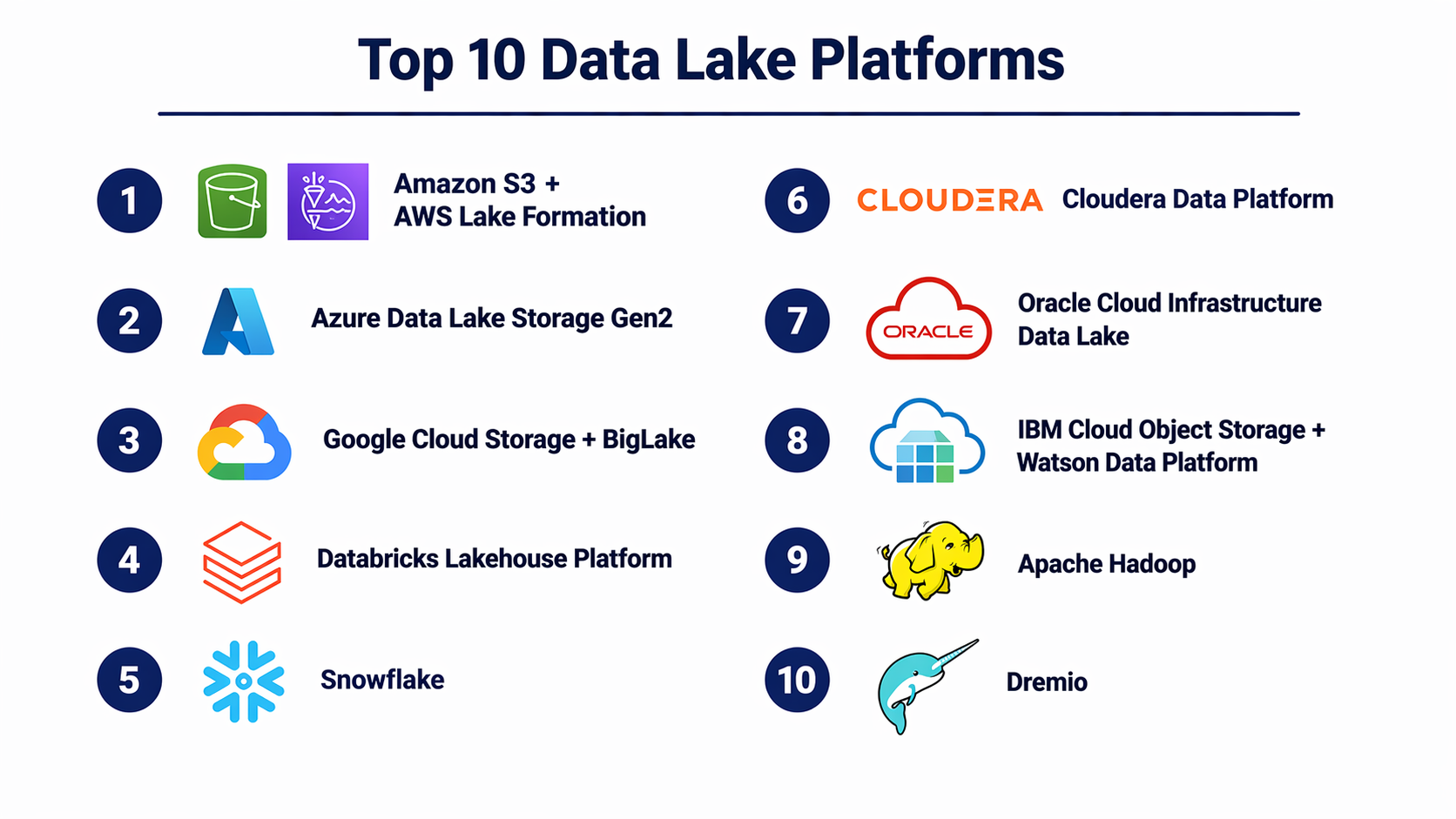
Top 10 Data Lake Platforms
#1 — Amazon S3 + AWS Lake Formation
Short description: A widely used cloud-native data lake solution combining scalable storage with governance tools. Best for AWS-centric organizations.
Key Features
- Highly scalable object storage
- Fine-grained access control via Lake Formation
- Integration with AWS analytics services
- Data catalog and metadata management
- Automated data ingestion pipelines
Pros
- Extremely scalable and reliable
- Deep integration with AWS ecosystem
Cons
- Can become complex for beginners
- Cost management requires careful planning
Platforms / Deployment
Cloud
Security & Compliance
Encryption, IAM roles, audit logs; certifications vary
Integrations & Ecosystem
Integrates with AWS Glue, Athena, Redshift, EMR
- API-driven architecture
- Supports third-party tools
- Compatible with open formats
Support & Community
Strong enterprise support and extensive documentation
#2 — Azure Data Lake Storage Gen2
Short description: Microsoft’s enterprise-grade data lake solution optimized for analytics and big data workloads.
Key Features
- Hierarchical namespace
- High-performance analytics integration
- Built-in security controls
- Seamless Azure ecosystem integration
- Data lifecycle management
Pros
- Strong integration with Microsoft tools
- High performance for analytics
Cons
- Limited outside Azure ecosystem
- Learning curve for new users
Platforms / Deployment
Cloud
Security & Compliance
RBAC, encryption, audit logs; compliance varies
Integrations & Ecosystem
Works with Azure Synapse, Databricks
- REST APIs
- Power BI integration
- Enterprise connectors
Support & Community
Enterprise-grade support, strong documentation
#3 — Google Cloud Storage + BigLake
Short description: A unified data lake solution with strong analytics and AI integration.
Key Features
- Unified storage layer
- Multi-engine data access
- AI and ML integration
- Metadata management
- Cross-cloud data access
Pros
- Strong AI/ML capabilities
- Flexible multi-cloud support
Cons
- Complex pricing model
- Requires expertise to optimize
Platforms / Deployment
Cloud
Security & Compliance
Encryption, IAM, audit logs; compliance varies
Integrations & Ecosystem
Works with BigQuery, Dataflow
- API support
- Open format compatibility
- ML tools integration
Support & Community
Strong enterprise support
#4 — Databricks Lakehouse Platform
Short description: Combines data lake and warehouse capabilities for unified analytics and AI workloads.
Key Features
- Delta Lake integration
- Unified data and AI platform
- Real-time analytics
- Collaborative notebooks
- Scalable compute engine
Pros
- Strong AI/ML support
- Lakehouse architecture leader
Cons
- Pricing can be high
- Requires skilled users
Platforms / Deployment
Cloud
Security & Compliance
RBAC, encryption, audit logs; compliance varies
Integrations & Ecosystem
Integrates with cloud providers and BI tools
- APIs and SDKs
- Open-source compatibility
- ML frameworks
Support & Community
Strong community and enterprise support
#5 — Snowflake (Data Lake Integration)
Short description: Primarily a data warehouse but supports data lake capabilities through external tables and lake integration.
Key Features
- Separation of storage and compute
- External table support
- Data sharing capabilities
- High performance queries
- Elastic scalability
Pros
- Easy to use
- Strong performance
Cons
- Not a native data lake
- Cost can increase quickly
Platforms / Deployment
Cloud
Security & Compliance
Encryption, RBAC; compliance varies
Integrations & Ecosystem
Works with cloud storage systems
- BI tools integration
- APIs
- Data sharing
Support & Community
Strong enterprise support
#6 — Cloudera Data Platform (CDP)
Short description: Hybrid data platform supporting large-scale data lake deployments.
Key Features
- Hybrid cloud support
- Data engineering tools
- Governance features
- Streaming analytics
- Open-source integration
Pros
- Strong enterprise features
- Flexible deployment
Cons
- Complex setup
- Requires expertise
Platforms / Deployment
Cloud / Hybrid
Security & Compliance
RBAC, encryption; compliance varies
Integrations & Ecosystem
Supports Hadoop ecosystem
- APIs
- Open-source tools
- Enterprise connectors
Support & Community
Enterprise support available
#7 — Oracle Cloud Infrastructure Data Lake
Short description: Enterprise-focused data lake solution with integrated analytics and governance.
Key Features
- Data catalog
- Integrated analytics
- Scalable storage
- Security controls
- Data lifecycle management
Pros
- Strong enterprise features
- Integrated ecosystem
Cons
- Limited outside Oracle ecosystem
- Learning curve
Platforms / Deployment
Cloud
Security & Compliance
Encryption, IAM; compliance varies
Integrations & Ecosystem
Works with Oracle analytics tools
- APIs
- Enterprise integrations
- Data connectors
Support & Community
Enterprise support available
#8 — IBM Cloud Object Storage + Watson Data Platform
Short description: A scalable data lake solution with strong AI and analytics capabilities.
Key Features
- Object storage scalability
- AI integration
- Data governance
- Multi-cloud support
- Analytics tools
Pros
- Strong AI capabilities
- Enterprise-ready
Cons
- Complex pricing
- Limited adoption compared to competitors
Platforms / Deployment
Cloud
Security & Compliance
Encryption, RBAC; compliance varies
Integrations & Ecosystem
Works with IBM Watson tools
- APIs
- Data connectors
- Analytics tools
Support & Community
Enterprise support
#9 — Apache Hadoop (HDFS-based Data Lake)
Short description: Open-source framework widely used for building on-premise data lakes.
Key Features
- Distributed storage
- Batch processing
- Open-source ecosystem
- Scalable architecture
- Customizable
Pros
- Highly flexible
- No licensing cost
Cons
- Complex management
- Requires significant expertise
Platforms / Deployment
Self-hosted
Security & Compliance
Varies / Not publicly stated
Integrations & Ecosystem
Works with Spark, Hive
- Open-source tools
- APIs
- Custom integrations
Support & Community
Strong open-source community
#10 — Dremio
Short description: Data lake analytics platform focused on performance and ease of use.
Key Features
- Data virtualization
- Query acceleration
- Semantic layer
- Self-service analytics
- Open data formats
Pros
- Fast query performance
- Easy analytics access
Cons
- Limited storage capabilities
- Requires external storage
Platforms / Deployment
Cloud / Hybrid
Security & Compliance
RBAC; compliance varies
Integrations & Ecosystem
Works with S3, Azure, Google Cloud
- BI tools
- APIs
- Open formats
Support & Community
Growing community and support
Comparison Table (Top 10)
| Tool Name | Best For | Platform(s) Supported | Deployment | Standout Feature | Public Rating |
|---|---|---|---|---|---|
| Amazon S3 + Lake Formation | AWS users | Web | Cloud | Scalability | N/A |
| Azure Data Lake Storage Gen2 | Microsoft ecosystem | Web | Cloud | Performance | N/A |
| Google Cloud Storage + BigLake | AI/ML workloads | Web | Cloud | AI integration | N/A |
| Databricks Lakehouse | Unified analytics | Web | Cloud | Lakehouse architecture | N/A |
| Snowflake | Data analytics | Web | Cloud | Ease of use | N/A |
| Cloudera CDP | Enterprise hybrid | Web | Hybrid | Flexibility | N/A |
| Oracle Data Lake | Enterprise | Web | Cloud | Integration | N/A |
| IBM Data Lake | AI-driven analytics | Web | Cloud | Watson AI | N/A |
| Apache Hadoop | On-prem big data | Linux | Self-hosted | Open-source | N/A |
| Dremio | Data lake analytics | Web | Hybrid | Query acceleration | N/A |
Evaluation & Scoring of Data Lake Platforms
| Tool Name | Core (25%) | Ease (15%) | Integrations (15%) | Security (10%) | Performance (10%) | Support (10%) | Value (15%) | Weighted Total |
|---|---|---|---|---|---|---|---|---|
| Amazon S3 | 9 | 7 | 9 | 9 | 9 | 9 | 8 | 8.7 |
| Azure Data Lake | 9 | 7 | 8 | 9 | 9 | 9 | 8 | 8.6 |
| Google BigLake | 9 | 7 | 9 | 9 | 9 | 8 | 8 | 8.6 |
| Databricks | 10 | 7 | 9 | 9 | 10 | 9 | 7 | 8.9 |
| Snowflake | 8 | 9 | 8 | 9 | 9 | 9 | 7 | 8.5 |
| Cloudera | 9 | 6 | 8 | 9 | 8 | 8 | 7 | 8.0 |
| Oracle | 8 | 7 | 7 | 9 | 8 | 8 | 7 | 7.9 |
| IBM | 8 | 6 | 7 | 9 | 8 | 8 | 7 | 7.8 |
| Hadoop | 8 | 5 | 8 | 7 | 7 | 7 | 9 | 7.6 |
| Dremio | 7 | 8 | 8 | 7 | 9 | 7 | 8 | 7.9 |
How to interpret scores:
- Scores are comparative across tools, not absolute.
- Higher scores indicate stronger overall capability.
- Choose based on your specific use case rather than just ranking.
Which Data Lake Platforms Right for You?
Solo / Freelancer
Choose simple, managed solutions like Snowflake or cloud-native storage.
SMB
Azure Data Lake or Google BigLake offers balance of cost and scalability.
Mid-Market
Databricks or Dremio provides flexibility with strong analytics.
Enterprise
Cloudera, AWS, or Azure offer governance, scale, and compliance.
Budget vs Premium
- Budget: Hadoop, basic cloud storage
- Premium: Databricks, Snowflake
Feature Depth vs Ease of Use
- Deep features: Databricks, Cloudera
- Easy use: Snowflake
Integrations & Scalability
Choose AWS, Azure, or Google for ecosystem strength.
Security & Compliance Needs
Enterprise tools like AWS, Azure, and Oracle are better suited.
Frequently Asked Questions (FAQs)
What is a data lake platform?
A system for storing raw data at scale for analytics and processing.
How is a data lake different from a data warehouse?
Data lakes store raw data, while warehouses store structured data.
Are data lakes expensive?
Costs vary based on storage, compute, and usage patterns.
Can small companies use data lakes?
Yes, but simpler tools may be more suitable initially.
What are common mistakes?
Poor governance and lack of data structure.
Do data lakes support real-time analytics?
Yes, with proper integration and tools.
How secure are data lakes?
Security depends on implementation and platform features.
Can I migrate from one data lake to another?
Yes, but it requires planning and data transformation.
What tools integrate with data lakes?
BI tools, ML platforms, and ETL pipelines.
Are data lakes suitable for AI workloads?
Yes, they are ideal for machine learning and analytics.
Conclusion
Data lake platforms have become a foundation for modern data architectures, especially as organizations move toward AI-driven decision-making and large-scale analytics. Each platform in this list brings its own strengths—whether it’s the scalability of cloud providers, the flexibility of open-source solutions, or the advanced capabilities of lakehouse platforms. However, there is no single “best” platform for everyone. The right choice depends on your data volume, team expertise, integration needs, and budget. Enterprises may prioritize governance and compliance, while smaller teams may focus on ease of use and cost efficiency.
