Introduction
Data Integration & ETL (Extract, Transform, Load) tools help organizations collect data from different sources, clean and transform it, and move it into a centralized system like a data warehouse or data lake. In simple terms, they make scattered data usable for reporting, analytics, and decision-making.
In the current data-driven environment, these tools are critical. Businesses now rely on real-time insights, AI models, and automated pipelines. Without proper data integration, teams struggle with inconsistent data, delayed reporting, and poor decision quality.
Real-world use cases include:
- Building centralized dashboards for business intelligence
- Migrating data between systems during cloud transformation
- Feeding clean datasets into machine learning pipelines
- Syncing SaaS tools like CRM, ERP, and marketing platforms
- Real-time data streaming for analytics and monitoring
What buyers should evaluate:
- Ease of use and learning curve
- Integration coverage (databases, APIs, SaaS apps)
- Performance and scalability
- Data transformation capabilities
- Security and compliance features
- Deployment flexibility (cloud, hybrid, on-prem)
- Cost structure and pricing transparency
- Support and community ecosystem
Best for: Data engineers, analytics teams, IT managers, SaaS companies, and enterprises handling large or complex datasets.
Not ideal for: Very small teams with minimal data needs, or companies using simple spreadsheets where manual integration is sufficient.
Key Trends in Data Integration & ETL Tools
- AI-powered data mapping and transformation reducing manual pipeline setup
- ELT over ETL adoption, pushing transformations to modern warehouses
- Real-time streaming pipelines becoming standard alongside batch processing
- Low-code/no-code interfaces for business users and analysts
- Data observability and pipeline monitoring gaining importance
- Security-first architecture with encryption and governance controls
- Cloud-native and serverless platforms replacing traditional on-prem tools
- Reverse ETL for syncing warehouse data back into business apps
- Open-source ecosystem growth for flexibility and cost control
- Consumption-based pricing models replacing fixed licensing
How We Selected These Tools (Methodology)
- Evaluated market adoption and industry recognition
- Assessed feature completeness and flexibility
- Considered performance and scalability signals
- Reviewed security and compliance capabilities
- Checked integration breadth across modern SaaS and databases
- Evaluated developer vs business user accessibility
- Considered deployment flexibility (cloud, hybrid, on-prem)
- Reviewed community support and ecosystem maturity
- Balanced enterprise-grade tools and lightweight solutions
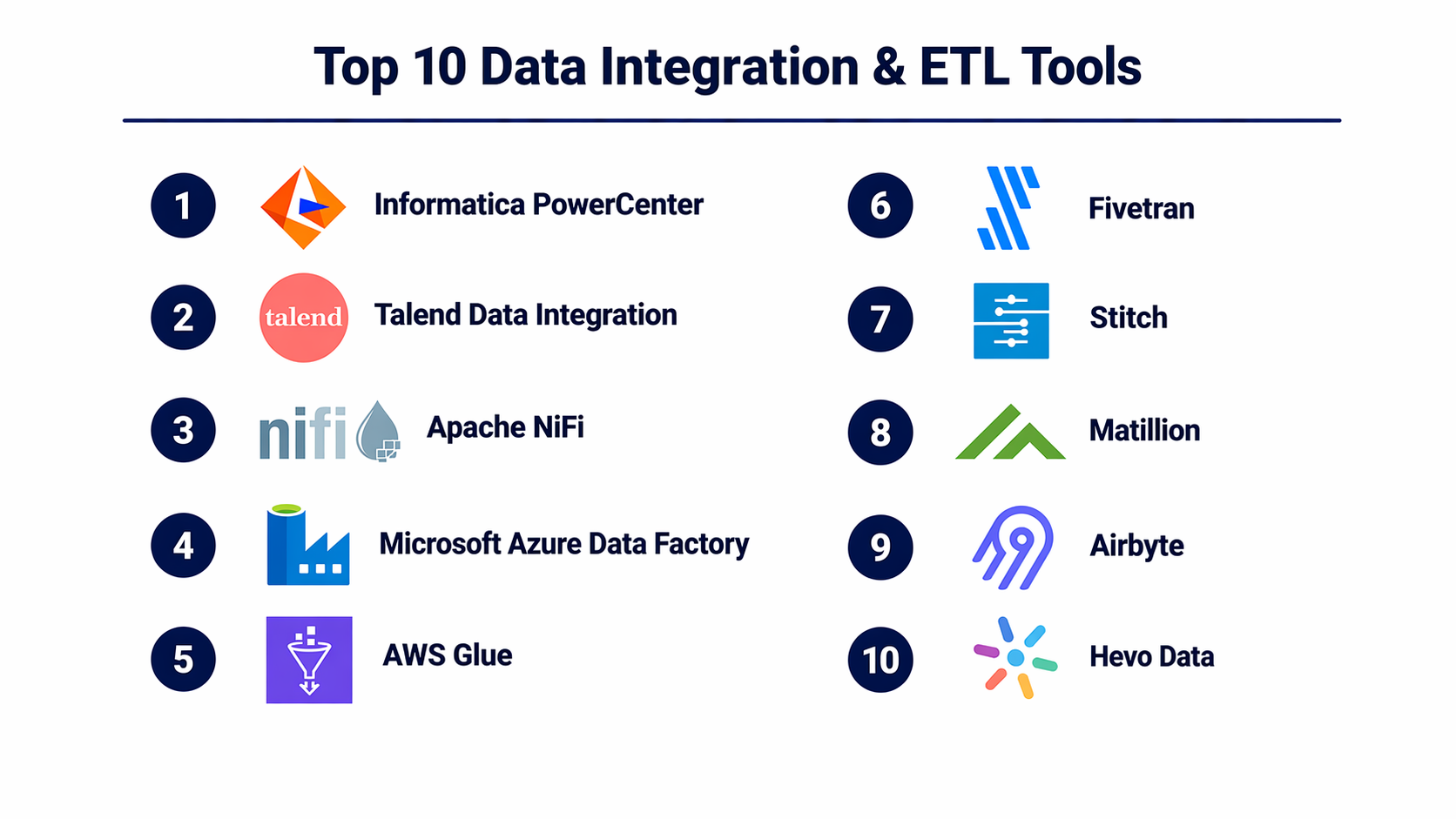
Top 10 Data Integration & ETL Tools
#1 — Informatica PowerCenter
Short description: Enterprise-grade ETL platform designed for large-scale data integration and governance.
Key Features
- Advanced data transformation engine
- Data quality and governance tools
- Metadata management
- Batch and real-time processing
- Workflow orchestration
- Scalable architecture
Pros
- Highly reliable for enterprise workloads
- Strong governance and compliance features
Cons
- Complex setup and learning curve
- Higher cost compared to modern tools
Platforms / Deployment
- Cloud / Self-hosted / Hybrid
Security & Compliance
- RBAC, encryption, audit logs
- Compliance: Not publicly stated
Integrations & Ecosystem
Supports databases, cloud platforms, and enterprise systems.
- Oracle, SQL Server
- Cloud data warehouses
- ERP/CRM systems
- APIs
Support & Community
Enterprise-level support with strong documentation and training programs.
#2 — Talend Data Integration
Short description: Open-source and enterprise data integration tool with strong transformation capabilities.
Key Features
- Drag-and-drop pipeline builder
- Data quality tools
- Real-time and batch processing
- Open-source flexibility
- Cloud and hybrid support
Pros
- Flexible and extensible
- Strong community support
Cons
- Performance may vary for large datasets
- Enterprise features require paid plans
Platforms / Deployment
- Cloud / Self-hosted
Security & Compliance
- Encryption, RBAC
- Compliance: Not publicly stated
Integrations & Ecosystem
Wide connector library and API support.
- Databases
- SaaS tools
- Cloud storage
Support & Community
Strong open-source community and enterprise support options.
#3 — Apache NiFi
Short description: Open-source data flow automation tool for real-time and batch data movement.
Key Features
- Visual flow-based programming
- Real-time data ingestion
- Data provenance tracking
- Back-pressure handling
- Extensible processors
Pros
- Excellent for real-time pipelines
- Strong monitoring and traceability
Cons
- Requires infrastructure management
- UI can become complex at scale
Platforms / Deployment
- Self-hosted
Security & Compliance
- Encryption, RBAC, audit logs
- Compliance: Not publicly stated
Integrations & Ecosystem
- Kafka, Hadoop
- REST APIs
- Databases
Support & Community
Active open-source community and strong documentation.
#4 — Microsoft Azure Data Factory
Short description: Cloud-based ETL and data integration service within the Azure ecosystem.
Key Features
- Data pipeline orchestration
- Serverless data integration
- Integration with Azure services
- Data transformation with Spark
- Scheduling and monitoring
Pros
- Seamless Azure integration
- Scalable and serverless
Cons
- Limited outside Azure ecosystem
- Debugging can be complex
Platforms / Deployment
- Cloud
Security & Compliance
- SSO, RBAC, encryption
- Compliance: Not publicly stated
Integrations & Ecosystem
- Azure services
- SQL, NoSQL databases
- SaaS applications
Support & Community
Strong enterprise support and large user base.
#5 — AWS Glue
Short description: Serverless ETL service designed for data preparation and analytics in AWS.
Key Features
- Serverless ETL pipelines
- Data catalog and metadata management
- Schema discovery
- Integration with AWS analytics tools
- Spark-based transformations
Pros
- Fully managed and scalable
- Tight AWS integration
Cons
- Limited multi-cloud support
- Cost can grow with usage
Platforms / Deployment
- Cloud
Security & Compliance
- IAM, encryption
- Compliance: Not publicly stated
Integrations & Ecosystem
- S3, Redshift
- Athena
- AWS ecosystem tools
Support & Community
Well-documented with AWS support tiers.
#6 — Fivetran
Short description: Fully managed ELT platform focused on automated data pipelines.
Key Features
- Pre-built connectors
- Automated schema handling
- Incremental data sync
- Minimal maintenance
- Cloud-native
Pros
- Easy to set up and maintain
- Reliable automated pipelines
Cons
- Limited transformation flexibility
- Pricing can be high
Platforms / Deployment
- Cloud
Security & Compliance
- Encryption, RBAC
- Compliance: Not publicly stated
Integrations & Ecosystem
- SaaS apps
- Data warehouses
- APIs
Support & Community
Strong support and growing ecosystem.
#7 — Stitch
Short description: Lightweight ETL tool designed for simple and fast data replication.
Key Features
- Simple data pipeline setup
- Pre-built connectors
- Cloud-based
- Data replication focus
Pros
- Easy to use
- Quick setup
Cons
- Limited transformation capabilities
- Not suitable for complex pipelines
Platforms / Deployment
- Cloud
Security & Compliance
- Encryption
- Compliance: Not publicly stated
Integrations & Ecosystem
- Databases
- SaaS apps
- APIs
Support & Community
Basic support with documentation.
#8 — Matillion
Short description: Cloud-native ETL tool optimized for modern data warehouses.
Key Features
- Visual pipeline builder
- Push-down transformations
- Integration with cloud warehouses
- Orchestration tools
Pros
- Strong warehouse optimization
- Good UI for developers
Cons
- Limited outside supported warehouses
- Pricing may be high
Platforms / Deployment
- Cloud
Security & Compliance
- Encryption, RBAC
- Compliance: Not publicly stated
Integrations & Ecosystem
- Snowflake
- Redshift
- BigQuery
Support & Community
Enterprise support with growing adoption.
#9 — Airbyte
Short description: Open-source data integration platform with growing connector ecosystem.
Key Features
- Open-source connectors
- Custom connector development
- ELT pipelines
- Cloud and self-hosted options
Pros
- Flexible and extensible
- Rapid connector development
Cons
- Still maturing
- Requires setup effort
Platforms / Deployment
- Cloud / Self-hosted
Security & Compliance
- Encryption
- Compliance: Not publicly stated
Integrations & Ecosystem
- APIs
- Databases
- SaaS tools
Support & Community
Strong open-source community.
#10 — Hevo Data
Short description: No-code data pipeline platform for real-time data integration.
Key Features
- Real-time data pipelines
- No-code interface
- Pre-built connectors
- Automated schema management
Pros
- Easy for non-technical users
- Real-time capabilities
Cons
- Limited advanced transformations
- Pricing varies
Platforms / Deployment
- Cloud
Security & Compliance
- Encryption, RBAC
- Compliance: Not publicly stated
Integrations & Ecosystem
- SaaS tools
- Databases
- Cloud warehouses
Support & Community
Responsive support with growing adoption.
Comparison Table (Top 10)
| Tool Name | Best For | Platform(s) Supported | Deployment | Standout Feature | Public Rating |
|---|---|---|---|---|---|
| Informatica PowerCenter | Enterprise ETL | Web | Hybrid | Governance tools | N/A |
| Talend Data Integration | Open-source flexibility | Web | Hybrid | Open-source model | N/A |
| Apache NiFi | Real-time pipelines | Linux | Self-hosted | Flow-based UI | N/A |
| Azure Data Factory | Azure users | Web | Cloud | Serverless pipelines | N/A |
| AWS Glue | AWS analytics | Web | Cloud | Data catalog | N/A |
| Fivetran | Automated pipelines | Web | Cloud | Pre-built connectors | N/A |
| Stitch | Simple ETL | Web | Cloud | Ease of use | N/A |
| Matillion | Warehouse ETL | Web | Cloud | Push-down processing | N/A |
| Airbyte | Open-source ETL | Web | Hybrid | Custom connectors | N/A |
| Hevo Data | No-code ETL | Web | Cloud | Real-time sync | N/A |
Evaluation & Scoring of Data Integration & ETL Tools
| Tool Name | Core | Ease | Integrations | Security | Performance | Support | Value | Weighted Total |
|---|---|---|---|---|---|---|---|---|
| Informatica PowerCenter | 9 | 6 | 9 | 8 | 9 | 8 | 6 | 8.0 |
| Talend Data Integration | 8 | 7 | 8 | 7 | 7 | 8 | 7 | 7.5 |
| Apache NiFi | 8 | 6 | 7 | 7 | 8 | 7 | 8 | 7.4 |
| Azure Data Factory | 9 | 7 | 8 | 8 | 9 | 8 | 7 | 8.2 |
| AWS Glue | 8 | 7 | 8 | 8 | 9 | 8 | 7 | 8.0 |
| Fivetran | 8 | 9 | 9 | 8 | 8 | 8 | 6 | 8.1 |
| Stitch | 6 | 9 | 7 | 7 | 7 | 7 | 8 | 7.5 |
| Matillion | 8 | 7 | 8 | 8 | 8 | 7 | 7 | 7.8 |
| Airbyte | 7 | 7 | 8 | 7 | 7 | 7 | 9 | 7.6 |
| Hevo Data | 7 | 9 | 8 | 7 | 8 | 8 | 7 | 7.9 |
How to interpret scores:
- Scores are relative comparisons across tools
- Higher total indicates stronger overall capability
- Consider your specific use case rather than highest score
- Some tools excel in niche scenarios (e.g., real-time, open-source)
Which Data Integration & ETL Tools Right for You?
Solo / Freelancer
Choose simple tools like Stitch or Hevo Data. Focus on ease of use and quick setup.
SMB
Fivetran or Airbyte offer a balance of automation and flexibility.
Mid-Market
Matillion and Talend provide scalability with reasonable complexity.
Enterprise
Informatica, Azure Data Factory, and AWS Glue are strong choices.
Budget vs Premium
- Budget: Airbyte, Stitch
- Premium: Informatica, Fivetran
Feature Depth vs Ease of Use
- Deep features: Informatica, Talend
- Easy to use: Hevo, Stitch
Integrations & Scalability
- Best integrations: Fivetran, AWS Glue
- Scalable: Azure Data Factory
Security & Compliance Needs
- Enterprise security: Informatica, Azure, AWS
- Basic needs: Stitch, Airbyte
Frequently Asked Questions (FAQs)
What is the difference between ETL and ELT?
ETL transforms data before loading, while ELT loads data first and transforms later inside the warehouse.
Are ETL tools still relevant?
Yes, but modern tools often support both ETL and ELT approaches.
How much do ETL tools cost?
Pricing varies widely depending on data volume, connectors, and features.
Can small businesses use ETL tools?
Yes, lightweight tools like Stitch or Hevo are designed for small teams.
Are ETL tools secure?
Most tools offer encryption and access control, but compliance varies.
Do these tools support real-time data?
Some tools like Hevo and NiFi support real-time pipelines.
How long does implementation take?
It can range from hours (simple tools) to weeks (enterprise platforms).
Can I switch ETL tools later?
Yes, but migration can be complex depending on pipelines.
Do ETL tools require coding?
Some tools are no-code, while others require developer expertise.
What are alternatives to ETL tools?
Manual scripts, APIs, or data virtualization tools can be alternatives.
Conclusion
Data integration and ETL tools are no longer optional—they are a foundational layer of modern data architecture. Whether you are building dashboards, powering analytics, or enabling AI workloads, the right tool can significantly impact performance, reliability, and cost. There is no single “best” tool. Enterprise teams may prefer robust platforms like Informatica or Azure Data Factory, while startups may lean toward simpler, automated tools like Fivetran or Hevo. Open-source options like Airbyte offer flexibility but require more effort.
