Introduction
Reverse ETL tools move data out of your data warehouse and into business applications like CRM, marketing automation, support tools, and analytics platforms. In simple terms, while traditional ETL brings data into a central system, Reverse ETL pushes clean, transformed data back into operational tools where teams actually work.
This category has become critical as companies adopt modern data stacks. With warehouses acting as the single source of truth, teams now need a way to activate that data in real-time across business systems.
Real-world use cases include:
- Syncing customer data from warehouses into CRM systems
- Powering personalized marketing campaigns using behavioral data
- Updating product analytics insights into support or sales tools
- Enabling customer success teams with real-time health scores
- Driving AI-powered recommendations in operational workflows
What buyers should evaluate:
- Supported destinations (CRM, ads platforms, SaaS tools)
- Data freshness (batch vs real-time sync)
- Transformation capabilities and SQL flexibility
- Ease of setup and maintenance
- Scalability and performance under large data volumes
- Security and governance controls
- Error handling and monitoring features
- Pricing model (rows synced, events, connectors)
- Integration with modern data stack (Snowflake, BigQuery, etc.)
Best for: Data teams, marketing teams, RevOps, product analytics teams, and SaaS companies that rely on centralized data warehouses.
Not ideal for: Organizations without a data warehouse or those that rely entirely on manual reporting or basic integrations.
Key Trends in Reverse ETL Tools
- AI-driven data activation enabling predictive segmentation and automation
- Real-time and event-driven syncs replacing batch-only pipelines
- Composable data stack adoption driving demand for Reverse ETL
- No-code interfaces empowering business users to create syncs
- Data governance and compliance integration becoming mandatory
- Customer 360 data models integrated into operational tools
- Warehouse-native architectures minimizing data duplication
- Usage-based pricing models based on rows or sync frequency
- Reverse ETL + CDP convergence creating unified data activation platforms
- Built-in observability and monitoring for pipeline health
How We Selected These Tools (Methodology)
- Considered market adoption and industry mindshare
- Evaluated feature depth for data activation and syncing
- Assessed performance and scalability capabilities
- Reviewed security and governance features
- Analyzed integration coverage with modern SaaS and warehouses
- Evaluated ease of use for technical and non-technical users
- Checked community and ecosystem maturity
- Balanced enterprise platforms and developer-first tools
- Focused on relevance for modern cloud data stacks
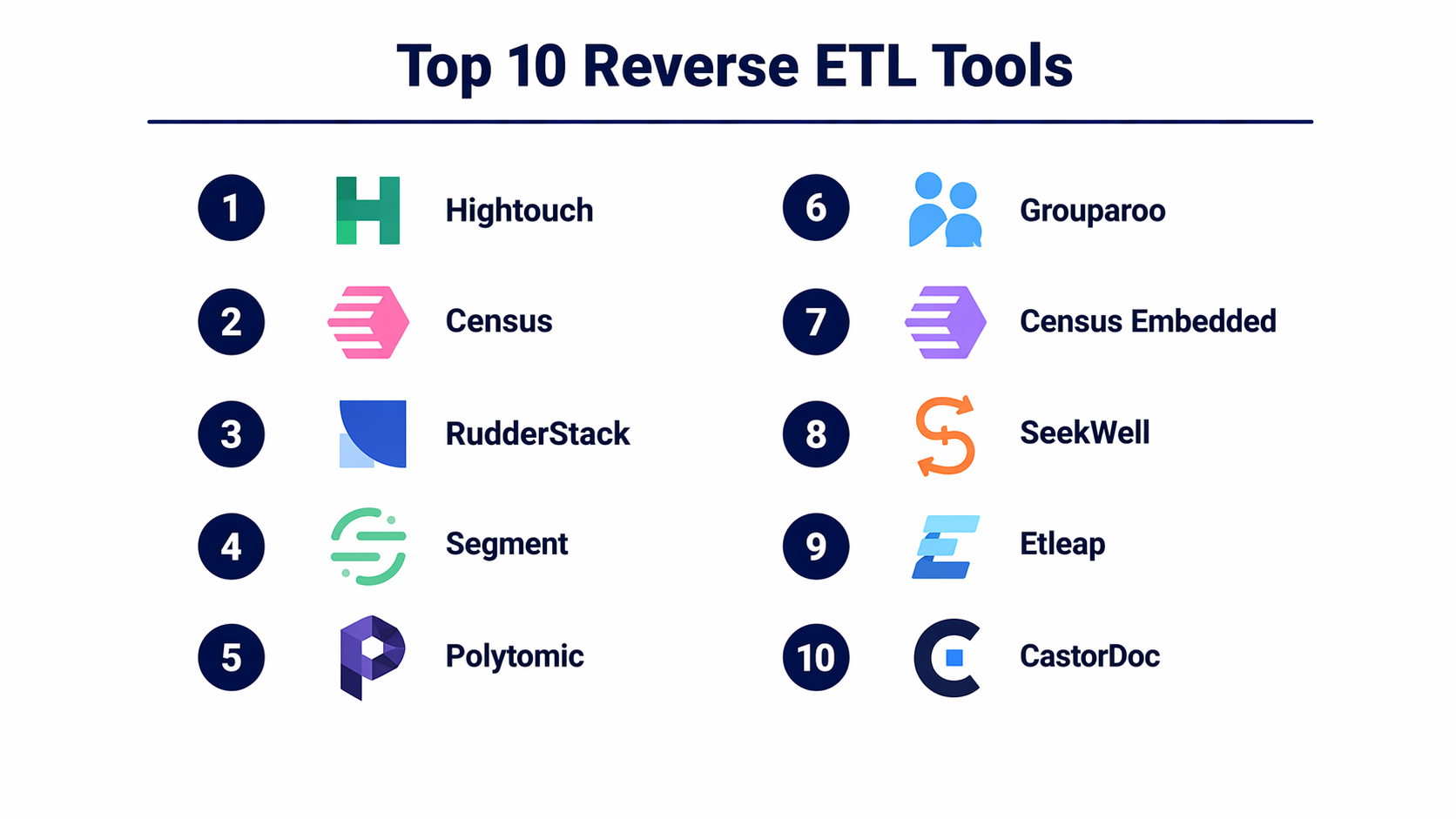
Top 10 Reverse ETL Tools
#1 — Hightouch
Short description: A leading Reverse ETL platform designed to sync warehouse data into business tools with minimal engineering effort.
Key Features
- SQL-based data modeling
- Real-time and batch syncs
- Pre-built SaaS connectors
- Identity resolution features
- Data activation workflows
- Monitoring and alerting
Pros
- Easy to use for data teams
- Strong integration ecosystem
Cons
- Pricing can scale quickly
- Advanced use cases may require SQL expertise
Platforms / Deployment
- Cloud
Security & Compliance
- Encryption, RBAC
- Compliance: Not publicly stated
Integrations & Ecosystem
Supports major SaaS tools and warehouses with API extensibility.
- Salesforce, HubSpot
- Snowflake, BigQuery
- Marketing platforms
- Custom APIs
Support & Community
Strong documentation, onboarding guides, and responsive support.
#2 — Census
Short description: Reverse ETL tool focused on operational analytics and syncing data into business applications.
Key Features
- SQL-based transformations
- Incremental sync logic
- Data modeling layer
- Pre-built connectors
- Monitoring dashboards
Pros
- Developer-friendly approach
- Reliable data syncing
Cons
- Limited no-code options
- Pricing may be high for large volumes
Platforms / Deployment
- Cloud
Security & Compliance
- Encryption, RBAC
- Compliance: Not publicly stated
Integrations & Ecosystem
- CRM platforms
- Marketing tools
- Data warehouses
- APIs
Support & Community
Good documentation and enterprise support options.
#3 — RudderStack
Short description: Customer data platform with Reverse ETL capabilities for event streaming and data activation.
Key Features
- Event streaming and pipelines
- Reverse ETL syncs
- Customer data platform features
- Real-time processing
- Open-source option
Pros
- Flexible deployment options
- Strong event-based architecture
Cons
- Complexity for beginners
- Requires setup effort
Platforms / Deployment
- Cloud / Self-hosted
Security & Compliance
- Encryption, RBAC
- Compliance: Not publicly stated
Integrations & Ecosystem
- Analytics tools
- Marketing platforms
- Data warehouses
- APIs
Support & Community
Active community and enterprise support available.
#4 — Segment (Functions / Personas)
Short description: Data platform combining CDP and Reverse ETL features for customer data activation.
Key Features
- Customer data platform
- Real-time event tracking
- Reverse ETL capabilities
- Identity resolution
- Data governance tools
Pros
- Unified data platform
- Strong ecosystem
Cons
- Expensive for smaller teams
- Complex setup
Platforms / Deployment
- Cloud
Security & Compliance
- SSO, encryption
- Compliance: Not publicly stated
Integrations & Ecosystem
- Marketing tools
- Analytics platforms
- SaaS integrations
Support & Community
Strong enterprise support and extensive documentation.
#5 — Polytomic
Short description: Reverse ETL tool designed for syncing data from warehouses to business tools with flexibility.
Key Features
- SQL-based syncs
- Real-time updates
- Data transformation
- Connector library
- Automation workflows
Pros
- Flexible configuration
- Fast data syncing
Cons
- Smaller ecosystem
- Less mature than competitors
Platforms / Deployment
- Cloud
Security & Compliance
- Encryption
- Compliance: Not publicly stated
Integrations & Ecosystem
- CRM tools
- Marketing platforms
- Data warehouses
Support & Community
Growing support and documentation.
#6 — Grouparoo
Short description: Open-source Reverse ETL platform focused on user data synchronization.
Key Features
- Open-source architecture
- Data modeling
- Automation workflows
- Scheduled syncs
- Extensible plugins
Pros
- Cost-effective
- Flexible customization
Cons
- Requires technical setup
- Limited enterprise features
Platforms / Deployment
- Self-hosted
Security & Compliance
- Encryption
- Compliance: Not publicly stated
Integrations & Ecosystem
- SaaS tools
- APIs
- Databases
Support & Community
Active open-source community.
#7 — Census Embedded
Short description: Embedded Reverse ETL solution for SaaS platforms offering data syncing as a feature.
Key Features
- Embedded data pipelines
- API-driven workflows
- White-label capabilities
- Real-time sync
- Developer tools
Pros
- Ideal for SaaS products
- Strong API support
Cons
- Requires engineering effort
- Limited standalone use
Platforms / Deployment
- Cloud
Security & Compliance
- Encryption, RBAC
- Compliance: Not publicly stated
Integrations & Ecosystem
- APIs
- SaaS platforms
- Data warehouses
Support & Community
Developer-focused support and documentation.
#8 — SeekWell
Short description: Lightweight data sync tool designed for pushing warehouse data into spreadsheets and apps.
Key Features
- Spreadsheet integrations
- Scheduled syncs
- Query automation
- Lightweight setup
- SaaS connectors
Pros
- Easy to use
- Good for small teams
Cons
- Limited enterprise capabilities
- Not suitable for large-scale pipelines
Platforms / Deployment
- Cloud
Security & Compliance
- Not publicly stated
Integrations & Ecosystem
- Google Sheets
- Slack
- Databases
Support & Community
Basic support and documentation.
#9 — Etleap
Short description: Data pipeline tool with Reverse ETL capabilities for automated data movement.
Key Features
- Automated pipelines
- Schema management
- Data transformation
- Monitoring tools
- Cloud-native
Pros
- Easy pipeline setup
- Automated workflows
Cons
- Limited Reverse ETL focus
- Smaller ecosystem
Platforms / Deployment
- Cloud
Security & Compliance
- Encryption
- Compliance: Not publicly stated
Integrations & Ecosystem
- Cloud storage
- Data warehouses
- APIs
Support & Community
Standard support options.
#10 — CastorDoc
Short description: Data catalog platform with Reverse ETL features for data activation and discovery.
Key Features
- Data catalog
- Reverse ETL sync
- Metadata management
- AI-driven insights
- Governance tools
Pros
- Strong data discovery features
- AI-driven insights
Cons
- Not purely Reverse ETL focused
- Limited connectors
Platforms / Deployment
- Cloud
Security & Compliance
- Encryption
- Compliance: Not publicly stated
Integrations & Ecosystem
- Data warehouses
- BI tools
- APIs
Support & Community
Growing platform with evolving support.
Comparison Table (Top 10)
| Tool Name | Best For | Platform(s) Supported | Deployment | Standout Feature | Public Rating |
|---|---|---|---|---|---|
| Hightouch | Data activation | Web | Cloud | SQL-based sync | N/A |
| Census | Operational analytics | Web | Cloud | Incremental sync | N/A |
| RudderStack | Event pipelines | Web | Hybrid | CDP + Reverse ETL | N/A |
| Segment | Customer data | Web | Cloud | Unified CDP | N/A |
| Polytomic | Flexible sync | Web | Cloud | Real-time updates | N/A |
| Grouparoo | Open-source ETL | Web | Self-hosted | Open-source model | N/A |
| Census Embedded | SaaS embedding | Web | Cloud | Embedded pipelines | N/A |
| SeekWell | Lightweight sync | Web | Cloud | Spreadsheet sync | N/A |
| Etleap | Automated pipelines | Web | Cloud | Automation | N/A |
| CastorDoc | Data catalog | Web | Cloud | AI insights | N/A |
Evaluation & Scoring of Reverse ETL Tools
| Tool Name | Core | Ease | Integrations | Security | Performance | Support | Value | Weighted Total |
|---|---|---|---|---|---|---|---|---|
| Hightouch | 9 | 8 | 9 | 8 | 8 | 8 | 7 | 8.2 |
| Census | 8 | 7 | 8 | 8 | 8 | 8 | 7 | 7.9 |
| RudderStack | 8 | 6 | 9 | 8 | 9 | 7 | 8 | 8.0 |
| Segment | 9 | 7 | 9 | 8 | 8 | 8 | 6 | 8.1 |
| Polytomic | 7 | 7 | 7 | 7 | 7 | 7 | 7 | 7.0 |
| Grouparoo | 7 | 6 | 7 | 7 | 7 | 7 | 9 | 7.3 |
| Census Embedded | 8 | 6 | 8 | 8 | 8 | 7 | 7 | 7.6 |
| SeekWell | 6 | 9 | 6 | 6 | 6 | 6 | 8 | 6.9 |
| Etleap | 7 | 7 | 7 | 7 | 7 | 7 | 7 | 7.0 |
| CastorDoc | 7 | 7 | 6 | 7 | 7 | 6 | 7 | 6.9 |
How to interpret scores:
- Scores are relative and comparative across tools
- Higher score indicates stronger overall capability
- Choose based on use case, not just score
- Some tools specialize in niche use cases
Which Reverse ETL Tools Right for You?
Solo / Freelancer
SeekWell or Grouparoo for simplicity and cost efficiency.
SMB
Hightouch or Census provide strong automation with manageable complexity.
Mid-Market
RudderStack and Polytomic offer flexibility and scalability.
Enterprise
Segment, Hightouch, and Census provide robust features and integrations.
Budget vs Premium
- Budget: Grouparoo, SeekWell
- Premium: Segment, Hightouch
Feature Depth vs Ease of Use
- Feature-rich: Segment, RudderStack
- Easy to use: Hightouch, SeekWell
Integrations & Scalability
- Strong integrations: Hightouch, Census
- Scalable: RudderStack
Security & Compliance Needs
- Enterprise-grade: Segment, Hightouch
- Basic: SeekWell, Grouparoo
Frequently Asked Questions (FAQs)
What is Reverse ETL?
Reverse ETL moves data from warehouses to business tools for operational use.
How is it different from ETL?
ETL moves data into warehouses, Reverse ETL moves it out.
Do I need Reverse ETL?
If you use a data warehouse and want to activate data, yes.
Is Reverse ETL expensive?
Pricing varies based on usage and connectors.
Can it run in real-time?
Many tools support real-time or near real-time sync.
Is coding required?
Some tools require SQL, others offer no-code interfaces.
How secure are these tools?
Most offer encryption and access control, but compliance varies.
Can I switch tools easily?
Migration can be complex depending on pipelines.
What are alternatives?
Custom scripts or APIs can be alternatives.
Do these tools support AI use cases?
Yes, especially for feeding data into AI-driven workflows.
Conclusion
Reverse ETL tools play a critical role in modern data ecosystems by bridging the gap between analytics and operations. They ensure that insights generated in data warehouses are not just stored but actively used across business applications. The right tool depends heavily on your organization’s size, technical maturity, and data strategy. Enterprise teams may prefer comprehensive platforms like Segment or Hightouch, while smaller teams can benefit from simpler tools like SeekWell or Grouparoo.
