Introduction
NoSQL database platforms are modern data storage systems designed to handle large volumes of unstructured or semi-structured data. Unlike traditional relational databases, they do not rely on fixed schemas, which makes them highly flexible and scalable for dynamic applications.
In today’s cloud-first and AI-driven landscape, NoSQL databases are critical. They power real-time analytics, support massive user bases, and enable high-performance applications across distributed environments. As businesses move toward microservices, event-driven architectures, and AI/ML workloads, NoSQL platforms are becoming the backbone of modern data infrastructure.
Common use cases include:
- Real-time analytics and dashboards
- E-commerce product catalogs and recommendation engines
- IoT data ingestion and processing
- Content management and social media platforms
- AI/ML data pipelines and feature stores
What buyers should evaluate:
- Data model (document, key-value, graph, column)
- Scalability and performance
- Query capabilities and indexing
- Security and compliance features
- Integration with cloud and DevOps tools
- Cost structure and pricing model
- Multi-region support and availability
- Developer experience and tooling
Best for: Developers, data engineers, startups, enterprises handling large-scale distributed data, and AI-driven organizations.
Not ideal for: Applications requiring strict ACID compliance, complex joins, or traditional relational schema constraints where SQL databases perform better.
Key Trends in NoSQL Database Platforms
- AI-native databases: Built-in support for vector search and AI workloads
- Serverless deployment models: Auto-scaling without infrastructure management
- Multi-model capabilities: Combining document, graph, and key-value in one platform
- Edge and distributed computing: Data closer to users for low latency
- Security-first design: Zero-trust access, encryption, and compliance readiness
- Integration with data lakes and analytics platforms
- Real-time processing and streaming support
- Usage-based pricing models replacing traditional licensing
- Developer-first APIs and SDK ecosystems
- Observability and performance monitoring improvements
How We Selected These Tools (Methodology)
- Strong market adoption and developer popularity
- Proven scalability and performance in production
- Feature completeness across multiple use cases
- Security and compliance readiness
- Integration with cloud ecosystems and DevOps pipelines
- Flexibility in deployment (cloud, hybrid, self-hosted)
- Community support and documentation quality
- Suitability across startups, SMBs, and enterprises
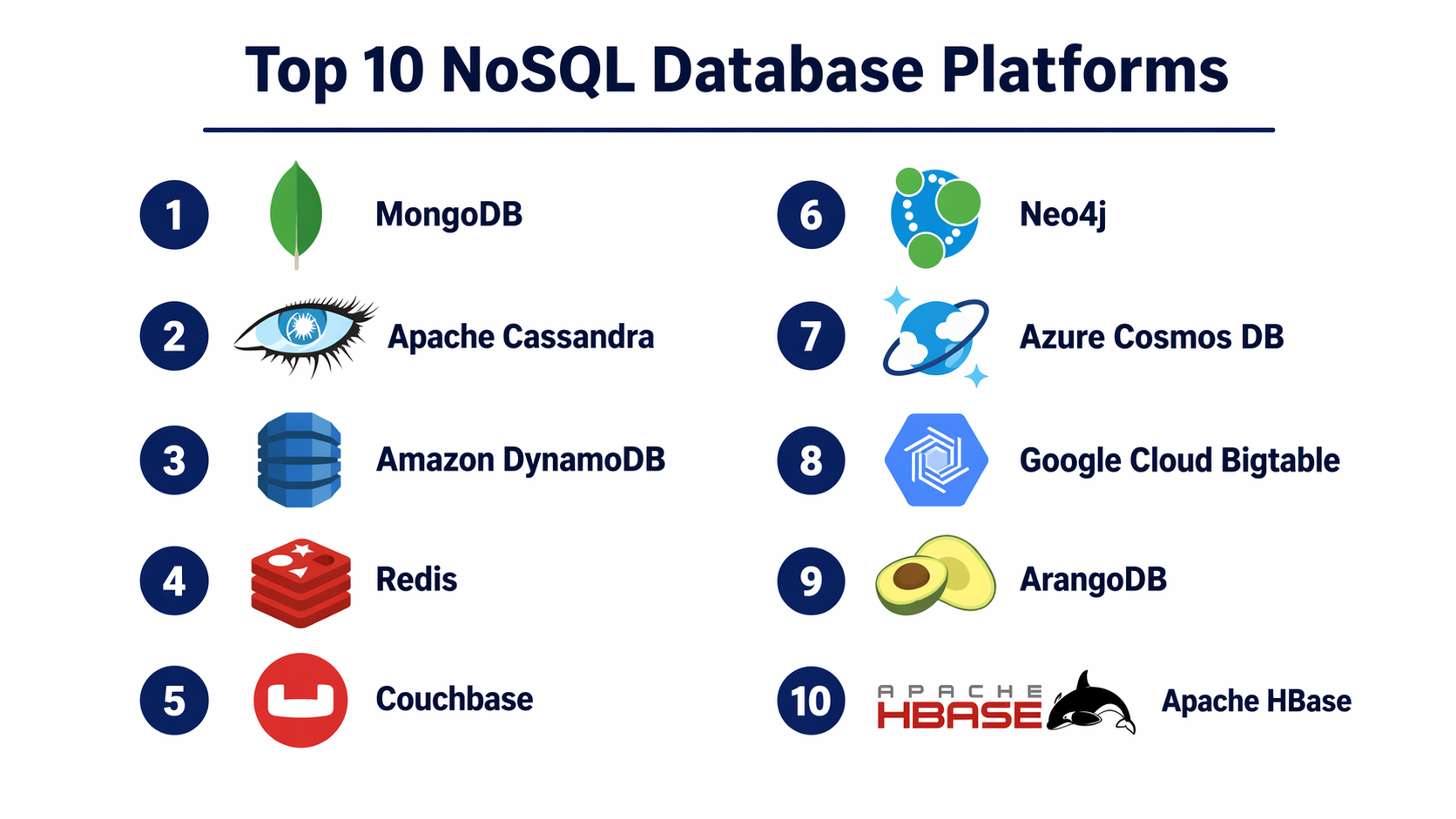
Top 10 NoSQL Database Platforms
#1 — MongoDB
Short description: A leading document-oriented NoSQL database widely used for modern applications and developer-friendly workflows.
Key Features
- Flexible JSON-like document model
- Horizontal scaling with sharding
- Advanced indexing and aggregation
- Built-in replication and high availability
- Atlas cloud platform
- Full-text search capabilities
- Multi-cloud support
Pros
- Easy to use for developers
- Strong ecosystem and community
- Scales well for large datasets
Cons
- Performance tuning can be complex
- Not ideal for heavy relational queries
Platforms / Deployment
Cloud / Self-hosted / Hybrid
Security & Compliance
RBAC, encryption, audit logs; certifications: Varies
Integrations & Ecosystem
Strong integration with analytics tools, cloud providers, and APIs
- BI tools
- Spark and Hadoop
- REST APIs
- Kubernetes
Support & Community
Extensive documentation, large community, enterprise support available
#2 — Apache Cassandra
Short description: A distributed wide-column store designed for high availability and massive scalability.
Key Features
- Peer-to-peer architecture
- Linear scalability
- Fault tolerance
- High write throughput
- Multi-data center replication
- Tunable consistency
- No single point of failure
Pros
- Extremely scalable
- Reliable for mission-critical workloads
Cons
- Complex setup and maintenance
- Limited query flexibility
Platforms / Deployment
Self-hosted / Cloud
Security & Compliance
Encryption, authentication; certifications: Not publicly stated
Integrations & Ecosystem
- Hadoop ecosystem
- Kafka
- Spark
- Kubernetes
Support & Community
Strong open-source community, enterprise support via vendors
#3 — Amazon DynamoDB
Short description: A fully managed key-value and document database designed for high-performance applications.
Key Features
- Serverless architecture
- Automatic scaling
- Low-latency performance
- Global tables
- Built-in caching
- Backup and restore
- Streams for event-driven apps
Pros
- Fully managed and scalable
- High availability
Cons
- Cost can increase with scale
- Vendor lock-in
Platforms / Deployment
Cloud
Security & Compliance
IAM integration, encryption, audit logs
Integrations & Ecosystem
- AWS services
- Lambda
- API Gateway
- Analytics tools
Support & Community
Enterprise-grade support with strong documentation
#4 — Redis
Short description: An in-memory data store used for caching, real-time analytics, and messaging.
Key Features
- In-memory performance
- Key-value data model
- Pub/Sub messaging
- Persistence options
- Data structures support
- High availability
- Real-time processing
Pros
- Extremely fast
- Simple to deploy
Cons
- Limited persistence compared to disk-based DBs
- Memory costs
Platforms / Deployment
Cloud / Self-hosted
Security & Compliance
Authentication, encryption; certifications: Not publicly stated
Integrations & Ecosystem
- Microservices
- Caching layers
- Streaming systems
Support & Community
Very strong community and ecosystem
#5 — Couchbase
Short description: A distributed NoSQL database combining document storage with key-value access.
Key Features
- SQL-like query language
- Distributed architecture
- Full-text search
- Mobile sync support
- Real-time analytics
- Multi-cloud deployment
- Built-in caching
Pros
- Flexible querying
- Strong performance
Cons
- Learning curve
- Licensing cost
Platforms / Deployment
Cloud / Hybrid
Security & Compliance
RBAC, encryption; certifications: Varies
Integrations & Ecosystem
- BI tools
- Mobile apps
- Cloud platforms
Support & Community
Enterprise support with growing community
#6 — Neo4j
Short description: A graph database optimized for connected data and relationship-driven queries.
Key Features
- Graph data model
- Cypher query language
- High-performance traversal
- Visualization tools
- ACID compliance
- Real-time insights
- AI/ML integration
Pros
- Ideal for graph use cases
- Powerful query language
Cons
- Not suitable for general-purpose workloads
- Scaling can be complex
Platforms / Deployment
Cloud / Self-hosted
Security & Compliance
RBAC, encryption; certifications: Not publicly stated
Integrations & Ecosystem
- Graph analytics
- AI tools
- APIs
Support & Community
Strong developer community and documentation
#7 — Azure Cosmos DB
Short description: A globally distributed multi-model database service.
Key Features
- Multi-model support
- Global distribution
- Low-latency access
- Automatic scaling
- SLA-backed availability
- Multiple APIs
- Integrated analytics
Pros
- Enterprise-ready
- Strong scalability
Cons
- Pricing complexity
- Vendor dependency
Platforms / Deployment
Cloud
Security & Compliance
Encryption, RBAC, compliance certifications
Integrations & Ecosystem
- Azure services
- AI tools
- DevOps pipelines
Support & Community
Enterprise support with documentation
#8 — Google Cloud Bigtable
Short description: A scalable wide-column database for large analytical and operational workloads.
Key Features
- High throughput
- Low latency
- Massive scalability
- Integration with analytics
- Fully managed
- Consistent performance
- Time-series support
Pros
- Strong performance
- Fully managed
Cons
- Limited query flexibility
- Vendor lock-in
Platforms / Deployment
Cloud
Security & Compliance
Encryption, IAM; certifications: Varies
Integrations & Ecosystem
- BigQuery
- AI tools
- Data pipelines
Support & Community
Enterprise support with cloud ecosystem
#9 — ArangoDB
Short description: A multi-model database supporting graph, document, and key-value data.
Key Features
- Multi-model support
- Flexible queries
- High availability
- Distributed architecture
- Graph analytics
- JSON storage
- REST APIs
Pros
- Versatile use cases
- Developer-friendly
Cons
- Smaller ecosystem
- Limited enterprise adoption
Platforms / Deployment
Cloud / Self-hosted
Security & Compliance
Authentication, encryption; certifications: Not publicly stated
Integrations & Ecosystem
- APIs
- Microservices
- Analytics tools
Support & Community
Moderate community support
#10 — Apache HBase
Short description: A column-oriented database built on Hadoop for large-scale data storage.
Key Features
- Distributed storage
- Strong consistency
- Integration with Hadoop
- High throughput
- Fault tolerance
- Real-time read/write
- Scalable architecture
Pros
- Good for big data
- Reliable
Cons
- Complex setup
- Limited query features
Platforms / Deployment
Self-hosted / Cloud
Security & Compliance
Kerberos, encryption; certifications: Not publicly stated
Integrations & Ecosystem
- Hadoop ecosystem
- Spark
- Data lakes
Support & Community
Strong open-source support
Comparison Table (Top 10)
| Tool Name | Best For | Platform(s) | Deployment | Standout Feature | Public Rating |
|---|---|---|---|---|---|
| MongoDB | Developers & apps | Cross-platform | Hybrid | Document model | N/A |
| Apache Cassandra | Large-scale systems | Linux | Self-hosted | High scalability | N/A |
| Amazon DynamoDB | Serverless apps | Cloud | Cloud | Auto scaling | N/A |
| Redis | Caching & real-time | Cross-platform | Hybrid | In-memory speed | N/A |
| Couchbase | Enterprise apps | Cross-platform | Hybrid | SQL-like queries | N/A |
| Neo4j | Graph data | Cross-platform | Hybrid | Graph analytics | N/A |
| Azure Cosmos DB | Enterprise cloud | Cloud | Cloud | Global distribution | N/A |
| Google Cloud Bigtable | Analytics | Cloud | Cloud | High throughput | N/A |
| ArangoDB | Multi-model apps | Cross-platform | Hybrid | Multi-model | N/A |
| Apache HBase | Big data | Linux | Hybrid | Hadoop integration | N/A |
Evaluation & Scoring of NoSQL Database Platforms
| Tool Name | Core | Ease | Integrations | Security | Performance | Support | Value | Weighted Total |
|---|---|---|---|---|---|---|---|---|
| MongoDB | 9 | 8 | 9 | 8 | 9 | 9 | 8 | 8.6 |
| Cassandra | 9 | 6 | 8 | 7 | 9 | 8 | 8 | 8.1 |
| DynamoDB | 9 | 8 | 9 | 9 | 9 | 9 | 7 | 8.7 |
| Redis | 8 | 9 | 8 | 7 | 10 | 9 | 8 | 8.6 |
| Couchbase | 8 | 7 | 8 | 8 | 8 | 8 | 7 | 7.8 |
| Neo4j | 8 | 7 | 7 | 7 | 8 | 8 | 7 | 7.6 |
| Cosmos DB | 9 | 8 | 9 | 9 | 9 | 9 | 7 | 8.7 |
| Bigtable | 8 | 7 | 8 | 8 | 9 | 8 | 7 | 7.9 |
| ArangoDB | 7 | 8 | 7 | 7 | 7 | 7 | 8 | 7.3 |
| HBase | 8 | 6 | 7 | 7 | 8 | 7 | 8 | 7.4 |
How to interpret:
Scores are comparative, not absolute. Higher scores indicate stronger overall capability in modern workloads. Evaluate based on your specific needs rather than relying only on totals.
Which NoSQL Database Platforms Is Right for You?
Solo / Freelancer
MongoDB, Redis, ArangoDB — easy to start and flexible
SMB
Couchbase, MongoDB, DynamoDB — balance of performance and cost
Mid-Market
Cassandra, Cosmos DB — scalable and reliable
Enterprise
Cosmos DB, DynamoDB, Bigtable — global scale and compliance
Budget vs Premium
Open-source options vs managed cloud services
Feature Depth vs Ease of Use
MongoDB (ease) vs Cassandra (depth)
Integrations & Scalability
Cloud-native platforms excel here
Security & Compliance Needs
Enterprise cloud solutions offer strongest compliance
Frequently Asked Questions (FAQs)
What is a NoSQL database?
A flexible database designed for non-relational data storage and scalability.
How is NoSQL different from SQL?
NoSQL avoids fixed schemas and supports distributed scaling.
Are NoSQL databases secure?
Yes, but security depends on configuration and platform.
Can NoSQL handle large-scale applications?
Yes, they are built for high scalability and performance.
What industries use NoSQL databases?
E-commerce, fintech, healthcare, AI, and IoT.
Is NoSQL expensive?
Varies depending on deployment and usage.
Can I migrate from SQL to NoSQL?
Yes, but requires data model redesign.
Do NoSQL databases support ACID?
Some do, but not all.
Which NoSQL is best for beginners?
MongoDB and Redis are beginner-friendly.
Are NoSQL databases cloud-based?
Many are, but self-hosted options exist.
Conclusion
NoSQL database platforms are essential for modern, scalable, and flexible data architectures. From document stores like MongoDB to graph databases like Neo4j and cloud-native solutions like DynamoDB and Cosmos DB, each platform serves a unique purpose. The right choice depends on your application type, scalability needs, and budget constraints.
