Introduction
Relational Database Management Systems (RDBMS) are software systems designed to store, manage, and retrieve structured data using tables, rows, and relationships. They rely on SQL (Structured Query Language) to define, query, and manipulate data efficiently. In simple terms, RDBMS helps organizations organize their data in a structured format where relationships between datasets are clearly defined.
In the modern digital landscape, RDBMS remains the backbone of critical applications—from banking systems and e-commerce platforms to enterprise SaaS products. Even with the rise of NoSQL databases, relational databases continue to dominate for workloads requiring consistency, structured schemas, and transactional integrity.
Real-world use cases include:
- Managing financial transactions in banking systems
- Running ERP and CRM systems
- Powering e-commerce platforms and inventory systems
- Supporting analytics and reporting workloads
- Managing backend data for SaaS applications
What buyers should evaluate:
- Scalability (vertical vs horizontal scaling)
- Performance under high workloads
- SQL support and query optimization
- Security features and compliance readiness
- High availability and disaster recovery
- Integration with cloud and DevOps tools
- Cost and licensing model
- Ease of administration and tooling
- Multi-region and distributed support
Best for: Enterprises, startups, SaaS companies, financial institutions, and any organization requiring structured, reliable, and consistent data storage.
Not ideal for: Applications requiring highly flexible schemas, unstructured data, or extreme horizontal scaling—where NoSQL or distributed databases may be more suitable.
Key Trends in Relational Database Management Systems
- Cloud-native RDBMS adoption: Managed database services are becoming the default choice
- AI-powered query optimization: Systems automatically tune indexes and queries
- Distributed SQL systems: Combining relational consistency with horizontal scalability
- Serverless databases: On-demand scaling without infrastructure management
- Multi-cloud deployments: Avoiding vendor lock-in through portability
- Enhanced security features: Built-in encryption, compliance, and auditing
- Automation-first operations: Backup, failover, and patching automation
- Integration with analytics tools: Real-time reporting and BI integration
- Hybrid database architectures: Mixing relational and NoSQL systems
- Usage-based pricing models: Cost aligned with actual consumption
How We Selected These Tools (Methodology)
- Considered global adoption and enterprise usage
- Evaluated core database capabilities including transactions and indexing
- Reviewed performance benchmarks and scalability patterns
- Assessed security features and compliance readiness
- Analyzed ecosystem integrations and cloud compatibility
- Included both open-source and commercial solutions
- Ensured coverage for different user segments and workloads
- Reviewed community strength and vendor support
- Focused on future-readiness and innovation trends
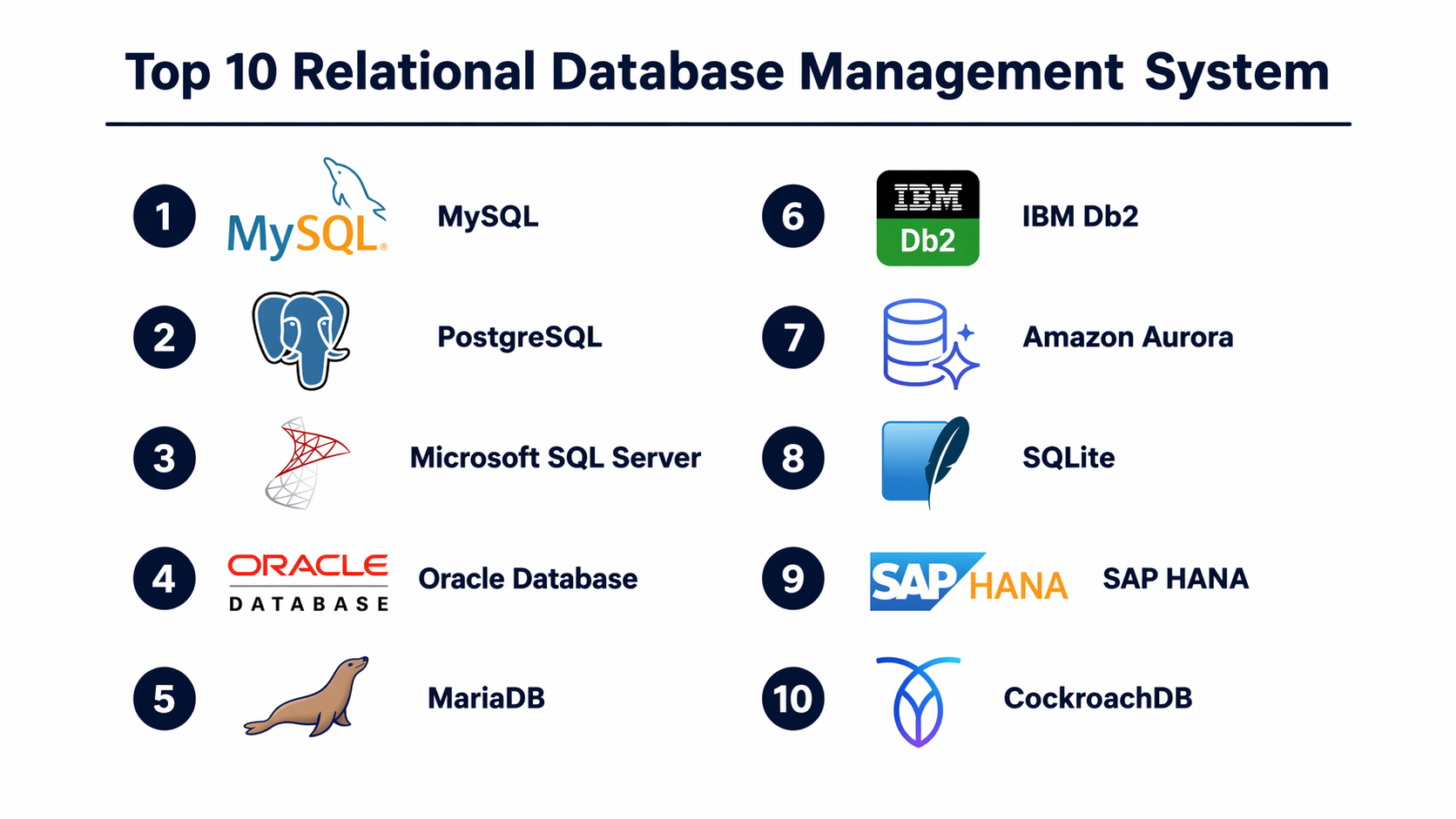
Top 10 Relational Database Management Systems
#1 — MySQL
Short description: One of the most widely used open-source relational databases, popular for web applications and startups.
Key Features
- ACID-compliant transactions
- Replication and clustering
- Strong SQL support
- Storage engine flexibility
- High performance for read-heavy workloads
- Wide ecosystem support
Pros
- Free and open-source
- Large community support
Cons
- Limited advanced enterprise features
- Scaling can be complex
Platforms / Deployment
Windows / macOS / Linux | Cloud / Self-hosted
Security & Compliance
User access control, SSL encryption; others Not publicly stated
Integrations & Ecosystem
Strong integration with web stacks and cloud services
- PHP, Python, Java ecosystems
- Cloud platforms (AWS, Azure)
- DevOps tools
Support & Community
Extensive community support and enterprise offerings
#2 — PostgreSQL
Short description: Advanced open-source relational database known for extensibility and standards compliance.
Key Features
- Advanced indexing techniques
- JSON and semi-structured data support
- ACID compliance
- Extensible architecture
- Parallel query execution
- Strong concurrency handling
Pros
- Highly extensible
- Excellent performance for complex queries
Cons
- Slightly steeper learning curve
- Resource-intensive
Platforms / Deployment
Windows / macOS / Linux | Cloud / Self-hosted
Security & Compliance
RBAC, SSL, audit logging; others Not publicly stated
Integrations & Ecosystem
Supports modern application architectures
- ORMs and frameworks
- Extensions ecosystem
- Cloud-native integrations
Support & Community
Very strong community and documentation
#3 — Microsoft SQL Server
Short description: Enterprise-grade relational database system with deep integration into Microsoft ecosystem.
Key Features
- Advanced analytics capabilities
- High availability features
- Data warehousing support
- Integration services
- Built-in reporting tools
Pros
- Enterprise-ready
- Strong tooling ecosystem
Cons
- Licensing cost
- Vendor lock-in concerns
Platforms / Deployment
Windows / Linux | Cloud / Hybrid
Security & Compliance
Encryption, RBAC, auditing; others Not publicly stated
Integrations & Ecosystem
Deep integration with enterprise tools
- Azure services
- Microsoft BI tools
- .NET ecosystem
Support & Community
Strong enterprise support
#4 — Oracle Database
Short description: High-performance enterprise database widely used in large-scale mission-critical applications.
Key Features
- Advanced security features
- High availability and clustering
- Autonomous database capabilities
- Advanced analytics
- Multi-model support
Pros
- Highly reliable
- Feature-rich
Cons
- Expensive
- Complex to manage
Platforms / Deployment
Cloud / On-prem
Security & Compliance
Encryption, auditing, RBAC; others Not publicly stated
Integrations & Ecosystem
- Oracle cloud ecosystem
- Enterprise integrations
Support & Community
Enterprise-grade support
#5 — MariaDB
Short description: Open-source fork of MySQL with enhanced performance and features.
Key Features
- High-performance storage engines
- Replication enhancements
- Open-source model
- Compatibility with MySQL
- ColumnStore for analytics
Pros
- Free and flexible
- MySQL compatibility
Cons
- Fragmentation from MySQL ecosystem
- Limited enterprise tooling
Platforms / Deployment
Linux / Windows | Cloud / Self-hosted
Security & Compliance
Access control, encryption; others Not publicly stated
Integrations & Ecosystem
- Compatible with MySQL tools
- Open-source integrations
Support & Community
Active community
#6 — IBM Db2
Short description: Enterprise database designed for high-performance transactional workloads.
Key Features
- AI-driven query optimization
- High availability
- Data compression
- Hybrid cloud support
- Advanced analytics
Pros
- Strong performance
- Enterprise features
Cons
- Complex setup
- Cost considerations
Platforms / Deployment
Linux / Windows / Cloud
Security & Compliance
Encryption, access control; others Not publicly stated
Integrations & Ecosystem
- IBM cloud ecosystem
- Enterprise tools
Support & Community
Enterprise support
#7 — Amazon Aurora
Short description: Cloud-native relational database compatible with MySQL and PostgreSQL.
Key Features
- High scalability
- Automated backups
- Fault-tolerant storage
- Serverless options
- High availability
Pros
- Cloud-optimized
- Managed service
Cons
- Vendor lock-in
- Pricing complexity
Platforms / Deployment
Cloud
Security & Compliance
Encryption, IAM integration; others Not publicly stated
Integrations & Ecosystem
- AWS ecosystem
- DevOps integrations
Support & Community
Enterprise cloud support
#8 — SQLite
Short description: Lightweight embedded database used in mobile and small applications.
Key Features
- Zero configuration
- Embedded database
- ACID compliance
- Small footprint
- Fast performance
Pros
- Extremely lightweight
- Easy to use
Cons
- Not suitable for large-scale systems
- Limited concurrency
Platforms / Deployment
All platforms | Embedded
Security & Compliance
Not publicly stated
Integrations & Ecosystem
- Embedded applications
- Mobile platforms
Support & Community
Strong community
#9 — SAP HANA
Short description: In-memory database designed for real-time analytics and enterprise workloads.
Key Features
- In-memory processing
- Real-time analytics
- Advanced compression
- Integration with SAP ecosystem
- High-speed transactions
Pros
- High performance
- Real-time capabilities
Cons
- Expensive
- Complex implementation
Platforms / Deployment
Cloud / On-prem
Security & Compliance
Enterprise-grade security; others Not publicly stated
Integrations & Ecosystem
- SAP applications
- Enterprise systems
Support & Community
Enterprise support
#10 — CockroachDB
Short description: Distributed SQL database designed for scalability and resilience.
Key Features
- Horizontal scalability
- Strong consistency
- Multi-region support
- Fault tolerance
- Cloud-native design
Pros
- Highly scalable
- Resilient architecture
Cons
- Learning curve
- Performance tuning complexity
Platforms / Deployment
Cloud / Self-hosted
Security & Compliance
Encryption, RBAC; others Not publicly stated
Integrations & Ecosystem
- Kubernetes integration
- Cloud-native tools
Support & Community
Growing community
Comparison Table (Top 10)
| Tool Name | Best For | Platform(s) Supported | Deployment | Standout Feature | Public Rating |
|---|---|---|---|---|---|
| MySQL | Web apps | Cross-platform | Hybrid | Popularity | N/A |
| PostgreSQL | Complex queries | Cross-platform | Hybrid | Extensibility | N/A |
| SQL Server | Enterprises | Windows/Linux | Hybrid | Enterprise tools | N/A |
| Oracle | Large enterprises | Cross-platform | Hybrid | Reliability | N/A |
| MariaDB | Open-source users | Cross-platform | Hybrid | MySQL compatibility | N/A |
| IBM Db2 | Enterprises | Cross-platform | Hybrid | AI optimization | N/A |
| Amazon Aurora | Cloud apps | Cloud | Cloud | Scalability | N/A |
| SQLite | Embedded apps | All | Embedded | Lightweight | N/A |
| SAP HANA | Real-time analytics | Cross-platform | Hybrid | In-memory | N/A |
| CockroachDB | Distributed apps | Cross-platform | Hybrid | Resilience | N/A |
Evaluation & Scoring of Relational Database Management Systems
| Tool Name | Core | Ease | Integrations | Security | Performance | Support | Value | Weighted Total |
|---|---|---|---|---|---|---|---|---|
| MySQL | 8 | 8 | 8 | 7 | 8 | 8 | 9 | 8.2 |
| PostgreSQL | 9 | 7 | 8 | 8 | 9 | 8 | 9 | 8.5 |
| SQL Server | 9 | 7 | 9 | 9 | 9 | 9 | 7 | 8.6 |
| Oracle | 10 | 6 | 9 | 9 | 10 | 9 | 6 | 8.5 |
| MariaDB | 8 | 8 | 7 | 7 | 8 | 7 | 9 | 8.0 |
| IBM Db2 | 9 | 6 | 8 | 8 | 9 | 8 | 7 | 8.2 |
| Aurora | 9 | 8 | 9 | 8 | 9 | 9 | 7 | 8.6 |
| SQLite | 7 | 9 | 6 | 6 | 7 | 7 | 10 | 7.8 |
| SAP HANA | 9 | 6 | 8 | 9 | 10 | 8 | 6 | 8.3 |
| CockroachDB | 9 | 7 | 8 | 8 | 9 | 7 | 7 | 8.2 |
Interpretation:
Scores are relative comparisons based on real-world capabilities and typical usage patterns. Higher scores indicate stronger overall capability but may not suit every scenario. Always align tool selection with your specific requirements.
Which Relational Database Management Systems Is Right for You?
Solo / Freelancer
SQLite or MySQL
SMB
MySQL or PostgreSQL
Mid-Market
PostgreSQL or MariaDB
Enterprise
Oracle, SQL Server, SAP HANA
Budget vs Premium
Open-source vs enterprise-grade solutions
Feature Depth vs Ease of Use
Balance between complexity and usability
Integrations & Scalability
Cloud-native vs traditional
Security & Compliance Needs
Enterprise databases offer stronger compliance
Frequently Asked Questions (FAQs)
What is an RDBMS?
It is a system for managing structured data using tables and relationships.
Are RDBMS still relevant?
Yes, especially for transactional systems.
What is the difference from NoSQL?
RDBMS uses structured schema; NoSQL is flexible.
Which is best for beginners?
MySQL or SQLite.
Are cloud databases better?
They simplify management and scaling.
Do I need SQL knowledge?
Yes, SQL is essential.
Are RDBMS secure?
Most provide strong security features.
Can RDBMS scale?
Yes, vertically and horizontally (in modern systems).
What is ACID compliance?
Ensures data reliability and consistency.
How to choose the best one?
Based on workload, budget, and scalability needs.
Conclusion
Relational Database Management Systems continue to play a foundational role in modern software and enterprise infrastructure. Despite the emergence of NoSQL and distributed data platforms, RDBMS solutions remain unmatched for structured data, transactional integrity, and consistency. From lightweight options like SQLite to enterprise-grade platforms like Oracle and SQL Server, each system serves a specific purpose based on workload requirements, scalability needs, and organizational maturity.
