Introduction
Treasury Cash Forecasting Tools help businesses predict how much cash they will have in the future. In simple terms, these tools collect financial data (like payments, receivables, expenses, and bank balances) and turn it into short-term and long-term cash forecasts. This helps companies avoid cash shortages, optimize liquidity, and make better financial decisions.
In the modern financial environment, where businesses operate across multiple banks, currencies, and regions, cash visibility is more complex than ever. With real-time payments, volatile markets, and tighter financial controls, treasury teams need accurate, automated forecasting rather than manual spreadsheets.
Real-world use cases:
- CFOs planning liquidity for upcoming investments
- Treasury teams managing multi-bank cash positions
- Finance teams forecasting payroll and operational expenses
- Enterprises optimizing working capital
- Global companies managing FX exposure and cash flows
What buyers should evaluate:
- Forecasting accuracy and AI capabilities
- Data integration (ERP, banks, accounting systems)
- Real-time visibility of cash positions
- Scenario planning and modeling tools
- Multi-currency and global support
- Ease of use and reporting dashboards
- Automation level and workflow efficiency
- Security and compliance readiness
- Scalability for large enterprises
- Pricing and ROI
Best for: CFOs, treasury teams, finance leaders, and enterprises managing complex cash flows across multiple accounts or regions.
Not ideal for: Small businesses with simple finances or those already managing cash flows easily through basic accounting tools.
Key Trends in Treasury Cash Forecasting Tools
- AI and machine learning improving forecast accuracy
- Real-time bank connectivity and API integrations
- Cloud-based treasury platforms replacing legacy systems
- Predictive analytics for scenario planning
- Increased focus on liquidity risk management
- Integration with ERP and financial planning tools
- Automation of data aggregation and reconciliation
- Multi-entity and multi-currency forecasting
- Enhanced dashboards and visualization tools
- Embedded analytics within treasury platforms
How We Selected These Tools (Methodology)
- Market adoption among treasury and finance teams
- Breadth and depth of forecasting capabilities
- Reliability and performance across large datasets
- Integration ecosystem with ERP and banking systems
- Security and compliance readiness
- Ease of use for finance professionals
- Support for global operations and currencies
- Innovation in AI and automation
- Customer feedback signals across segments
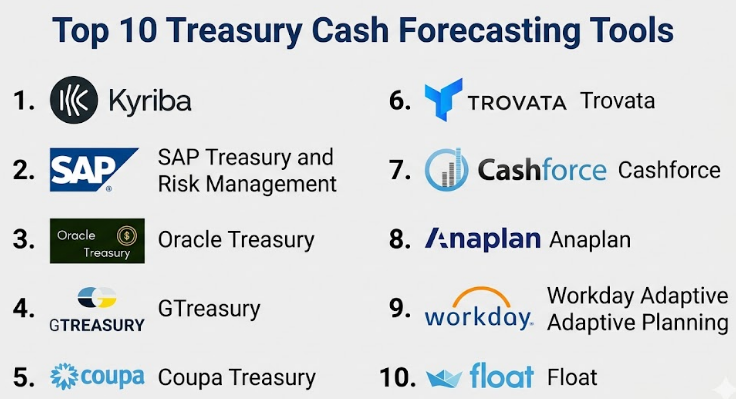
Top 10 Treasury Cash Forecasting Tools
#1 — Kyriba
Short description:
A leading treasury management platform offering advanced cash forecasting, liquidity management, and risk analytics. It is widely used by large enterprises managing global cash operations.
Key Features
- AI-driven cash forecasting
- Real-time liquidity visibility
- Multi-bank connectivity
- Scenario planning tools
- Risk and FX exposure management
- Integrated treasury dashboard
Pros
- Enterprise-grade scalability
- Strong analytics capabilities
Cons
- Complex implementation
- Premium pricing
Platforms / Deployment
Cloud
Security & Compliance
Not publicly stated
Integrations & Ecosystem
Kyriba integrates deeply with enterprise financial systems and banks.
- ERP systems
- Banking APIs
- Financial platforms
Support & Community
Strong enterprise support with structured onboarding.
#2 — SAP Treasury and Risk Management
Short description:
A comprehensive treasury solution embedded within SAP ecosystem, designed for large organizations needing integrated financial management.
Key Features
- Cash forecasting and liquidity planning
- Risk management tools
- Integration with SAP ERP
- Financial reporting
- FX and interest rate risk analysis
Pros
- Deep ERP integration
- Strong compliance capabilities
Cons
- High implementation effort
- Requires SAP ecosystem
Platforms / Deployment
Cloud / Hybrid
Security & Compliance
Not publicly stated
Integrations & Ecosystem
Best suited for SAP environments.
- SAP ERP
- Financial modules
- Banking systems
Support & Community
Extensive documentation and enterprise support.
#3 — Oracle Treasury
Short description:
Part of Oracle’s financial suite, offering forecasting, liquidity management, and risk analysis for enterprises.
Key Features
- Cash flow forecasting
- Risk management tools
- Financial analytics
- Multi-entity support
- Integration with Oracle ERP
Pros
- Strong analytics
- Scalable architecture
Cons
- Requires Oracle ecosystem
- Complex setup
Platforms / Deployment
Cloud
Security & Compliance
Not publicly stated
Integrations & Ecosystem
Tightly integrated with Oracle systems.
- Oracle ERP
- Financial modules
Support & Community
Enterprise-grade support.
#4 — GTreasury
Short description:
A treasury platform designed for mid-market and enterprise companies with strong forecasting and liquidity tools.
Key Features
- Cash forecasting models
- Liquidity management
- Bank connectivity
- Reporting dashboards
- Risk management
Pros
- Flexible forecasting models
- Good usability
Cons
- Limited advanced AI
- Smaller ecosystem
Platforms / Deployment
Cloud
Security & Compliance
Not publicly stated
Integrations & Ecosystem
Integrates with financial systems and banks.
- ERP systems
- Banking platforms
Support & Community
Reliable customer support.
#5 — Coupa Treasury
Short description:
A treasury solution integrated with Coupa’s spend management platform, offering visibility and forecasting capabilities.
Key Features
- Cash flow forecasting
- Spend and liquidity insights
- Scenario modeling
- Integration with procurement systems
- Analytics dashboards
Pros
- Strong spend integration
- Easy visibility
Cons
- Limited standalone treasury depth
- Best within Coupa ecosystem
Platforms / Deployment
Cloud
Security & Compliance
Not publicly stated
Integrations & Ecosystem
Works well with Coupa platform.
- Procurement tools
- Financial systems
Support & Community
Enterprise support available.
#6 — Trovata
Short description:
A modern, API-first cash management platform focused on real-time data aggregation and forecasting.
Key Features
- Real-time bank data aggregation
- AI forecasting models
- API-first architecture
- Cash visibility dashboards
- Data automation
Pros
- Fast implementation
- Strong real-time capabilities
Cons
- Newer platform
- Limited legacy integrations
Platforms / Deployment
Cloud
Security & Compliance
Not publicly stated
Integrations & Ecosystem
API-driven integrations.
- Banking APIs
- Financial systems
Support & Community
Growing support ecosystem.
#7 — Cashforce
Short description:
A cash forecasting tool focused on automation and integration with ERP systems for accurate forecasting.
Key Features
- Automated forecasting
- ERP data integration
- Scenario planning
- Reporting tools
- Working capital insights
Pros
- Strong ERP integration
- Accurate forecasting
Cons
- Requires data maturity
- Limited UI flexibility
Platforms / Deployment
Cloud
Security & Compliance
Not publicly stated
Integrations & Ecosystem
Works closely with ERP platforms.
- SAP
- Oracle
- Financial systems
Support & Community
Good enterprise support.
#8 — Anaplan
Short description:
A planning platform that includes cash forecasting as part of broader financial planning capabilities.
Key Features
- Scenario planning
- Financial modeling
- Real-time collaboration
- Forecasting dashboards
- Workflow automation
Pros
- Flexible modeling
- Cross-functional planning
Cons
- Not treasury-specific
- Complex setup
Platforms / Deployment
Cloud
Security & Compliance
Not publicly stated
Integrations & Ecosystem
Broad integrations.
- ERP systems
- Financial tools
Support & Community
Strong community and training.
#9 — Workday Adaptive Planning
Short description:
A financial planning tool with cash forecasting features, suitable for mid-market and enterprise finance teams.
Key Features
- Cash forecasting
- Financial planning
- Reporting dashboards
- Scenario analysis
- Workflow automation
Pros
- User-friendly interface
- Strong planning tools
Cons
- Limited treasury depth
- Not specialized
Platforms / Deployment
Cloud
Security & Compliance
Not publicly stated
Integrations & Ecosystem
Integrates with financial systems.
- ERP tools
- HR systems
Support & Community
Good documentation and support.
#10 — Float
Short description:
A simple cash flow forecasting tool designed for small and growing businesses.
Key Features
- Cash flow forecasting
- Scenario planning
- Integration with accounting tools
- Visual dashboards
- Budget tracking
Pros
- Easy to use
- Affordable
Cons
- Limited enterprise features
- Basic analytics
Platforms / Deployment
Cloud
Security & Compliance
Not publicly stated
Integrations & Ecosystem
Integrates with accounting tools.
- QuickBooks
- Xero
Support & Community
Strong SMB support.
Comparison Table (Top 10)
| Tool Name | Best For | Platform(s) Supported | Deployment | Standout Feature | Public Rating |
|---|---|---|---|---|---|
| Kyriba | Enterprise | Web | Cloud | AI forecasting | N/A |
| SAP Treasury | Enterprises | Web | Hybrid | ERP integration | N/A |
| Oracle Treasury | Enterprises | Web | Cloud | Financial analytics | N/A |
| GTreasury | Mid-market | Web | Cloud | Forecasting models | N/A |
| Coupa Treasury | Enterprises | Web | Cloud | Spend visibility | N/A |
| Trovata | Modern teams | Web | Cloud | Real-time data | N/A |
| Cashforce | Enterprises | Web | Cloud | ERP forecasting | N/A |
| Anaplan | Planning teams | Web | Cloud | Scenario modeling | N/A |
| Workday Adaptive Planning | Mid-market | Web | Cloud | Financial planning | N/A |
| Float | SMB | Web | Cloud | Simplicity | N/A |
Evaluation & Treasury Cash Forecasting Tools
| Tool Name | Core | Ease | Integrations | Security | Performance | Support | Value | Weighted Total |
|---|---|---|---|---|---|---|---|---|
| Kyriba | 9 | 7 | 9 | 7 | 9 | 8 | 7 | 8.05 |
| SAP Treasury | 9 | 6 | 9 | 8 | 9 | 8 | 6 | 7.90 |
| Oracle Treasury | 9 | 6 | 9 | 7 | 9 | 8 | 6 | 7.85 |
| GTreasury | 8 | 8 | 7 | 7 | 8 | 8 | 8 | 7.90 |
| Coupa Treasury | 8 | 8 | 8 | 7 | 8 | 8 | 7 | 7.95 |
| Trovata | 8 | 9 | 8 | 7 | 8 | 7 | 8 | 8.00 |
| Cashforce | 8 | 7 | 9 | 7 | 8 | 8 | 7 | 7.85 |
| Anaplan | 8 | 7 | 9 | 7 | 8 | 8 | 7 | 7.85 |
| Workday Adaptive | 7 | 8 | 8 | 7 | 8 | 8 | 8 | 7.80 |
| Float | 6 | 9 | 7 | 6 | 7 | 7 | 9 | 7.40 |
How to interpret:
These scores compare tools across key dimensions. Higher scores indicate stronger capabilities overall, but the best choice depends on your organization’s size, complexity, and integration needs. Enterprise tools may score higher in features but lower in ease of use, while SMB tools may offer simplicity with fewer advanced features.
Which Treasury Cash Forecasting Tools
Solo / Freelancer
Float is the most practical choice due to simplicity and affordability.
SMB
Float and Workday Adaptive Planning offer a balance of usability and features.
Mid-Market
GTreasury, Trovata, and Cashforce provide strong forecasting and integration capabilities.
Enterprise
Kyriba, SAP Treasury, Oracle Treasury, and Coupa Treasury are top choices.
Budget vs Premium
- Budget: Float, Workday Adaptive
- Premium: Kyriba, SAP, Oracle
Feature Depth vs Ease of Use
- Deep features: Kyriba, SAP, Oracle
- Easy to use: Float, Trovata
Integrations & Scalability
- Strong integrations: SAP, Oracle, Cashforce
- Scalable platforms: Kyriba, Coupa
Security & Compliance Needs
- High compliance: SAP, Oracle
- Standard needs: Float, Trovata
Frequently Asked Questions (FAQs)
1. What is a treasury cash forecasting tool?
It helps businesses predict future cash positions by analyzing inflows and outflows.
2. Why is cash forecasting important?
It ensures liquidity, prevents cash shortages, and supports financial planning.
3. Are these tools suitable for small businesses?
Yes, tools like Float are designed for smaller teams.
4. Do these tools integrate with banks?
Most modern tools support bank API integrations.
5. How accurate are forecasts?
Accuracy depends on data quality and forecasting models used.
6. Do they support multiple currencies?
Yes, most enterprise tools support multi-currency operations.
7. How long does implementation take?
It can range from days to months depending on complexity.
8. Are they secure?
Most platforms follow standard security practices, though details vary.
9. Can these tools replace spreadsheets?
Yes, they automate and improve forecasting compared to manual spreadsheets.
10. What are alternatives?
Basic accounting tools or manual forecasting, but they lack automation and accuracy.
Conclusion
Treasury Cash Forecasting Tools have become essential for modern finance teams navigating complex, fast-moving financial environments. With increasing transaction volumes, global operations, and real-time payment systems, relying on spreadsheets is no longer sustainable. These tools provide visibility, automation, and predictive insights that help businesses make smarter financial decisions, reduce risk, and optimize liquidity.