Introduction
A Hedge Fund Order Management System (OMS) is software that helps investment firms manage the full lifecycle of trades—from idea generation to execution and post-trade analysis. In simple terms, it acts as the central control system for trading operations, ensuring orders are placed correctly, tracked in real time, and compliant with regulations.
In today’s fast-moving markets, OMS platforms are no longer optional. With increasing market volatility, multi-asset trading, and regulatory pressure, modern OMS tools now include AI-driven analytics, real-time risk controls, and automation features that help firms operate faster and smarter.
Real-world use cases:
- Managing high-frequency equity and derivatives trading
- Automating compliance checks before trade execution
- Tracking portfolio performance across multiple asset classes
- Coordinating trades across multiple brokers and venues
- Supporting global trading operations with real-time visibility
What buyers should evaluate:
- Multi-asset class support (equities, derivatives, FX, fixed income)
- Execution speed and latency performance
- Integration with EMS, PMS, and market data systems
- Compliance and audit capabilities
- Scalability for growing trading volumes
- Customization and workflow flexibility
- Deployment model (cloud vs on-premise)
- Cost structure and licensing flexibility
Best for: Hedge funds, asset managers, proprietary trading firms, and institutional investors managing complex portfolios and high trading volumes.
Not ideal for: Small retail traders or basic investment setups—simpler trading platforms or broker tools may be more cost-effective and easier to use.
Key Trends in Hedge Fund Order Management Systems (OMS)
- AI-driven trade optimization for smarter execution strategies
- Cloud-native OMS platforms replacing legacy on-prem systems
- Real-time risk and compliance monitoring integrated into workflows
- API-first architecture for seamless integration with fintech ecosystems
- Multi-asset and cross-border trading support becoming standard
- Automation of trade lifecycle reducing manual errors
- Advanced analytics dashboards for performance insights
- Integration with ESG and alternative data sources
- Cybersecurity enhancements including zero-trust frameworks
- Shift toward modular OMS + EMS ecosystems
How We Selected These Tools (Methodology)
- Evaluated market adoption and institutional usage
- Assessed feature completeness across asset classes
- Reviewed performance and scalability indicators
- Considered security and compliance capabilities
- Analyzed integration flexibility and ecosystem support
- Included tools suitable for different firm sizes (SMB to enterprise)
- Looked at innovation trends (AI, cloud, automation)
- Balanced legacy leaders and modern cloud platforms
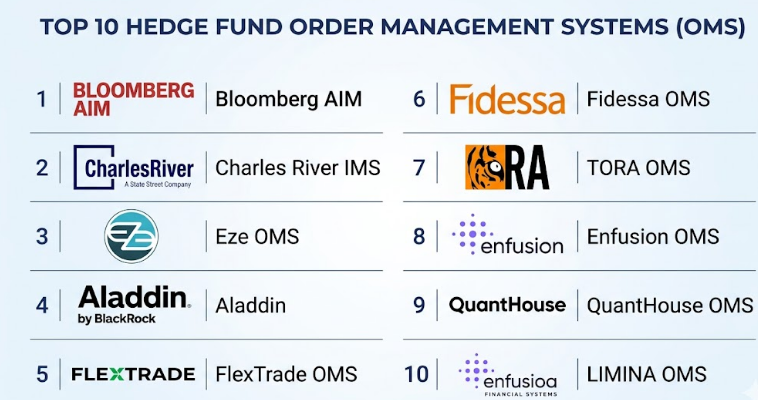
Top 10 Hedge Fund Order Management Systems (OMS)
#1 — Bloomberg AIM
Short description :
Bloomberg AIM is a widely adopted OMS designed for institutional asset managers and hedge funds. It integrates deeply with Bloomberg’s data ecosystem, providing strong analytics and execution capabilities. It supports multi-asset trading and offers robust compliance tools. Known for reliability and global reach, it is favored by large firms. It works best for organizations already using Bloomberg Terminal.
Key Features
- Multi-asset order management
- Integrated market data and analytics
- Pre- and post-trade compliance
- Portfolio and risk management tools
- Real-time trade tracking
- Workflow automation
Pros
- Strong integration with Bloomberg ecosystem
- Reliable and widely trusted
Cons
- Expensive for smaller firms
- Requires Bloomberg infrastructure
Platforms / Deployment
Cloud / Hybrid
Security & Compliance
SSO, audit logs, RBAC; other certifications Not publicly stated
Integrations & Ecosystem
Strong integration with Bloomberg tools and external trading systems
- EMS platforms
- Market data feeds
- Portfolio systems
- APIs for customization
Support & Community
Enterprise-grade support with extensive documentation; strong institutional user base
#2 — Charles River IMS
Short description :
Charles River IMS is a comprehensive investment management system combining OMS, EMS, and portfolio management. It is widely used by asset managers and hedge funds globally. Known for its scalability, it supports complex workflows and regulatory requirements. It is suitable for firms needing a unified platform.
Key Features
- Integrated OMS + EMS
- Multi-asset support
- Compliance automation
- Risk analytics
- Global trading capabilities
Pros
- End-to-end platform
- Strong scalability
Cons
- Complex implementation
- High cost
Platforms / Deployment
Cloud / Hybrid
Security & Compliance
MFA, RBAC, audit logs; certifications Not publicly stated
Integrations & Ecosystem
- Custodians
- Brokers
- Data providers
- APIs
Support & Community
Strong enterprise support; widely adopted in institutional space
#3 — Eze OMS (SS&C Eze)
Short description :
Eze OMS is a flexible platform tailored for hedge funds and asset managers. It offers strong portfolio management and trading capabilities. The system is known for usability and cloud deployment. It is suitable for mid-sized to large firms.
Key Features
- Order lifecycle management
- Portfolio analytics
- Compliance tools
- Cloud deployment
- Multi-asset support
Pros
- User-friendly interface
- Good cloud capabilities
Cons
- Limited customization in some areas
- Integration complexity
Platforms / Deployment
Cloud
Security & Compliance
MFA, encryption, RBAC; certifications Not publicly stated
Integrations & Ecosystem
- Accounting systems
- Brokers
- APIs
Support & Community
Good support with onboarding assistance
#4 — Aladdin (BlackRock)
Short description :
Aladdin is a powerful platform combining OMS, risk management, and analytics. Used by some of the largest financial institutions, it offers deep insights and automation. It is best suited for large-scale operations.
Key Features
- Risk analytics
- Multi-asset OMS
- Portfolio management
- Data integration
- Compliance tools
Pros
- Extremely powerful analytics
- Scalable for global firms
Cons
- Very expensive
- Complex to deploy
Platforms / Deployment
Cloud / Hybrid
Security & Compliance
Enterprise-grade security; certifications Not publicly stated
Integrations & Ecosystem
- Data providers
- Trading systems
- APIs
Support & Community
High-end enterprise support
#5 — FlexTrade OMS
Short description :
FlexTrade provides customizable OMS solutions with strong execution capabilities. It is known for flexibility and performance. It suits firms needing tailored workflows.
Key Features
- Custom workflows
- Multi-asset support
- Execution optimization
- API integration
- Risk controls
Pros
- Highly customizable
- Strong execution tools
Cons
- Requires technical expertise
- Setup complexity
Platforms / Deployment
Hybrid
Security & Compliance
Not publicly stated
Integrations & Ecosystem
- EMS
- Brokers
- APIs
Support & Community
Technical support available; enterprise-focused
#6 — Fidessa OMS
Short description :
Fidessa is a well-known trading platform focusing on equities and derivatives. It provides strong connectivity and execution tools. Widely used by institutional traders.
Key Features
- Market connectivity
- Execution management
- Order tracking
- Analytics
- Compliance
Pros
- Strong market connectivity
- Reliable performance
Cons
- Legacy system feel
- Limited modern UI
Platforms / Deployment
Hybrid
Security & Compliance
Not publicly stated
Integrations & Ecosystem
- Exchanges
- Brokers
- APIs
Support & Community
Established support network
#7 — TORA OMS
Short description :
TORA OMS is designed for global trading with strong cloud capabilities. It offers real-time data and analytics. Suitable for firms with international exposure.
Key Features
- Cloud-based OMS
- Real-time analytics
- Multi-asset trading
- Risk monitoring
- Compliance tools
Pros
- Cloud-native
- Strong analytics
Cons
- Limited customization
- Smaller ecosystem
Platforms / Deployment
Cloud
Security & Compliance
Not publicly stated
Integrations & Ecosystem
- Brokers
- Data providers
- APIs
Support & Community
Moderate support availability
#8 — Enfusion OMS
Short description :
Enfusion combines OMS, accounting, and analytics into one platform. It is cloud-native and designed for modern hedge funds. Known for ease of use and fast deployment.
Key Features
- Integrated platform
- Cloud deployment
- Real-time reporting
- Compliance tools
- Portfolio management
Pros
- Easy to deploy
- All-in-one solution
Cons
- Limited deep customization
- Pricing varies
Platforms / Deployment
Cloud
Security & Compliance
MFA, encryption; certifications Not publicly stated
Integrations & Ecosystem
- APIs
- Brokers
- Data feeds
Support & Community
Good onboarding and support
#9 — QuantHouse OMS
Short description :
QuantHouse focuses on low-latency trading and market connectivity. It is ideal for high-frequency trading firms. It offers strong infrastructure support.
Key Features
- Low-latency execution
- Market data integration
- API support
- Connectivity solutions
- Real-time analytics
Pros
- High performance
- Ideal for HFT
Cons
- Niche use case
- Requires technical setup
Platforms / Deployment
Hybrid
Security & Compliance
Not publicly stated
Integrations & Ecosystem
- Exchanges
- APIs
- Data feeds
Support & Community
Technical support focused
#10 — LIMINA OMS
Short description :
LIMINA is a modern cloud-based OMS focusing on usability and flexibility. It supports multiple asset classes and is designed for growing firms.
Key Features
- Cloud-native
- Multi-asset support
- Workflow automation
- Compliance tools
- API-first design
Pros
- Modern interface
- Flexible deployment
Cons
- Smaller market presence
- Limited enterprise adoption
Platforms / Deployment
Cloud
Security & Compliance
Not publicly stated
Integrations & Ecosystem
- APIs
- Brokers
- Data systems
Support & Community
Growing support ecosystem
Comparison Table (Top 10)
| Tool Name | Best For | Platform(s) Supported | Deployment | Standout Feature | Public Rating |
|---|---|---|---|---|---|
| Bloomberg AIM | Large institutions | Web | Hybrid | Data integration | N/A |
| Charles River IMS | Enterprise firms | Web | Hybrid | End-to-end platform | N/A |
| Eze OMS | Mid-large funds | Web | Cloud | Usability | N/A |
| Aladdin | Large asset managers | Web | Hybrid | Risk analytics | N/A |
| FlexTrade | Custom workflows | Web | Hybrid | Flexibility | N/A |
| Fidessa | Equities trading | Web | Hybrid | Connectivity | N/A |
| TORA OMS | Global trading | Web | Cloud | Real-time analytics | N/A |
| Enfusion OMS | Modern hedge funds | Web | Cloud | All-in-one system | N/A |
| QuantHouse OMS | HFT firms | Web | Hybrid | Low latency | N/A |
| LIMINA OMS | Growing firms | Web | Cloud | Modern UI | N/A |
Evaluation & Hedge Fund Order Management Systems (OMS)
| Tool Name | Core | Ease | Integrations | Security | Performance | Support | Value | Weighted Total |
|---|---|---|---|---|---|---|---|---|
| Bloomberg AIM | 9 | 7 | 9 | 8 | 9 | 9 | 6 | 8.3 |
| Charles River IMS | 9 | 6 | 9 | 8 | 9 | 9 | 6 | 8.2 |
| Eze OMS | 8 | 8 | 8 | 7 | 8 | 8 | 7 | 7.8 |
| Aladdin | 10 | 6 | 9 | 9 | 9 | 9 | 5 | 8.4 |
| FlexTrade | 8 | 6 | 8 | 7 | 8 | 7 | 7 | 7.5 |
| Fidessa | 8 | 6 | 8 | 7 | 8 | 7 | 7 | 7.4 |
| TORA OMS | 7 | 7 | 7 | 6 | 8 | 7 | 7 | 7.1 |
| Enfusion OMS | 8 | 9 | 7 | 7 | 8 | 8 | 8 | 7.9 |
| QuantHouse OMS | 8 | 5 | 8 | 6 | 9 | 7 | 6 | 7.3 |
| LIMINA OMS | 7 | 8 | 7 | 6 | 7 | 7 | 8 | 7.2 |
How to interpret scores:
These scores are comparative and based on typical capabilities in the OMS category. A higher score reflects stronger overall balance across features, usability, and performance. However, the best tool depends on your firm’s specific needs—especially integration, latency, and compliance requirements.
Which Hedge Fund Order Management Systems (OMS)
Solo / Freelancer
Not recommended. Use broker platforms instead.
SMB
Choose Enfusion OMS or LIMINA for ease of use and cloud deployment.
Mid-Market
Eze OMS or TORA OMS provide a balance of features and cost.
Enterprise
Bloomberg AIM, Charles River, or Aladdin for full-scale operations.
Budget vs Premium
- Budget: LIMINA, TORA
- Premium: Aladdin, Bloomberg AIM
Feature Depth vs Ease of Use
- Deep features: Aladdin, Charles River
- Easy to use: Enfusion, Eze
Integrations & Scalability
- Best integrations: Bloomberg, Charles River
- Scalable: Aladdin
Security & Compliance Needs
- Enterprise-grade: Aladdin, Bloomberg
- Moderate: Enfusion, Eze
Frequently Asked Questions (FAQs)
1. What is the cost of an OMS system?
Pricing varies widely depending on features and firm size. Most enterprise OMS solutions use subscription or license models, often customized per client.
2. How long does implementation take?
Implementation can take weeks to months depending on complexity, integrations, and data migration requirements.
3. Can OMS integrate with existing systems?
Yes, most modern OMS platforms provide APIs and integrations with EMS, PMS, and accounting systems.
4. Are OMS platforms secure?
Most platforms include encryption, access controls, and audit logs, but certifications vary by vendor.
5. Do OMS tools support multiple asset classes?
Yes, most modern OMS platforms support equities, derivatives, FX, and fixed income.
6. What are common mistakes when choosing an OMS?
Ignoring integration needs, underestimating costs, and choosing overly complex systems are common mistakes.
7. Can small firms use OMS platforms?
Some cloud-based OMS tools are suitable for smaller firms, but costs may still be high.
8. What is the difference between OMS and EMS?
OMS handles order lifecycle management, while EMS focuses on execution and trade routing.
9. Is cloud OMS better than on-premise?
Cloud OMS offers scalability and faster deployment, while on-premise may offer more control.
10. How to switch from one OMS to another?
Switching requires careful data migration, integration testing, and phased rollout to avoid disruption.
Conclusion
Hedge Fund Order Management Systems have become the backbone of modern trading operations. As markets grow more complex and data-driven, the role of OMS platforms continues to expand—from simple order tracking to full lifecycle management, analytics, and compliance automation. While enterprise solutions like Aladdin and Bloomberg AIM offer unmatched depth and scalability, newer cloud-based platforms like Enfusion and LIMINA provide flexibility and faster deployment for growing firms. The right choice ultimately depends on your firm’s size, trading complexity, integration needs, and budget. A practical next step is to shortlist two or three platforms, run a pilot, and validate how well they integrate with your existing systems and workflows before making a final decision.