Introduction
Transaction Monitoring (AML) Systems are software platforms used by financial institutions to detect suspicious activities such as fraud, money laundering, and financial crime. These systems continuously analyze transactions, identify unusual patterns, and trigger alerts for further investigation.
In today’s regulatory-heavy environment, especially with increasing digital payments and cross-border transactions, AML monitoring has become mission-critical. Governments and regulators are tightening compliance standards, while fraudsters are becoming more sophisticated. This makes real-time monitoring, AI-driven detection, and automation essential.
Real-world use cases:
- Detecting suspicious fund transfers in banks
- Monitoring crypto transactions for illicit activity
- Identifying unusual patterns in payment gateways
- Preventing fraud in fintech lending platforms
- Ensuring compliance with global AML regulations
What buyers should evaluate:
- Detection accuracy and false positive rates
- AI/ML capabilities
- Real-time vs batch monitoring
- Integration with core banking and payment systems
- Case management and alert workflows
- Regulatory reporting capabilities
- Scalability and performance
- Deployment flexibility
- Cost and licensing model
Best for: Banks, fintech companies, payment processors, NBFCs, crypto exchanges, and large enterprises handling high transaction volumes.
Not ideal for: Small businesses with low transaction volumes or those not under strict regulatory compliance; basic fraud detection tools may suffice.
Key Trends in Transaction Monitoring (AML) Systems
- AI and machine learning replacing rule-based detection
- Real-time transaction monitoring becoming standard
- Increased focus on reducing false positives
- Integration with fraud detection and KYC platforms
- Rise of cloud-native AML platforms
- Regulatory technology (RegTech) convergence
- Explainable AI for compliance transparency
- Support for crypto and digital asset monitoring
- API-first architecture for fintech integrations
- Automation of reporting and compliance workflows
How We Selected These Tools (Methodology)
- Market presence and enterprise adoption
- Breadth of AML and compliance features
- Performance in high-volume transaction environments
- Security and compliance capabilities
- Integration flexibility with financial systems
- Customer segments served (SMB to enterprise)
- Innovation in AI/ML and automation
- Reliability and uptime expectations
- Vendor reputation and long-term viability
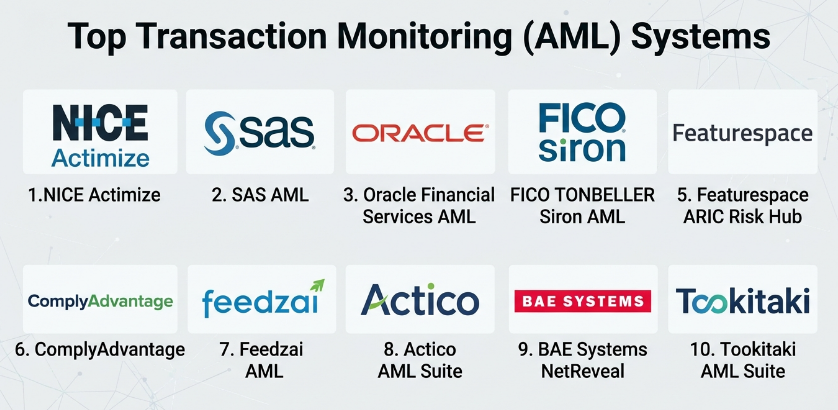
Top 10 Transaction Monitoring (AML) Systems
#1 — NICE Actimize
Short description:
A leading enterprise AML and fraud prevention platform designed for large financial institutions. It offers advanced analytics, AI-driven detection, and strong case management capabilities. Widely used by banks for transaction monitoring and compliance. Suitable for organizations with complex regulatory requirements.
Key Features
- Real-time and batch transaction monitoring
- AI-driven anomaly detection
- Integrated case management
- Risk scoring models
- Regulatory reporting tools
- Behavioral analytics
Pros
- Strong enterprise capabilities
- High scalability
Cons
- Complex implementation
- High cost
Platforms / Deployment
Cloud / Hybrid
Security & Compliance
Supports encryption, RBAC, audit logs; certifications not publicly stated
Integrations & Ecosystem
Integrates with core banking, payment systems, and fraud tools
- APIs for customization
- Data lake integrations
- Third-party analytics tools
Support & Community
Enterprise-grade support; onboarding can be intensive
#2 — SAS AML
Short description:
A robust AML solution powered by advanced analytics and data science. SAS AML is known for its strong statistical modeling and regulatory compliance features. Ideal for institutions requiring deep analytics and customization.
Key Features
- Advanced analytics engine
- Scenario-based monitoring
- Risk scoring
- Data integration capabilities
- Regulatory compliance tools
Pros
- Powerful analytics
- Highly customizable
Cons
- Requires skilled resources
- Expensive
Platforms / Deployment
Cloud / On-premise
Security & Compliance
Encryption, access controls; certifications not publicly stated
Integrations & Ecosystem
Strong integration with enterprise data platforms
- Data warehouse support
- APIs
- BI tools
Support & Community
Strong enterprise support; requires technical expertise
#3 — Oracle Financial Services AML
Short description:
A comprehensive AML platform integrated with Oracle’s financial services suite. Offers strong transaction monitoring, compliance management, and scalability for large enterprises.
Key Features
- Transaction monitoring
- Case management
- Risk scoring
- Regulatory reporting
- Data integration
Pros
- Scalable architecture
- Strong enterprise ecosystem
Cons
- Complex deployment
- Costly
Platforms / Deployment
Cloud / On-premise
Security & Compliance
Enterprise-grade controls; certifications not publicly stated
Integrations & Ecosystem
Deep integration with Oracle ecosystem
- Banking systems
- Data analytics tools
- APIs
Support & Community
Enterprise support; documentation available
#4 — FICO TONBELLER Siron AML
Short description:
A well-established AML platform focused on transaction monitoring and compliance. Known for its flexible deployment and regulatory coverage across regions.
Key Features
- Rule-based monitoring
- Scenario management
- Case management
- Compliance reporting
- Risk assessment
Pros
- Regulatory coverage
- Flexible deployment
Cons
- Less advanced AI features
- UI can feel outdated
Platforms / Deployment
Cloud / On-premise
Security & Compliance
Standard enterprise controls; details not publicly stated
Integrations & Ecosystem
Supports integration with banking systems
- APIs
- Data ingestion tools
Support & Community
Moderate support; enterprise clients supported
#5 — Featurespace ARIC Risk Hub
Short description:
AI-native AML and fraud detection platform using adaptive behavioral analytics. Designed to reduce false positives and improve detection accuracy.
Key Features
- Adaptive behavioral analytics
- Real-time monitoring
- Machine learning models
- Fraud and AML integration
- Risk scoring
Pros
- Strong AI capabilities
- Low false positives
Cons
- Limited legacy system compatibility
- Premium pricing
Platforms / Deployment
Cloud
Security & Compliance
Encryption, access control; certifications not publicly stated
Integrations & Ecosystem
API-first integration approach
- Payment systems
- Banking platforms
- Data pipelines
Support & Community
Strong vendor support; modern documentation
#6 — ComplyAdvantage
Short description:
A modern AML platform offering real-time transaction monitoring and risk intelligence. Popular among fintech startups and mid-sized companies.
Key Features
- Real-time transaction monitoring
- Risk scoring
- Sanctions screening
- API-first design
- Case management
Pros
- Easy to integrate
- Developer-friendly
Cons
- Limited deep customization
- Not ideal for very large banks
Platforms / Deployment
Cloud
Security & Compliance
Supports encryption and access control; certifications not publicly stated
Integrations & Ecosystem
Strong API ecosystem
- Fintech integrations
- Payment gateways
- CRM systems
Support & Community
Good support; strong developer resources
#7 — Feedzai AML
Short description:
AI-driven financial crime prevention platform combining fraud detection and AML monitoring. Designed for real-time decision-making.
Key Features
- AI-driven risk scoring
- Real-time monitoring
- Behavioral analytics
- Fraud and AML integration
- Case management
Pros
- Real-time insights
- Unified fraud + AML
Cons
- High implementation effort
- Premium pricing
Platforms / Deployment
Cloud
Security & Compliance
Encryption, RBAC; certifications not publicly stated
Integrations & Ecosystem
Supports enterprise integrations
- APIs
- Payment platforms
- Banking systems
Support & Community
Enterprise support; onboarding required
#8 — Actico AML Suite
Short description:
A flexible AML platform focused on decision automation and compliance. Known for its rule-based and AI hybrid approach.
Key Features
- Rule engine
- Decision automation
- Risk scoring
- Case management
- Compliance reporting
Pros
- Flexible rules engine
- Good customization
Cons
- Less AI maturity
- UI improvements needed
Platforms / Deployment
Cloud / On-premise
Security & Compliance
Standard controls; certifications not publicly stated
Integrations & Ecosystem
Integrates with enterprise systems
- APIs
- Data platforms
Support & Community
Moderate support; enterprise focus
#9 — BAE Systems NetReveal
Short description:
Enterprise-grade AML and fraud detection platform offering advanced analytics and network-based detection.
Key Features
- Network analytics
- Transaction monitoring
- Case management
- Risk scoring
- Compliance reporting
Pros
- Strong analytics
- Enterprise-grade
Cons
- Complex setup
- Expensive
Platforms / Deployment
Cloud / On-premise
Security & Compliance
Enterprise controls; certifications not publicly stated
Integrations & Ecosystem
Supports large-scale integrations
- Banking systems
- Data lakes
- APIs
Support & Community
Strong enterprise support
#10 — Tookitaki AML Suite
Short description:
AI-powered AML platform focusing on collaborative intelligence and regulatory compliance. Designed for banks and fintechs.
Key Features
- AI-based detection
- Community intelligence
- Risk scoring
- Case management
- Compliance automation
Pros
- Innovative approach
- Good for fintechs
Cons
- Smaller ecosystem
- Limited enterprise adoption
Platforms / Deployment
Cloud
Security & Compliance
Encryption and access controls; certifications not publicly stated
Integrations & Ecosystem
API-based integrations
- Banking systems
- Payment platforms
Support & Community
Growing support ecosystem
Comparison Table (Top 10)
| Tool Name | Best For | Platform(s) Supported | Deployment | Standout Feature | Public Rating |
|---|---|---|---|---|---|
| NICE Actimize | Large banks | Web | Cloud/Hybrid | Enterprise AML suite | N/A |
| SAS AML | Data-heavy orgs | Web | Cloud/On-prem | Advanced analytics | N/A |
| Oracle AML | Enterprises | Web | Cloud/On-prem | Ecosystem integration | N/A |
| FICO TONBELLER | Compliance-heavy orgs | Web | Cloud/On-prem | Regulatory coverage | N/A |
| Featurespace | AI-first fintech | Web | Cloud | Behavioral analytics | N/A |
| ComplyAdvantage | SMB fintech | Web | Cloud | API-first AML | N/A |
| Feedzai | Real-time AML | Web | Cloud | AI risk scoring | N/A |
| Actico | Rule-based automation | Web | Cloud/On-prem | Decision engine | N/A |
| BAE NetReveal | Large enterprises | Web | Cloud/On-prem | Network analytics | N/A |
| Tookitaki | Fintech & banks | Web | Cloud | Collaborative intelligence | N/A |
Evaluation & Transaction Monitoring (AML) Systems
| Tool Name | Core (25%) | Ease (15%) | Integrations (15%) | Security (10%) | Performance (10%) | Support (10%) | Value (15%) | Weighted Total |
|---|---|---|---|---|---|---|---|---|
| NICE Actimize | 9 | 6 | 8 | 8 | 9 | 8 | 6 | 7.95 |
| SAS AML | 9 | 5 | 8 | 8 | 9 | 8 | 5 | 7.70 |
| Oracle AML | 8 | 6 | 9 | 8 | 8 | 8 | 6 | 7.75 |
| FICO TONBELLER | 7 | 6 | 7 | 7 | 7 | 7 | 6 | 6.80 |
| Featurespace | 8 | 7 | 7 | 7 | 8 | 7 | 6 | 7.25 |
| ComplyAdvantage | 7 | 9 | 8 | 7 | 7 | 8 | 8 | 7.85 |
| Feedzai | 9 | 7 | 8 | 8 | 9 | 8 | 6 | 8.10 |
| Actico | 7 | 7 | 7 | 7 | 7 | 7 | 7 | 7.00 |
| BAE NetReveal | 9 | 6 | 8 | 8 | 9 | 8 | 6 | 7.95 |
| Tookitaki | 7 | 8 | 7 | 7 | 7 | 7 | 7 | 7.20 |
How to interpret scores:
These scores are comparative across tools, not absolute benchmarks. A higher score indicates better alignment with enterprise AML needs. Core features carry the most weight, while ease and value reflect usability and ROI. Choose based on your priorities rather than just total score.
Which Transaction Monitoring (AML) Systems
Solo / Freelancer
Not required. Basic fraud detection tools are sufficient.
SMB
Choose ComplyAdvantage or Tookitaki for ease and cost efficiency.
Mid-Market
Feedzai or Featurespace provide balance between AI and scalability.
Enterprise
NICE Actimize, SAS AML, or BAE NetReveal are best for large-scale compliance.
Budget vs Premium
- Budget: ComplyAdvantage, Tookitaki
- Premium: NICE Actimize, SAS AML
Feature Depth vs Ease of Use
- Deep features: SAS AML, Oracle
- Easy to use: ComplyAdvantage
Integrations & Scalability
- Strong integrations: Oracle, NICE Actimize
- Scalable AI: Feedzai
Security & Compliance Needs
- High compliance: NICE Actimize, BAE NetReveal
Frequently Asked Questions (FAQs)
1. What is an AML transaction monitoring system?
It is software that tracks financial transactions to detect suspicious activities and ensure compliance with regulations.
2. How much do AML systems cost?
Pricing varies widely depending on features, scale, and deployment; typically enterprise-level pricing.
3. Are AML systems required for fintech companies?
Yes, especially if handling financial transactions or operating under regulatory frameworks.
4. What is the biggest challenge in AML monitoring?
Reducing false positives while maintaining detection accuracy.
5. Can AML systems work in real-time?
Yes, modern systems support real-time monitoring and alerts.
6. How long does implementation take?
From weeks to months depending on complexity and integrations.
7. Do these systems support APIs?
Most modern AML platforms provide API-based integrations.
8. Can small businesses use AML tools?
Yes, but simpler and cost-effective solutions are more suitable.
9. Are AML systems cloud-based?
Many modern solutions are cloud-native, though hybrid options exist.
10. What happens after a suspicious transaction is detected?
An alert is generated, investigated, and reported if necessary.
Conclusion
Transaction Monitoring (AML) Systems are no longer optional for financial institutions—they are essential for compliance, risk management, and fraud prevention. The market offers a wide range of solutions, from AI-driven platforms like Feedzai and Featurespace to enterprise-grade systems like NICE Actimize and SAS AML. The right choice depends on your organization’s size, regulatory requirements, and technical capabilities. Smaller fintechs may prioritize ease of integration and cost, while large banks need scalability and deep analytics.