Introduction
Algorithmic Trading Platforms are software systems that allow traders, investors, and institutions to automate buying and selling decisions in financial markets using predefined rules or strategies. Instead of manually placing trades, users can create algorithms based on price, volume, timing, or complex mathematical models.
In today’s fast-moving financial markets, these platforms are critical. With increasing data volume, latency-sensitive trading, and AI-driven strategies becoming mainstream, automation is no longer optional—it’s a competitive advantage. Traders now rely on algorithms to execute trades in milliseconds, manage risk, and identify patterns that are impossible to detect manually.
Real-world use cases include:
- High-frequency trading (HFT) by institutions
- Retail traders automating technical strategies
- Portfolio rebalancing using rules-based logic
- Arbitrage opportunities across exchanges
- Quantitative hedge fund strategies
What buyers should evaluate:
- Strategy development capabilities (coding vs no-code)
- Backtesting and simulation accuracy
- Execution speed and latency
- Broker/exchange integrations
- Risk management features
- Scalability and infrastructure
- Security and compliance support
- Cost and pricing model
- Community and support ecosystem
Best for: Quant traders, hedge funds, fintech teams, advanced retail traders, and developers building automated strategies.
Not ideal for: Casual investors, beginners without trading knowledge, or those preferring manual discretionary trading.
Key Trends in Algorithmic Trading Platforms
- AI & Machine Learning Integration: Platforms now support predictive analytics, pattern recognition, and adaptive strategies.
- Low-Code / No-Code Strategy Builders: Making algo trading accessible to non-developers.
- Cloud-Based Trading Infrastructure: Faster deployment, scalability, and reduced hardware dependency.
- API-First Ecosystems: Seamless integration with brokers, data providers, and analytics tools.
- Real-Time Risk Management: Built-in controls to prevent catastrophic losses.
- Multi-Asset Trading: Support for equities, crypto, forex, derivatives in one platform.
- Data-Centric Strategies: Heavy reliance on alternative data sources and big data analytics.
- Regulatory Compliance Tools: Automated reporting and audit trails.
- Backtesting with High Fidelity: Simulation accuracy is becoming a key differentiator.
- Community & Marketplace Growth: Strategy sharing, plugins, and third-party extensions.
How We Selected These Tools (Methodology)
- Evaluated market adoption and brand recognition across retail and institutional segments
- Assessed feature completeness, including backtesting, automation, and execution
- Considered performance and reliability indicators such as uptime and latency
- Reviewed security posture signals where publicly available
- Analyzed integration ecosystems (brokers, APIs, data providers)
- Included tools for multiple user segments (beginner to enterprise)
- Balanced developer-first platforms and GUI-based tools
- Checked community strength and documentation quality
- Considered pricing flexibility and accessibility
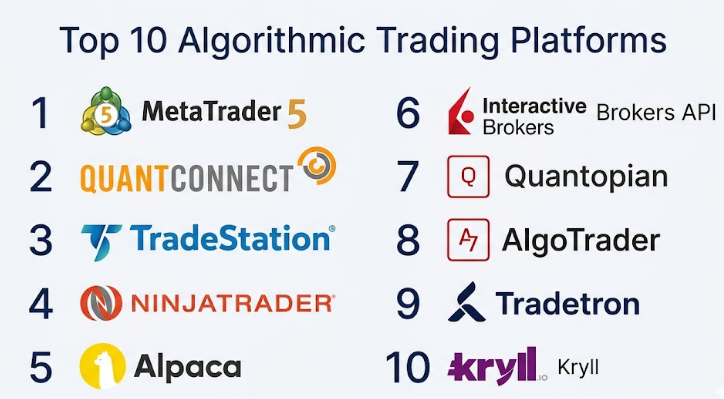
Top 10 Algorithmic Trading Platforms
#1 — MetaTrader 5
Short description:
MetaTrader 5 is a widely used trading platform supporting forex, stocks, and derivatives. It offers built-in algorithmic trading via Expert Advisors (EAs). It is ideal for retail traders and brokers due to its large ecosystem and ease of use. Strong backtesting and automation capabilities make it a go-to platform globally.
Key Features
- Built-in algorithmic trading engine
- Multi-asset support
- Strategy tester with historical data
- Custom indicators and scripts
- Large marketplace for trading bots
Pros
- Massive user community
- Easy onboarding for beginners
Cons
- Limited flexibility compared to custom platforms
- UI feels dated
Platforms / Deployment
Windows / macOS / Web / Mobile
Security & Compliance
MFA supported, other details Not publicly stated
Integrations & Ecosystem
Strong ecosystem with brokers and third-party plugins
- Broker integrations
- Strategy marketplaces
- Data feeds
Support & Community
Very strong community, extensive tutorials and forums
#2 — QuantConnect
Short description:
QuantConnect is a cloud-based algorithmic trading platform designed for quants and developers. It uses Lean engine and supports multiple asset classes. Ideal for developers and hedge funds building advanced strategies.
Key Features
- Cloud-based backtesting
- Multi-language support (Python, C#)
- Large dataset library
- Open-source Lean engine
- Live trading deployment
Pros
- Highly scalable
- Strong developer ecosystem
Cons
- Steep learning curve
- Requires coding skillsTop 10 Algorithmic Trading Platforms Features, Pros, Cons & Comparison
Platforms / Deployment
Cloud
Security & Compliance
Not publicly stated
Integrations & Ecosystem
- Broker APIs
- Data providers
- Open-source contributions
Support & Community
Active developer community and documentation
#3 — TradeStation
Short description:
TradeStation offers a powerful platform for trading and automation with strong analytics tools. It caters to both retail traders and professionals.
Key Features
- EasyLanguage scripting
- Advanced charting
- Strategy automation
- Backtesting tools
- Real-time data
Pros
- Strong analytics
- Reliable execution
Cons
- Limited customization beyond ecosystem
- Pricing varies
Platforms / Deployment
Web / Desktop
Security & Compliance
Not publicly stated
Integrations & Ecosystem
- Brokerage services
- APIs
- Market data integrations
Support & Community
Good support and educational resources
#4 — NinjaTrader
Short description:
NinjaTrader is popular among futures traders and offers advanced charting and automation tools.
Key Features
- Strategy builder
- Backtesting engine
- Custom indicators
- Market replay
- Automated trading
Pros
- Strong for futures trading
- Flexible customization
Cons
- Limited asset class support
- Desktop-focused
Platforms / Deployment
Windows
Security & Compliance
Not publicly stated
Integrations & Ecosystem
- Broker integrations
- Add-ons marketplace
Support & Community
Active community and forums
#5 — Alpaca
Short description:
Alpaca provides API-first trading for developers building algorithmic trading apps. It is widely used in fintech.
Key Features
- Commission-free trading APIs
- Real-time data
- Paper trading
- REST APIs
- Crypto and equities support
Pros
- Developer-friendly
- Easy API integration
Cons
- Limited advanced analytics
- Not ideal for non-coders
Platforms / Deployment
Cloud
Security & Compliance
Not publicly stated
Integrations & Ecosystem
- REST APIs
- Third-party tools
- Fintech integrations
Support & Community
Growing developer community
#6 — Interactive Brokers API
Short description:
Interactive Brokers provides a robust API for institutional-grade algorithmic trading.
Key Features
- Global market access
- Advanced order types
- API integration
- Portfolio management
- Risk controls
Pros
- Institutional-level capabilities
- Wide market access
Cons
- Complex setup
- Requires expertise
Platforms / Deployment
Web / Desktop / API
Security & Compliance
Not publicly stated
Integrations & Ecosystem
- APIs
- Market data
- Third-party platforms
Support & Community
Strong but technical support
#7 — Quantopian (Legacy Influence / Community-based tools)
Short description:
While no longer active as a trading platform, Quantopian influenced many modern platforms and still exists in community tools.
Key Features
- Python-based strategies
- Backtesting tools
- Community-driven models
Pros
- Strong legacy ecosystem
- Educational value
Cons
- Not active platform
- Limited production use
Platforms / Deployment
Varies / N/A
Security & Compliance
Not publicly stated
Integrations & Ecosystem
Community-driven tools
Support & Community
Strong historical community
#8 — AlgoTrader
Short description:
AlgoTrader is an institutional-grade platform for automated trading across multiple asset classes.
Key Features
- Multi-asset trading
- Strategy automation
- Risk management
- Backtesting
- Execution engine
Pros
- Enterprise-grade
- Highly customizable
Cons
- Expensive
- Complex implementation
Platforms / Deployment
Cloud / On-prem
Security & Compliance
Not publicly stated
Integrations & Ecosystem
- Broker integrations
- Data feeds
- APIs
Support & Community
Enterprise-level support
#9 — Tradetron
Short description:
Tradetron is a no-code algorithmic trading platform aimed at retail users.
Key Features
- No-code strategy builder
- Cloud execution
- Marketplace
- Multi-broker support
Pros
- Beginner-friendly
- No coding required
Cons
- Limited advanced control
- Strategy complexity constraints
Platforms / Deployment
Cloud
Security & Compliance
Not publicly stated
Integrations & Ecosystem
- Broker integrations
- Strategy marketplace
Support & Community
Moderate support, growing community
#10 — Kryll
Short description:
Kryll is focused on crypto algorithmic trading with a visual strategy builder.
Key Features
- Drag-and-drop strategy builder
- Crypto exchange integration
- Backtesting
- Marketplace
Pros
- Easy to use
- Crypto-focused
Cons
- Limited to crypto
- Less institutional features
Platforms / Deployment
Web
Security & Compliance
Not publicly stated
Integrations & Ecosystem
- Crypto exchanges
- Strategy marketplace
Support & Community
Growing community
Comparison Table (Top 10)
| Tool Name | Best For | Platform(s) Supported | Deployment | Standout Feature | Public Rating |
|---|---|---|---|---|---|
| MetaTrader 5 | Retail traders | Desktop/Web/Mobile | Hybrid | Expert Advisors | N/A |
| QuantConnect | Developers | Cloud | Cloud | Lean engine | N/A |
| TradeStation | Active traders | Web/Desktop | Hybrid | EasyLanguage | N/A |
| NinjaTrader | Futures traders | Desktop | Local | Market replay | N/A |
| Alpaca | Developers | API/Cloud | Cloud | API-first trading | N/A |
| Interactive Brokers API | Institutions | Web/Desktop/API | Hybrid | Global access | N/A |
| Quantopian | Learning | N/A | N/A | Community models | N/A |
| AlgoTrader | Enterprises | Cloud/On-prem | Hybrid | Multi-asset automation | N/A |
| Tradetron | Beginners | Web | Cloud | No-code builder | N/A |
| Kryll | Crypto traders | Web | Cloud | Visual strategy builder | N/A |
Evaluation & Algorithmic Trading Platforms
| Tool Name | Core | Ease | Integrations | Security | Performance | Support | Value | Weighted Total |
|---|---|---|---|---|---|---|---|---|
| MetaTrader 5 | 9 | 8 | 8 | 6 | 8 | 9 | 9 | 8.2 |
| QuantConnect | 9 | 6 | 9 | 7 | 9 | 8 | 8 | 8.3 |
| TradeStation | 8 | 8 | 7 | 6 | 8 | 7 | 7 | 7.5 |
| NinjaTrader | 8 | 7 | 7 | 6 | 8 | 7 | 7 | 7.4 |
| Alpaca | 7 | 7 | 8 | 6 | 7 | 7 | 8 | 7.3 |
| Interactive Brokers API | 9 | 5 | 9 | 7 | 9 | 7 | 7 | 8.0 |
| Quantopian | 6 | 6 | 6 | 5 | 6 | 6 | 7 | 6.2 |
| AlgoTrader | 9 | 6 | 9 | 7 | 9 | 8 | 6 | 8.1 |
| Tradetron | 7 | 9 | 7 | 6 | 7 | 7 | 8 | 7.6 |
| Kryll | 7 | 8 | 6 | 5 | 7 | 6 | 7 | 6.9 |
How to interpret:
These scores are comparative, not absolute. A higher score reflects better balance across features, usability, and ecosystem. Enterprise tools score high on performance but may rank lower on ease of use. Choose based on your needs, not just total score.
Which Algorithmic Trading Platforms
Solo / Freelancer
- Best: Tradetron, MetaTrader 5, Kryll
- Focus on simplicity, low cost, and ease of strategy building
SMB
- Best: TradeStation, NinjaTrader, Alpaca
- Balance between automation and usability
Mid-Market
- Best: QuantConnect, Interactive Brokers API
- Strong integrations and scalability
Enterprise
- Best: AlgoTrader, QuantConnect
- Advanced infrastructure and multi-asset support
Budget vs Premium
- Budget: Tradetron, Kryll
- Premium: AlgoTrader, QuantConnect
Feature Depth vs Ease of Use
- Feature-rich: QuantConnect, AlgoTrader
- Easy-to-use: Tradetron, MetaTrader
Integrations & Scalability
- Best: Alpaca, Interactive Brokers API
Security & Compliance Needs
- Enterprise-grade platforms are better suited
Frequently Asked Questions (FAQs)
1. What is an algorithmic trading platform?
It is software that allows automated trading using predefined rules and strategies without manual intervention.
2. Do I need coding skills?
Not always. Some platforms offer no-code tools, but advanced strategies require programming.
3. How much do these platforms cost?
Pricing varies widely—from free tiers to enterprise-level subscriptions depending on features.
4. Is algorithmic trading risky?
Yes, poor strategies can lead to losses. Risk management is critical.
5. Can beginners use these platforms?
Yes, beginner-friendly tools like Tradetron exist.
6. What markets are supported?
Most platforms support equities, forex, crypto, and derivatives.
7. How important is backtesting?
Very important—it helps validate strategies before live trading.
8. Are these platforms secure?
Security varies; always check authentication and data protection features.
9. Can I switch platforms easily?
Switching can be complex due to strategy migration and integration dependencies.
10. What alternatives exist?
Manual trading platforms or advisory services are alternatives.
Conclusion
Algorithmic trading platforms have evolved into powerful ecosystems that combine automation, data analysis, and execution speed. Whether you are a beginner experimenting with simple strategies or an institution running complex quantitative models, the right platform depends heavily on your technical skills, trading goals, and scale of operations.