Introduction
Fraud Case Management Tools are specialized platforms used by organizations to track, investigate, manage, and resolve fraud cases efficiently. In simple terms, they help teams organize alerts, assign cases, collect evidence, collaborate, and make decisions faster without losing critical data.
In today’s digital-first environment, fraud has become more sophisticated. With the rise of real-time payments, digital banking, e-commerce, and AI-driven attacks, organizations need structured workflows to handle increasing volumes of fraud alerts and investigations. This is where modern case management tools play a crucial role.
Common real-world use cases include:
- Banking fraud investigations (card fraud, account takeover)
- AML (Anti-Money Laundering) case tracking
- Insurance fraud detection and claims validation
- E-commerce transaction fraud analysis
- Telecom and subscription fraud monitoring
What buyers should evaluate:
- Case workflow automation and customization
- Integration with fraud detection and AML systems
- Audit trails and compliance reporting
- Role-based access and security controls
- AI/ML capabilities for prioritization and triage
- Scalability for high-volume case handling
- Ease of use for analysts and investigators
- Reporting and analytics capabilities
Best for: Financial institutions, fintech companies, payment processors, insurance firms, telecom providers, and large enterprises with dedicated fraud or compliance teams.
Not ideal for: Small teams with minimal fraud exposure or businesses that only need basic ticketing tools—simpler helpdesk or CRM systems may be sufficient in such cases.
Key Trends in Fraud Case Management Tools
- AI-driven case prioritization to reduce analyst workload and highlight high-risk cases
- Automation-first workflows for faster case assignment and resolution
- Unified fraud + AML platforms combining detection, monitoring, and case management
- Real-time collaboration tools for distributed fraud teams
- Explainable AI features to support compliance and regulatory audits
- Cloud-native deployments for scalability and faster updates
- API-first architectures enabling seamless integration with fraud detection engines
- Behavioral analytics integration to enrich case investigations
- Regulatory compliance focus with strong audit trails and reporting
- Low-code/no-code customization for workflows and rules
How We Selected These Tools (Methodology)
- Evaluated market adoption and industry reputation
- Assessed feature completeness for fraud case lifecycle management
- Considered performance and scalability signals in high-volume environments
- Reviewed security posture indicators like access controls and compliance readiness
- Checked integration capabilities with fraud detection, AML, and CRM systems
- Analyzed usability for investigators and analysts
- Ensured coverage across enterprise, mid-market, and flexible platforms
- Looked at vendor ecosystem strength and support models
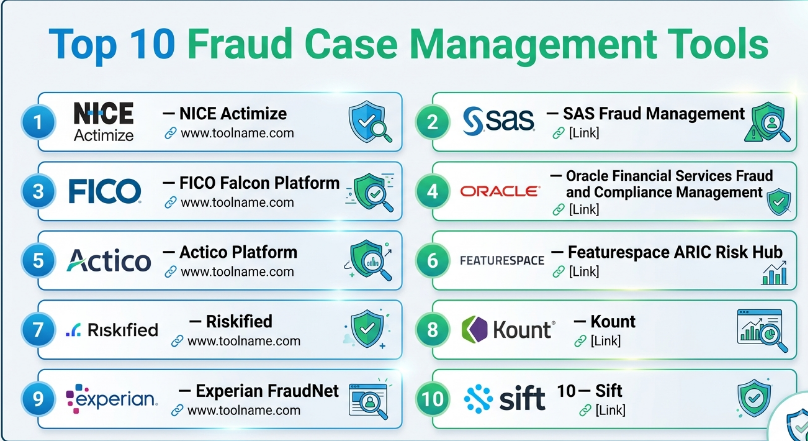
Top 10 Fraud Case Management Tools
#1 — NICE Actimize
Short description :
A widely adopted enterprise-grade fraud and AML platform. NICE Actimize offers strong case management capabilities combined with advanced analytics. It is designed for large financial institutions that need robust workflows, compliance features, and scalability for high-volume fraud operations.
Key Features
- Centralized case management dashboard
- AI-based alert prioritization
- Advanced reporting and analytics
- Workflow automation and routing
- Regulatory compliance tracking
- Cross-channel fraud monitoring
Pros
- Highly scalable for large enterprises
- Strong analytics and reporting capabilities
Cons
- Complex implementation
- Higher cost compared to smaller tools
Platforms / Deployment
Cloud / Hybrid
Security & Compliance
RBAC, audit logs, encryption; other certifications Not publicly stated
Integrations & Ecosystem
Integrates with core banking systems, AML platforms, and data warehouses.
- API integrations
- Data ingestion pipelines
- Third-party analytics tools
Support & Community
Enterprise-grade support with onboarding assistance; community presence limited publicly
#2 — SAS Fraud Management
Short description :
SAS provides a comprehensive fraud management solution with integrated case management. Known for strong analytics and AI capabilities, it is suitable for organizations that need deep data-driven fraud investigation workflows.
Key Features
- AI and machine learning models
- Centralized case lifecycle management
- Real-time fraud detection integration
- Customizable workflows
- Risk scoring engine
Pros
- Powerful analytics capabilities
- Flexible customization options
Cons
- Requires skilled resources
- Implementation complexity
Platforms / Deployment
Cloud / On-premise
Security & Compliance
Not publicly stated
Integrations & Ecosystem
Works with enterprise data platforms and analytics tools.
- APIs for integration
- Data warehouse connectivity
- BI tools compatibility
Support & Community
Strong enterprise support; documentation is comprehensive
#3 — FICO Falcon Platform
Short description :
FICO Falcon is a well-known fraud detection platform with integrated case management. It is widely used in banking for card fraud and transaction monitoring, offering intelligent workflows and decision management.
Key Features
- Real-time fraud detection
- Case workflow management
- Decision engine integration
- Customer behavior analytics
- Alert management
Pros
- Proven track record in banking
- Strong fraud detection integration
Cons
- Limited flexibility for non-banking use cases
- Complex configuration
Platforms / Deployment
Cloud / Hybrid
Security & Compliance
Not publicly stated
Integrations & Ecosystem
Integrates with payment systems and transaction monitoring tools.
- API-based integration
- Banking system connectivity
- Risk engines
Support & Community
Enterprise support with training and onboarding
#4 — Oracle Financial Services Fraud and Compliance Management
Short description :
Oracle offers a unified platform for fraud and compliance, including case management. It is designed for financial institutions needing regulatory alignment and scalable operations.
Key Features
- End-to-end fraud case management
- Regulatory reporting tools
- Workflow automation
- Risk scoring
- Data analytics integration
Pros
- Strong compliance capabilities
- Scalable architecture
Cons
- Complex deployment
- Requires Oracle ecosystem familiarity
Platforms / Deployment
Cloud / On-premise
Security & Compliance
Not publicly stated
Integrations & Ecosystem
Integrates with Oracle financial systems and external tools.
- APIs
- Data platforms
- Financial systems
Support & Community
Enterprise-level support with structured onboarding
#5 — Actico Platform
Short description :
Actico provides decision automation with integrated case management. It is ideal for organizations seeking flexible workflows and rule-based fraud investigation processes.
Key Features
- Decision automation engine
- Case lifecycle tracking
- Workflow customization
- Risk assessment tools
- Reporting dashboards
Pros
- Flexible rule-based system
- Good for mid-sized organizations
Cons
- Smaller ecosystem
- Limited global visibility
Platforms / Deployment
Cloud / On-premise
Security & Compliance
Not publicly stated
Integrations & Ecosystem
Supports integration with fraud detection systems.
- APIs
- Workflow connectors
- Data sources
Support & Community
Moderate support; community visibility limited
#6 — Featurespace ARIC Risk Hub
Short description :
Featurespace offers AI-driven fraud detection with case management capabilities. It is known for adaptive behavioral analytics and is widely used in banking and payments.
Key Features
- Behavioral analytics engine
- Case management workflows
- Real-time fraud detection
- Alert prioritization
- AI-driven insights
Pros
- Strong AI capabilities
- Effective for real-time fraud detection
Cons
- Requires integration effort
- Limited customization in some areas
Platforms / Deployment
Cloud
Security & Compliance
Not publicly stated
Integrations & Ecosystem
Integrates with banking and payment systems.
- APIs
- Data ingestion tools
- Payment gateways
Support & Community
Enterprise support with onboarding assistance
#7 — Riskified
Short description :
Riskified focuses on e-commerce fraud prevention with case handling capabilities. It is ideal for online retailers looking to manage chargebacks and transaction fraud.
Key Features
- Fraud detection for e-commerce
- Case review workflows
- Chargeback management
- AI-based decision engine
- Reporting dashboards
Pros
- Strong for e-commerce use cases
- Easy integration
Cons
- Limited outside retail
- Less customizable workflows
Platforms / Deployment
Cloud
Security & Compliance
Not publicly stated
Integrations & Ecosystem
Works with e-commerce platforms and payment gateways.
- Shopify integrations
- Payment processors
- APIs
Support & Community
Good customer support for merchants
#8 — Kount
Short description :
Kount provides fraud detection and case management solutions tailored for digital businesses. It focuses on identity trust and transaction monitoring.
Key Features
- Identity-based fraud detection
- Case management workflows
- Risk scoring
- Real-time monitoring
- Reporting tools
Pros
- Strong identity fraud detection
- Good for digital platforms
Cons
- Limited enterprise customization
- Reporting can be basic
Platforms / Deployment
Cloud
Security & Compliance
Not publicly stated
Integrations & Ecosystem
Integrates with payment and identity systems.
- APIs
- Payment platforms
- Identity verification tools
Support & Community
Moderate support; documentation available
#9 — Experian FraudNet
Short description :
Experian FraudNet provides fraud detection and case management with strong data-driven insights. It is widely used in financial services and telecom sectors.
Key Features
- Fraud analytics
- Case management system
- Risk scoring
- Identity verification
- Reporting tools
Pros
- Strong data insights
- Wide industry adoption
Cons
- Can be expensive
- Requires integration effort
Platforms / Deployment
Cloud
Security & Compliance
Not publicly stated
Integrations & Ecosystem
Integrates with credit and identity systems.
- APIs
- Data platforms
- CRM systems
Support & Community
Enterprise-level support available
#10 — Sift
Short description :
Sift is a fraud prevention platform with case management features designed for digital businesses. It uses machine learning to detect and manage fraud cases in real time.
Key Features
- AI-based fraud detection
- Case management dashboard
- Real-time monitoring
- Workflow automation
- Reporting tools
Pros
- Easy to use
- Strong for digital businesses
Cons
- Limited enterprise depth
- Less customizable workflows
Platforms / Deployment
Cloud
Security & Compliance
Not publicly stated
Integrations & Ecosystem
Integrates with digital platforms and payment systems.
- APIs
- E-commerce platforms
- Payment gateways
Support & Community
Good support for SMB and mid-market users
Comparison Table (Top 10)
| Tool Name | Best For | Platform(s) Supported | Deployment | Standout Feature | Public Rating |
|---|---|---|---|---|---|
| NICE Actimize | Large banks | Web | Cloud/Hybrid | Advanced analytics | N/A |
| SAS Fraud Management | Data-driven orgs | Web | Cloud/On-prem | AI analytics | N/A |
| FICO Falcon | Card fraud | Web | Cloud/Hybrid | Decision engine | N/A |
| Oracle Financial Services | Compliance-heavy orgs | Web | Cloud/On-prem | Regulatory tools | N/A |
| Actico Platform | Mid-market | Web | Cloud/On-prem | Rule-based workflows | N/A |
| Featurespace ARIC | AI fraud detection | Web | Cloud | Behavioral analytics | N/A |
| Riskified | E-commerce | Web | Cloud | Chargeback handling | N/A |
| Kount | Digital businesses | Web | Cloud | Identity fraud detection | N/A |
| Experian FraudNet | Financial services | Web | Cloud | Data insights | N/A |
| Sift | SMB digital platforms | Web | Cloud | ML-based fraud detection | N/A |
Evaluation & Fraud Case Management Tools
| Tool Name | Core (25%) | Ease (15%) | Integrations (15%) | Security (10%) | Performance (10%) | Support (10%) | Value (15%) | Weighted Total |
|---|---|---|---|---|---|---|---|---|
| NICE Actimize | 9 | 6 | 8 | 8 | 9 | 8 | 6 | 8.0 |
| SAS Fraud Management | 9 | 6 | 8 | 8 | 9 | 8 | 6 | 8.0 |
| FICO Falcon | 9 | 6 | 8 | 8 | 9 | 8 | 6 | 8.0 |
| Oracle Financial Services | 8 | 6 | 8 | 8 | 8 | 8 | 6 | 7.7 |
| Actico Platform | 7 | 7 | 7 | 7 | 7 | 7 | 7 | 7.0 |
| Featurespace ARIC | 8 | 7 | 7 | 7 | 8 | 7 | 7 | 7.5 |
| Riskified | 7 | 8 | 7 | 7 | 8 | 8 | 8 | 7.6 |
| Kount | 7 | 8 | 7 | 7 | 7 | 7 | 8 | 7.4 |
| Experian FraudNet | 8 | 7 | 8 | 8 | 8 | 8 | 6 | 7.8 |
| Sift | 7 | 8 | 7 | 7 | 8 | 8 | 8 | 7.6 |
How to interpret scores:
These scores are comparative and based on category expectations. A higher score does not mean universally better—it reflects fit for complex fraud environments. Enterprise tools score higher on depth, while SMB tools often score better in ease and value.
Which Fraud Case Management Tools
Solo / Freelancer
Basic fraud tools or payment provider dashboards are usually enough. Full case management platforms may be unnecessary.
SMB
Tools like Sift or Riskified provide ease of use and faster deployment without heavy infrastructure.
Mid-Market
Actico or Kount offer a balance between flexibility and cost, making them suitable for growing teams.
Enterprise
NICE Actimize, SAS, and Oracle are best for large-scale operations with compliance requirements.
Budget vs Premium
- Budget: Sift, Kount
- Premium: NICE Actimize, SAS
Feature Depth vs Ease of Use
- Deep features: SAS, NICE Actimize
- Easy to use: Riskified, Sift
Integrations & Scalability
- Strong integrations: Oracle, SAS
- Moderate: Kount, Sift
Security & Compliance Needs
- High compliance: Oracle, NICE Actimize
- Moderate: SMB-focused tools
Frequently Asked Questions (FAQs)
1. What is a fraud case management tool?
It is software that helps organizations manage fraud investigations, track cases, and resolve alerts efficiently.
2. How is it different from fraud detection tools?
Detection tools identify suspicious activity, while case management tools handle investigation and resolution workflows.
3. Are these tools only for banks?
No, they are used across industries including e-commerce, insurance, telecom, and fintech.
4. What is the typical pricing model?
Pricing varies—some use subscription models, others are usage-based depending on transaction volume.
5. How long does implementation take?
Implementation can range from weeks to months depending on complexity and integrations.
6. Do these tools support AI features?
Yes, most modern platforms include AI for risk scoring and case prioritization.
7. Can they integrate with existing systems?
Yes, most tools offer APIs and integrations with fraud detection and CRM systems.
8. Are they compliant with regulations?
Enterprise tools typically support compliance, but exact certifications vary.
9. What are common mistakes when choosing a tool?
Ignoring integration needs, underestimating complexity, and choosing based only on price.
10. Can I switch tools later?
Yes, but migration can be complex, especially with large datasets.
Conclusion
Fraud Case Management Tools have become essential for organizations dealing with increasing fraud complexity and regulatory pressure. While enterprise platforms like NICE Actimize, SAS, and Oracle provide deep capabilities for large-scale operations, tools like Sift, Riskified, and Kount offer simplicity and speed for growing digital businesses. The right choice depends on your scale, industry, compliance needs, and technical maturity. Instead of looking for a single “best” solution, it is more practical to shortlist two or three tools that align with your workflows. Run a pilot, test integrations, validate reporting capabilities, and ensure your team can adopt it effectively before making a final decision.