Introduction
A School Management System (SMS) is a software platform designed to manage and automate the daily operations of schools, including student records, attendance, fees, exams, communication, and administration. In simple terms, it helps schools move from manual paperwork to a centralized digital system that connects teachers, students, parents, and administrators.
In the current digital-first education environment, School Management Systems are becoming essential. Schools are expected to deliver real-time updates, online learning integration, automated processes, and better parent engagement. Modern SMS platforms now include mobile apps, analytics dashboards, and AI-driven insights to improve efficiency and student outcomes.
Real-world use cases:
- Managing admissions and student enrollment workflows
- Automating attendance and exam management
- Handling fee collection and financial tracking
- Enabling parent-teacher communication via portals
- Generating reports for academic and administrative insights
What buyers should evaluate:
- Ease of use for staff and parents
- Mobile access and usability
- Integration with LMS and payment systems
- Customization and scalability
- Security and data privacy
- Reporting and analytics capabilities
- Automation features
- Pricing and deployment flexibility
Best for: Schools (K-12), coaching institutes, private academies, and education groups managing multiple branches.
Not ideal for: Individual tutors or very small setups where simple tools like spreadsheets or basic apps are sufficient.
Key Trends in School Management Systems
- AI-driven insights for student performance and attendance prediction
- Cloud-based platforms replacing traditional on-premise systems
- Mobile-first design for parents, teachers, and students
- Integration with online learning tools (LMS)
- Automation of administrative tasks such as fee collection and report generation
- Digital communication tools (SMS, email, app notifications)
- Self-service portals for parents and students
- Data security and compliance focus
- API-based ecosystems for third-party integrations
- Subscription-based pricing models
How We Selected These Tools (Methodology)
- Evaluated market adoption and popularity in schools
- Assessed feature completeness across academic and administrative workflows
- Reviewed ease of use and user experience
- Considered performance and scalability
- Analyzed security and compliance readiness
- Evaluated integration capabilities with LMS, finance, and communication tools
- Considered fit for different school sizes (small to enterprise)
- Reviewed support quality and onboarding experience
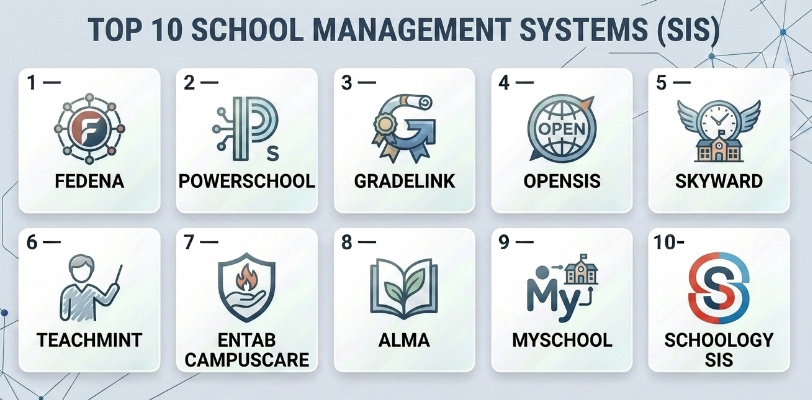
Top 10 School Management Systems
#1 — Fedena
Short description :
Fedena is a widely used School Management System known for its flexibility and global adoption. It supports both small schools and large institutions with customizable modules. It offers tools for attendance, exams, finance, and communication. The platform is suitable for schools looking for a scalable and adaptable solution. It also supports mobile access for better engagement.
Key Features
- Student information management
- Attendance and exam tracking
- Finance and fee management
- Customizable workflows
- Mobile apps
- Reporting and analytics
Pros
- Highly customizable
- Suitable for various school sizes
Cons
- UI may vary across deployments
- Advanced features may require setup
Platforms / Deployment
- Web / iOS / Android
- Cloud / Self-hosted
Security & Compliance
- Basic encryption and RBAC
- Compliance: Not publicly stated
Integrations & Ecosystem
Fedena supports integrations with various educational tools and APIs.
- LMS platforms
- Payment gateways
- API integrations
Support & Community
Moderate support with growing global user base.
#2 — PowerSchool
Short description:
PowerSchool is a comprehensive School Management System widely used in K-12 institutions. It offers a full suite of tools for academic and administrative processes. Known for scalability, it supports large school districts.
Key Features
- Student records management
- Attendance and grading
- Parent portals
- Scheduling tools
- Reporting dashboards
Pros
- Strong ecosystem
- Enterprise scalability
Cons
- Complex setup
- Pricing not transparent
Platforms / Deployment
- Web / Mobile
- Cloud
Security & Compliance
- SSO, encryption
- Compliance: Not publicly stated
Integrations & Ecosystem
- LMS integrations
- Google and Microsoft tools
- APIs
Support & Community
Strong enterprise support and large user base.
#3 — Gradelink
Short description:
Gradelink is a simple and user-friendly School Management System designed for small schools. It focuses on ease of use and affordability.
Key Features
- Gradebook
- Attendance tracking
- Parent communication
- Reporting tools
- Mobile access
Pros
- Easy to use
- Affordable
Cons
- Limited scalability
- Fewer advanced features
Platforms / Deployment
- Web
- Cloud
Security & Compliance
- Basic security
- Compliance: Not publicly stated
Integrations & Ecosystem
- Limited integrations
- Basic API support
Support & Community
Good support for small schools.
#4 — OpenSIS
Short description:
OpenSIS is an open-source School Management System offering flexibility and cost control. It is suitable for schools with technical teams.
Key Features
- Student records
- Scheduling
- Attendance tracking
- Reporting
- Open-source customization
Pros
- Cost-effective
- Customizable
Cons
- Requires technical expertise
- Limited official support
Platforms / Deployment
- Web
- Self-hosted
Security & Compliance
- Depends on deployment
- Compliance: Not publicly stated
Integrations & Ecosystem
- Custom integrations
- APIs
- LMS compatibility
Support & Community
Community-driven support.
#5 — Skyward
Short description:
Skyward is a reliable School Management System used by many school districts. It focuses on administrative efficiency and user-friendly workflows.
Key Features
- Student data management
- Attendance tracking
- Financial tools
- Parent portals
- Reporting tools
Pros
- Easy to use
- Reliable system
Cons
- Limited advanced analytics
- Customization constraints
Platforms / Deployment
- Web
- Cloud / Hybrid
Security & Compliance
- MFA, encryption
- Compliance: Not publicly stated
Integrations & Ecosystem
- LMS integrations
- Financial systems
- APIs
Support & Community
Good onboarding and support.
#6 — Teachmint
Short description:
Teachmint is a modern School Management System designed for digital-first schools and coaching institutes. It combines teaching and administration features.
Key Features
- Attendance tracking
- Fee management
- Communication tools
- Online classes support
- Mobile-first platform
Pros
- Strong mobile experience
- Easy setup
Cons
- Limited enterprise features
- Less suitable for large institutions
Platforms / Deployment
- Web / Android / iOS
- Cloud
Security & Compliance
- Basic security features
- Compliance: Not publicly stated
Integrations & Ecosystem
- Payment integrations
- Communication tools
- APIs
Support & Community
Good support for SMB segment.
#7 — Entab CampusCare
Short description:
CampusCare is a School Management System focused on Indian schools. It provides tools for administration, academics, and communication.
Key Features
- Student data management
- Fee management
- Attendance tracking
- Parent communication
- Reporting tools
Pros
- Localized features
- Affordable
Cons
- Limited global scalability
- UI improvements needed
Platforms / Deployment
- Web / Mobile
- Cloud
Security & Compliance
- Basic encryption
- Compliance: Not publicly stated
Integrations & Ecosystem
- Payment gateways
- SMS integrations
- APIs
Support & Community
Strong regional support.
#8 — Alma
Short description:
Alma is a modern School Management System focused on usability and analytics. It is designed for K-12 schools.
Key Features
- Real-time dashboards
- Attendance tracking
- Parent portals
- Analytics tools
- Cloud-based system
Pros
- Modern interface
- Easy to use
Cons
- Limited enterprise features
- Feature gaps for large schools
Platforms / Deployment
- Web
- Cloud
Security & Compliance
- Encryption, RBAC
- Compliance: Not publicly stated
Integrations & Ecosystem
- LMS integrations
- APIs
- Reporting tools
Support & Community
Responsive support.
#9 — MySchool
Short description:
MySchool is a simple School Management System designed for small to mid-sized schools. It focuses on essential administrative tasks.
Key Features
- Student records
- Attendance tracking
- Fee management
- Communication tools
- Reporting
Pros
- Simple interface
- Affordable
Cons
- Limited advanced features
- Scalability issues
Platforms / Deployment
- Web
- Cloud
Security & Compliance
- Basic security
- Compliance: Not publicly stated
Integrations & Ecosystem
- Basic integrations
- APIs
Support & Community
Moderate support.
#10 — Schoology SIS (via LMS integration)
Short description:
Schoology, primarily an LMS, offers SIS-like capabilities when integrated with school systems. It is useful for institutions focused on digital learning.
Key Features
- Learning management integration
- Gradebook
- Communication tools
- Analytics
- Mobile access
Pros
- Strong LMS integration
- Good user experience
Cons
- Not a full SIS standalone
- Requires integrations
Platforms / Deployment
- Web / Mobile
- Cloud
Security & Compliance
- SSO, encryption
- Compliance: Not publicly stated
Integrations & Ecosystem
- LMS ecosystem
- APIs
- Third-party tools
Support & Community
Strong documentation and community.
Comparison Table (Top 10)
| Tool Name | Best For | Platform(s) Supported | Deployment | Standout Feature | Public Rating |
|---|---|---|---|---|---|
| Fedena | All sizes | Web/Mobile | Hybrid | Customization | N/A |
| PowerSchool | Large schools | Web/Mobile | Cloud | Full ecosystem | N/A |
| Gradelink | Small schools | Web | Cloud | Simplicity | N/A |
| OpenSIS | Tech-savvy schools | Web | Self-hosted | Open-source | N/A |
| Skyward | Schools | Web | Hybrid | Ease of use | N/A |
| Teachmint | Coaching/SMB | Web/Mobile | Cloud | Mobile-first | N/A |
| CampusCare | Indian schools | Web/Mobile | Cloud | Local features | N/A |
| Alma | K-12 schools | Web | Cloud | Modern UI | N/A |
| MySchool | SMB schools | Web | Cloud | Simplicity | N/A |
| Schoology SIS | Digital learning | Web/Mobile | Cloud | LMS integration | N/A |
Evaluation & School Management Systems
| Tool Name | Core | Ease | Integrations | Security | Performance | Support | Value | Weighted Total |
|---|---|---|---|---|---|---|---|---|
| Fedena | 8 | 8 | 7 | 7 | 8 | 7 | 8 | 7.8 |
| PowerSchool | 9 | 7 | 9 | 8 | 9 | 8 | 7 | 8.4 |
| Gradelink | 6 | 9 | 5 | 6 | 7 | 8 | 9 | 7.1 |
| OpenSIS | 6 | 6 | 6 | 6 | 7 | 6 | 9 | 6.8 |
| Skyward | 8 | 8 | 7 | 7 | 8 | 8 | 8 | 7.9 |
| Teachmint | 7 | 9 | 7 | 6 | 7 | 8 | 8 | 7.6 |
| CampusCare | 7 | 8 | 6 | 6 | 7 | 8 | 8 | 7.3 |
| Alma | 7 | 9 | 7 | 7 | 7 | 8 | 8 | 7.6 |
| MySchool | 6 | 8 | 5 | 6 | 7 | 7 | 8 | 6.9 |
| Schoology SIS | 7 | 8 | 8 | 7 | 8 | 8 | 7 | 7.7 |
Interpretation:
Scores are comparative and highlight relative strengths across tools. Higher scores indicate better overall capability, but the best choice depends on your institution’s size, budget, and requirements.
Which School Management Systems
Solo / Freelancer
Not recommended. Use simple tools like spreadsheets.
SMB
- Best: Gradelink, Teachmint, MySchool
- Focus on affordability and ease of use
Mid-Market
- Best: Fedena, Skyward, Alma
- Balance features and usability
Enterprise
- Best: PowerSchool
- Focus on scalability and integrations
Budget vs Premium
- Budget: OpenSIS, Gradelink
- Premium: PowerSchool
Feature Depth vs Ease of Use
- Feature depth: PowerSchool
- Ease of use: Teachmint, Alma
Integrations & Scalability
- High: PowerSchool
- Moderate: Fedena, Skyward
Security & Compliance Needs
- Enterprise: PowerSchool
- Basic: OpenSIS, MySchool
Frequently Asked Questions (FAQs)
1. What is a School Management System?
It is software that helps schools manage student data, attendance, fees, and communication.
2. How much does it cost?
Costs vary depending on features and size, typically subscription-based.
3. Is cloud-based SMS better?
Cloud systems offer scalability and ease of maintenance.
4. Can SMS integrate with LMS?
Yes, most modern systems support LMS integrations.
5. Is it secure?
Most platforms offer encryption and access controls, but compliance varies.
6. Can small schools use SMS?
Yes, tools like Gradelink and Teachmint are ideal.
7. How long does implementation take?
It can take weeks to months depending on complexity.
8. What are common mistakes?
Choosing based only on price and ignoring integrations.
9. Can SMS handle finances?
Yes, many systems include fee management modules.
10. Is switching difficult?
Yes, due to data migration and training requirements.
Conclusion
School Management Systems have become essential for modern educational institutions. They streamline operations, improve communication, and enable better decision-making through data. However, the right choice depends on your specific needs. Large schools may require enterprise-grade solutions like PowerSchool, while smaller institutions benefit from simpler tools like Gradelink or Teachmint. Instead of searching for a single “best” solution, shortlist a few options, test them in real scenarios, and evaluate their usability, integrations, and scalability. This approach ensures you choose a system that truly fits your institution’s long-term goals.