Introduction
Laboratory Information Management Systems (LIMS) are specialized platforms designed to manage laboratory workflows, track samples, store test data, and ensure compliance across research, healthcare, and industrial labs. In simple terms, a LIMS replaces manual tracking (spreadsheets, paper logs) with a centralized system that improves accuracy, traceability, and efficiency.
In today’s environment, labs deal with massive data volumes, strict regulatory requirements, and the need for faster results. A modern LIMS helps automate repetitive tasks, maintain audit trails, and integrate with lab instruments—making it critical for labs operating at scale.
Common use cases include:
- Clinical diagnostics and pathology labs
- Pharmaceutical R&D and drug discovery
- Environmental testing labs
- Food safety and quality testing
- Biotech and genomics research
What buyers should evaluate:
- Sample tracking and workflow automation
- Regulatory compliance (GxP, FDA, ISO)
- Instrument integration capabilities
- Data integrity and audit trails
- Scalability and performance
- User interface and ease of use
- Customization and configuration flexibility
- Integration with ERP, ELN, and analytics tools
- Cost and implementation complexity
Best for: Clinical labs, pharma companies, biotech firms, and research organizations managing high volumes of samples and regulatory workflows.
Not ideal for: Small labs with minimal data complexity or teams needing only basic record-keeping (simple tools may suffice).
Key Trends in Laboratory Information Management Systems (LIMS)
- AI-driven data validation to reduce manual errors and improve quality control
- Cloud-native LIMS adoption for scalability and remote access
- Automation of lab workflows including sample lifecycle and reporting
- Integration with IoT-enabled lab instruments for real-time data capture
- Advanced analytics and dashboards for decision-making
- Stronger regulatory compliance frameworks (GxP, FDA, ISO)
- API-first architectures enabling ecosystem integrations
- Mobile-friendly interfaces for field and lab access
- Electronic lab notebook (ELN) convergence with LIMS platforms
- Subscription-based pricing models replacing traditional licensing
How We Selected These Tools (Methodology)
- Evaluated market presence and industry adoption across healthcare, pharma, and research
- Assessed feature depth in sample management and workflows
- Considered performance and reliability in high-volume environments
- Reviewed security and compliance readiness
- Analyzed integration capabilities with lab instruments and enterprise systems
- Included tools suitable for SMB, mid-market, and enterprise labs
- Balanced modern cloud solutions and legacy enterprise systems
- Focused on user experience and configurability
- Prioritized platforms supporting future-ready lab operations
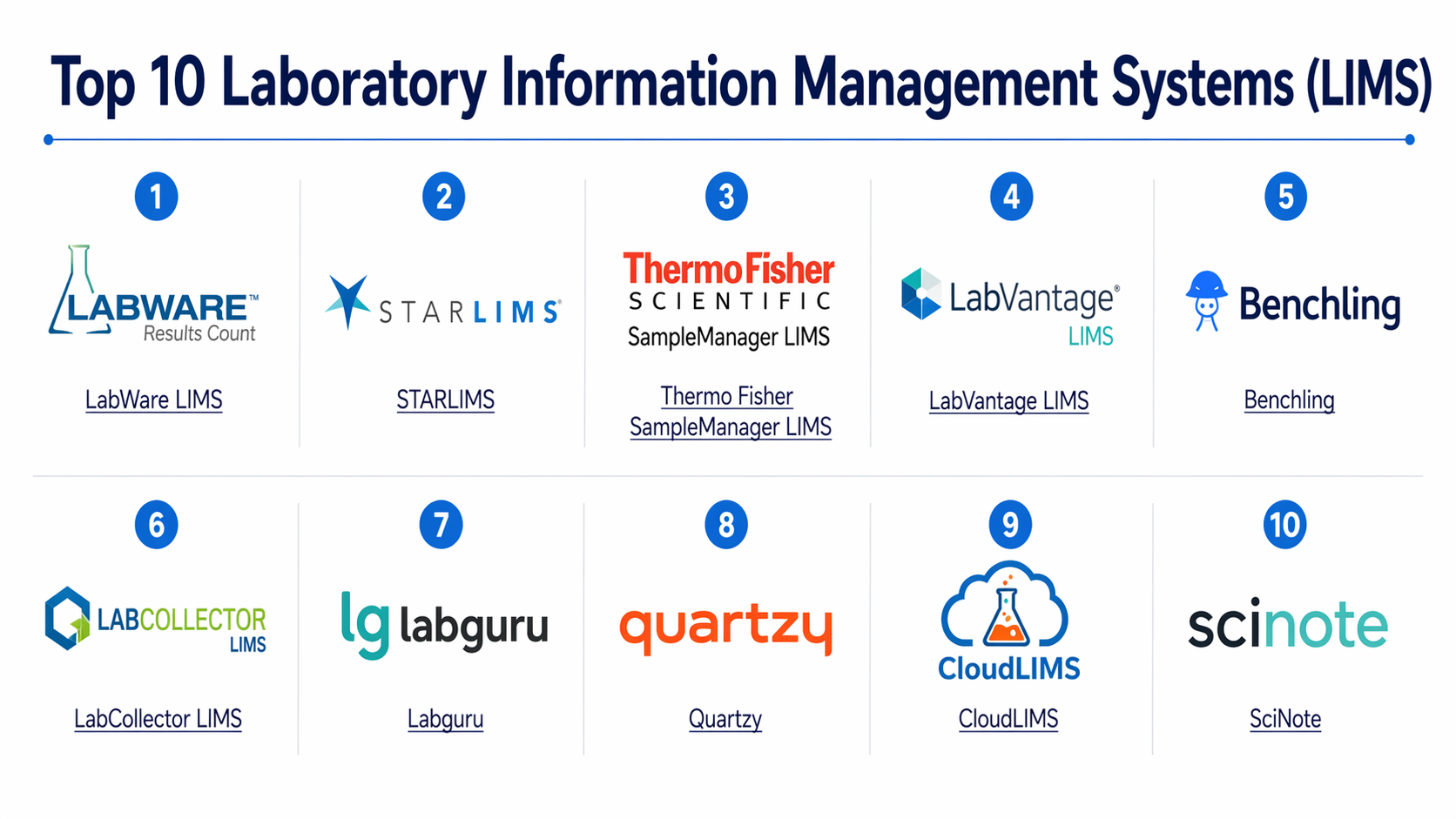
Top 10 Laboratory Information Management Systems (LIMS)
#1 — LabWare LIMS
Short description :
LabWare LIMS is one of the most widely used enterprise LIMS platforms. It provides comprehensive sample tracking, workflow automation, and compliance features. Designed for highly regulated industries, it supports complex lab operations. It is best suited for large organizations requiring customization and scalability.
Key Features
- Advanced workflow automation
- Sample lifecycle management
- Compliance and audit trails
- Instrument integration
- Reporting and analytics
Pros
- Highly customizable
- Strong regulatory support
Cons
- Complex implementation
- Requires training
Platforms / Deployment
Web / Windows / Cloud / Self-hosted / Hybrid
Security & Compliance
RBAC, audit logs, compliance frameworks – Not publicly stated
Integrations & Ecosystem
Extensive integration capabilities with enterprise systems and instruments
- ERP systems
- Laboratory instruments
- APIs
Support & Community
Strong enterprise support; onboarding may require consultants
#2 — STARLIMS
Short description :
STARLIMS is a cloud-based LIMS platform focused on regulated industries such as healthcare and pharma. It offers end-to-end lab management with strong compliance features.
Key Features
- Sample tracking
- Workflow automation
- Compliance management
- Data analytics
- Mobile access
Pros
- Cloud-native
- Strong compliance features
Cons
- Customization complexity
- Pricing not transparent
Platforms / Deployment
Web / Cloud
Security & Compliance
SSO, audit trails – Not publicly stated
Integrations & Ecosystem
Integrates with lab systems and enterprise tools
- APIs
- Instrument integrations
- ERP systems
Support & Community
Enterprise-grade support
#3 — Thermo Fisher SampleManager LIMS
Short description :
SampleManager LIMS is a robust platform designed for complex laboratories. It supports end-to-end data management and integrates with lab instruments.
Key Features
- Sample tracking
- Data management
- Workflow automation
- Instrument integration
- Reporting
Pros
- Strong enterprise capabilities
- Reliable performance
Cons
- Expensive
- Requires setup effort
Platforms / Deployment
Web / Cloud / On-premise
Security & Compliance
Not publicly stated
Integrations & Ecosystem
Strong integration ecosystem
- Lab instruments
- APIs
- Enterprise tools
Support & Community
Good enterprise support
#4 — LabVantage LIMS
Short description :
LabVantage offers a modern LIMS platform with integrated ELN capabilities. It supports research, QA/QC, and manufacturing labs.
Key Features
- LIMS + ELN integration
- Workflow automation
- Data analytics
- Compliance tracking
- Sample management
Pros
- Unified platform
- Scalable
Cons
- Learning curve
- Configuration effort
Platforms / Deployment
Web / Cloud / Hybrid
Security & Compliance
Not publicly stated
Integrations & Ecosystem
Supports enterprise integrations
- APIs
- ERP systems
- Instruments
Support & Community
Strong enterprise support
#5 — Benchling
Short description :
Benchling is a cloud-based platform combining LIMS, ELN, and data management. It is widely used in biotech and life sciences.
Key Features
- Sample tracking
- Data management
- Collaboration tools
- Workflow automation
- Analytics
Pros
- Modern UI
- Strong collaboration
Cons
- Expensive
- Not ideal for all industries
Platforms / Deployment
Web / Cloud
Security & Compliance
SSO, encryption – Not publicly stated
Integrations & Ecosystem
Strong integration ecosystem
- APIs
- Bioinformatics tools
- Cloud services
Support & Community
Strong support and onboarding
#6 — LabCollector LIMS
Short description :
LabCollector is a flexible LIMS designed for small to mid-sized labs. It provides modular features and customization.
Key Features
- Sample tracking
- Data storage
- Workflow management
- Modular design
- Reporting
Pros
- Affordable
- Flexible
Cons
- Limited enterprise features
- UI not modern
Platforms / Deployment
Web / Self-hosted / Cloud
Security & Compliance
Not publicly stated
Integrations & Ecosystem
Supports integrations via APIs
- Instruments
- Data tools
Support & Community
Moderate support
#7 — Labguru
Short description :
Labguru is a cloud-based LIMS and ELN platform focused on life sciences labs. It simplifies data management and collaboration.
Key Features
- Sample tracking
- ELN integration
- Workflow automation
- Inventory management
- Reporting
Pros
- Easy to use
- Good collaboration
Cons
- Limited scalability
- Fewer advanced features
Platforms / Deployment
Web / Cloud
Security & Compliance
Not publicly stated
Integrations & Ecosystem
Supports integrations with lab tools
- APIs
- Instrument connections
Support & Community
Good onboarding and support
#8 — Quartzy
Short description :
Quartzy is a lightweight LIMS focused on inventory and lab management. It is popular among academic labs.
Key Features
- Inventory management
- Order tracking
- Sample tracking
- Collaboration
- Reporting
Pros
- Easy setup
- Affordable
Cons
- Limited advanced LIMS features
- Not enterprise-grade
Platforms / Deployment
Web / Cloud
Security & Compliance
Not publicly stated
Integrations & Ecosystem
Basic integrations
- APIs
- Procurement tools
Support & Community
Moderate support
#9 — CloudLIMS
Short description :
CloudLIMS is a SaaS-based LIMS platform designed for clinical and testing labs. It focuses on compliance and automation.
Key Features
- Sample tracking
- Workflow automation
- Compliance management
- Reporting
- Multi-tenant architecture
Pros
- Cloud-native
- Good compliance features
Cons
- Limited customization
- Smaller ecosystem
Platforms / Deployment
Web / Cloud
Security & Compliance
Audit logs, compliance features – Not publicly stated
Integrations & Ecosystem
Supports integrations
- APIs
- Lab instruments
Support & Community
Good customer support
#10 — SciNote
Short description :
SciNote is an ELN with LIMS-like capabilities designed for research labs. It supports compliance and collaboration.
Key Features
- Experiment tracking
- Data storage
- Collaboration
- Compliance tracking
- Reporting
Pros
- Easy to use
- Affordable
Cons
- Limited full LIMS capabilities
- Not ideal for large enterprises
Platforms / Deployment
Web / Cloud / Self-hosted
Security & Compliance
Not publicly stated
Integrations & Ecosystem
Supports integrations
- APIs
- Lab tools
Support & Community
Active community and support
Comparison Table (Top 10)
| Tool Name | Best For | Platform(s) Supported | Deployment | Standout Feature | Public Rating |
|---|---|---|---|---|---|
| LabWare LIMS | Enterprise labs | Web, Windows | Hybrid | Deep customization | N/A |
| STARLIMS | Regulated industries | Web | Cloud | Compliance focus | N/A |
| SampleManager LIMS | Large labs | Web | Hybrid | Instrument integration | N/A |
| LabVantage LIMS | Research & QA | Web | Hybrid | LIMS + ELN | N/A |
| Benchling | Biotech | Web | Cloud | Modern collaboration | N/A |
| LabCollector | SMB labs | Web | Hybrid | Modular design | N/A |
| Labguru | Life sciences | Web | Cloud | Ease of use | N/A |
| Quartzy | Academic labs | Web | Cloud | Inventory focus | N/A |
| CloudLIMS | Clinical labs | Web | Cloud | SaaS compliance | N/A |
| SciNote | Research labs | Web | Hybrid | ELN + LIMS | N/A |
Evaluation & Laboratory Information Management Systems
| Tool Name | Core (25%) | Ease (15%) | Integrations (15%) | Security (10%) | Performance (10%) | Support (10%) | Value (15%) | Weighted Total |
|---|---|---|---|---|---|---|---|---|
| LabWare LIMS | 9 | 6 | 8 | 8 | 9 | 8 | 7 | 8.1 |
| STARLIMS | 8 | 7 | 7 | 8 | 8 | 8 | 7 | 7.8 |
| SampleManager | 9 | 6 | 8 | 8 | 9 | 8 | 6 | 8.0 |
| LabVantage | 8 | 7 | 8 | 7 | 8 | 8 | 7 | 7.8 |
| Benchling | 8 | 8 | 8 | 7 | 8 | 8 | 6 | 7.8 |
| LabCollector | 7 | 7 | 6 | 6 | 7 | 7 | 8 | 7.0 |
| Labguru | 7 | 8 | 6 | 6 | 7 | 7 | 7 | 7.1 |
| Quartzy | 6 | 9 | 5 | 6 | 6 | 7 | 8 | 6.9 |
| CloudLIMS | 7 | 7 | 6 | 7 | 7 | 7 | 7 | 7.0 |
| SciNote | 6 | 8 | 6 | 6 | 7 | 7 | 8 | 7.0 |
How to interpret scores:
- Scores compare tools within this category.
- Enterprise tools score higher in performance and compliance.
- Cloud tools score higher in ease of use.
- Open or lightweight tools often score higher in value.
Which Laboratory Information Management Systems
Solo / Freelancer
- Quartzy, SciNote
Simple, low-cost, easy setup
SMB
- LabCollector, Labguru
Balanced features and usability
Mid-Market
- CloudLIMS, Benchling
Good scalability and automation
Enterprise
- LabWare, STARLIMS, SampleManager
Advanced compliance and performance
Budget vs Premium
- Budget: Quartzy, SciNote
- Premium: LabWare, Benchling
Feature Depth vs Ease of Use
- Easy: Quartzy, Labguru
- Advanced: LabWare, SampleManager
Integrations & Scalability
- High: LabWare, Benchling
- Moderate: CloudLIMS
Security & Compliance Needs
- High: STARLIMS, LabWare
- Moderate: CloudLIMS
Frequently Asked Questions (FAQs)
1. What is a LIMS system?
A LIMS is software used to manage lab data, workflows, and sample tracking in a centralized system.
2. Who uses LIMS platforms?
Clinical labs, research institutions, biotech firms, and manufacturing labs use LIMS.
3. How much does a LIMS cost?
Costs vary from affordable SaaS subscriptions to expensive enterprise deployments.
4. Is cloud LIMS better than on-premise?
Cloud LIMS offers scalability and ease of access, while on-premise offers more control.
5. Can LIMS integrate with lab instruments?
Yes, most modern LIMS platforms support instrument integration.
6. How long does implementation take?
It can range from weeks to months depending on complexity.
7. Are LIMS systems secure?
Most provide encryption, audit trails, and compliance features.
8. What are common mistakes when choosing LIMS?
Ignoring scalability, poor integration planning, and underestimating implementation effort.
9. Can I switch LIMS platforms later?
Yes, but migration can be complex and requires planning.
10. Do small labs need LIMS?
Only if they handle significant data or require compliance tracking.
Conclusion
Laboratory Information Management Systems have become essential tools for modern laboratories that need to manage large volumes of data, ensure compliance, and improve operational efficiency. From sample tracking to workflow automation and reporting, LIMS platforms bring structure and reliability to lab operations.