Introduction
A Clinical Trial Management System (CTMS) is software used by research organizations, pharmaceutical companies, and clinical sites to plan, track, and manage clinical trials from start to finish. In simple terms, it acts as the central hub where all trial-related activities—patient enrollment, site management, budgeting, compliance, and reporting—are coordinated.
In today’s environment, where clinical trials are becoming more complex, decentralized, and globally distributed, CTMS platforms are no longer optional—they are essential. Regulatory pressure, real-time data needs, and the push for faster drug development have made digital coordination critical.
Real-world use cases include:
- Managing multi-site clinical trials across regions
- Tracking patient recruitment and retention
- Budgeting and financial tracking for trials
- Monitoring compliance with regulatory standards
- Coordinating CROs, sponsors, and investigators
What buyers should evaluate:
- Ease of use and user interface
- Integration with EDC, eTMF, and other systems
- Compliance capabilities (HIPAA, GDPR, audit trails)
- Reporting and analytics features
- Scalability for global trials
- Automation and workflow management
- Deployment flexibility (cloud vs hybrid)
- Vendor support and onboarding
Best for: Pharma companies, CROs, research hospitals, biotech firms, and academic research institutions handling structured clinical trials.
Not ideal for: Small clinics or research teams with minimal trial complexity—basic project management tools may suffice.
Key Trends in Clinical Trial Management Systems (CTMS)
- AI-driven patient recruitment improving enrollment speed and targeting
- Decentralized clinical trials (DCT) support with remote monitoring tools
- Integration-first platforms connecting EDC, ePRO, and eTMF systems
- Real-time dashboards and predictive analytics for trial performance
- Cloud-native deployment models for global scalability
- Automation of workflows like site activation and compliance tracking
- Enhanced compliance frameworks for global regulations (GDPR, HIPAA)
- Mobile accessibility for investigators and site staff
- Risk-based monitoring (RBM) embedded into workflows
- API-first architectures enabling ecosystem expansion
How We Selected These Tools (Methodology)
- Strong market adoption and industry reputation
- Proven feature depth in clinical trial workflows
- Reliable performance across large-scale deployments
- Demonstrated compliance capabilities and audit readiness
- Integration support with EDC, eTMF, and other clinical systems
- Coverage across enterprise and mid-market segments
- Vendor maturity and customer support ecosystem
- Flexibility for global trials and multi-site coordination
- Feedback signals from clinical operations teams
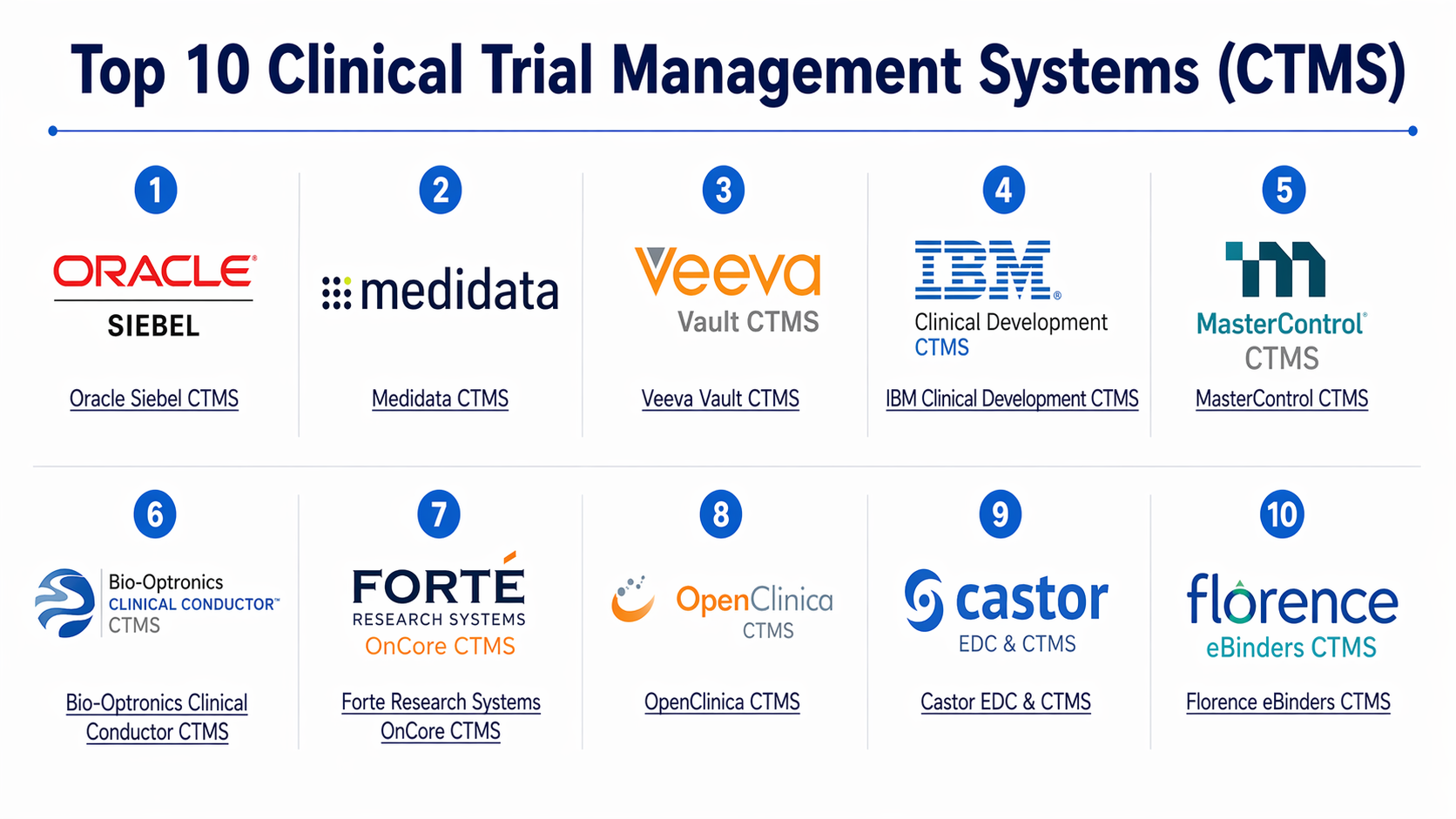
Top 10 Clinical Trial Management Systems (CTMS)
#1 — Oracle Siebel CTMS
Short description :
Oracle Siebel CTMS is a widely used enterprise-grade system designed for large pharmaceutical companies managing complex global trials. It offers deep functionality for trial planning, site management, and financial tracking. Known for its scalability, it supports high-volume operations. It is often used in combination with Oracle’s broader healthcare ecosystem. Best suited for organizations with advanced compliance needs.
Key Features
- Comprehensive trial lifecycle management
- Advanced reporting and analytics
- Site and investigator tracking
- Budgeting and financial management
- Workflow automation
- Integration with Oracle Health systems
Pros
- Highly scalable for enterprise trials
- Strong reporting capabilities
Cons
- Complex implementation
- Requires training for full utilization
Platforms / Deployment
- Web / Cloud / Hybrid
Security & Compliance
- RBAC, audit logs, encryption; others Not publicly stated
Integrations & Ecosystem
Oracle ecosystem integration is a major strength.
- EDC systems
- eTMF platforms
- Financial systems
- APIs for extensions
Support & Community
Strong enterprise support; documentation is extensive but complex.
#2 — Medidata CTMS
Short description :
Medidata CTMS is part of the Medidata Rave platform and is widely used for integrated clinical data management. It focuses on real-time visibility and operational efficiency. Known for strong analytics and seamless integration with EDC. Ideal for data-driven trial management environments.
Key Features
- Real-time dashboards
- Patient recruitment tracking
- Integration with Rave EDC
- Financial tracking
- Workflow automation
Pros
- Strong data integration
- User-friendly dashboards
Cons
- Premium pricing
- Dependency on Medidata ecosystem
Platforms / Deployment
- Web / Cloud
Security & Compliance
- Not publicly stated
Integrations & Ecosystem
Tightly integrated with Medidata products.
- EDC
- ePRO
- Analytics tools
Support & Community
Strong vendor support and onboarding programs.
#3 — Veeva Vault CTMS
Short description :
Veeva Vault CTMS is a modern cloud-based system built for life sciences companies. It offers unified management across clinical operations and documents. Known for its usability and compliance features. Ideal for organizations looking for a modern platform with strong regulatory alignment.
Key Features
- Unified CTMS and eTMF
- Cloud-native architecture
- Real-time reporting
- Compliance tracking
- Workflow automation
Pros
- Easy to use
- Strong compliance support
Cons
- Limited customization flexibility
- Premium pricing
Platforms / Deployment
- Web / Cloud
Security & Compliance
- Not publicly stated
Integrations & Ecosystem
Strong API ecosystem.
- CRM systems
- EDC tools
- Document management systems
Support & Community
Excellent onboarding and documentation.
#4 — IBM Clinical Development CTMS
Short description :
IBM CTMS is designed for decentralized and hybrid clinical trials. It provides flexibility for modern trial designs. Known for remote monitoring capabilities and analytics. Suitable for organizations adopting digital-first trials.
Key Features
- Remote trial management
- Data analytics
- Patient engagement tools
- Risk-based monitoring
Pros
- Supports decentralized trials
- Strong analytics
Cons
- Limited customization
- Smaller ecosystem
Platforms / Deployment
- Web / Cloud
Security & Compliance
- Not publicly stated
Integrations & Ecosystem
- Data analytics tools
- APIs
- External systems
Support & Community
Moderate support ecosystem.
#5 — MasterControl CTMS
Short description :
MasterControl CTMS focuses on compliance-heavy industries. It integrates quality management with clinical trial tracking. Ideal for regulated environments like biotech and medical devices.
Key Features
- Compliance management
- Document control
- Audit readiness
- Workflow automation
Pros
- Strong compliance tools
- Good for regulated industries
Cons
- Limited flexibility
- Complex setup
Platforms / Deployment
- Web / Cloud
Security & Compliance
- Not publicly stated
Integrations & Ecosystem
- QMS systems
- Document systems
- APIs
Support & Community
Strong compliance-focused support.
#6 — Bio-Optronics Clinical Conductor CTMS
Short description :
Clinical Conductor is popular among research sites and CROs. It provides a balance of usability and functionality. Known for budgeting and site management tools.
Key Features
- Budget tracking
- Patient tracking
- Site management
- Reporting tools
Pros
- User-friendly
- Good for mid-sized organizations
Cons
- Limited enterprise scalability
- Basic analytics
Platforms / Deployment
- Web / Cloud
Security & Compliance
- Not publicly stated
Integrations & Ecosystem
- EDC
- Financial tools
- APIs
Support & Community
Good customer support for mid-market users.
#7 — Forte Research Systems OnCore CTMS
Short description :
OnCore CTMS is widely used in academic research institutions. It provides tools for study management and compliance tracking. Known for flexibility in research settings.
Key Features
- Study tracking
- Financial management
- Compliance workflows
- Reporting
Pros
- Academic-focused
- Flexible workflows
Cons
- Older UI
- Limited automation
Platforms / Deployment
- Web / Cloud
Security & Compliance
- Not publicly stated
Integrations & Ecosystem
- EHR systems
- Research tools
Support & Community
Strong academic community support.
#8 — OpenClinica CTMS
Short description :
OpenClinica offers a combined EDC and CTMS platform. It is suitable for smaller organizations and research teams. Known for affordability and flexibility.
Key Features
- Data capture
- Trial tracking
- Reporting
- Workflow management
Pros
- Cost-effective
- Flexible
Cons
- Limited enterprise features
- Smaller ecosystem
Platforms / Deployment
- Web / Cloud
Security & Compliance
- Not publicly stated
Integrations & Ecosystem
- APIs
- External research tools
Support & Community
Moderate support; growing community.
#9 — Castor EDC & CTMS
Short description :
Castor provides an integrated platform for clinical data and trial management. It focuses on simplicity and accessibility. Ideal for SMBs and research teams.
Key Features
- EDC integration
- Study management
- Reporting
- Collaboration tools
Pros
- Easy to use
- Affordable
Cons
- Limited advanced features
- Smaller ecosystem
Platforms / Deployment
- Web / Cloud
Security & Compliance
- Not publicly stated
Integrations & Ecosystem
- APIs
- Data tools
Support & Community
Good onboarding support.
#10 — Florence eBinders CTMS
Short description :
Florence eBinders focuses on site-level trial management and document handling. It simplifies workflows for clinical sites. Best suited for site-centric operations.
Key Features
- Document management
- Site workflows
- Compliance tracking
- Collaboration tools
Pros
- Easy to adopt
- Strong document handling
Cons
- Limited enterprise features
- Not full CTMS replacement
Platforms / Deployment
- Web / Cloud
Security & Compliance
- Not publicly stated
Integrations & Ecosystem
- eTMF
- EHR
- APIs
Support & Community
Strong support for site-level users.
Comparison Table (Top 10)
| Tool Name | Best For | Platform(s) Supported | Deployment | Standout Feature | Public Rating |
|---|---|---|---|---|---|
| Oracle Siebel CTMS | Enterprise pharma | Web | Hybrid | Deep enterprise functionality | N/A |
| Medidata CTMS | Data-driven trials | Web | Cloud | Real-time analytics | N/A |
| Veeva Vault CTMS | Compliance-focused orgs | Web | Cloud | Unified CTMS + eTMF | N/A |
| IBM CTMS | Decentralized trials | Web | Cloud | Remote monitoring | N/A |
| MasterControl CTMS | Regulated industries | Web | Cloud | Compliance management | N/A |
| Clinical Conductor | CROs & mid-market | Web | Cloud | Budget tracking | N/A |
| OnCore CTMS | Academic research | Web | Cloud | Study tracking | N/A |
| OpenClinica CTMS | SMB research teams | Web | Cloud | Cost-effective | N/A |
| Castor CTMS | SMB trials | Web | Cloud | Ease of use | N/A |
| Florence CTMS | Clinical sites | Web | Cloud | Document workflows | N/A |
Evaluation & Clinical Trial Management Systems (CTMS)
| Tool Name | Core (25%) | Ease (15%) | Integrations (15%) | Security (10%) | Performance (10%) | Support (10%) | Value (15%) | Weighted Total |
|---|---|---|---|---|---|---|---|---|
| Oracle Siebel CTMS | 9 | 6 | 8 | 8 | 9 | 8 | 6 | 7.8 |
| Medidata CTMS | 9 | 8 | 9 | 8 | 9 | 8 | 6 | 8.2 |
| Veeva Vault CTMS | 9 | 9 | 8 | 8 | 9 | 9 | 7 | 8.4 |
| IBM CTMS | 8 | 7 | 7 | 7 | 8 | 7 | 7 | 7.5 |
| MasterControl CTMS | 8 | 6 | 7 | 9 | 8 | 8 | 7 | 7.7 |
| Clinical Conductor | 7 | 8 | 7 | 7 | 7 | 8 | 8 | 7.6 |
| OnCore CTMS | 7 | 6 | 6 | 7 | 7 | 7 | 8 | 7.0 |
| OpenClinica CTMS | 6 | 8 | 6 | 6 | 7 | 7 | 9 | 7.1 |
| Castor CTMS | 6 | 9 | 6 | 6 | 7 | 7 | 9 | 7.2 |
| Florence CTMS | 6 | 9 | 6 | 6 | 7 | 8 | 8 | 7.3 |
How to interpret scores:
These scores are comparative and based on typical market positioning. Higher scores indicate stronger capabilities relative to peers, not absolute performance. Enterprise tools score higher on features, while SMB tools score better on ease and value. Choose based on your specific needs.
Which Clinical Trial Management Systems (CTMS)
Solo / Freelancer
Basic research teams should consider OpenClinica or Castor for simplicity and cost.
SMB
Clinical Conductor and Castor provide balance between usability and features.
Mid-Market
Veeva Vault CTMS and Medidata CTMS offer strong capabilities with manageable complexity.
Enterprise
Oracle Siebel CTMS and Veeva Vault CTMS are best for global, complex trials.
Budget vs Premium
Budget: OpenClinica, Castor
Premium: Oracle, Veeva, Medidata
Feature Depth vs Ease of Use
Feature-heavy: Oracle, Medidata
User-friendly: Castor, Florence
Integrations & Scalability
Best: Medidata, Veeva, Oracle
Security & Compliance Needs
Best: MasterControl, Veeva
Frequently Asked Questions (FAQs)
1. What is a CTMS used for?
It is used to manage all aspects of clinical trials including planning, execution, and reporting.
2. How much does a CTMS cost?
Pricing varies widely depending on scale and features. Typically enterprise tools are expensive.
3. Is CTMS required for all clinical trials?
Not mandatory, but highly recommended for complex or regulated trials.
4. How long does implementation take?
Implementation can take weeks to months depending on complexity.
5. Can CTMS integrate with EDC systems?
Yes, most modern CTMS platforms support EDC integration.
6. What are common mistakes when choosing CTMS?
Ignoring integrations, underestimating training needs, and overpaying for unused features.
7. Is CTMS secure?
Most platforms include security features, but specifics vary by vendor.
8. Can CTMS handle global trials?
Yes, enterprise-grade CTMS platforms are designed for global trials.
9. What industries use CTMS?
Pharma, biotech, CROs, and academic research institutions.
10. Can you switch CTMS platforms easily?
Switching is complex and requires data migration planning.
Conclusion
Clinical Trial Management Systems are now a core part of modern clinical research operations. As trials become more decentralized, data-driven, and globally distributed, the need for centralized coordination platforms continues to grow. However, there is no single “best” CTMS—each tool is designed for different scales, budgets, and operational complexity levels. Enterprise organizations should focus on scalability and integrations, while smaller teams should prioritize usability and cost efficiency. The smartest approach is to shortlist two or three platforms, run a pilot program, validate integrations with existing systems, and ensure compliance needs are fully met before committing long-term.