Introduction
Academic Credentialing Platforms are specialized systems used by universities, colleges, certification bodies, and training institutions to issue, manage, and verify academic credentials such as diplomas, transcripts, certificates, and digital badges. These platforms replace traditional paper-based processes with secure, digital-first workflows that improve accessibility, authenticity, and operational efficiency.
In today’s education landscape, where remote learning, global mobility, and digital verification are standard, these platforms play a critical role. Institutions must ensure credentials are tamper-proof, instantly verifiable, and easily shareable across borders and employers. Digital credentials also support lifelong learning, micro-credentials, and skill-based hiring models.
Common use cases include:
- Issuing digital diplomas and degree certificates
- Managing official academic transcripts
- Providing micro-credentials and skill badges
- Verifying student records for employers or institutions
- Supporting alumni access to credentials
What buyers should evaluate:
- Credential security and verification methods
- Transcript and record management capabilities
- Integration with Student Information Systems (SIS)
- Automation of issuance workflows
- Compliance with education and data privacy regulations
- Custom branding and institutional identity
- Scalability for large student populations
- API access and interoperability
- Long-term credential storage and accessibility
Best for: Universities, colleges, EdTech platforms, certification bodies, and government education departments.
Not ideal for: Small organizations needing only basic certificates or teams without formal academic credentialing requirements.
Key Trends in Academic Credentialing Platforms
- Digital-first credentialing: Institutions moving fully away from paper-based transcripts and certificates
- Blockchain verification adoption: Increasing use of tamper-proof credential validation
- Micro-credentials growth: Short courses and skill-based certifications gaining popularity
- AI-driven verification: AI helping detect fraudulent academic records
- Student-controlled credentials: Learners owning and sharing their credentials via digital wallets
- Interoperability standards: Adoption of Open Badges and W3C Verifiable Credentials
- Automation of registrar workflows: Reduced manual effort in transcript processing
- Mobile accessibility: Credentials accessible via mobile apps and wallets
- Global credential recognition: Cross-border verification for education and employment
How We Selected These Tools (Methodology)
- Considered platforms widely adopted by academic institutions
- Evaluated completeness of credential lifecycle management
- Assessed scalability for large student populations
- Reviewed security features and verification mechanisms
- Analyzed integration with SIS and LMS systems
- Included a mix of enterprise-grade and flexible solutions
- Focused on platforms supporting modern credential standards
- Considered usability for both administrators and students
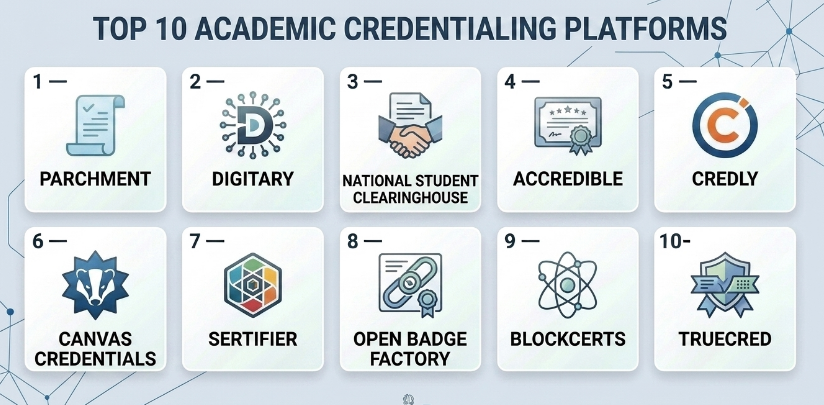
Top 10 Academic Credentialing Platforms
#1 — Parchment
Short description:
Parchment is a widely adopted academic credentialing platform focused on transcript management and digital credential delivery. It is trusted by universities for secure and reliable record exchange.
Key Features
- Digital transcript delivery
- Credential verification tools
- Integration with SIS systems
- Secure document exchange
- Data analytics for institutions
- Global credential sharing
Pros
- Strong adoption in academia
- Reliable and secure delivery
Cons
- Limited use outside education
- Pricing varies by institution
Platforms / Deployment
Web / Cloud
Security & Compliance
Encryption, audit logs (Other compliance: Not publicly stated)
Integrations & Ecosystem
Integrates deeply with academic systems and registrar workflows.
- Student Information Systems
- APIs for institutional systems
- Employer verification tools
Support & Community
Strong institutional support with structured onboarding and documentation.
#2 — Digitary
Short description:
Digitary provides secure digital credentialing solutions for higher education institutions, focusing on privacy, compliance, and identity verification.
Key Features
- Secure credential issuance
- Identity verification
- Blockchain-enabled credentials
- Digital document management
- Compliance-focused design
Pros
- High security standards
- Trusted by universities and governments
Cons
- Complex implementation
- Higher cost
Platforms / Deployment
Cloud / Hybrid
Security & Compliance
Encryption, audit logs (Other: Not publicly stated)
Integrations & Ecosystem
Supports integrations with academic systems.
- SIS platforms
- APIs for custom workflows
Support & Community
Enterprise-grade support with dedicated onboarding.
#3 — National Student Clearinghouse
Short description:
A major provider of academic verification and transcript services, widely used across educational institutions.
Key Features
- Transcript services
- Enrollment verification
- Degree verification
- Data reporting tools
- Institutional compliance support
Pros
- Widely recognized authority
- Strong data accuracy
Cons
- Limited customization
- Focused mainly on U.S. institutions
Platforms / Deployment
Web / Cloud
Security & Compliance
Not publicly stated
Integrations & Ecosystem
Integrates with academic and verification systems.
- SIS integrations
- Employer verification systems
Support & Community
Strong institutional support network.
#4 — Accredible
Short description:
Accredible supports academic institutions with digital certificates and badges, combining ease of use with strong branding.
Key Features
- Digital certificates and badges
- Automated issuance
- Analytics and tracking
- Custom branding
- Blockchain support
Pros
- Easy to use
- Strong branding features
Cons
- Not specialized for transcripts
- Pricing may be high
Platforms / Deployment
Cloud
Security & Compliance
SSO, encryption (Other: Not publicly stated)
Integrations & Ecosystem
Works with LMS and academic tools.
- Canvas
- Moodle
- APIs
Support & Community
Strong documentation and responsive support.
#5 — Credly
Short description:
Credly enables institutions to issue digital badges aligned with skills and competencies, often used for professional and continuing education.
Key Features
- Digital badge issuance
- Skills mapping
- Analytics dashboards
- Credential sharing
- Workforce alignment
Pros
- Strong analytics
- Enterprise-ready
Cons
- Less focus on traditional academic credentials
- Limited transcript support
Platforms / Deployment
Cloud
Security & Compliance
SSO, MFA (Other: Not publicly stated)
Integrations & Ecosystem
Broad integration ecosystem.
- LMS tools
- HR platforms
- APIs
Support & Community
Enterprise-level support and strong documentation.
#6 — Canvas Credentials (Badgr)
Short description:
Canvas Credentials integrates credentialing into learning environments, especially for institutions using Canvas LMS.
Key Features
- Open badge issuance
- Learning pathways
- LMS integration
- Verification tools
- Digital wallets
Pros
- Strong LMS integration
- Easy for educators
Cons
- Limited outside Canvas ecosystem
- Basic customization
Platforms / Deployment
Cloud
Security & Compliance
Not publicly stated
Integrations & Ecosystem
Deep integration with Canvas LMS.
- Canvas
- APIs
Support & Community
Active education-focused user base.
#7 — Sertifier
Short description:
Sertifier provides automated academic certificate issuance with a focus on scalability and branding.
Key Features
- Bulk certificate issuance
- Email automation
- Verification links
- Analytics dashboard
- Custom templates
Pros
- Easy automation
- Good reporting
Cons
- Limited academic specialization
- Smaller ecosystem
Platforms / Deployment
Cloud
Security & Compliance
Encryption (Other: Not publicly stated)
Integrations & Ecosystem
Supports basic integrations.
- APIs
- Email tools
Support & Community
Responsive support with smaller community presence.
#8 — Open Badge Factory
Short description:
Open Badge Factory supports institutions issuing Open Badges aligned with global standards.
Key Features
- Open badge standard compliance
- Badge pathways
- Team collaboration
- API support
- Verification tools
Pros
- Standards-based approach
- Flexible badge design
Cons
- UI limitations
- Not focused on transcripts
Platforms / Deployment
Cloud
Security & Compliance
Not publicly stated
Integrations & Ecosystem
Supports LMS integrations.
- Moodle
- APIs
Support & Community
Niche but active community.
#9 — Blockcerts
Short description:
Blockcerts is an open-source framework for issuing blockchain-based academic credentials.
Key Features
- Blockchain credential issuance
- Decentralized verification
- Open standard compliance
- Wallet integration
- Developer tools
Pros
- Fully decentralized
- Transparent verification
Cons
- Requires technical expertise
- Limited user interface
Platforms / Deployment
Self-hosted / Open-source
Security & Compliance
Blockchain-based security
Integrations & Ecosystem
Developer-focused ecosystem.
- APIs
- Wallet systems
Support & Community
Strong open-source community.
#10 — TrueCred
Short description:
TrueCred offers digital credentialing solutions for education institutions with a focus on secure issuance and verification.
Key Features
- Digital credential issuance
- Verification tools
- Blockchain support
- Branding customization
- Analytics
Pros
- Secure credentialing
- Easy verification
Cons
- Limited market presence
- Fewer integrations
Platforms / Deployment
Cloud
Security & Compliance
Encryption (Other: Not publicly stated)
Integrations & Ecosystem
Supports API-based integrations.
- APIs
- Academic systems
Support & Community
Moderate support; growing ecosystem.
Comparison Table (Top 10)
| Tool Name | Best For | Platform(s) Supported | Deployment | Standout Feature | Public Rating |
|---|---|---|---|---|---|
| Parchment | Universities | Web | Cloud | Transcript management | N/A |
| Digitary | Secure credentials | Web | Hybrid | Identity verification | N/A |
| National Student Clearinghouse | Verification services | Web | Cloud | Enrollment verification | N/A |
| Accredible | Certificates | Web | Cloud | Branding | N/A |
| Credly | Skills badges | Web | Cloud | Analytics | N/A |
| Canvas Credentials | LMS users | Web | Cloud | Canvas integration | N/A |
| Sertifier | Automation | Web | Cloud | Bulk issuance | N/A |
| Open Badge Factory | Open badges | Web | Cloud | Standards compliance | N/A |
| Blockcerts | Developers | Web | Self-hosted | Blockchain | N/A |
| TrueCred | Secure credentials | Web | Cloud | Verification tools | N/A |
Evaluation & Academic Credentialing Platforms
| Tool Name | Core | Ease | Integrations | Security | Performance | Support | Value | Weighted Total |
|---|---|---|---|---|---|---|---|---|
| Parchment | 9 | 8 | 8 | 8 | 8 | 8 | 7 | 8.1 |
| Digitary | 9 | 6 | 7 | 9 | 8 | 8 | 6 | 7.9 |
| National Student Clearinghouse | 8 | 7 | 7 | 8 | 8 | 8 | 7 | 7.7 |
| Accredible | 8 | 9 | 8 | 8 | 8 | 8 | 7 | 8.2 |
| Credly | 9 | 7 | 9 | 8 | 8 | 8 | 7 | 8.2 |
| Canvas Credentials | 7 | 8 | 7 | 7 | 7 | 7 | 8 | 7.4 |
| Sertifier | 7 | 8 | 6 | 7 | 7 | 7 | 8 | 7.4 |
| Open Badge Factory | 8 | 7 | 7 | 7 | 7 | 7 | 7 | 7.3 |
| Blockcerts | 8 | 5 | 6 | 9 | 7 | 7 | 7 | 7.2 |
| TrueCred | 7 | 7 | 6 | 8 | 7 | 7 | 7 | 7.1 |
How to interpret scores:
- These scores compare tools relative to each other
- Higher scores indicate balanced capabilities
- Enterprise tools often excel in security
- Simpler tools score higher on usability
- Choose based on your specific needs
Which Academic Credentialing Platforms
Solo / Freelancer
Use simple tools like Sertifier or Accredible for issuing certificates without complex setup.
SMB
Accredible and Canvas Credentials offer good balance between ease and functionality.
Mid-Market
Credly and Open Badge Factory provide structured credentialing and analytics.
Enterprise
Digitary and Parchment are ideal for large-scale, secure academic environments.
Budget vs Premium
- Budget: Sertifier, Canvas Credentials
- Premium: Digitary, Parchment
Feature Depth vs Ease of Use
- Feature-rich: Digitary, Credly
- Easy-to-use: Accredible, Sertifier
Integrations & Scalability
- Strong integrations: Credly, Parchment
- Developer flexibility: Blockcerts
Security & Compliance Needs
- High security: Digitary, Blockcerts
- Moderate: Accredible, Credly
Frequently Asked Questions (FAQs)
1. What is an academic credentialing platform?
It is software used by educational institutions to issue and manage digital credentials like diplomas and transcripts securely.
2. Are digital credentials legally valid?
Yes, many institutions and employers accept them, especially when verification systems are in place.
3. How secure are these platforms?
Most use encryption and verification mechanisms; some use blockchain for added security.
4. Can students access credentials anytime?
Yes, most platforms provide lifetime access through digital wallets or portals.
5. Do these platforms support transcripts?
Some platforms specialize in transcripts, while others focus on certificates and badges.
6. How long does implementation take?
Basic setups can be quick, but full integration with academic systems may take weeks.
7. Can institutions migrate existing records?
Yes, though it depends on data compatibility and migration tools.
8. What integrations are important?
SIS, LMS, and identity systems are critical for seamless operation.
9. Are these platforms expensive?
Pricing varies based on scale, features, and usage.
10. What are alternatives?
Basic certificate tools exist, but they lack verification and automation capabilities.
Conclusion
Academic Credentialing Platforms are becoming essential for modern education systems that require secure, scalable, and verifiable digital records. As institutions move toward digital-first operations, these platforms help streamline credential issuance, improve trust, and enhance student experience. However, the right choice depends on your institution’s size, infrastructure, and goals. Some platforms excel in transcript management, while others focus on digital badges or blockchain-based verification. The best approach is to shortlist a few platforms, test their workflows, and validate integration with your existing systems before making a final decision.