Introduction
Market Data Platforms are systems that collect, process, and deliver financial data such as stock prices, trading volumes, economic indicators, and alternative data. In simple terms, they provide the real-time and historical information that traders, analysts, and institutions use to make financial decisions.
In today’s fast-moving financial environment, access to accurate and timely market data is critical. With algorithmic trading, AI-driven investment strategies, and global market interconnectivity, delays or inaccuracies in data can lead to significant losses.
Real-world use cases:
- Traders executing high-frequency strategies based on real-time feeds
- Investment firms analyzing historical trends for portfolio optimization
- Banks monitoring market risk exposure
- FinTech platforms powering trading apps and dashboards
- Research analysts generating forecasts and reports
What buyers should evaluate:
- Data coverage (equities, FX, commodities, crypto, etc.)
- Real-time vs delayed data availability
- Data accuracy and latency
- API and integration capabilities
- Historical data depth
- Analytics and visualization tools
- Scalability and performance
- Security and compliance
- Pricing model (subscription, usage-based)
- Ease of access and usability
Best for: Trading firms, hedge funds, banks, FinTech companies, and analysts needing reliable, real-time market insights.
Not ideal for: Small businesses or individuals without active trading or analytics needs; basic financial apps may be sufficient.
Key Trends in Market Data Platforms
- Real-time streaming data: Low-latency feeds are now a standard requirement
- AI-powered insights: Predictive analytics and anomaly detection are growing
- Alternative data integration: Satellite, social sentiment, and ESG data gaining importance
- Cloud-native platforms: Faster scalability and global access
- API-first architecture: Developers can easily integrate data into apps
- Data normalization: Unified formats across multiple exchanges
- Self-service analytics: Users can build dashboards without coding
- Cost optimization models: Usage-based pricing becoming common
- Multi-asset coverage: Platforms expanding beyond equities to crypto and derivatives
- Data governance focus: Ensuring data quality and compliance
How We Selected These Tools (Methodology)
- Reviewed global market adoption and brand trust
- Assessed data coverage across asset classes
- Evaluated real-time performance and latency
- Considered API and developer ecosystem strength
- Checked analytics and visualization capabilities
- Analyzed security and compliance readiness
- Included platforms for enterprise and developer use cases
- Balanced premium and flexible solutions
- Focused on scalability and reliability
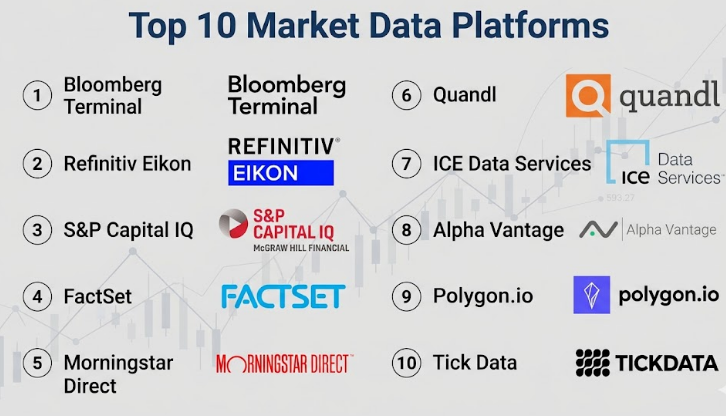
Top 10 Market Data Platforms
#1 — Bloomberg Terminal
Short description:
Bloomberg Terminal is one of the most widely used financial data platforms globally. It provides real-time market data, analytics, and news. Used by banks, hedge funds, and financial institutions, it offers deep insights across asset classes. It also includes communication tools for traders. It is considered a premium, all-in-one solution.
Key Features
- Real-time global market data
- Advanced analytics and charting
- Financial news integration
- Portfolio management tools
- Messaging and collaboration features
Pros
- Industry-leading data coverage
- Highly reliable and accurate
Cons
- Very expensive
- Steep learning curve
Platforms / Deployment
Windows / Cloud
Security & Compliance
Not publicly stated
Integrations & Ecosystem
Extensive ecosystem for financial workflows.
- APIs for data extraction
- Integration with trading systems
- Data export tools
Support & Community
Strong enterprise support with extensive training resources.
#2 — Refinitiv Eikon
Short description:
Refinitiv Eikon provides real-time data, analytics, and news. It is widely used for trading and research. It offers multi-asset data coverage and strong visualization tools. It is suitable for financial professionals needing reliable data access.
Key Features
- Real-time data feeds
- Market analytics
- News and research tools
- Charting capabilities
- Data visualization
Pros
- Broad asset coverage
- Strong analytics tools
Cons
- Complex interface
- Costly for smaller firms
Platforms / Deployment
Web / Desktop / Cloud
Security & Compliance
Not publicly stated
Integrations & Ecosystem
Supports enterprise integrations.
- APIs
- Data feeds
- Trading platforms
Support & Community
Enterprise-level support with global reach.
#3 — S&P Capital IQ
Short description:
Capital IQ focuses on financial data, research, and analytics. It is widely used for investment research and corporate analysis. It provides deep financial insights and company data. It is ideal for analysts and investment professionals.
Key Features
- Financial data and analytics
- Company profiles
- Market research tools
- Historical data
- Custom reporting
Pros
- Strong research capabilities
- Reliable data
Cons
- Limited real-time trading features
- Subscription cost
Platforms / Deployment
Web / Cloud
Security & Compliance
Not publicly stated
Integrations & Ecosystem
Integrates with research workflows.
- APIs
- Excel integration
- Data export tools
Support & Community
Good documentation and analyst-focused support.
#4 — FactSet
Short description:
FactSet provides financial data and analytics for investment professionals. It combines data, analytics, and workflow tools in one platform. It is widely used by asset managers and research analysts.
Key Features
- Multi-asset data coverage
- Portfolio analytics
- Risk analysis tools
- Custom dashboards
- Data integration
Pros
- Strong analytics
- Customizable interface
Cons
- Learning curve
- Premium pricing
Platforms / Deployment
Web / Desktop / Cloud
Security & Compliance
Not publicly stated
Integrations & Ecosystem
Extensive integration capabilities.
- APIs
- Data connectors
- Excel plugins
Support & Community
Strong support and training resources.
#5 — Morningstar Direct
Short description:
Morningstar Direct focuses on investment research and analytics. It is widely used for portfolio analysis and fund research. It provides deep insights into investment performance.
Key Features
- Investment research tools
- Portfolio analysis
- Data visualization
- Fund performance tracking
- Reporting tools
Pros
- Strong research focus
- Easy-to-use interface
Cons
- Limited real-time trading data
- Not ideal for high-frequency trading
Platforms / Deployment
Web / Cloud
Security & Compliance
Not publicly stated
Integrations & Ecosystem
Supports research integrations.
- Data export
- APIs
- Reporting tools
Support & Community
Good support for research users.
#6 — Quandl (Nasdaq Data Link)
Short description:
Quandl provides financial and alternative data via APIs. It is popular among developers and data scientists. It offers easy access to structured datasets.
Key Features
- API-first data access
- Alternative datasets
- Historical data
- Data visualization
- Easy integration
Pros
- Developer-friendly
- Flexible data access
Cons
- Limited built-in analytics
- Requires technical skills
Platforms / Deployment
Cloud / API-based
Security & Compliance
Not publicly stated
Integrations & Ecosystem
Strong developer ecosystem.
- REST APIs
- Data libraries
- Integration tools
Support & Community
Active developer community.
#7 — ICE Data Services
Short description:
ICE Data Services provides pricing, analytics, and reference data. It is used by financial institutions for trading and risk management. It supports multiple asset classes.
Key Features
- Pricing data
- Market analytics
- Reference data
- Risk insights
- Data feeds
Pros
- Strong market coverage
- Reliable data
Cons
- Complex integration
- Enterprise-focused
Platforms / Deployment
Cloud / On-premises
Security & Compliance
Not publicly stated
Integrations & Ecosystem
Enterprise integrations supported.
- APIs
- Data feeds
- Trading systems
Support & Community
Enterprise-level support.
#8 — Alpha Vantage
Short description:
Alpha Vantage is a lightweight API-based market data provider. It is widely used by developers and small trading applications. It provides stock, FX, and crypto data.
Key Features
- API-based data access
- Stock and crypto data
- Technical indicators
- Historical data
- Easy integration
Pros
- Affordable
- Easy to use
Cons
- Limited enterprise features
- Data limitations
Platforms / Deployment
Cloud / API
Security & Compliance
Not publicly stated
Integrations & Ecosystem
Developer-friendly integrations.
- APIs
- SDKs
- Data tools
Support & Community
Moderate community support.
#9 — Polygon.io
Short description:
Polygon.io offers real-time and historical market data via APIs. It is designed for developers and trading platforms. It provides low-latency data for multiple asset classes.
Key Features
- Real-time data feeds
- Historical data
- API-first architecture
- Multi-asset coverage
- Low latency
Pros
- Fast data delivery
- Developer-friendly
Cons
- Limited UI tools
- Requires integration effort
Platforms / Deployment
Cloud / API
Security & Compliance
Not publicly stated
Integrations & Ecosystem
Strong API ecosystem.
- REST APIs
- WebSocket feeds
- SDKs
Support & Community
Active developer support.
#10 — Tick Data (LSEG Tick History)
Short description:
Tick Data provides high-quality historical market data. It is used for backtesting and quantitative analysis. It is ideal for research and strategy development.
Key Features
- Historical tick data
- Data cleaning and normalization
- Backtesting support
- Multi-asset data
- Data delivery tools
Pros
- High-quality historical data
- Reliable datasets
Cons
- Not real-time focused
- Limited analytics tools
Platforms / Deployment
Cloud / Data delivery
Security & Compliance
Not publicly stated
Integrations & Ecosystem
Supports analytics workflows.
- Data export
- APIs
- Integration tools
Support & Community
Specialized support.
Comparison Table (Top 10)
| Tool Name | Best For | Platform(s) Supported | Deployment | Standout Feature | Public Rating |
|---|---|---|---|---|---|
| Bloomberg Terminal | Enterprise trading | Windows | Cloud | All-in-one platform | N/A |
| Refinitiv Eikon | Financial research | Web/Desktop | Cloud | Multi-asset data | N/A |
| S&P Capital IQ | Investment analysis | Web | Cloud | Deep financial insights | N/A |
| FactSet | Asset management | Web/Desktop | Cloud | Portfolio analytics | N/A |
| Morningstar Direct | Fund research | Web | Cloud | Investment analysis | N/A |
| Quandl | Developers | API | Cloud | Alternative data | N/A |
| ICE Data Services | Institutions | Web | Hybrid | Pricing data | N/A |
| Alpha Vantage | Small apps | API | Cloud | Affordable APIs | N/A |
| Polygon.io | Trading apps | API | Cloud | Low latency | N/A |
| Tick Data | Quant research | Data delivery | Cloud | Historical data | N/A |
Evaluation & Market Data Platforms
| Tool Name | Core | Ease | Integrations | Security | Performance | Support | Value | Weighted Total |
|---|---|---|---|---|---|---|---|---|
| Bloomberg Terminal | 10 | 6 | 9 | 8 | 10 | 9 | 5 | 8.3 |
| Refinitiv Eikon | 9 | 6 | 9 | 8 | 9 | 8 | 6 | 8.0 |
| S&P Capital IQ | 8 | 7 | 8 | 7 | 8 | 7 | 7 | 7.6 |
| FactSet | 9 | 7 | 9 | 8 | 9 | 8 | 6 | 8.1 |
| Morningstar Direct | 8 | 8 | 7 | 7 | 7 | 7 | 7 | 7.5 |
| Quandl | 7 | 8 | 9 | 7 | 8 | 7 | 8 | 7.8 |
| ICE Data Services | 9 | 6 | 8 | 8 | 9 | 8 | 6 | 8.0 |
| Alpha Vantage | 6 | 9 | 8 | 6 | 7 | 6 | 9 | 7.5 |
| Polygon.io | 7 | 8 | 9 | 7 | 9 | 7 | 8 | 7.9 |
| Tick Data | 8 | 7 | 7 | 7 | 8 | 7 | 7 | 7.5 |
How to interpret scores:
These scores compare tools across multiple dimensions. Enterprise tools rank higher in core features and performance, while developer tools score higher in ease of use and value. Choose based on your use case rather than just total score.
Which Market Data Platform
Solo / Freelancer
Alpha Vantage or Polygon.io are ideal due to affordability and simplicity.
SMB
Quandl or Morningstar Direct offer a good balance of features and cost.
Mid-Market
FactSet or S&P Capital IQ provide strong analytics and scalability.
Enterprise
Bloomberg Terminal, Refinitiv, or ICE Data Services are best for large-scale operations.
Budget vs Premium
- Budget: Alpha Vantage, Polygon.io
- Premium: Bloomberg, Refinitiv
Feature Depth vs Ease of Use
- Deep features: Bloomberg, FactSet
- Easy to use: Morningstar, Alpha Vantage
Integrations & Scalability
- Strong: Quandl, Polygon.io
- Moderate: Morningstar, Alpha Vantage
Security & Compliance Needs
- High: Bloomberg, ICE Data
- Moderate: Developer tools
Frequently Asked Questions (FAQs)
1. What is a Market Data Platform?
It provides financial data like stock prices, volumes, and analytics for decision-making.
2. Who uses these platforms?
Traders, analysts, financial institutions, and developers.
3. Are these platforms expensive?
Enterprise tools are costly, while API-based tools are affordable.
4. What data do they provide?
Equities, FX, commodities, crypto, and alternative datasets.
5. Do they offer real-time data?
Yes, most platforms provide real-time or near real-time feeds.
6. Can developers use these platforms?
Yes, many platforms offer APIs for integration.
7. What is the difference between free and paid tools?
Paid tools offer more accuracy, coverage, and support.
8. How to choose the right platform?
Evaluate data needs, budget, and integration requirements.
9. Are they secure?
Most enterprise platforms have strong security, but details vary.
10. Can I switch platforms easily?
Switching requires data migration and integration adjustments.
Conclusion
Market Data Platforms play a critical role in modern financial ecosystems. Whether you are a trader, analyst, or developer, having access to accurate and timely data can significantly impact decision-making. However, there is no one-size-fits-all solution. Enterprise platforms provide deep analytics and reliability but come with higher costs, while API-based tools offer flexibility and affordability with fewer built-in features. The best approach is to shortlist a few platforms based on your needs, test their data quality, evaluate integration capabilities, and ensure they align with your performance and security requirements before making a final decision.