Introduction
Financial Risk Management Software helps organizations identify, measure, monitor, and reduce financial risks such as credit risk, market risk, liquidity risk, and operational risk. In simple terms, it gives businesses a clear view of “what could go wrong financially” and how to act before losses happen.
In the current environment, where markets are volatile, regulations are tightening, and digital transactions are increasing, these tools are more important than ever. Businesses are now expected to manage risks in real time, not after the damage is done.
Real-world use cases:
- Banks managing credit and market risk exposure
- Investment firms tracking portfolio risk and volatility
- Corporates managing cash flow and currency risks
- FinTech companies ensuring compliance and fraud prevention
- Insurance firms modeling risk scenarios
What buyers should evaluate:
- Risk modeling capabilities
- Data integration and real-time analytics
- Regulatory compliance features
- Reporting and dashboards
- Scalability and performance
- Security and access controls
- Ease of use and implementation
- Cost and ROI
Best for: Banks, financial institutions, investment firms, large enterprises, and regulated industries needing deep risk insights.
Not ideal for: Small businesses or startups with minimal financial complexity; spreadsheets or lightweight tools may be sufficient in early stages.
Key Trends in Financial Risk Management Software
- AI-driven risk modeling: Predictive analytics and machine learning are improving forecasting accuracy.
- Real-time risk monitoring: Continuous tracking instead of periodic reporting.
- Cloud-first adoption: Faster deployment and scalability for global operations.
- Regulatory automation: Built-in compliance for evolving global regulations.
- Integrated platforms: Combining credit, market, and operational risk into one system.
- API-first architecture: Easier integration with core banking, ERP, and trading systems.
- Data centralization: Unified data lakes for risk analysis across departments.
- Scenario simulation: Stress testing and “what-if” analysis becoming standard.
- User-friendly dashboards: Visual analytics for non-technical stakeholders.
- Cyber risk integration: Financial risk tools now include digital and cybersecurity risk aspects.
How We Selected These Tools (Methodology)
- Evaluated market adoption and industry reputation
- Assessed feature completeness across risk domains
- Reviewed performance and reliability signals
- Considered security and compliance capabilities
- Checked integration ecosystem and API support
- Included tools for different company sizes and industries
- Prioritized scalable and future-ready platforms
- Balanced enterprise-grade and flexible solutions
- Focused on real-world usability and implementation ease
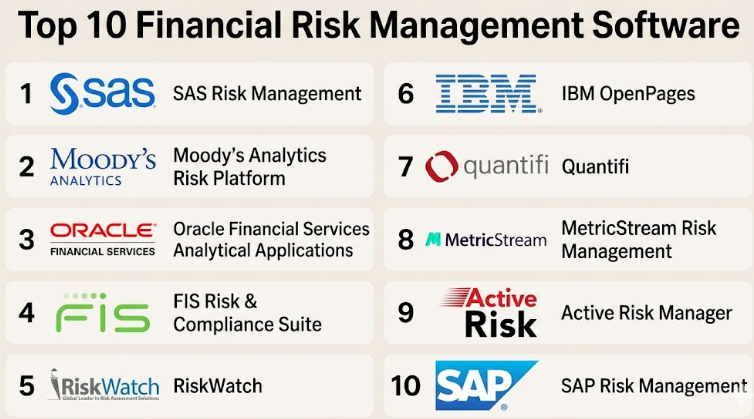
Top 10 Financial Risk Management Software
#1 — SAS Risk Management
Short description:
SAS Risk Management is a comprehensive enterprise platform designed for banks and financial institutions. It supports credit, market, liquidity, and operational risk with advanced analytics. Known for its strong statistical modeling, it is widely used by large institutions. It is ideal for organizations needing deep insights and regulatory compliance. The platform handles large-scale data processing efficiently.
Key Features
- Advanced analytics and risk modeling
- Regulatory compliance reporting
- Stress testing and scenario analysis
- Data integration and management
- Real-time risk monitoring
Pros
- Highly powerful analytics engine
- Trusted by large enterprises
Cons
- Complex implementation
- High cost for smaller firms
Platforms / Deployment
Cloud / On-premises / Hybrid
Security & Compliance
Encryption, RBAC, audit logs (specific certifications not publicly stated)
Integrations & Ecosystem
Strong integration with enterprise data systems and analytics tools.
- APIs for data ingestion
- Integration with ERP systems
- Data warehouse connectivity
Support & Community
Enterprise-grade support with strong documentation; community mostly enterprise-focused.
#2 — Moody’s Analytics Risk Platform
Short description:
Moody’s platform focuses on credit risk, financial modeling, and regulatory reporting. It is widely used by banks and investment firms. It provides strong data insights and market intelligence. The platform is designed for decision-making at executive levels. It supports complex financial modeling.
Key Features
- Credit risk modeling
- Market data integration
- Scenario analysis
- Portfolio risk management
- Regulatory compliance tools
Pros
- Strong financial data insights
- Industry-recognized models
Cons
- Expensive licensing
- Requires skilled users
Platforms / Deployment
Cloud / Hybrid
Security & Compliance
Not publicly stated
Integrations & Ecosystem
Integrates with financial systems and data providers.
- API-based integration
- Market data feeds
- Reporting tools
Support & Community
Professional support with financial domain expertise.
#3 — Oracle Financial Services Analytical Applications (OFSAA)
Short description:
OFSAA is an enterprise-grade solution offering risk and compliance management. It supports financial institutions with large-scale operations. Known for strong regulatory capabilities, it handles complex financial data workflows. It is ideal for banks needing integrated risk management.
Key Features
- Risk and compliance management
- Financial analytics
- Data governance
- Scenario planning
- Reporting dashboards
Pros
- Highly scalable
- Strong compliance features
Cons
- Complex setup
- Requires Oracle ecosystem
Platforms / Deployment
Cloud / On-premises
Security & Compliance
RBAC, audit logs (certifications not publicly stated)
Integrations & Ecosystem
Deep integration with Oracle products.
- ERP integration
- Database connectivity
- API support
Support & Community
Strong enterprise support and global presence.
#4 — FIS Risk & Compliance Suite
Short description:
FIS offers a broad risk management suite focused on financial institutions. It covers credit risk, fraud detection, and compliance. The platform is widely used in banking and payment systems. It supports real-time monitoring and reporting.
Key Features
- Fraud detection
- Credit risk analysis
- Compliance tracking
- Real-time alerts
- Reporting tools
Pros
- Strong banking integration
- Real-time insights
Cons
- Limited flexibility
- High implementation effort
Platforms / Deployment
Cloud / Hybrid
Security & Compliance
Not publicly stated
Integrations & Ecosystem
Works well with banking systems.
- Payment systems integration
- API support
- Data feeds
Support & Community
Enterprise-level support.
#5 — RiskWatch
Short description:
RiskWatch focuses on enterprise risk management and compliance. It is used across industries, including finance and healthcare. It provides tools for risk assessment and mitigation planning. It is suitable for organizations needing structured risk workflows.
Key Features
- Risk assessment tools
- Compliance tracking
- Incident management
- Reporting dashboards
- Workflow automation
Pros
- Easy to use
- Flexible across industries
Cons
- Limited advanced analytics
- Not ideal for deep financial modeling
Platforms / Deployment
Cloud
Security & Compliance
Not publicly stated
Integrations & Ecosystem
Basic integration capabilities.
- API support
- Data import/export
- Third-party connectors
Support & Community
Standard support with moderate documentation.
#6 — IBM OpenPages
Short description:
IBM OpenPages is a governance, risk, and compliance (GRC) platform. It integrates AI for risk insights and automation. It is suitable for enterprises needing unified risk visibility. It supports multiple risk domains in one platform.
Key Features
- AI-driven risk insights
- Workflow automation
- Compliance management
- Dashboard analytics
- Policy management
Pros
- Strong AI capabilities
- Integrated GRC approach
Cons
- Complex customization
- High cost
Platforms / Deployment
Cloud / On-premises
Security & Compliance
Encryption, RBAC (certifications not publicly stated)
Integrations & Ecosystem
Part of IBM ecosystem.
- API integrations
- Data connectors
- Enterprise tools
Support & Community
Strong enterprise support.
#7 — Quantifi
Short description:
Quantifi is focused on trading and derivatives risk management. It is widely used by investment banks and asset managers. It provides real-time analytics and pricing models. It is ideal for complex financial instruments.
Key Features
- Derivatives pricing
- Real-time analytics
- Risk modeling
- Portfolio management
- Scenario analysis
Pros
- Strong in trading environments
- Real-time capabilities
Cons
- Niche focus
- Requires financial expertise
Platforms / Deployment
Cloud
Security & Compliance
Not publicly stated
Integrations & Ecosystem
Integrates with trading systems.
- Market data feeds
- API access
- Portfolio systems
Support & Community
Specialized support for financial markets.
#8 — MetricStream Risk Management
Short description:
MetricStream provides enterprise risk management and compliance solutions. It is widely used for governance and risk reporting. The platform supports workflow automation and audit management.
Key Features
- Enterprise risk management
- Audit management
- Compliance tracking
- Workflow automation
- Reporting dashboards
Pros
- Strong GRC capabilities
- Scalable platform
Cons
- UI can be complex
- Implementation effort required
Platforms / Deployment
Cloud
Security & Compliance
Not publicly stated
Integrations & Ecosystem
Supports enterprise integrations.
- APIs
- ERP systems
- Data connectors
Support & Community
Enterprise-level support.
#9 — Active Risk Manager (ARM)
Short description:
Active Risk Manager is designed for operational and financial risk management. It helps organizations track risk exposure and mitigation. It is used across industries including finance.
Key Features
- Risk identification
- Incident tracking
- Reporting tools
- Compliance management
- Risk dashboards
Pros
- Easy to deploy
- Good reporting
Cons
- Limited advanced analytics
- Not highly scalable
Platforms / Deployment
Cloud
Security & Compliance
Not publicly stated
Integrations & Ecosystem
Basic integrations.
- APIs
- Data import/export
- Reporting tools
Support & Community
Moderate support availability.
#10 — SAP Risk Management
Short description:
SAP Risk Management integrates with SAP ERP systems to provide financial risk insights. It is ideal for enterprises already using SAP. It supports compliance, governance, and financial risk tracking.
Key Features
- Risk monitoring
- Compliance management
- Integration with SAP ERP
- Reporting dashboards
- Workflow automation
Pros
- Seamless SAP integration
- Strong enterprise capabilities
Cons
- Limited outside SAP ecosystem
- Complex implementation
Platforms / Deployment
Cloud / On-premises
Security & Compliance
RBAC, audit logs (certifications not publicly stated)
Integrations & Ecosystem
Deep SAP ecosystem integration.
- ERP integration
- APIs
- Data analytics tools
Support & Community
Strong enterprise support.
Comparison Table (Top 10)
| Tool Name | Best For | Platform(s) | Deployment | Standout Feature | Public Rating |
|---|---|---|---|---|---|
| SAS Risk Management | Large banks | Web | Hybrid | Advanced analytics | N/A |
| Moody’s Analytics | Credit risk | Web | Cloud | Financial data insights | N/A |
| OFSAA | Enterprise banks | Web | Hybrid | Compliance tools | N/A |
| FIS Suite | Banking systems | Web | Hybrid | Real-time monitoring | N/A |
| RiskWatch | SMB/Enterprise | Web | Cloud | Ease of use | N/A |
| IBM OpenPages | Enterprises | Web | Hybrid | AI risk insights | N/A |
| Quantifi | Trading firms | Web | Cloud | Derivatives modeling | N/A |
| MetricStream | GRC use | Web | Cloud | Workflow automation | N/A |
| Active Risk Manager | Mid-market | Web | Cloud | Reporting tools | N/A |
| SAP Risk Management | SAP users | Web | Hybrid | ERP integration | N/A |
Evaluation & Financial Risk Management Software
| Tool Name | Core | Ease | Integrations | Security | Performance | Support | Value | Weighted Total |
|---|---|---|---|---|---|---|---|---|
| SAS Risk Management | 9 | 6 | 9 | 8 | 9 | 8 | 6 | 8.0 |
| Moody’s Analytics | 9 | 6 | 8 | 8 | 8 | 8 | 6 | 7.8 |
| OFSAA | 9 | 6 | 9 | 8 | 9 | 8 | 6 | 8.0 |
| FIS Suite | 8 | 7 | 8 | 7 | 8 | 7 | 7 | 7.6 |
| RiskWatch | 7 | 8 | 6 | 7 | 7 | 6 | 8 | 7.2 |
| IBM OpenPages | 9 | 6 | 8 | 8 | 8 | 8 | 6 | 7.8 |
| Quantifi | 8 | 6 | 7 | 7 | 9 | 7 | 6 | 7.5 |
| MetricStream | 8 | 7 | 8 | 7 | 8 | 7 | 7 | 7.6 |
| Active Risk Manager | 7 | 8 | 6 | 7 | 7 | 6 | 8 | 7.2 |
| SAP Risk Management | 8 | 6 | 9 | 8 | 8 | 8 | 6 | 7.7 |
How to interpret scores:
These scores are comparative, not absolute. A higher score means better overall balance across features, usability, and value. Enterprise tools score higher in core features but lower in ease of use. SMB-friendly tools score higher in usability and value but may lack depth.
Which Financial Risk Management Software
Solo / Freelancer
Not typically required. Use basic financial tools or spreadsheets.
SMB
RiskWatch or Active Risk Manager offer simplicity and affordability.
Mid-Market
MetricStream or FIS provide a balance of features and scalability.
Enterprise
SAS, OFSAA, SAP, or IBM OpenPages are best for large-scale operations.
Budget vs Premium
- Budget: RiskWatch, Active Risk Manager
- Premium: SAS, Moody’s, IBM OpenPages
Feature Depth vs Ease of Use
- Deep features: SAS, OFSAA
- Easy to use: RiskWatch, MetricStream
Integrations & Scalability
- Strong integration: SAP, Oracle, SAS
- Moderate: RiskWatch, ARM
Security & Compliance Needs
- High compliance: OFSAA, SAS, SAP
- Moderate: RiskWatch, ARM
Frequently Asked Questions (FAQs)
1. What is Financial Risk Management Software?
It is a tool that helps businesses identify, analyze, and reduce financial risks like credit, market, and operational risks.
2. Who should use this software?
Banks, financial institutions, and large enterprises benefit the most from these tools.
3. Is it expensive?
Pricing varies widely. Enterprise tools are costly, while simpler tools are more affordable.
4. How long does implementation take?
It can range from a few weeks for simple tools to several months for enterprise systems.
5. Does it require technical expertise?
Yes, especially for advanced platforms with modeling capabilities.
6. Can it integrate with existing systems?
Most tools support integration via APIs and connectors.
7. Is cloud better than on-premises?
Cloud offers scalability, while on-premises provides more control.
8. What are common mistakes?
Choosing overly complex tools or ignoring integration requirements.
9. Can small businesses use it?
Yes, but they should choose lightweight solutions.
10. How to switch tools?
Plan migration carefully, ensure data compatibility, and run parallel testing.
Conclusion
Financial Risk Management Software is no longer optional for organizations dealing with complex financial operations. Whether it is managing credit exposure, ensuring compliance, or predicting market risks, the right tool can significantly reduce uncertainty and improve decision-making. However, the “best” solution depends entirely on your organization’s size, complexity, and goals. Enterprise platforms offer deep analytics but require investment, while simpler tools provide ease of use with limited capabilities. The practical next step is to shortlist two or three tools that match your needs, run pilot implementations, and validate integrations, performance, and security before making a final decision.