Introduction
Digital Banking Platforms are software systems that enable banks and financial institutions to deliver services like account management, payments, lending, and customer engagement through digital channels such as web and mobile apps. In simple terms, they act as the backbone for modern banking experiences—allowing customers to access financial services anytime, anywhere without visiting a branch.
As banking shifts toward fully digital ecosystems, these platforms are becoming essential. Customers now expect real-time transactions, seamless mobile experiences, and personalized services. At the same time, banks must deal with strict regulations, cybersecurity risks, and competition from fintech startups. Modern platforms solve this by combining cloud infrastructure, APIs, AI-driven insights, and strong security controls.
Common use cases include:
- Retail and corporate digital banking apps
- Neobanking and fintech product launches
- Payments and transaction processing
- Loan origination and servicing
- Customer onboarding and KYC automation
What buyers should evaluate:
- API-first architecture and flexibility
- Core banking integration
- Security and compliance features
- User experience and customization
- Scalability and performance
- AI and analytics capabilities
- Deployment model (cloud vs hybrid)
- Vendor ecosystem and support
- Cost vs long-term ROI
Best for: Banks, fintech startups, NBFCs, payment providers, and large enterprises building digital financial products.
Not ideal for: Small businesses or companies that only need basic accounting or payment tools without full banking capabilities.
Key Trends in Digital Banking Platforms
- AI-powered personalization: Platforms use AI to offer tailored financial recommendations.
- Open banking APIs: Banks expose APIs to integrate with fintech ecosystems.
- Cloud-native banking: SaaS and microservices-based deployments dominate.
- Embedded finance: Banking services embedded into non-financial apps.
- Real-time payments: Instant payment systems becoming standard.
- Digital onboarding: Automated KYC and identity verification using AI.
- Cybersecurity focus: Advanced fraud detection and zero-trust security models.
- Composable banking: Modular platforms replacing monolithic systems.
- Data-driven banking: Advanced analytics and customer insights tools.
How We Selected These Tools (Methodology)
- Evaluated global adoption among banks and fintech companies
- Assessed feature completeness across digital banking workflows
- Considered scalability and performance in real-world deployments
- Reviewed security posture and compliance capabilities
- Analyzed integration capabilities and API ecosystems
- Checked customer fit across SMB, mid-market, and enterprise
- Prioritized innovation (AI, cloud-native, composable architecture)
- Evaluated vendor reputation and long-term viability
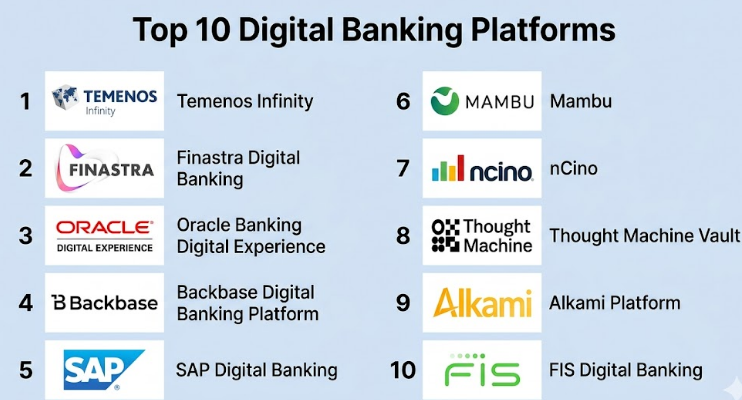
Top 10 Digital Banking Platforms
#1 — Temenos Infinity
Short description :
Temenos Infinity is a leading digital banking platform designed for banks aiming to deliver omnichannel customer experiences. It supports retail, corporate, and wealth banking use cases. The platform offers strong API capabilities and integrates seamlessly with Temenos core banking. Known for scalability and flexibility, it is widely adopted by global financial institutions. It is ideal for enterprises modernizing legacy systems.
Key Features
- Omnichannel banking experience
- API-first architecture
- Customer journey orchestration
- AI-driven personalization
- Digital onboarding tools
- Analytics and reporting
Pros
- Strong global adoption
- Highly scalable
Cons
- Complex implementation
- Requires skilled teams
Platforms / Deployment
Cloud / On-premise / Hybrid
Security & Compliance
SSO, MFA, encryption, audit logs; certifications Not publicly stated
Integrations & Ecosystem
Extensive integrations with banking and fintech ecosystems.
- Core banking systems
- Payment gateways
- CRM systems
- Open APIs
Support & Community
Enterprise-grade support with strong global presence
#2 — Finastra Digital Banking
Short description:
Finastra Digital Banking provides a comprehensive suite for retail and business banking. It focuses on user experience and engagement while integrating with core banking systems.
Key Features
- Retail and business banking modules
- Digital payments
- Customer engagement tools
- API integration
- Analytics
Pros
- Strong feature set
- Good integration capabilities
Cons
- Customization can be complex
- Pricing varies
Platforms / Deployment
Cloud / Hybrid
Security & Compliance
MFA, encryption; details Not publicly stated
Integrations & Ecosystem
Connects with financial systems and fintech services.
- Core banking
- APIs
- Payment systems
Support & Community
Enterprise support with onboarding services
#3 — Oracle Banking Digital Experience
Short description:
Oracle Banking Digital Experience offers a robust platform for delivering digital banking services across multiple channels. It is part of Oracle’s financial services suite.
Key Features
- Omnichannel banking
- Customer analytics
- Digital onboarding
- Workflow automation
- API support
Pros
- Strong enterprise integration
- Reliable performance
Cons
- Requires Oracle ecosystem familiarity
- High cost
Platforms / Deployment
Cloud / On-premise
Security & Compliance
Encryption, RBAC; certifications Not publicly stated
Integrations & Ecosystem
Integrates with Oracle and third-party systems.
- Oracle ERP
- Banking systems
- APIs
Support & Community
Strong enterprise documentation and support
#4 — Backbase Digital Banking Platform
Short description:
Backbase provides a modern digital banking platform focused on customer experience and engagement. It helps banks build unified digital experiences across channels.
Key Features
- Customer journey orchestration
- Modular architecture
- API-first design
- Personalization tools
- Mobile banking features
Pros
- Strong UX capabilities
- Flexible architecture
Cons
- Requires customization
- Implementation effort
Platforms / Deployment
Cloud / Hybrid
Security & Compliance
MFA, encryption; details Not publicly stated
Integrations & Ecosystem
Strong API ecosystem for integrations.
- CRM systems
- Core banking
- APIs
Support & Community
Active enterprise support and partner ecosystem
#5 — SAP Digital Banking
Short description:
SAP Digital Banking integrates banking services into SAP’s enterprise ecosystem. It is ideal for organizations already using SAP ERP and finance modules.
Key Features
- ERP integration
- Financial analytics
- Workflow automation
- Compliance tools
- Customer management
Pros
- Strong SAP integration
- Reliable performance
Cons
- Limited outside SAP ecosystem
- Requires SAP expertise
Platforms / Deployment
Cloud / On-premise
Security & Compliance
SSO, RBAC; details Not publicly stated
Integrations & Ecosystem
Deep SAP ecosystem integration.
- SAP ERP
- Financial systems
- APIs
Support & Community
Large enterprise support network
#6 — Mambu
Short description:
Mambu is a cloud-native core banking and digital platform used by fintechs and neobanks. It offers flexibility and rapid deployment.
Key Features
- Cloud-native architecture
- API-first design
- Lending and deposit modules
- Real-time processing
- Scalability
Pros
- Fast deployment
- Flexible configuration
Cons
- Limited legacy integration
- Requires technical expertise
Platforms / Deployment
Cloud
Security & Compliance
Encryption, RBAC; details Not publicly stated
Integrations & Ecosystem
Extensive API integrations.
- Fintech apps
- Payment gateways
- APIs
Support & Community
Growing global community and support
#7 — nCino
Short description:
nCino is a cloud-based banking platform built on Salesforce. It focuses on lending, onboarding, and customer lifecycle management.
Key Features
- Loan origination
- CRM integration
- Workflow automation
- Customer onboarding
- Analytics
Pros
- Strong CRM integration
- User-friendly
Cons
- Salesforce dependency
- Pricing complexity
Platforms / Deployment
Cloud
Security & Compliance
Encryption, MFA; details Not publicly stated
Integrations & Ecosystem
Built on Salesforce ecosystem.
- CRM systems
- APIs
- Financial systems
Support & Community
Strong partner ecosystem
#8 — Thought Machine Vault
Short description:
Thought Machine Vault is a modern cloud-native core banking platform enabling banks to build digital-first services.
Key Features
- Cloud-native architecture
- Smart contracts
- Real-time processing
- API-first design
- Product configuration
Pros
- Highly flexible
- Modern architecture
Cons
- Requires technical expertise
- Implementation complexity
Platforms / Deployment
Cloud
Security & Compliance
Encryption; details Not publicly stated
Integrations & Ecosystem
API-driven ecosystem.
- Fintech integrations
- APIs
- Banking systems
Support & Community
Enterprise-focused support
#9 — Alkami Platform
Short description:
Alkami is a digital banking platform designed primarily for credit unions and regional banks, focusing on user experience and engagement.
Key Features
- Retail banking tools
- Mobile banking
- Analytics
- Personalization
- Payment integration
Pros
- Strong UX
- Good for mid-sized institutions
Cons
- Limited enterprise capabilities
- Regional focus
Platforms / Deployment
Cloud
Security & Compliance
Encryption, MFA; details Not publicly stated
Integrations & Ecosystem
Integrates with banking systems.
- APIs
- Payment systems
- CRM
Support & Community
Strong customer support
#10 — FIS Digital Banking
Short description:
FIS Digital Banking provides solutions for banks and financial institutions to deliver digital services and improve customer engagement.
Key Features
- Digital banking services
- Payment processing
- Analytics
- Customer engagement
- API integration
Pros
- Strong global presence
- Reliable infrastructure
Cons
- Complex pricing
- Implementation effort
Platforms / Deployment
Cloud / Hybrid
Security & Compliance
Encryption, RBAC; details Not publicly stated
Integrations & Ecosystem
Extensive financial integrations.
- Core banking
- APIs
- Payment networks
Support & Community
Enterprise-grade support
Comparison Table (Top 10)
| Tool Name | Best For | Platform(s) Supported | Deployment | Standout Feature | Public Rating |
|---|---|---|---|---|---|
| Temenos Infinity | Global banks | Web/Mobile | Hybrid | Omnichannel banking | N/A |
| Finastra Digital Banking | Enterprises | Web/Mobile | Cloud/Hybrid | Customer engagement | N/A |
| Oracle Banking Digital Experience | Enterprise banks | Web | Hybrid | Enterprise integration | N/A |
| Backbase Digital Banking Platform | Mid-large banks | Web/Mobile | Cloud/Hybrid | UX focus | N/A |
| SAP Digital Banking | SAP users | Web | Hybrid | ERP integration | N/A |
| Mambu | Fintechs | Web | Cloud | Cloud-native core | N/A |
| nCino | Lending institutions | Web | Cloud | Salesforce integration | N/A |
| Thought Machine Vault | Digital banks | Web | Cloud | Smart contracts | N/A |
| Alkami Platform | Credit unions | Web/Mobile | Cloud | UX design | N/A |
| FIS Digital Banking | Large banks | Web | Hybrid | Payment integration | N/A |
Evaluation & Digital Banking Platforms
| Tool Name | Core (25%) | Ease (15%) | Integrations (15%) | Security (10%) | Performance (10%) | Support (10%) | Value (15%) | Weighted Total |
|---|---|---|---|---|---|---|---|---|
| Temenos Infinity | 9 | 7 | 9 | 8 | 9 | 8 | 7 | 8.3 |
| Finastra Digital Banking | 8 | 7 | 8 | 8 | 8 | 8 | 7 | 7.8 |
| Oracle Banking Digital Experience | 9 | 7 | 9 | 8 | 9 | 8 | 6 | 8.1 |
| Backbase Digital Banking Platform | 8 | 8 | 8 | 7 | 8 | 8 | 7 | 7.9 |
| SAP Digital Banking | 8 | 7 | 8 | 8 | 8 | 8 | 7 | 7.8 |
| Mambu | 8 | 8 | 8 | 7 | 8 | 7 | 8 | 7.9 |
| nCino | 8 | 8 | 8 | 8 | 8 | 8 | 7 | 7.9 |
| Thought Machine Vault | 9 | 7 | 8 | 8 | 9 | 7 | 7 | 8.0 |
| Alkami Platform | 7 | 8 | 7 | 7 | 7 | 8 | 7 | 7.3 |
| FIS Digital Banking | 9 | 7 | 9 | 8 | 9 | 8 | 6 | 8.2 |
Interpretation:
These scores are comparative indicators based on feature strength, usability, and ecosystem maturity. Higher totals suggest stronger all-around platforms, but selection should depend on business needs, not just ranking.
Which Digital Banking Platforms
Solo / Freelancer
Not required; use fintech apps or payment platforms instead.
SMB
Mambu or Alkami are good choices for ease of use and flexibility.
Mid-Market
Backbase and Finastra provide balanced capabilities.
Enterprise
Temenos, Oracle, SAP, and FIS are best for large-scale operations.
Budget vs Premium
- Budget: Mambu, Alkami
- Premium: Temenos, Oracle, SAP
Feature Depth vs Ease of Use
- Deep features: Temenos, Oracle
- Ease of use: Mambu, Alkami
Integrations & Scalability
- High: Temenos, SAP, Oracle
- Moderate: Mambu, Alkami
Security & Compliance Needs
- High compliance: Temenos, FIS
- Moderate: Mambu, Backbase
Frequently Asked Questions (FAQs)
1. What is a Digital Banking Platform?
It is software that enables banks to deliver financial services digitally via web and mobile channels.
2. How much do these platforms cost?
Costs vary widely and are usually customized based on scale and features.
3. Are these platforms cloud-based?
Most modern platforms offer cloud or hybrid deployment options.
4. Can fintech startups use them?
Yes, platforms like Mambu are designed for fintechs.
5. How secure are these systems?
They use encryption, MFA, and access controls, but certifications vary.
6. Do they support real-time payments?
Yes, many platforms support instant payments.
7. What integrations are required?
ERP, CRM, payment gateways, and core banking systems are common.
8. How long does implementation take?
It can range from weeks to several months depending on complexity.
9. Can I switch platforms later?
Yes, but migration can be complex and costly.
10. What are alternatives?
Core banking systems, fintech APIs, or custom-built solutions.
Conclusion
Digital Banking Platforms are at the center of modern financial transformation. They enable banks and fintechs to deliver seamless, secure, and scalable services while adapting to evolving customer expectations. However, there is no single “best” platform for every organization. Enterprises may prioritize scalability and compliance, while startups may value flexibility and speed. The most practical approach is to shortlist a few platforms, evaluate their integration capabilities, and run pilot implementations. This ensures alignment with your business goals and minimizes long-term risks while maximizing value.