Introduction
Credit Scoring Platforms are systems that assess the creditworthiness of individuals or businesses using financial data, behavioral patterns, and predictive analytics. In simple terms, these platforms help lenders decide whether to approve a loan, set interest rates, or define credit limits—based on risk.
credit scoring has evolved far beyond traditional models. With the rise of fintech, digital lending, and embedded finance, organizations now rely on real-time data, AI models, and alternative data sources (like transaction behavior or mobile usage) to make faster and more accurate decisions.
Real-world use cases include:
- Banks evaluating loan applications
- Fintech startups offering instant credit approvals
- Buy Now Pay Later (BNPL) providers assessing risk
- Insurance companies analyzing financial behavior
- Telecom firms determining postpaid eligibility
What buyers should evaluate:
- Accuracy and predictive power of scoring models
- Support for alternative data sources
- Real-time decisioning capabilities
- Integration with lending systems and CRMs
- Regulatory compliance (fair lending, GDPR, etc.)
- Explainability of AI models
- Customization and model tuning
- Scalability and performance
- Data security and governance
- Cost and licensing model
Best for: Banks, NBFCs, fintech lenders, credit bureaus, and large enterprises dealing with lending or credit risk decisions.
Not ideal for: Businesses that do not provide credit services or only need simple payment tracking—basic accounting tools may be enough.
Key Trends in Credit Scoring Platforms
- AI/ML-based credit scoring replacing static rule-based models
- Use of alternative data (social, behavioral, transaction data)
- Real-time credit decisioning for instant approvals
- Increased focus on explainable AI for compliance
- API-first platforms enabling embedded finance
- Cloud-native deployment for scalability
- Regulatory pressure on fairness and bias reduction
- Integration with open banking frameworks
- Automated model monitoring and drift detection
- Subscription-based SaaS pricing models
How We Selected These Tools (Methodology)
- Market leadership and global adoption
- Breadth of features across scoring and decisioning
- Proven performance and scalability
- Availability of AI/ML capabilities
- Integration ecosystem and API maturity
- Security and compliance posture signals
- Flexibility across industries and regions
- Vendor innovation and roadmap direction
- Usability and customer feedback trends
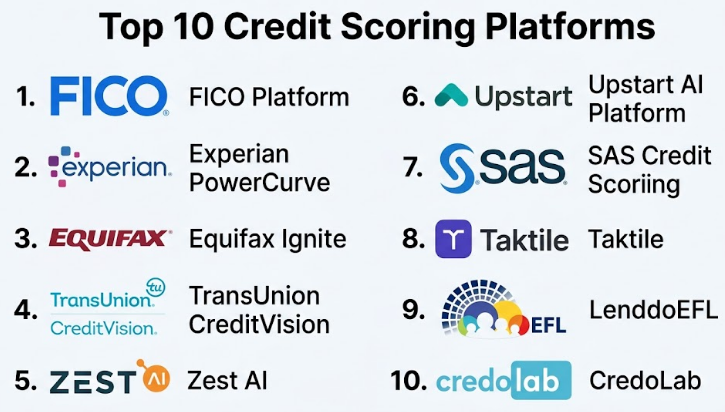
Top 10 Credit Scoring Platforms
#1 — FICO Platform
Short description :
FICO Platform is one of the most recognized credit scoring solutions globally. It powers many traditional credit scores used by financial institutions. The platform offers advanced analytics, decisioning tools, and fraud detection. It is widely used by banks and credit bureaus for risk management and lending decisions.
Key Features
- Advanced credit scoring models
- Decision management tools
- Fraud detection integration
- Real-time analytics
- AI-driven risk assessment
- Regulatory compliance tools
Pros
- Industry standard scoring models
- Highly reliable and scalable
Cons
- Expensive for smaller organizations
- Requires specialized expertise
Platforms / Deployment
Cloud / Hybrid
Security & Compliance
Encryption, audit logs; other details Not publicly stated
Integrations & Ecosystem
Strong integration with financial systems and data providers.
- Core banking systems
- Credit bureaus
- APIs
- Data warehouses
Support & Community
Enterprise-grade support with extensive documentation and onboarding.
#2 — Experian PowerCurve
Short description :
Experian PowerCurve combines credit scoring with decisioning capabilities. It allows organizations to build and deploy risk strategies quickly. It leverages Experian’s data assets and analytics expertise.
Key Features
- Decision engine
- Credit risk analytics
- Customer segmentation
- Strategy testing tools
- Real-time scoring
Pros
- Strong data integration
- Flexible decisioning
Cons
- Complex setup
- Requires training
Platforms / Deployment
Cloud
Security & Compliance
Not publicly stated
Integrations & Ecosystem
Integrates with Experian datasets and enterprise systems.
- APIs
- CRM systems
- Data platforms
Support & Community
Enterprise support available; onboarding assistance provided.
#3 — Equifax Ignite
Short description :
Equifax Ignite is a cloud-based analytics platform designed for credit risk modeling and decisioning. It provides access to Equifax data assets and tools for building custom models. It is widely used by financial institutions.
Key Features
- Data analytics tools
- Model development environment
- Real-time decisioning
- Risk scoring
- Data visualization
Pros
- Strong data capabilities
- Flexible modeling
Cons
- Limited UI simplicity
- Requires data expertise
Platforms / Deployment
Cloud
Security & Compliance
Not publicly stated
Integrations & Ecosystem
Works with enterprise data systems and APIs.
- Data lakes
- CRM tools
- APIs
Support & Community
Vendor support available; documentation varies.
#4 — TransUnion CreditVision
Short description :
TransUnion CreditVision uses trended data to provide deeper insights into consumer credit behavior. It enhances traditional credit scoring with historical patterns. It is useful for lenders seeking more accurate risk predictions.
Key Features
- Trended credit data
- Risk scoring models
- Behavioral analytics
- Customer insights
- Decision support
Pros
- Improved predictive accuracy
- Rich historical data
Cons
- Limited customization
- Dependent on TransUnion data
Platforms / Deployment
Cloud
Security & Compliance
Not publicly stated
Integrations & Ecosystem
Integrated with TransUnion services and APIs.
- Financial systems
- APIs
- Data tools
Support & Community
Vendor-driven support; limited public community.
#5 — Zest AI
Short description :
Zest AI is a modern AI-driven credit scoring platform focused on improving underwriting decisions. It uses machine learning to increase approval rates while reducing risk. It is popular among fintech companies.
Key Features
- Machine learning models
- Bias detection tools
- Model explainability
- Risk analytics
- Automated decisioning
Pros
- Strong AI capabilities
- Improves approval rates
Cons
- Requires data quality
- May need integration effort
Platforms / Deployment
Cloud
Security & Compliance
Not publicly stated
Integrations & Ecosystem
API-first platform for fintech integrations.
- Lending platforms
- APIs
- Data pipelines
Support & Community
Good support for enterprise clients; documentation available.
#6 — Upstart AI Platform
Short description :
Upstart uses AI models to assess creditworthiness using alternative data. It focuses on expanding access to credit. It is widely used in digital lending ecosystems.
Key Features
- AI-based scoring
- Alternative data usage
- Real-time decisioning
- Risk assessment
- Loan approval optimization
Pros
- Expands credit access
- Fast decision-making
Cons
- Limited customization
- Dependence on proprietary models
Platforms / Deployment
Cloud
Security & Compliance
Not publicly stated
Integrations & Ecosystem
Integrates with lending systems.
- APIs
- Fintech platforms
- Data sources
Support & Community
Vendor support available; limited community ecosystem.
#7 — SAS Credit Scoring
Short description :
SAS Credit Scoring provides advanced analytics for risk modeling and credit decisions. It is widely used in large enterprises. It supports complex statistical modeling and regulatory compliance.
Key Features
- Advanced analytics
- Model development tools
- Risk scoring
- Reporting dashboards
- Compliance features
Pros
- Highly powerful analytics
- Enterprise-grade capabilities
Cons
- Steep learning curve
- High cost
Platforms / Deployment
Cloud / On-premise
Security & Compliance
Not publicly stated
Integrations & Ecosystem
Strong integration with enterprise systems.
- Data platforms
- APIs
- CRM systems
Support & Community
Strong enterprise support; large user community.
#8 — Taktile
Short description :
Taktile is a decisioning platform designed for fintech companies. It allows teams to build and deploy credit policies quickly. It emphasizes flexibility and speed.
Key Features
- Decision workflows
- API-based scoring
- Rule engine
- Real-time analytics
- Data integrations
Pros
- Developer-friendly
- Fast deployment
Cons
- Limited enterprise features
- Smaller ecosystem
Platforms / Deployment
Cloud
Security & Compliance
Not publicly stated
Integrations & Ecosystem
API-first integration approach.
- Data sources
- Lending platforms
- APIs
Support & Community
Good onboarding support; growing ecosystem.
#9 — LenddoEFL
Short description :
LenddoEFL focuses on alternative credit scoring using behavioral and digital data. It is widely used in emerging markets. It helps lenders assess thin-file customers.
Key Features
- Alternative data scoring
- Behavioral analytics
- Risk models
- Fraud detection
- Customer insights
Pros
- Useful for underserved markets
- Expands financial inclusion
Cons
- Limited traditional scoring
- Regional focus
Platforms / Deployment
Cloud
Security & Compliance
Not publicly stated
Integrations & Ecosystem
Integrates with fintech platforms.
- APIs
- Data sources
- Mobile data
Support & Community
Vendor support available; ecosystem varies by region.
#10 — CredoLab
Short description :
CredoLab uses mobile and behavioral data to generate credit scores. It is designed for digital lenders and emerging markets. It helps assess customers without traditional credit history.
Key Features
- Mobile data scoring
- AI analytics
- Risk assessment
- Fraud detection
- API integration
Pros
- Works without credit history
- Fast deployment
Cons
- Limited traditional data
- Privacy considerations
Platforms / Deployment
Cloud
Security & Compliance
Not publicly stated
Integrations & Ecosystem
API-based integrations with digital platforms.
- Fintech apps
- APIs
- Data systems
Support & Community
Support available; documentation varies.
Comparison Table (Top 10)
| Tool Name | Best For | Platform(s) Supported | Deployment | Standout Feature | Public Rating |
|---|---|---|---|---|---|
| FICO Platform | Enterprise banks | Web | Hybrid | Industry-standard scoring | N/A |
| Experian PowerCurve | Data-driven lending | Web | Cloud | Decision engine | N/A |
| Equifax Ignite | Data modeling | Web | Cloud | Analytics tools | N/A |
| TransUnion CreditVision | Behavioral scoring | Web | Cloud | Trended data | N/A |
| Zest AI | AI underwriting | Web | Cloud | ML models | N/A |
| Upstart AI Platform | Alternative scoring | Web | Cloud | AI decisions | N/A |
| SAS Credit Scoring | Enterprise analytics | Web | Hybrid | Advanced analytics | N/A |
| Taktile | Fintech startups | Web | Cloud | API-first design | N/A |
| LenddoEFL | Emerging markets | Web | Cloud | Alternative data | N/A |
| CredoLab | Mobile scoring | Web | Cloud | Mobile analytics | N/A |
Evaluation & Credit Scoring Platforms
| Tool Name | Core (25%) | Ease (15%) | Integrations (15%) | Security (10%) | Performance (10%) | Support (10%) | Value (15%) | Weighted Total |
|---|---|---|---|---|---|---|---|---|
| FICO Platform | 9 | 6 | 9 | 8 | 9 | 8 | 6 | 8.0 |
| Experian PowerCurve | 9 | 6 | 9 | 8 | 9 | 8 | 6 | 8.0 |
| Equifax Ignite | 8 | 6 | 8 | 7 | 8 | 7 | 7 | 7.5 |
| TransUnion CreditVision | 8 | 6 | 8 | 7 | 8 | 7 | 6 | 7.3 |
| Zest AI | 8 | 8 | 8 | 7 | 8 | 7 | 7 | 7.8 |
| Upstart AI Platform | 8 | 7 | 7 | 7 | 8 | 7 | 7 | 7.5 |
| SAS Credit Scoring | 9 | 5 | 8 | 7 | 9 | 8 | 6 | 7.8 |
| Taktile | 7 | 8 | 8 | 6 | 7 | 6 | 7 | 7.2 |
| LenddoEFL | 7 | 7 | 7 | 6 | 7 | 6 | 7 | 6.9 |
| CredoLab | 7 | 7 | 7 | 6 | 7 | 6 | 7 | 6.9 |
How to interpret scores:
These scores reflect relative strengths across key criteria. Enterprise tools score higher on depth and scalability, while fintech-focused tools excel in ease of use and innovation. The best choice depends on your use case, data availability, and integration needs.
Which Credit Scoring Platform
Solo / Freelancer
Not typically required unless building fintech products.
SMB
Taktile or CredoLab offer simple and flexible solutions.
Mid-Market
Zest AI and Upstart provide strong AI-driven scoring.
Enterprise
FICO Platform, Experian PowerCurve, and SAS are ideal.
Budget vs Premium
Budget tools focus on flexibility; premium tools offer advanced analytics.
Feature Depth vs Ease of Use
Enterprise tools are powerful but complex; fintech tools are simpler.
Integrations & Scalability
API-first platforms are better for scaling digital lending.
Security & Compliance Needs
Banks should prioritize compliance-heavy platforms.
Frequently Asked Questions (FAQs)
1. What is a credit scoring platform?
It evaluates borrower risk using data and analytics.
2. How accurate are these platforms?
Accuracy depends on data quality and model design.
3. Can they use alternative data?
Yes, many platforms support non-traditional data sources.
4. Are they compliant with regulations?
Most enterprise tools are designed with compliance in mind.
5. How long does implementation take?
It can take weeks to months depending on complexity.
6. Can they integrate with lending systems?
Yes, most platforms offer APIs for integration.
7. Do they require data scientists?
Advanced tools often require technical expertise.
8. Are they cloud-based?
Most modern platforms are cloud-native.
9. Can small businesses use them?
Yes, but simpler tools are recommended.
10. What are alternatives?
Manual scoring or basic rule-based systems.
Conclusion
Credit Scoring Platforms are essential for modern lending and financial decision-making. They have evolved into intelligent systems that combine AI, analytics, and real-time data processing. While enterprise platforms offer unmatched depth and reliability, newer fintech solutions provide flexibility and speed.