Introduction
Semantic Search Platforms are technologies that improve search accuracy by understanding context, intent, relationships, and meaning instead of relying only on exact keyword matching. These platforms use artificial intelligence, natural language processing (NLP), vector search, embeddings, ontologies, and knowledge graphs to deliver more relevant search results across enterprise data, websites, applications, and AI systems.
In semantic search has become a critical component of enterprise AI, Retrieval-Augmented Generation (RAG), customer support automation, internal enterprise search, and intelligent knowledge management. As organizations manage massive amounts of structured and unstructured data, semantic search platforms help users discover information faster and more accurately.
Common real-world use cases include:
- AI-powered enterprise search
- RAG and generative AI systems
- Customer support knowledge retrieval
- E-commerce recommendation and product discovery
- Semantic document and content search
When evaluating Semantic Search Platforms, buyers should consider:
- Vector search capabilities
- NLP and embedding model support
- Hybrid keyword + semantic search
- Scalability and indexing performance
- Real-time search responsiveness
- Integration ecosystem
- Security and governance controls
- Knowledge graph compatibility
- Multi-cloud deployment support
- Developer APIs and SDKs
Best for: Enterprises, AI engineering teams, SaaS companies, customer support platforms, knowledge management teams, and organizations building intelligent search experiences.
Not ideal for: Small applications with basic keyword search requirements or organizations without AI-driven search use cases.
Key Trends in Semantic Search Platforms
- Vector databases and semantic search are increasingly converging into unified AI retrieval platforms.
- Hybrid search combining keyword and semantic retrieval is becoming the enterprise standard.
- Retrieval-Augmented Generation (RAG) architectures are driving major semantic search adoption.
- Multimodal search across text, image, audio, and video is expanding rapidly.
- Real-time embedding generation and indexing are improving AI responsiveness.
- Knowledge graph integration is enhancing contextual search accuracy.
- Open-source embedding models are reducing dependence on proprietary AI systems.
- Semantic search governance and explainability are becoming important for regulated industries.
- GPU acceleration and distributed vector indexing are improving large-scale performance.
- Cloud-native semantic search services are simplifying enterprise deployment.
How We Selected These Tools (Methodology)
The platforms in this list were selected using a balanced evaluation framework focused on AI relevance, scalability, enterprise readiness, and ecosystem maturity.
Selection criteria included:
- Enterprise adoption and market visibility
- Semantic and vector search capabilities
- NLP and AI integration support
- Scalability and indexing performance
- Hybrid and cloud deployment flexibility
- Security and governance features
- API ecosystem and developer tooling
- Knowledge graph compatibility
- Documentation and community support
- Innovation in AI-driven retrieval systems
The final list balances cloud-native platforms, vector databases, enterprise search engines, open-source ecosystems, and AI-native retrieval platforms.
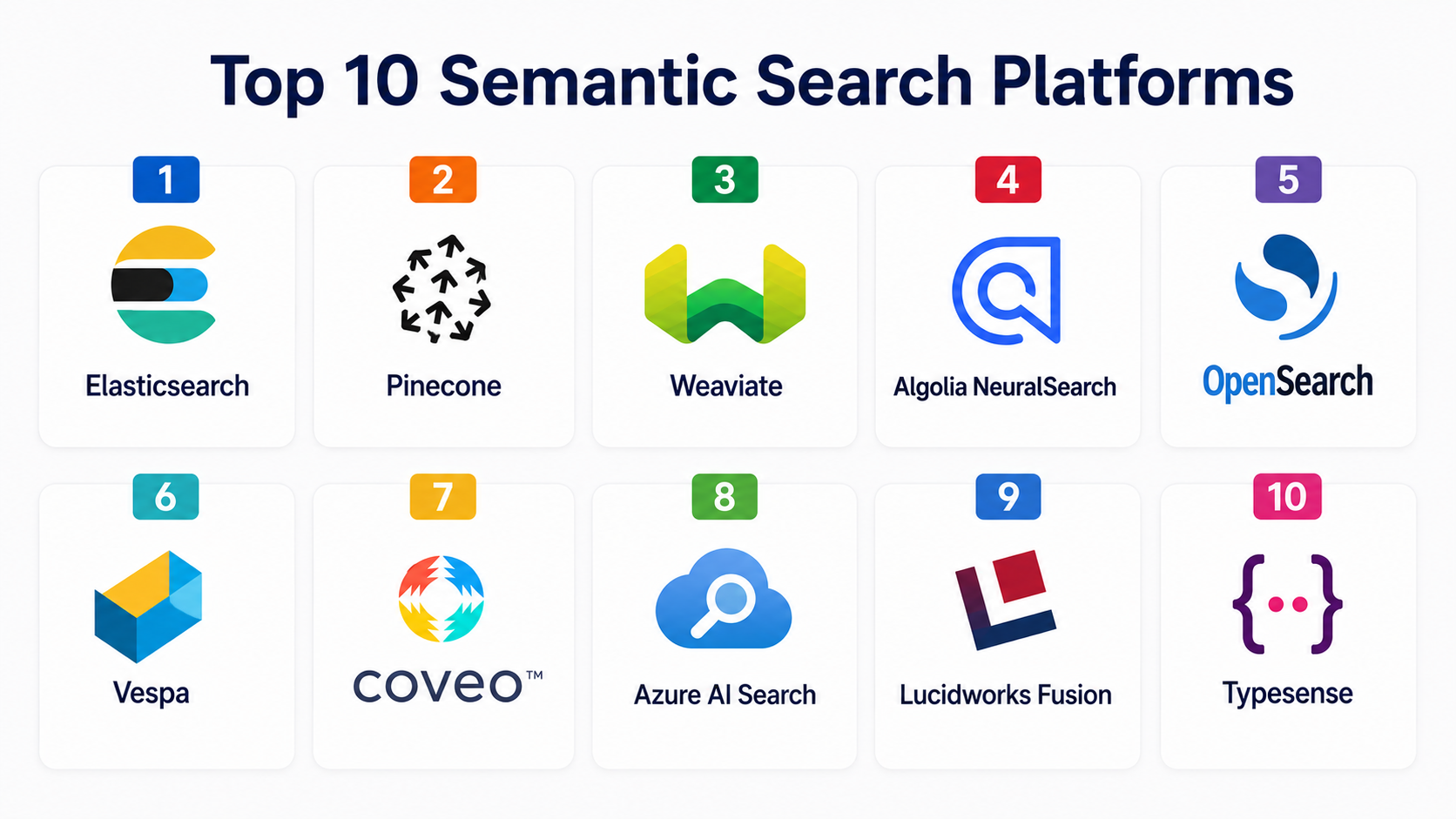
Semantic Search Platforms
#1 — Elasticsearch
Short description :
Elasticsearch is one of the most widely adopted search and analytics platforms globally. Originally designed for keyword search and log analytics, it now supports semantic search, vector retrieval, and AI-powered relevance capabilities. Elasticsearch is commonly used for enterprise search, observability, e-commerce search, and AI retrieval systems. Its ecosystem includes extensive integrations, APIs, and distributed scaling support.
Key Features
- Hybrid keyword and vector search
- Distributed indexing architecture
- NLP and embedding support
- Real-time search analytics
- AI relevance ranking
- REST APIs and SDKs
- Scalable clustering
Pros
- Extremely mature ecosystem
- Strong scalability and reliability
- Flexible deployment options
Cons
- Operational complexity at scale
- Advanced tuning can require expertise
- Enterprise licensing costs for premium features
Platforms / Deployment
- Windows / Linux / macOS
- Cloud / Self-hosted / Hybrid
Security & Compliance
- SSO/SAML
- MFA
- Encryption
- RBAC
- Audit logs
- SOC 2
- GDPR support
Integrations & Ecosystem
Elasticsearch integrates with analytics systems, AI frameworks, observability stacks, and cloud platforms.
- Kibana
- Logstash
- OpenAI APIs
- AWS
- Azure
- Google Cloud
Support & Community
Elasticsearch has one of the largest search platform communities globally, with strong enterprise documentation and training resources.
#2 — Pinecone
Short description :
Pinecone is a managed vector database platform designed specifically for semantic search, AI retrieval, and RAG applications. It focuses on scalable vector indexing and low-latency similarity search for AI systems. Pinecone is widely adopted among AI startups, SaaS companies, and enterprise generative AI initiatives.
Key Features
- Managed vector database
- Real-time similarity search
- AI embedding optimization
- Scalable indexing
- Low-latency retrieval
- Metadata filtering
- Cloud-native architecture
Pros
- Excellent semantic retrieval performance
- Simplified managed infrastructure
- Strong AI ecosystem integration
Cons
- Primarily focused on vector workloads
- Less suitable for traditional keyword search
- Cloud-centric deployment model
Platforms / Deployment
- Web
- Cloud
Security & Compliance
- Encryption
- RBAC
- Audit logging
- SOC 2
Integrations & Ecosystem
Pinecone integrates with AI frameworks, embedding models, and generative AI pipelines.
- LangChain
- OpenAI
- Hugging Face
- AWS
- Python SDKs
Support & Community
Pinecone offers strong developer documentation and rapidly growing AI developer communities.
#3 — Weaviate
Short description :
Weaviate is an open-source vector search platform designed for semantic search and AI-native applications. It supports hybrid search, vector embeddings, and modular AI integrations. Weaviate is popular among developers building semantic search systems and enterprise AI retrieval architectures.
Key Features
- Vector search engine
- Hybrid semantic + keyword search
- Modular AI integrations
- GraphQL APIs
- Real-time indexing
- Multi-tenant architecture
- Open-source deployment options
Pros
- Flexible open-source architecture
- Strong AI integration ecosystem
- Good developer experience
Cons
- Enterprise governance still evolving
- Scaling large deployments requires expertise
- Smaller ecosystem than Elasticsearch
Platforms / Deployment
- Linux
- Cloud / Self-hosted / Hybrid
Security & Compliance
- Encryption
- RBAC
- SSO/SAML
Integrations & Ecosystem
Weaviate integrates with embedding providers, AI frameworks, and vector workflows.
- OpenAI
- Cohere
- Hugging Face
- LangChain
- Kubernetes
Support & Community
Weaviate has a rapidly growing open-source community and active AI developer ecosystem.
#4 — Algolia NeuralSearch
Short description :
Algolia NeuralSearch combines semantic search with traditional keyword relevance for customer-facing search experiences. The platform is widely used in e-commerce, SaaS, and digital experience applications requiring fast and intelligent search interactions.
Key Features
- Hybrid semantic search
- AI-powered ranking
- Fast indexing performance
- Real-time query suggestions
- NLP relevance optimization
- Analytics dashboard
- API-first architecture
Pros
- Excellent search speed
- Strong user experience tooling
- Good e-commerce search optimization
Cons
- Premium pricing at scale
- Cloud-centric architecture
- Less flexible for deep custom AI workflows
Platforms / Deployment
- Web
- Cloud
Security & Compliance
- Encryption
- RBAC
- SSO/SAML
- GDPR support
Integrations & Ecosystem
Algolia integrates with CMS platforms, e-commerce systems, and frontend frameworks.
- Shopify
- Salesforce Commerce
- React
- Vue.js
- APIs
Support & Community
Algolia provides enterprise support, onboarding services, and strong developer documentation.
#5 — OpenSearch
Short description :
OpenSearch is an open-source search and analytics platform derived from Elasticsearch. It supports semantic search, vector engines, and AI-powered retrieval while maintaining strong open-source flexibility. OpenSearch is commonly used in enterprise search, observability, and AI retrieval systems.
Key Features
- Open-source search platform
- Vector search support
- Distributed indexing
- Real-time analytics
- AI and ML integrations
- Query customization
- Scalable clustering
Pros
- Open-source flexibility
- Strong scalability
- Lower licensing costs
Cons
- Operational complexity
- Smaller enterprise ecosystem than Elasticsearch
- Advanced AI tooling still evolving
Platforms / Deployment
- Linux / Windows
- Cloud / Self-hosted / Hybrid
Security & Compliance
- Encryption
- RBAC
- Audit logging
- SSO/SAML
Integrations & Ecosystem
OpenSearch integrates with cloud services, analytics systems, and AI frameworks.
- AWS
- Kibana-compatible dashboards
- LangChain
- Python SDKs
- Kafka
Support & Community
OpenSearch benefits from strong open-source community activity and cloud provider support.
#6 — Vespa
Short description :
Vespa is a large-scale search and recommendation platform designed for real-time semantic retrieval, machine learning inference, and AI-powered ranking. It is widely used in high-performance search applications and recommendation systems.
Key Features
- Real-time semantic retrieval
- Vector search
- AI inference integration
- Distributed search architecture
- Large-scale indexing
- Ranking customization
- Recommendation engine support
Pros
- Excellent performance at scale
- Strong AI ranking support
- Real-time serving capabilities
Cons
- Steeper learning curve
- Requires infrastructure expertise
- Smaller mainstream adoption
Platforms / Deployment
- Linux
- Cloud / Self-hosted / Hybrid
Security & Compliance
- RBAC
- Encryption
- Audit logging
Integrations & Ecosystem
Vespa integrates with machine learning pipelines and large-scale search systems.
- TensorFlow
- ONNX
- Kubernetes
- Java
- Python
Support & Community
Vespa has strong technical documentation and active engineering-focused communities.
#7 — Coveo
Short description :
Coveo is an enterprise AI search and relevance platform focused on customer experience, workplace search, and support automation. It combines semantic search, recommendation engines, and AI personalization capabilities for enterprise environments.
Key Features
- AI relevance optimization
- Enterprise semantic search
- Recommendation engines
- Personalization capabilities
- Workplace search
- Analytics and reporting
- SaaS delivery model
Pros
- Strong enterprise search capabilities
- Excellent personalization features
- Good customer experience integrations
Cons
- Enterprise pricing model
- Primarily SaaS-focused
- Less developer-centric flexibility
Platforms / Deployment
- Web
- Cloud
Security & Compliance
- SSO/SAML
- Encryption
- RBAC
- SOC 2
- GDPR support
Integrations & Ecosystem
Coveo integrates with enterprise SaaS platforms and customer support systems.
- Salesforce
- ServiceNow
- Adobe Experience Cloud
- Zendesk
- Microsoft ecosystems
Support & Community
Coveo provides enterprise onboarding, consulting, and customer success programs.
#8 — Azure AI Search
Short description :
Azure AI Search is Microsoft’s cloud-native search platform supporting semantic ranking, vector search, NLP enrichment, and enterprise AI retrieval systems. It integrates closely with Azure AI services and enterprise Microsoft ecosystems.
Key Features
- Semantic ranking
- Vector search support
- AI enrichment pipelines
- Cognitive search capabilities
- Cloud-native scalability
- Hybrid search architecture
- Azure integration
Pros
- Strong Microsoft ecosystem alignment
- Good AI enrichment capabilities
- Simplified cloud deployment
Cons
- Best suited for Azure-heavy organizations
- Limited portability
- Advanced optimization may require expertise
Platforms / Deployment
- Web
- Cloud
Security & Compliance
- Encryption
- RBAC
- MFA
- SSO/SAML
- SOC 2
- ISO 27001
Integrations & Ecosystem
Azure AI Search integrates deeply with Microsoft AI, analytics, and cloud services.
- Azure OpenAI
- Microsoft Fabric
- Power BI
- Azure AI Studio
- Synapse Analytics
Support & Community
Microsoft provides extensive enterprise support and cloud documentation resources.
#9 — Lucidworks Fusion
Short description :
Lucidworks Fusion is an enterprise search and AI relevance platform built on Apache Solr. It focuses on intelligent search experiences, semantic ranking, analytics, and enterprise knowledge discovery.
Key Features
- AI-powered relevance tuning
- Semantic search capabilities
- Enterprise analytics
- NLP processing
- Data ingestion pipelines
- Search personalization
- Scalable architecture
Pros
- Strong enterprise search tooling
- Good analytics capabilities
- Mature Solr-based architecture
Cons
- Enterprise complexity
- Premium licensing costs
- Requires tuning expertise
Platforms / Deployment
- Linux
- Cloud / Self-hosted / Hybrid
Security & Compliance
- SSO/SAML
- Encryption
- RBAC
- Audit logging
Integrations & Ecosystem
Lucidworks integrates with enterprise content systems and analytics platforms.
- Apache Solr
- SharePoint
- Salesforce
- Hadoop
- APIs
Support & Community
Lucidworks provides enterprise support and professional implementation services.
#10 — Typesense
Short description :
Typesense is a developer-friendly search engine focused on fast, typo-tolerant, and semantic search experiences. It offers simplified deployment and modern APIs for SaaS applications, e-commerce, and AI-enhanced search systems.
Key Features
- Semantic and vector search
- Typo tolerance
- Fast indexing
- Developer-friendly APIs
- Real-time updates
- Hybrid search support
- Lightweight deployment
Pros
- Easy developer experience
- Fast implementation
- Lightweight operational footprint
Cons
- Smaller enterprise ecosystem
- Less advanced governance features
- Limited large-scale enterprise tooling
Platforms / Deployment
- Linux / macOS
- Cloud / Self-hosted
Security & Compliance
- Encryption
- API key access controls
- RBAC
Integrations & Ecosystem
Typesense integrates with modern web frameworks, AI embeddings, and developer tooling.
- OpenAI
- LangChain
- React
- Node.js
- Python
Support & Community
Typesense has active open-source communities and strong developer documentation.
Comparison Table (Top 10)
| Tool Name | Best For | Platform(s) Supported | Deployment | Standout Feature | Public Rating |
|---|---|---|---|---|---|
| Elasticsearch | Enterprise search and analytics | Windows, Linux, macOS | Hybrid | Hybrid semantic + keyword search | N/A |
| Pinecone | AI vector retrieval | Web | Cloud | Managed vector infrastructure | N/A |
| Weaviate | Open-source semantic AI | Linux | Hybrid | AI-native vector architecture | N/A |
| Algolia NeuralSearch | E-commerce semantic search | Web | Cloud | Fast AI-powered relevance | N/A |
| OpenSearch | Open-source enterprise search | Windows, Linux | Hybrid | Open-source vector search | N/A |
| Vespa | Large-scale AI retrieval | Linux | Hybrid | Real-time AI ranking | N/A |
| Coveo | Enterprise AI personalization | Web | Cloud | Personalized semantic relevance | N/A |
| Azure AI Search | Microsoft enterprise AI | Web | Cloud | Azure-native semantic search | N/A |
| Lucidworks Fusion | Enterprise intelligent search | Linux | Hybrid | AI relevance tuning | N/A |
| Typesense | Lightweight semantic search | Linux, macOS | Hybrid | Developer-friendly semantic APIs | N/A |
Evaluation & Semantic Search Platforms
| Tool Name | Core (25%) | Ease (15%) | Integrations (15%) | Security (10%) | Performance (10%) | Support (10%) | Value (15%) | Weighted Total |
|---|---|---|---|---|---|---|---|---|
| Elasticsearch | 9 | 7 | 10 | 9 | 9 | 9 | 7 | 8.6 |
| Pinecone | 8 | 9 | 8 | 8 | 9 | 8 | 7 | 8.1 |
| Weaviate | 8 | 8 | 8 | 7 | 8 | 7 | 8 | 7.9 |
| Algolia NeuralSearch | 8 | 9 | 8 | 8 | 9 | 8 | 6 | 8.0 |
| OpenSearch | 8 | 7 | 8 | 7 | 8 | 7 | 9 | 7.9 |
| Vespa | 9 | 5 | 7 | 7 | 10 | 7 | 7 | 7.8 |
| Coveo | 8 | 8 | 8 | 8 | 8 | 8 | 6 | 7.8 |
| Azure AI Search | 8 | 8 | 9 | 9 | 8 | 8 | 7 | 8.1 |
| Lucidworks Fusion | 8 | 6 | 8 | 8 | 8 | 7 | 6 | 7.4 |
| Typesense | 7 | 9 | 7 | 6 | 7 | 7 | 9 | 7.6 |
These scores are comparative rather than absolute. Some platforms prioritize enterprise governance and hybrid search, while others focus more heavily on AI-native vector retrieval or developer simplicity. Buyers should evaluate platforms based on workload scale, AI architecture, deployment preferences, and operational expertise.
Which Semantic Search Platforms
Solo / Freelancer
Individual developers and startups may prefer:
- Typesense
- Weaviate
- OpenSearch
These tools provide flexible semantic search capabilities without requiring massive enterprise infrastructure.
SMB
Small and medium-sized businesses should focus on usability, fast deployment, and manageable operational complexity.
Recommended options:
- Algolia NeuralSearch
- Typesense
- Pinecone
Mid-Market
Mid-sized organizations often need scalable AI retrieval and hybrid search functionality.
Recommended options:
- Elasticsearch
- Weaviate
- Azure AI Search
- Pinecone
Enterprise
Large enterprises with advanced AI, governance, and large-scale retrieval workloads should prioritize scalability and ecosystem maturity.
Recommended options:
- Elasticsearch
- Azure AI Search
- Coveo
- Lucidworks Fusion
Budget vs Premium
- Budget-friendly: OpenSearch, Typesense
- Premium enterprise: Coveo, Lucidworks, Algolia
- Balanced value: Elasticsearch, Weaviate
Feature Depth vs Ease of Use
- Deepest enterprise features: Elasticsearch
- Best usability: Algolia, Pinecone
- Best developer flexibility: Weaviate, OpenSearch
Integrations & Scalability
- Best AWS ecosystem fit: OpenSearch
- Best Microsoft ecosystem fit: Azure AI Search
- Best AI-native integrations: Pinecone, Weaviate
Security & Compliance Needs
Organizations in regulated sectors should prioritize:
- Elasticsearch
- Azure AI Search
- Coveo
- Lucidworks Fusion
Frequently Asked Questions (FAQs)
1. What is semantic search?
Semantic search improves search accuracy by understanding context, meaning, relationships, and user intent instead of relying only on exact keyword matching.
2. How is semantic search different from keyword search?
Keyword search focuses on matching exact terms, while semantic search uses AI, NLP, embeddings, and contextual understanding to retrieve more relevant results.
3. What role do vector databases play in semantic search?
Vector databases store embeddings that enable similarity-based retrieval for semantic search, recommendation systems, and generative AI applications.
4. Why is semantic search important for AI applications?
Semantic search is foundational for Retrieval-Augmented Generation (RAG), enterprise AI assistants, recommendation systems, and intelligent document retrieval.
5. What industries use semantic search platforms?
Industries include e-commerce, healthcare, SaaS, finance, customer support, publishing, cybersecurity, and enterprise knowledge management.
6. What are embeddings in semantic search?
Embeddings are numerical vector representations of text, images, or other content used to identify semantic similarity between pieces of information.
7. Are semantic search platforms difficult to implement?
Implementation complexity varies. Managed cloud services simplify deployment, while highly customized enterprise systems may require advanced AI and infrastructure expertise.
8. Can semantic search work with existing databases?
Yes. Many semantic search platforms integrate with relational databases, document stores, knowledge graphs, and enterprise content management systems.
9. What should buyers prioritize when evaluating semantic search platforms?
Buyers should evaluate scalability, vector search quality, NLP integrations, security, deployment flexibility, hybrid search support, and operational complexity.
10. Are open-source semantic search platforms enterprise-ready?
Several open-source platforms such as OpenSearch and Weaviate are increasingly enterprise-ready, especially when paired with managed infrastructure and strong governance practices.
Conclusion
Semantic Search Platforms have become critical infrastructure for AI-powered retrieval, enterprise knowledge management, customer experience optimization, and intelligent data discovery. As organizations adopt generative AI, Retrieval-Augmented Generation (RAG), and large-scale semantic retrieval architectures, the demand for scalable and intelligent search systems continues to grow rapidly.Elasticsearch remains one of the strongest overall enterprise search platforms due to its mature ecosystem and hybrid retrieval capabilities, while Pinecone and Weaviate stand out for AI-native vector retrieval architectures.
