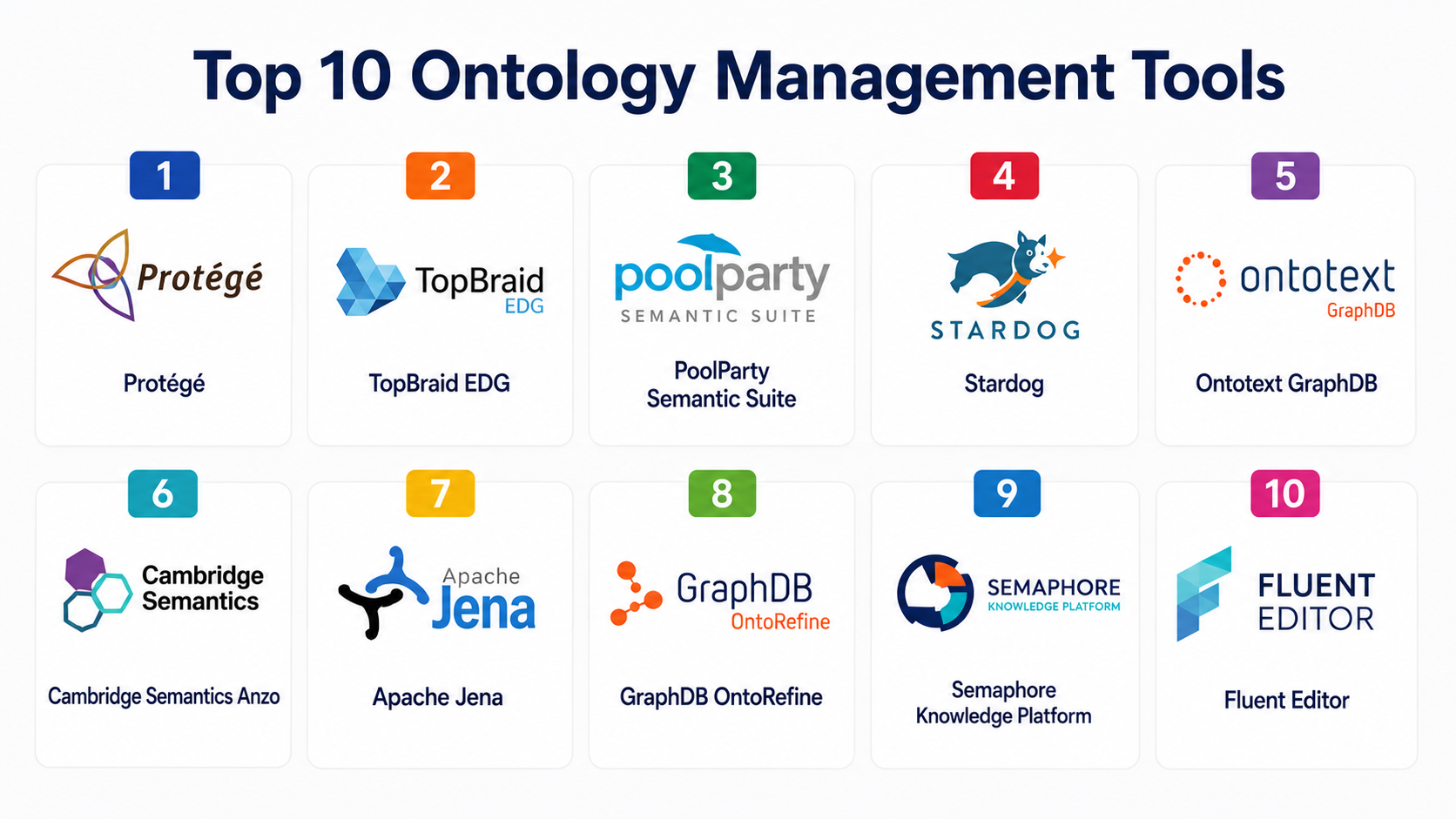
Introduction
Ontology Management Tools are specialized platforms used to create, organize, manage, govern, and maintain ontologies for semantic data systems, knowledge graphs, AI applications, and enterprise metadata environments. Ontologies define relationships, concepts, entities, and rules that help machines and humans understand data contextually.
In ontology management has become increasingly important because organizations are building AI-ready data architectures, semantic search systems, enterprise knowledge graphs, and Retrieval-Augmented Generation (RAG) applications. Ontologies help standardize meaning across distributed systems, improving interoperability, governance, and AI reasoning capabilities.
Common real-world use cases include:
- Enterprise knowledge graph management
- Semantic AI and NLP applications
- Healthcare and life sciences data standardization
- Regulatory and compliance metadata governance
- Product taxonomy and enterprise search systems
When evaluating Ontology Management Tools, buyers should consider:
- OWL and RDF standards support
- Collaboration and governance capabilities
- Reasoning and inference engines
- Knowledge graph integration
- Scalability and performance
- Version control and change tracking
- API and integration ecosystem
- Visualization capabilities
- Cloud and hybrid deployment options
- AI and semantic search integration
Best for: Enterprises, semantic web developers, AI teams, data governance teams, healthcare organizations, research institutions, and knowledge graph architects.
Not ideal for: Small businesses with simple relational data models, lightweight metadata requirements, or teams without semantic data use cases.
Key Trends in Ontology Management Tools
- AI-powered ontology generation and semantic modeling are becoming more common.
- Ontology tools are increasingly integrated with enterprise knowledge graph platforms.
- Retrieval-Augmented Generation (RAG) systems are driving ontology adoption in AI architectures.
- Collaborative ontology editing and governance workflows are improving for distributed teams.
- Cloud-native semantic platforms are reducing infrastructure complexity.
- Semantic interoperability across enterprise systems is becoming a strategic priority.
- Graph visualization and semantic exploration interfaces are improving usability.
- Industry-specific ontologies for healthcare, finance, and manufacturing are expanding.
- Metadata governance and lineage tracking are becoming tightly integrated with ontology management.
- Hybrid graph and vector search architectures are influencing semantic modeling strategies.
How We Selected These Tools (Methodology)
The platforms in this list were selected using a balanced evaluation framework focused on semantic capabilities, enterprise adoption, interoperability, and long-term ecosystem relevance.
Selection criteria included:
- Market adoption and semantic web credibility
- Support for OWL, RDF, and SPARQL standards
- Collaboration and governance capabilities
- Reasoning and inference support
- Enterprise integration ecosystem
- Scalability and deployment flexibility
- Visualization and usability
- AI and knowledge graph compatibility
- Documentation and community activity
- Vendor maturity and innovation
The final list includes enterprise semantic platforms, open-source ontology editors, knowledge graph-centric tools, and developer-focused semantic ecosystems.
Ontology Management Tools
#1 — Protégé
Short description :
Protégé is one of the most widely used ontology management and semantic modeling tools in the world. Developed by Stanford University, it is an open-source platform for building ontologies and knowledge-based systems. Protégé supports OWL, RDF, and semantic reasoning workflows, making it popular among researchers, enterprises, healthcare organizations, and semantic web developers. It is widely used for ontology design, semantic data modeling, and academic research projects. The platform also supports plugins and integrations for advanced semantic workflows.
Key Features
- OWL ontology editing
- RDF support
- Semantic reasoning integration
- Visualization plugins
- Ontology versioning
- Extensible plugin architecture
- Knowledge graph modeling
Pros
- Strong semantic web standards support
- Large academic and enterprise community
- Free and open-source platform
Cons
- Desktop-oriented workflow
- UI can feel dated
- Limited enterprise governance features
Platforms / Deployment
- Windows / Linux / macOS
- Self-hosted
Security & Compliance
- Varies / N/A
Integrations & Ecosystem
Protégé integrates with semantic reasoners, RDF stores, and ontology frameworks. Its plugin ecosystem extends support for visualization, inference, and semantic validation.
- OWL APIs
- RDF frameworks
- SPARQL endpoints
- Pellet
- HermiT
Support & Community
Protégé has one of the strongest ontology and semantic web communities globally, with extensive academic resources and tutorials.
#2 — TopBraid EDG
Short description :
TopBraid EDG is an enterprise knowledge graph and ontology management platform focused on governance, semantic integration, and linked data management. It helps organizations build enterprise semantic layers and govern business vocabularies across distributed systems. The platform is commonly used in government, healthcare, manufacturing, and large enterprise environments.
Key Features
- Enterprise ontology management
- Knowledge graph integration
- Semantic governance workflows
- RDF and SHACL support
- Metadata management
- Collaborative editing
- Semantic search capabilities
Pros
- Strong enterprise governance features
- Excellent semantic standards support
- Mature linked data tooling
Cons
- Enterprise-focused pricing
- Requires semantic expertise
- Smaller ecosystem than mainstream data platforms
Platforms / Deployment
- Web / Linux
- Cloud / Self-hosted / Hybrid
Security & Compliance
- SSO/SAML
- RBAC
- Encryption
- Audit logs
Integrations & Ecosystem
TopBraid integrates with semantic repositories, enterprise metadata systems, and graph platforms.
- SPARQL endpoints
- Graph databases
- REST APIs
- RDF repositories
- Enterprise metadata tools
Support & Community
TopQuadrant provides enterprise onboarding, semantic consulting, and technical support programs.
#3 — PoolParty Semantic Suite
Short description :
PoolParty Semantic Suite is a semantic AI and taxonomy management platform designed for enterprise knowledge management and semantic enrichment. It supports ontology management, taxonomy development, metadata governance, and semantic search applications. The platform is widely used for enterprise search, NLP, and AI-driven knowledge discovery.
Key Features
- Ontology and taxonomy management
- Semantic enrichment
- NLP integration
- Knowledge graph support
- Metadata governance
- AI-powered semantic tagging
- Enterprise search optimization
Pros
- Strong semantic AI capabilities
- Good enterprise usability
- Advanced taxonomy management
Cons
- Premium enterprise pricing
- Requires semantic modeling expertise
- Complex enterprise deployments
Platforms / Deployment
- Web
- Cloud / Self-hosted / Hybrid
Security & Compliance
- SSO/SAML
- Encryption
- RBAC
- Audit logging
Integrations & Ecosystem
PoolParty integrates with enterprise search systems, NLP frameworks, and knowledge graph environments.
- Elasticsearch
- Solr
- Graph databases
- REST APIs
- NLP pipelines
Support & Community
Enterprise onboarding, consulting, and semantic AI implementation support are available through the vendor.
#4 — Stardog
Short description :
Stardog is an enterprise knowledge graph and ontology platform focused on semantic reasoning, virtual graphs, and AI-ready semantic architectures. It enables organizations to manage ontologies alongside enterprise knowledge graphs and semantic integration workflows. Stardog is commonly used in regulated industries and enterprise AI projects.
Key Features
- Ontology management
- Semantic reasoning engine
- Virtual knowledge graphs
- RDF and OWL support
- SPARQL querying
- Data virtualization
- AI-ready semantic modeling
Pros
- Strong semantic reasoning capabilities
- Enterprise knowledge graph support
- Advanced ontology integration
Cons
- Requires semantic expertise
- Premium pricing
- Smaller community than open-source tools
Platforms / Deployment
- Linux
- Cloud / Self-hosted / Hybrid
Security & Compliance
- SSO/SAML
- RBAC
- Encryption
- Audit logs
Integrations & Ecosystem
Stardog integrates with enterprise metadata systems, graph databases, and AI frameworks.
- GraphQL
- Kafka
- Snowflake
- Databricks
- AWS
Support & Community
Stardog provides enterprise support, consulting, and semantic architecture training programs.
#5 — Ontotext GraphDB
Short description :
Ontotext GraphDB is a semantic graph platform optimized for RDF data management, ontology reasoning, and enterprise knowledge graph architectures. It supports semantic interoperability and linked data applications across industries such as healthcare, publishing, and research.
Key Features
- RDF graph storage
- Ontology reasoning
- SPARQL query engine
- Linked data support
- Semantic inference
- Knowledge graph visualization
- Data federation
Pros
- Strong RDF performance
- Excellent semantic standards support
- Mature enterprise semantic tooling
Cons
- Less suitable for operational transactional workloads
- Requires ontology expertise
- Smaller ecosystem
Platforms / Deployment
- Linux
- Cloud / Self-hosted / Hybrid
Security & Compliance
- RBAC
- Encryption
- Audit logging
Integrations & Ecosystem
GraphDB integrates with semantic web technologies, analytics systems, and graph databases.
- RDF frameworks
- Elasticsearch
- Kafka
- AWS
- Azure
Support & Community
Ontotext provides enterprise semantic consulting, technical documentation, and support services.
#6 — Cambridge Semantics Anzo
Short description :
Cambridge Semantics Anzo is an enterprise semantic knowledge graph platform focused on ontology-driven analytics and semantic integration. It helps enterprises unify complex data sources while enabling business-friendly semantic exploration and analytics workflows.
Key Features
- Ontology management
- Semantic data integration
- Knowledge graph analytics
- Business glossary management
- Data virtualization
- Semantic governance
- Visualization tools
Pros
- Strong enterprise analytics capabilities
- Good semantic integration workflows
- Business-friendly visualization features
Cons
- Enterprise-oriented pricing
- Smaller developer ecosystem
- Complex onboarding process
Platforms / Deployment
- Web / Linux
- Cloud / Hybrid
Security & Compliance
- SSO/SAML
- Encryption
- RBAC
- Audit logs
Integrations & Ecosystem
Anzo integrates with analytics platforms, metadata systems, and enterprise data environments.
- Tableau
- Power BI
- Graph databases
- Cloud data warehouses
- REST APIs
Support & Community
Cambridge Semantics provides enterprise implementation assistance and semantic consulting services.
#7 — Apache Jena
Short description :
Apache Jena is an open-source semantic web framework for building RDF applications and ontology-driven systems. It includes APIs, RDF storage, reasoning engines, and SPARQL query processing tools. Jena is widely used by developers building semantic applications and custom ontology platforms.
Key Features
- RDF framework
- SPARQL query engine
- Ontology APIs
- Semantic reasoning
- Triple store support
- Linked data support
- Java-based semantic tooling
Pros
- Strong open-source flexibility
- Excellent semantic standards support
- Highly customizable framework
Cons
- Developer-focused rather than business-friendly
- Requires engineering expertise
- Limited enterprise UI tooling
Platforms / Deployment
- Windows / Linux / macOS
- Self-hosted
Security & Compliance
- Varies / N/A
Integrations & Ecosystem
Apache Jena integrates with semantic web technologies, RDF systems, and custom Java applications.
- RDF stores
- Java frameworks
- SPARQL endpoints
- Semantic APIs
- Linked data systems
Support & Community
Apache Jena has strong open-source community support and extensive technical documentation.
#8 — GraphDB OntoRefine
Short description :
GraphDB OntoRefine is a semantic data transformation and ontology management tool designed for RDF data curation and semantic enrichment. It helps organizations prepare, clean, and align data for ontology-driven knowledge graph systems.
Key Features
- Semantic data transformation
- Ontology alignment
- RDF mapping
- Data cleaning workflows
- SPARQL support
- Linked data management
- Semantic enrichment
Pros
- Good semantic transformation tooling
- Useful for RDF data preparation
- Integrates well with knowledge graph systems
Cons
- Specialized semantic use cases
- Smaller ecosystem
- Limited general-purpose analytics capabilities
Platforms / Deployment
- Linux
- Cloud / Self-hosted
Security & Compliance
- RBAC
- Encryption
Integrations & Ecosystem
OntoRefine integrates with RDF repositories, semantic pipelines, and graph systems.
- RDF frameworks
- GraphDB
- SPARQL endpoints
- ETL pipelines
Support & Community
Support varies depending on deployment model and enterprise agreements.
#9 — Semaphore Knowledge Platform
Short description :
Semaphore Knowledge Platform focuses on enterprise taxonomy and ontology management for semantic AI, content intelligence, and enterprise search systems. It is widely used in publishing, financial services, and enterprise content management environments.
Key Features
- Ontology management
- Taxonomy governance
- Semantic tagging
- Enterprise search optimization
- Metadata enrichment
- NLP integration
- Knowledge graph support
Pros
- Strong enterprise taxonomy tooling
- Good semantic content management
- Useful AI enrichment capabilities
Cons
- Enterprise pricing
- Limited open-source ecosystem
- Requires semantic governance expertise
Platforms / Deployment
- Web
- Cloud / Hybrid
Security & Compliance
- SSO/SAML
- Encryption
- RBAC
- Audit logs
Integrations & Ecosystem
Semaphore integrates with enterprise content management and semantic search platforms.
- SharePoint
- Elasticsearch
- Solr
- REST APIs
- NLP systems
Support & Community
Enterprise support, onboarding, and semantic consulting are available from the vendor.
#10 — Fluent Editor
Short description :
Fluent Editor is an ontology editing environment designed for semantic modeling and knowledge engineering workflows. It provides graphical ontology editing capabilities and supports semantic web standards for ontology development projects.
Key Features
- Ontology editing
- Semantic modeling
- OWL support
- Graphical knowledge representation
- Semantic reasoning support
- Visualization capabilities
- Rule-based modeling
Pros
- User-friendly ontology editing
- Visual semantic modeling
- Good academic and research support
Cons
- Smaller ecosystem
- Limited enterprise governance capabilities
- Less scalable for massive enterprise deployments
Platforms / Deployment
- Windows
- Self-hosted
Security & Compliance
- Varies / N/A
Integrations & Ecosystem
Fluent Editor integrates with semantic reasoning frameworks and ontology standards environments.
- OWL APIs
- RDF frameworks
- Semantic reasoners
- Knowledge graph systems
Support & Community
Community support is available primarily through academic and semantic web communities.
Comparison Table (Top 10)
| Tool Name | Best For | Platform(s) Supported | Deployment | Standout Feature | Public Rating |
|---|---|---|---|---|---|
| Protégé | Academic and enterprise ontology modeling | Windows, Linux, macOS | Self-hosted | Open-source ontology editor | N/A |
| TopBraid EDG | Enterprise semantic governance | Web, Linux | Hybrid | Semantic governance workflows | N/A |
| PoolParty Semantic Suite | Semantic AI and enterprise search | Web | Hybrid | AI-powered semantic enrichment | N/A |
| Stardog | Enterprise knowledge graphs | Linux | Hybrid | Semantic reasoning engine | N/A |
| Ontotext GraphDB | RDF knowledge graphs | Linux | Hybrid | RDF semantic optimization | N/A |
| Cambridge Semantics Anzo | Ontology-driven analytics | Web, Linux | Hybrid | Semantic analytics platform | N/A |
| Apache Jena | Developer semantic frameworks | Windows, Linux, macOS | Self-hosted | Open-source RDF framework | N/A |
| GraphDB OntoRefine | RDF transformation workflows | Linux | Hybrid | Semantic data transformation | N/A |
| Semaphore Knowledge Platform | Enterprise taxonomy management | Web | Hybrid | Content intelligence workflows | N/A |
| Fluent Editor | Visual ontology editing | Windows | Self-hosted | Graphical ontology modeling | N/A |
Evaluation & Ontology Management Tools
| Tool Name | Core (25%) | Ease (15%) | Integrations (15%) | Security (10%) | Performance (10%) | Support (10%) | Value (15%) | Weighted Total |
|---|---|---|---|---|---|---|---|---|
| Protégé | 9 | 7 | 7 | 5 | 7 | 9 | 10 | 7.9 |
| TopBraid EDG | 9 | 7 | 8 | 8 | 8 | 8 | 6 | 7.9 |
| PoolParty Semantic Suite | 8 | 8 | 8 | 8 | 8 | 8 | 6 | 7.8 |
| Stardog | 9 | 6 | 8 | 8 | 9 | 7 | 6 | 7.8 |
| Ontotext GraphDB | 8 | 6 | 7 | 7 | 8 | 7 | 7 | 7.2 |
| Cambridge Semantics Anzo | 8 | 7 | 8 | 8 | 8 | 7 | 6 | 7.5 |
| Apache Jena | 8 | 5 | 8 | 5 | 7 | 8 | 9 | 7.2 |
| GraphDB OntoRefine | 7 | 6 | 7 | 6 | 7 | 6 | 7 | 6.7 |
| Semaphore Knowledge Platform | 8 | 7 | 7 | 8 | 7 | 7 | 6 | 7.2 |
| Fluent Editor | 6 | 7 | 5 | 5 | 6 | 6 | 8 | 6.3 |
These scores are comparative rather than absolute. Some platforms prioritize semantic governance and enterprise workflows, while others focus more on developer flexibility or academic semantic modeling. Buyers should evaluate platforms based on ontology complexity, governance requirements, semantic standards support, and AI integration needs.
Which Ontology Management Tools
Solo / Freelancer
Individual developers and researchers may prefer:
- Protégé
- Apache Jena
- Fluent Editor
These tools provide flexible semantic modeling capabilities without requiring enterprise-scale infrastructure.
SMB
Small and medium-sized businesses should focus on usability, integration simplicity, and semantic search support.
Recommended options:
- PoolParty Semantic Suite
- Protégé
- Semaphore Knowledge Platform
Mid-Market
Mid-sized organizations often require governance workflows and scalable semantic integration.
Recommended options:
- TopBraid EDG
- Stardog
- Cambridge Semantics Anzo
Enterprise
Large enterprises with AI, compliance, and knowledge graph initiatives should prioritize governance, interoperability, and scalability.
Recommended options:
- Stardog
- TopBraid EDG
- PoolParty Semantic Suite
- Ontotext GraphDB
Budget vs Premium
- Budget-friendly: Protégé, Apache Jena
- Premium enterprise: Stardog, TopBraid EDG
- Balanced value: PoolParty, Ontotext GraphDB
Feature Depth vs Ease of Use
- Deepest semantic capabilities: Stardog, TopBraid
- Best usability: PoolParty
- Best open-source flexibility: Protégé, Apache Jena
Integrations & Scalability
- Best enterprise integration: TopBraid EDG
- Best semantic AI integration: PoolParty
- Best custom developer workflows: Apache Jena
Security & Compliance Needs
Organizations in regulated industries should prioritize:
- TopBraid EDG
- Stardog
- Cambridge Semantics Anzo
- PoolParty Semantic Suite
Frequently Asked Questions (FAQs)
1. What is an ontology management tool?
An ontology management tool helps organizations define, organize, govern, and maintain semantic relationships between concepts, entities, and data structures.
2. Why are ontologies important for AI?
Ontologies provide structured semantic context that improves AI reasoning, semantic search, entity understanding, and Retrieval-Augmented Generation (RAG) systems.
3. What is the difference between ontology and taxonomy?
A taxonomy organizes categories hierarchically, while an ontology defines richer semantic relationships, rules, properties, and logical constraints between concepts.
4. Which industries use ontology management platforms most?
Healthcare, finance, government, manufacturing, publishing, and research organizations commonly use ontology management systems for semantic interoperability and governance.
5. What standards matter in ontology management?
Important standards include OWL, RDF, SPARQL, SKOS, and SHACL. These standards improve interoperability across semantic systems and knowledge graphs.
6. Are ontology management tools difficult to learn?
Some platforms require specialized semantic web knowledge and ontology engineering expertise. Business-friendly platforms are improving usability, but semantic modeling still has a learning curve.
7. Can ontology tools integrate with knowledge graphs?
Yes. Many ontology management tools are tightly integrated with enterprise knowledge graph platforms and graph databases.
8. What role do ontologies play in enterprise search?
Ontologies improve search relevance by defining semantic relationships, synonyms, contextual meanings, and structured knowledge representations.
9. Are open-source ontology tools reliable for enterprise use?
Several open-source tools like Protégé and Apache Jena are widely used in enterprise and research environments. However, enterprise governance features may require additional tooling.
10. What should buyers evaluate before choosing a platform?
Buyers should evaluate semantic standards support, governance workflows, scalability, integrations, collaboration features, reasoning capabilities, and AI compatibility.
Conclusion
Ontology Management Tools have become foundational technologies for organizations building semantic AI systems, enterprise knowledge graphs, intelligent search platforms, and data governance architectures. As enterprises increasingly rely on contextual intelligence and AI-ready semantic data models, ontology management is evolving from a niche discipline into a strategic enterprise capability.Protégé remains one of the most influential open-source ontology tools, while enterprise platforms like Stardog and TopBraid EDG provide advanced governance and semantic integration capabilities.
