Introduction
Knowledge Graph Databases are specialized database systems designed to store, connect, and analyze highly related data using graph structures. Instead of relying only on traditional tables and rows, these platforms model data as nodes, relationships, and properties, making it easier to represent complex connections between people, systems, documents, products, or events.
In knowledge graph databases have become increasingly important because organizations need contextual intelligence for AI, recommendation systems, semantic search, fraud detection, cybersecurity, and enterprise analytics. As generative AI and retrieval-augmented generation (RAG) systems grow, graph databases are playing a major role in connecting structured and unstructured enterprise knowledge.
Common real-world use cases include:
- AI knowledge retrieval and semantic search
- Fraud detection and cybersecurity analysis
- Customer 360 and recommendation engines
- Supply chain relationship mapping
- Enterprise metadata and governance systems
When evaluating Knowledge Graph Databases, buyers should consider:
- Query language capabilities
- Scalability and graph performance
- AI and machine learning integration
- Real-time analytics support
- Multi-cloud deployment flexibility
- Security and compliance features
- Visualization and graph exploration tools
- Schema flexibility
- API and integration ecosystem
- Developer tooling and community support
Best for: Enterprises, AI teams, data scientists, cybersecurity analysts, recommendation system developers, and organizations managing highly connected data.
Not ideal for: Small applications with simple relational data, lightweight CRUD systems, or organizations without graph-oriented analytics needs.
Key Trends in Knowledge Graph Databases
- AI-driven semantic search and retrieval systems are rapidly increasing graph database adoption.
- Graph-powered Retrieval-Augmented Generation (RAG) architectures are becoming mainstream in enterprise AI.
- Hybrid graph and vector database capabilities are emerging.
- Real-time graph analytics are increasingly used in fraud detection and cybersecurity.
- Multi-model databases are combining graph, document, and relational capabilities.
- Cloud-native managed graph services are reducing deployment complexity.
- Graph visualization and low-code exploration tools are improving accessibility for business users.
- Metadata governance and lineage tracking are expanding in enterprise graph platforms.
- Open standards like RDF and SPARQL continue to matter in semantic web and research applications.
- GPU acceleration and distributed graph processing are improving large-scale performance.
How We Selected These Tools (Methodology)
The platforms in this list were selected using a balanced evaluation framework focused on enterprise readiness, innovation, scalability, and ecosystem maturity.
Selection criteria included:
- Market adoption and enterprise usage
- Graph query language capabilities
- Scalability and distributed architecture
- AI and analytics integration support
- Performance for large graph workloads
- Cloud and hybrid deployment options
- Security and governance features
- Developer ecosystem and APIs
- Community activity and documentation quality
- Long-term vendor viability and innovation
The final list balances enterprise-grade vendors, cloud-native graph databases, semantic web platforms, and developer-focused graph technologies.
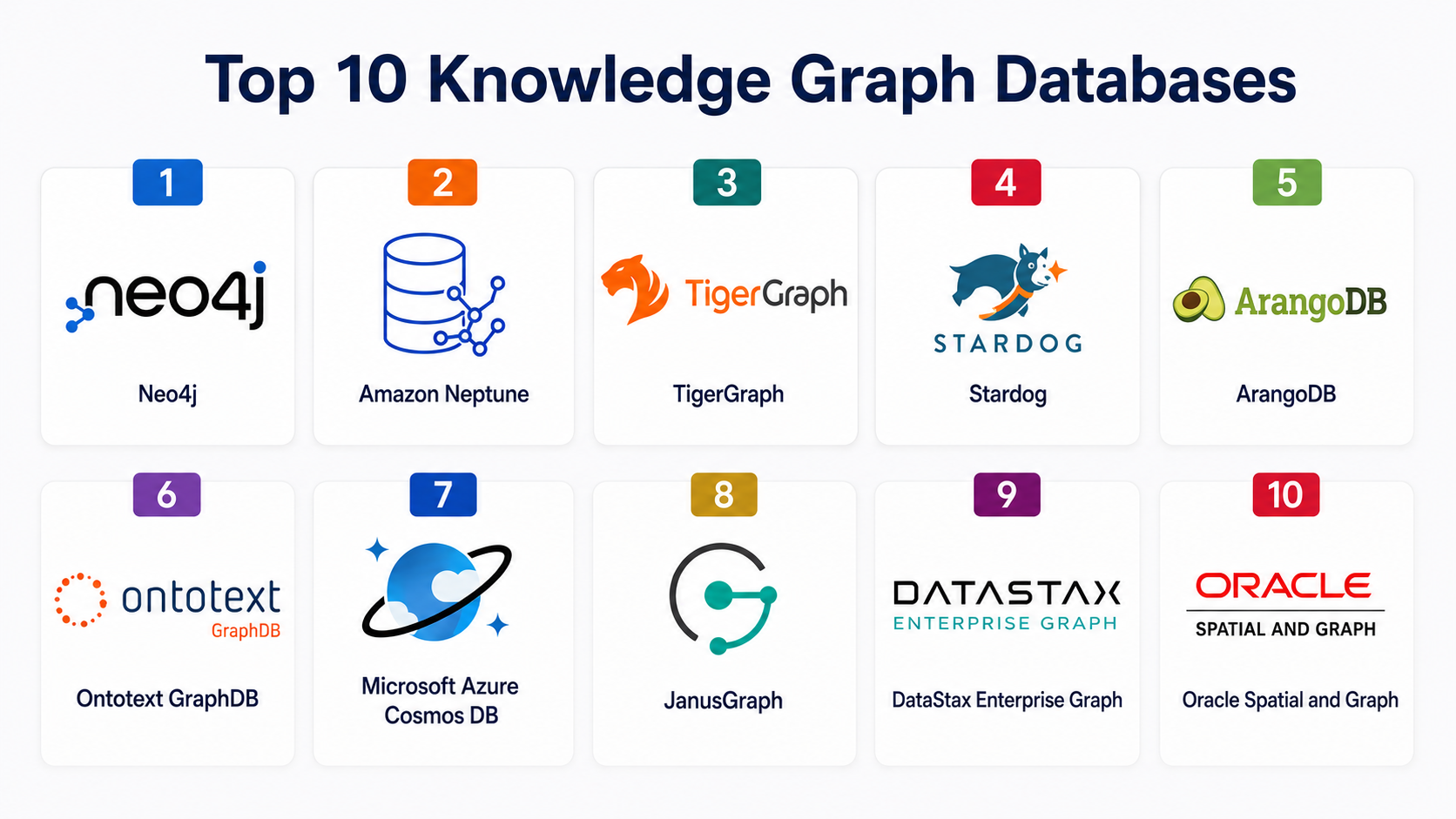
Knowledge Graph Databases
#1 — Neo4j
Short description :
Neo4j is one of the most widely recognized graph databases and a leading platform for knowledge graph development. It uses a native graph architecture optimized for connected data analysis and relationship-heavy workloads. Neo4j is commonly used for fraud detection, recommendation engines, AI knowledge graphs, and enterprise metadata systems. The platform supports both cloud and self-hosted deployments. Its Cypher query language is also widely adopted across the graph ecosystem.
Key Features
- Native graph database engine
- Cypher graph query language
- Graph data science library
- Real-time relationship analysis
- Knowledge graph modeling
- Visualization and exploration tools
- Cloud-native deployment options
Pros
- Strong developer ecosystem
- Excellent graph query performance
- Mature documentation and tooling
Cons
- Large-scale deployments can become costly
- Learning curve for graph modeling
- Advanced clustering requires expertise
Platforms / Deployment
- Web / Windows / Linux / macOS
- Cloud / Self-hosted / Hybrid
Security & Compliance
- SSO/SAML
- RBAC
- Encryption
- Audit logging
- MFA
- GDPR support
Integrations & Ecosystem
Neo4j integrates with analytics platforms, AI frameworks, cloud environments, and enterprise applications. Its ecosystem includes extensive APIs and graph analytics tooling.
- Apache Spark
- Kafka
- Python
- AWS
- Azure
- Google Cloud
Support & Community
Neo4j has one of the largest graph database communities globally. Documentation, tutorials, certifications, and enterprise support are extensive.
#2 — Amazon Neptune
Short description :
Amazon Neptune is a fully managed graph database service designed for highly connected datasets and large-scale graph analytics. It supports both property graph and RDF graph models, making it suitable for semantic web and enterprise knowledge graph workloads. Neptune integrates deeply with AWS services and is commonly used for fraud detection, recommendation systems, and identity graph applications.
Key Features
- Managed graph database service
- Supports Gremlin and SPARQL
- RDF and property graph models
- High availability architecture
- Automated backups
- Real-time graph querying
- AWS-native integration
Pros
- Fully managed infrastructure
- Strong AWS ecosystem integration
- Good scalability for enterprise workloads
Cons
- Best suited for AWS-centric environments
- Limited portability compared to open platforms
- Advanced graph tuning may require expertise
Platforms / Deployment
- Web
- Cloud
Security & Compliance
- Encryption
- IAM integration
- Audit logging
- RBAC
- GDPR support
- SOC 2
- ISO 27001
Integrations & Ecosystem
Amazon Neptune integrates tightly with AWS analytics, AI, and data processing services.
- Amazon SageMaker
- AWS Lambda
- S3
- IAM
- OpenSearch
- Apache TinkerPop
Support & Community
AWS provides enterprise support plans, technical documentation, and cloud onboarding resources. Community activity is strong within AWS ecosystems.
#3 — TigerGraph
Short description :
TigerGraph is a distributed graph analytics platform designed for high-performance enterprise workloads and large-scale graph processing. It focuses heavily on real-time analytics, AI applications, and deep link analysis. TigerGraph is often used in cybersecurity, financial fraud detection, telecommunications, and supply chain intelligence systems.
Key Features
- Distributed native graph architecture
- Parallel graph processing
- Real-time analytics
- AI and machine learning integration
- Graph visualization
- Scalable clustering
- Graph data science tools
Pros
- Excellent performance for large datasets
- Strong real-time analytics capabilities
- Enterprise AI integration support
Cons
- Higher operational complexity
- Requires graph expertise
- Smaller community than Neo4j
Platforms / Deployment
- Linux
- Cloud / Self-hosted / Hybrid
Security & Compliance
- SSO/SAML
- Encryption
- RBAC
- Audit logs
- MFA
Integrations & Ecosystem
TigerGraph integrates with analytics, streaming, and enterprise AI systems.
- Kafka
- Spark
- Kubernetes
- AWS
- Azure
- Python
Support & Community
TigerGraph provides enterprise support, onboarding assistance, and graph analytics training resources.
#4 — Stardog
Short description :
Stardog is an enterprise knowledge graph platform focused on semantic reasoning, virtual knowledge graphs, and AI-ready data integration. It combines graph database functionality with ontology management and semantic web technologies. Stardog is widely used in regulated industries, government, and enterprise AI projects.
Key Features
- Knowledge graph management
- Semantic reasoning engine
- Virtual graph integration
- RDF and SPARQL support
- Data virtualization
- AI-ready semantic modeling
- Governance capabilities
Pros
- Strong semantic web support
- Excellent enterprise knowledge graph capabilities
- Advanced reasoning features
Cons
- Requires semantic modeling expertise
- Enterprise pricing structure
- Smaller ecosystem than mainstream databases
Platforms / Deployment
- Linux
- Cloud / Self-hosted / Hybrid
Security & Compliance
- SSO/SAML
- Encryption
- RBAC
- Audit logging
Integrations & Ecosystem
Stardog integrates with enterprise metadata systems, analytics platforms, and semantic web technologies.
- GraphQL
- Kafka
- Snowflake
- Databricks
- AWS
- Azure
Support & Community
Stardog offers enterprise support, technical consulting, and semantic knowledge graph training programs.
#5 — ArangoDB
Short description :
ArangoDB is a multi-model database that combines graph, document, and key-value data models in a unified platform. It is designed for developers building flexible modern applications requiring graph capabilities alongside operational workloads. ArangoDB supports distributed deployments and cloud-native architectures.
Key Features
- Multi-model database engine
- Native graph support
- Distributed clustering
- Flexible schema design
- Graph traversal queries
- Full-text search
- Cloud-native deployment
Pros
- Flexible multi-model architecture
- Good developer experience
- Supports operational and analytical workloads
Cons
- Smaller enterprise footprint
- Advanced scaling requires tuning
- Less specialized than dedicated graph platforms
Platforms / Deployment
- Windows / Linux / macOS
- Cloud / Self-hosted / Hybrid
Security & Compliance
- Encryption
- RBAC
- Audit logging
- SSO/SAML
Integrations & Ecosystem
ArangoDB integrates with cloud infrastructure, APIs, and analytics systems.
- Kubernetes
- AWS
- Azure
- Google Cloud
- Python
- JavaScript
Support & Community
ArangoDB maintains active open-source communities alongside enterprise support offerings.
#6 — Ontotext GraphDB
Short description :
Ontotext GraphDB is a semantic graph database optimized for RDF data, linked data applications, and enterprise knowledge graph projects. It is commonly used in research, healthcare, publishing, and semantic AI initiatives. GraphDB focuses heavily on ontology management and semantic reasoning.
Key Features
- RDF graph database
- SPARQL query engine
- Semantic reasoning
- Ontology management
- Linked data support
- Data federation
- Knowledge graph visualization
Pros
- Strong semantic web standards support
- Excellent RDF performance
- Good enterprise knowledge graph tooling
Cons
- Less suitable for general-purpose operational apps
- Requires semantic expertise
- Smaller ecosystem
Platforms / Deployment
- Linux
- Cloud / Self-hosted / Hybrid
Security & Compliance
- RBAC
- Encryption
- Audit logs
Integrations & Ecosystem
GraphDB integrates with semantic technologies, AI systems, and metadata platforms.
- RDF frameworks
- Elasticsearch
- Kafka
- AWS
- Azure
Support & Community
Ontotext provides enterprise support and semantic technology consulting. Community activity is moderate.
#7 — Microsoft Azure Cosmos DB (Gremlin API)
Short description :
Azure Cosmos DB is a globally distributed multi-model database platform that includes graph capabilities through its Gremlin API. It is commonly used by organizations building cloud-native applications requiring scalable graph processing within Microsoft Azure ecosystems.
Key Features
- Managed graph database service
- Global distribution
- Gremlin API support
- Multi-model architecture
- Elastic scalability
- Real-time analytics
- Azure-native integration
Pros
- Strong cloud scalability
- Excellent Azure integration
- Global replication support
Cons
- Primarily optimized for Azure environments
- Graph tooling less specialized than dedicated graph databases
- Pricing complexity
Platforms / Deployment
- Web
- Cloud
Security & Compliance
- Encryption
- RBAC
- MFA
- Audit logging
- SOC 2
- ISO 27001
- GDPR support
Integrations & Ecosystem
Cosmos DB integrates deeply with Microsoft cloud and analytics services.
- Azure AI
- Power BI
- Synapse Analytics
- Kubernetes
- Microsoft Fabric
Support & Community
Microsoft provides enterprise-grade support, training, and cloud documentation resources.
#8 — JanusGraph
Short description :
JanusGraph is an open-source distributed graph database optimized for scalable graph storage and analytics. It is commonly used by organizations building highly customized graph architectures using open-source big data technologies. JanusGraph integrates well with distributed storage backends and graph processing frameworks.
Key Features
- Distributed graph database
- Open-source architecture
- Scalable graph storage
- Gremlin query support
- Big data ecosystem integration
- Flexible storage backends
- Graph analytics support
Pros
- Open-source flexibility
- Strong scalability potential
- Integrates with big data ecosystems
Cons
- Complex deployment and management
- Limited commercial support
- Requires strong engineering expertise
Platforms / Deployment
- Linux
- Self-hosted / Hybrid
Security & Compliance
- Varies / N/A
Integrations & Ecosystem
JanusGraph integrates with distributed storage and processing technologies.
- Cassandra
- HBase
- Elasticsearch
- Spark
- Kafka
- Hadoop
Support & Community
Community-driven support is available through open-source ecosystems. Enterprise support varies by deployment provider.
#9 — DataStax Enterprise Graph
Short description :
DataStax Enterprise Graph extends Apache Cassandra with graph database capabilities for large-scale distributed graph workloads. It is designed for organizations requiring high availability and operational scalability across distributed environments.
Key Features
- Distributed graph processing
- Cassandra integration
- Gremlin support
- Real-time scalability
- High availability architecture
- Enterprise clustering
- Multi-datacenter support
Pros
- Excellent distributed scalability
- Strong operational resilience
- Good for large global deployments
Cons
- Complex operational management
- Smaller graph ecosystem
- Requires Cassandra expertise
Platforms / Deployment
- Linux
- Cloud / Self-hosted / Hybrid
Security & Compliance
- Encryption
- RBAC
- Audit logs
- SSO/SAML
Integrations & Ecosystem
DataStax integrates with distributed infrastructure and streaming platforms.
- Cassandra
- Kafka
- Spark
- Kubernetes
- AWS
Support & Community
Enterprise support is available through DataStax, with broader support from Cassandra communities.
#10 — Oracle Spatial and Graph
Short description :
Oracle Spatial and Graph provides graph analytics and spatial intelligence capabilities within Oracle database ecosystems. It is designed for enterprises already invested in Oracle infrastructure requiring graph analytics alongside relational workloads.
Key Features
- Graph analytics engine
- Spatial intelligence
- Property graph support
- SQL and graph integration
- Enterprise security controls
- Scalable analytics
- Oracle ecosystem integration
Pros
- Tight Oracle integration
- Strong enterprise governance
- Combines relational and graph workloads
Cons
- Best suited for Oracle-centric organizations
- Complex enterprise deployments
- Premium pricing
Platforms / Deployment
- Linux
- Cloud / Self-hosted / Hybrid
Security & Compliance
- Encryption
- RBAC
- Audit logs
- SSO/SAML
- GDPR support
Integrations & Ecosystem
Oracle Spatial and Graph integrates with Oracle enterprise databases, analytics, and cloud systems.
- Oracle Database
- Oracle Cloud
- OCI Analytics
- Java
- Python
Support & Community
Oracle provides enterprise support, consulting services, and enterprise documentation resources.
Comparison Table (Top 10)
| Tool Name | Best For | Platform(s) Supported | Deployment | Standout Feature | Public Rating |
|---|---|---|---|---|---|
| Neo4j | Enterprise knowledge graphs | Windows, Linux, macOS | Hybrid | Native graph engine | N/A |
| Amazon Neptune | AWS graph workloads | Web | Cloud | Managed RDF + property graph support | N/A |
| TigerGraph | Large-scale analytics | Linux | Hybrid | Distributed graph processing | N/A |
| Stardog | Semantic enterprise graphs | Linux | Hybrid | Semantic reasoning engine | N/A |
| ArangoDB | Multi-model applications | Windows, Linux, macOS | Hybrid | Multi-model database support | N/A |
| Ontotext GraphDB | RDF knowledge graphs | Linux | Hybrid | Semantic web optimization | N/A |
| Azure Cosmos DB | Azure-native graph apps | Web | Cloud | Global graph scalability | N/A |
| JanusGraph | Open-source graph infrastructure | Linux | Self-hosted | Distributed open-source graph engine | N/A |
| DataStax Enterprise Graph | Distributed enterprise graphs | Linux | Hybrid | Cassandra-based scalability | N/A |
| Oracle Spatial and Graph | Oracle enterprise analytics | Linux | Hybrid | Graph + spatial analytics | N/A |
Evaluation & Knowledge Graph Databases
| Tool Name | Core (25%) | Ease (15%) | Integrations (15%) | Security (10%) | Performance (10%) | Support (10%) | Value (15%) | Weighted Total |
|---|---|---|---|---|---|---|---|---|
| Neo4j | 9 | 8 | 9 | 8 | 9 | 9 | 7 | 8.4 |
| Amazon Neptune | 8 | 8 | 9 | 9 | 8 | 8 | 7 | 8.0 |
| TigerGraph | 9 | 6 | 8 | 8 | 10 | 7 | 6 | 7.9 |
| Stardog | 8 | 6 | 7 | 8 | 8 | 7 | 6 | 7.2 |
| ArangoDB | 8 | 8 | 7 | 7 | 7 | 7 | 8 | 7.7 |
| Ontotext GraphDB | 7 | 6 | 7 | 7 | 8 | 7 | 7 | 7.0 |
| Azure Cosmos DB | 8 | 8 | 9 | 9 | 8 | 8 | 7 | 8.0 |
| JanusGraph | 7 | 5 | 8 | 6 | 8 | 6 | 9 | 7.0 |
| DataStax Enterprise Graph | 8 | 5 | 8 | 8 | 9 | 7 | 6 | 7.4 |
| Oracle Spatial and Graph | 8 | 6 | 7 | 8 | 8 | 8 | 6 | 7.3 |
These scores are comparative rather than absolute. Organizations should evaluate platforms based on workload type, deployment model, graph complexity, and ecosystem compatibility. Some platforms excel in semantic web use cases, while others focus more on operational scalability or AI-driven graph analytics.
Which Knowledge Graph Databases
Solo / Freelancer
Individual developers and researchers may prefer:
- ArangoDB
- Neo4j Community Edition
- JanusGraph
These options provide flexible development environments without requiring massive enterprise infrastructure.
SMB
Small and medium-sized businesses should focus on usability, cloud simplicity, and manageable operational overhead.
Recommended options:
- Neo4j
- ArangoDB
- Azure Cosmos DB
Mid-Market
Mid-sized organizations often need scalable analytics and cloud-native integrations.
Recommended options:
- Amazon Neptune
- Neo4j
- TigerGraph
- Stardog
Enterprise
Large enterprises with advanced AI, governance, and analytics requirements should prioritize scalability and operational maturity.
Recommended options:
- Neo4j
- TigerGraph
- Amazon Neptune
- Oracle Spatial and Graph
Budget vs Premium
- Budget-friendly: JanusGraph, ArangoDB
- Premium enterprise: TigerGraph, Oracle, Stardog
- Balanced value: Neo4j, Neptune
Feature Depth vs Ease of Use
- Deepest graph analytics: TigerGraph
- Best usability: Neo4j
- Best semantic capabilities: Stardog, GraphDB
Integrations & Scalability
- Best AWS integration: Neptune
- Best Azure integration: Cosmos DB
- Best open-source flexibility: JanusGraph
Security & Compliance Needs
Organizations in regulated sectors should prioritize:
- Amazon Neptune
- Neo4j Enterprise
- Oracle Spatial and Graph
- Azure Cosmos DB
Frequently Asked Questions (FAQs)
1. What is a knowledge graph database?
A knowledge graph database stores data as connected entities and relationships rather than tables. This structure allows organizations to analyze highly connected information efficiently and uncover contextual insights.
2. How are graph databases different from relational databases?
Relational databases are optimized for structured tabular data, while graph databases are optimized for relationship-heavy data and complex traversals across interconnected entities.
3. Are graph databases important for AI?
Yes. Graph databases are increasingly important for AI applications such as semantic search, recommendation engines, entity resolution, and Retrieval-Augmented Generation (RAG) systems.
4. What industries commonly use knowledge graph databases?
Common industries include finance, healthcare, cybersecurity, telecommunications, retail, manufacturing, and government organizations handling complex relationship data.
5. What query languages are used in graph databases?
Popular graph query languages include Cypher, Gremlin, and SPARQL. The supported language depends on the graph model and platform architecture.
6. Are cloud-native graph databases reliable for enterprise workloads?
Modern cloud-native graph databases provide high availability, automated scaling, backups, and enterprise-grade security controls suitable for many production workloads.
7. What are the biggest implementation challenges?
Challenges often include graph modeling complexity, data integration, performance optimization, and finding teams with graph database expertise.
8. Can graph databases scale to billions of relationships?
Yes. Several enterprise graph platforms are specifically designed for distributed large-scale graph processing involving billions of nodes and relationships.
9. Are graph databases replacing relational databases?
Usually not. Many organizations use graph databases alongside relational databases depending on workload requirements and application design.
10. What should buyers evaluate before choosing a platform?
Buyers should evaluate scalability, graph query performance, deployment flexibility, ecosystem integrations, AI compatibility, governance features, and operational complexity.
Conclusion
Knowledge Graph Databases have become essential technologies for organizations building AI-driven applications, semantic search systems, fraud detection engines, and enterprise intelligence platforms. As businesses increasingly depend on contextual understanding and connected data analysis, graph technologies continue expanding beyond niche analytics into mainstream enterprise infrastructure.Neo4j remains one of the strongest overall choices for general enterprise graph workloads, while TigerGraph excels in large-scale analytics performance.
